
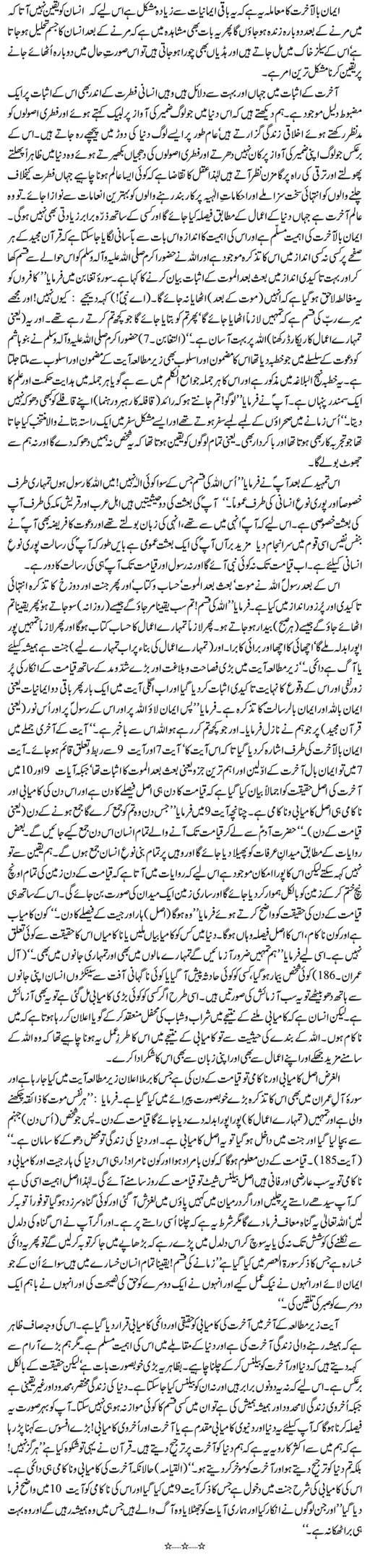
Asal Kamiyabi Or Naakami Ka Din
TAG: Day of Judgement
Concealing The Weaknesses Of Others
A very bad and dirty habit to be commonly found is to reveal and make public the fault of other people. People don’t think for a second to comment upon any other fault or weakness. While avoiding harm to others and concealing the weakness of one’s fellow human beings is a prominent theme of the moral teachings of the Quran and the Sunnah. Please have a look at the Few Sayings of our Prophet are as follows:
1- “If a person conceals the weakness of another in this world, Allah will conceal their weakness in the hereafter”
[Al Nawawi, Riyad al Salihin p 135, Hadith no 245; al Ghazali, Kitab Adab p 344]
2- “Whoever protects the honor of his brother, will have Allah protect his countenance from the fire on the Day of Judgement ”
[Al Nawawi, Riyad al Salihin p 488, Hadith no 1530]
3- “Do not harm Muslims, and do not revile them, nor pursue their imperfections. For verily, whosoever pursues the imperfections of his brother shall have his own imperfections pursued by Allah ”
[Sunan of al Tirmidhi, as quoted in Principles of State and Government in Islam, p 85]
Whoever sees a Muslim’s imperfection and then conceals it is like one who gives new life to a female infant buried in the desert.
[Bukhari]
Verily, Allah does not like people who are obscene and who spread obscenities.
[Bukhari]
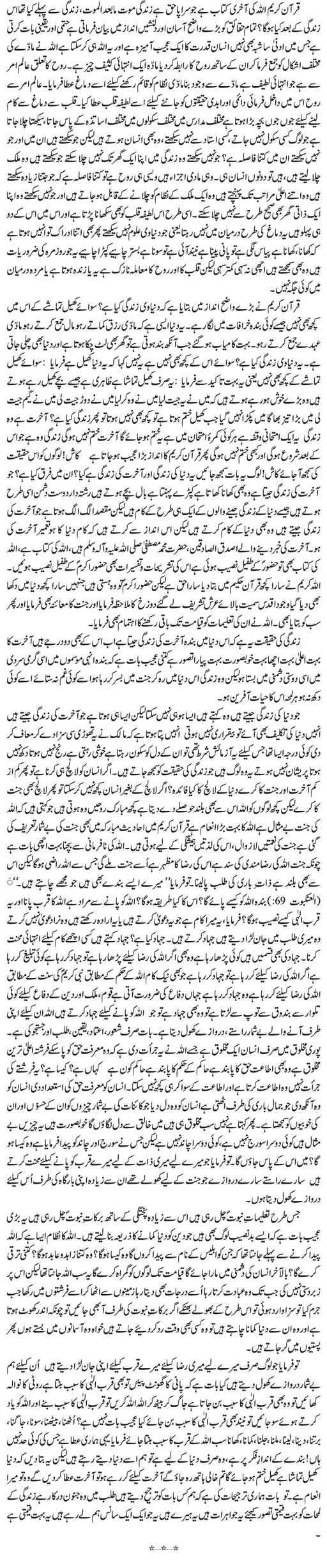
Akhrat Ki Zindagi
Akhrat Ki Zindagi
Human Rights In Islam
ISLAM guarantees the basic rights of every living creature. The sanctity of human life is extremely sacred.
Prophet Muhammad (peace be upon him) said: “Truly your blood, your property, and your honor are inviolable.” (Al-Bukhari)
Allah said in the Qur’an:
“O mankind! We have created you from a male and a female and made you into nations and tribes that you may know one another. Verily, the most honorable of you with Allah is that (believer) who is pious. Verily, Allah is All-Knowing, Well-Acquainted (with all things).” (Qur’an, 49:13)
The human race is only for the purpose of identification in Islam, and it doesn’t give one superiority over another.
Prophet Muhammad (peace be upon him) said: “O people! Your God is one and your forefather (Adam) is one. An Arab is not better than a non-Arab and a non-Arab is not better than an Arab, and a red (i.e. white tinged with red) person is not better than a black person and a black person is not better than a red person, except through piety.” (Musnad Ahmad)
Allah has commanded to uphold justice and discharge the trust of people:
“Verily, Allah commands that you should render back the trusts to those, to whom they are due; and that when you judge between men, you judge with justice. Verily, how excellent is the teaching which He (Allah) gives you! Truly, Allah is Ever All-Hearer, All-Seer.” (Qur’an, 4:58)
“…And act justly. Truly, Allah loves those who are just.” (Qur’an 49:9)
“…and let not the enmity and hatred of others make you avoid justice. Be just: that is nearer to piety;…” (Qur’an 5:8)
The Prophet Muhammad (peace be upon him) said: “O People, beware of injustice, for injustice shall be darkness on the Day of Judgement.” (Saheeh Al-Bukhari).
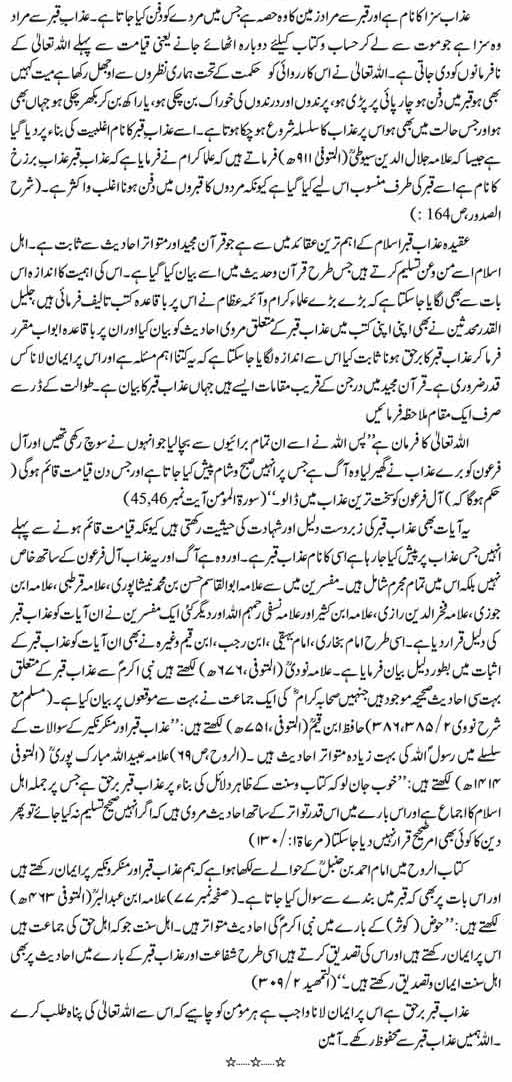
Azab-e-Qabar
Azab-e-Qabar
Love, Fear And Hope
One of the most beautiful things about the concept of worship in Islam is the truly unique way in which it incorporates the feelings of love, fear, and hope within the hearts of the worshipers of Allah. Understanding how to combine these three qualities into the worship (‘Ibadah) of Allah is one of the most essential things that every Muslim must grasp.
No worship is complete without the presence of all three qualities: Love of Allah, Hope in His Mercy and Fear of His Punishment. Contemplate the opening Surah of the Qur’an – Surah Al-Fatihah – and you will see for yourself.
Verse 1: “In the Name of Allah, the Most Beneficent, the Most Merciful.”
In this opening verse of the Qur’an, we have ‘Love’ of Allah, and every time we recite this verse we are testifying to our love for Allah. We are acknowledging that Allah is our Rabb and the Rabb of all the worlds. Rabb means that Allah is the Creator of everything; He sustains and nourishes everything; He gives life and death; anything good that we have is from Him; everything is dependent on Him and nothing can happen unless He wills it. Furthermore, for the Muslim He – the Rabb – is the One who has guided us to the Truth and given us good morals and manners.
Allah is the One Who has given us so many blessings – so many that if we tried to enumerate His blessings upon us, we cannot count them. So how could we not love Him? We should be overwhelmed in our love for Him and thank Him and say:
“All Praises [and Thanks] are for Allah, Rabbil-‘aalameen.”
Verse 2: “All the praises and thanks be to Allah, the Lord of the ‘Alamin (mankind, jinns, and all that exists).”
In the first verse, Allah mentioned that He was Ar-Rabb. In the next verse, two more of His beautiful names are mentioned: Ar-Rahmaan and Ar-Raheem. Ar-Rahman means that He is the Most Merciful, that is, His Nature or His Essence is Merciful. Ar-Raheem means that He is the Giver of Mercy, in other words, His actions are full of Mercy and He shows Mercy to His creation. (As explained by Ibnul-Qayyim (d.751H) in Badaa’i-ul-Faawaa’id and others)
When we mention these two names of Allah, then we have ‘Hope’. Since He has described Himself as so full of Mercy then we have hope that He will forgive our sins, and no matter how numerous our sins may be, we should never lose this hope, because Allah has told us: “O ‘Ibadi (My slaves) who have transgressed against themselves (by committing evil deeds and sins)! Despair not of the Mercy of Allah, verily Allah forgives all sins. Truly, He is Oft-Forgiving, Most Merciful.” (Qur’an, 39:53)
The need to have ‘Fear’ in our worship is shown by the next verse of Surah Al-Fatihah:
Verse 3: “The Most Beneficent, the Most Merciful.”
When we recite this verse we are reminding ourselves of the Day of Judgement – that awful Day, when we shall all stand before Allah, naked, uncircumcised, and barefooted. Some will be sweating so much that it will go 70 arm-length into the earth. People will appear intoxicated though they are not. On this Day, every person will stand before Allah and account for his deeds, knowing that not even the smallest action which he did is hidden from Allah:
“So whosoever does good equal to the weight of an atom (or a small ant), shall see it. And whosoever does evil equal to the weight of an atom (or a small ant), shall see it.” (Qur’an, 99:7-8)
So when we recite this third verse, we remind ourselves of the judgment and accountability, and that should bring about in us a sense of fear – that maybe our evil deeds will be too great and we will be responsible for them – may Allah protect us from such a fate.
Then the next verse goes on to say: “You alone we worship.” This means we single out Allah for our worship. And how do we worship Him? With Love, Hope, and Fear. And in order to achieve these qualities, we need Allah’s assistance, so we say then:
“The Only Owner (and the Only Ruling Judge) of the Day of Recompense (i.e. the Day of Resurrection).” (Qur’an, 1:4)
– Courtesy: Ad-Dawah il-Allah Magazine
The Poor On The Day Of Judgement
Who are the Poor on Judgement Day
Abu Huraira. reported Allah’s Messenger (may peace be upon him) as saying: Do you know who is poor? They (the Companions of the Holy Prophet) said: A poor man amongst us is one who has neither dirham with him nor wealth. He (the Holy Prophet) said: The poor of my Ummah would be he who would come on the Day of Resurrection with prayers and fasts and Zakat but (he would find himself bankrupt on that day as he would have exhausted his funds of virtues) since he hurled abuses upon others, brought calumny against others and unlawfully consumed the wealth of others and shed the blood of others and beat others, and his virtues would be credited to the account of one (who suffered at his hand). And if his good deeds fall short to clear the account, then his sins would be entered in (his account) and he would be thrown in the Hell-Fire.
Sahih Muslim Book 32, Number 6251:
May Allah guard us against Oppressing others, May Allah strengthen our Moral Character
Oppression is the darkness on the Day of Resurrection.
Jabir b. Abdullah reported that Allah’s Messenger (may peace be upon him) said: Be on your guard against committing oppression, for oppression is a darkness on the Day of Resurrection, and be on your guard against petty mindedness for petty mindedness destroyed those who were before you, as it incited them to shed blood and make lawful what was unlawful for them.
Sahih Muslim Book 32, Number 6248:
Ibu ‘Umar reported Allah’s Messenger (may peace be upon him) as saying: Oppression is the darkness on the Day of Resurrection.
Sahih Muslim Book 32, Number 6249:
Saving others from Oppression
Salim reported on the authority of his father that Allah’s Messenger (may peace be upon him) said: A Muslim is the brother of a fellow Muslim. He should neither commit oppression upon him nor ruin him, and he who meets the need of a brother, Allah would meet his needs, and he who relieved a Muslim from hardship Allah would relieve him from the hardships to which he would be put on the Day of Resurrection, and he who did not expose (the follies of a Muslim) Allah would conceal his follies on the Day of Resurrection.
Sahih Muslim Book 32, Number 6250: