
TAG: Deen
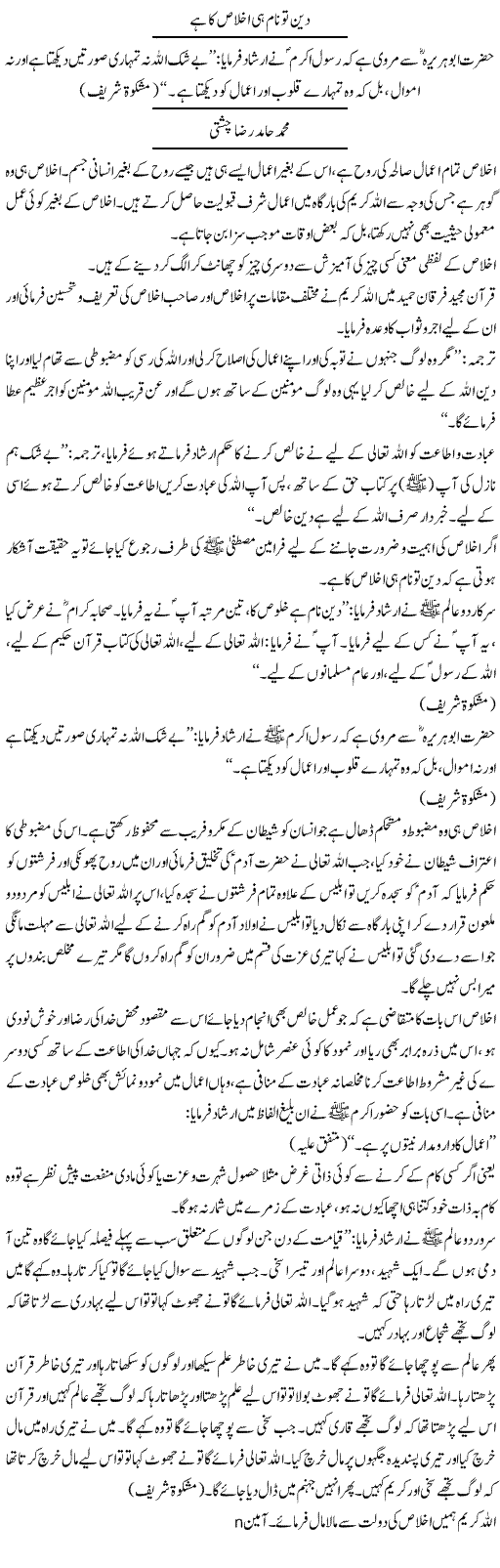
Deen Ko Dunya Kamanay Ka Zirya Bananey Ki Mumaniat
Hidayat Aur Aafiyat Ki Dua


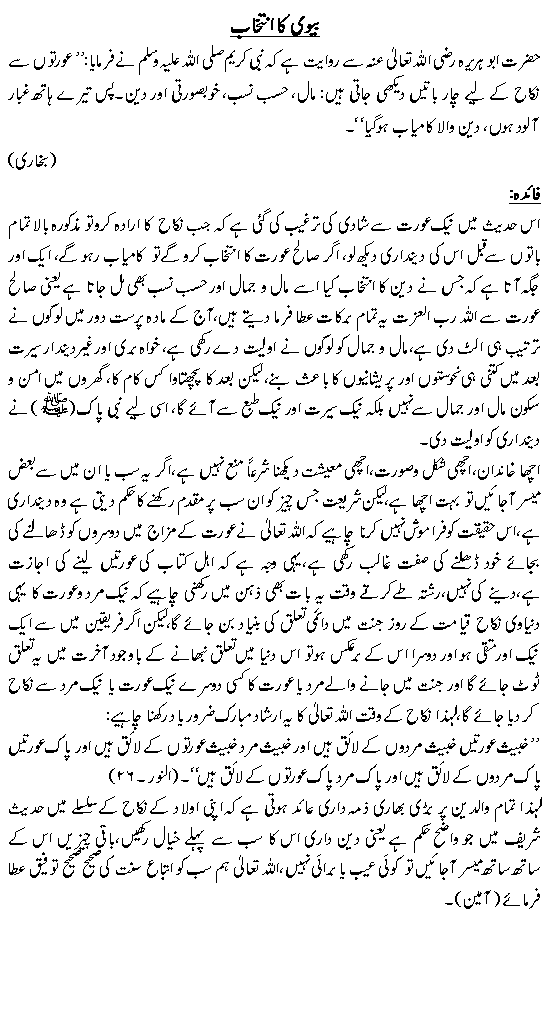
Biwi Ka Intekhab
10 Things To Hand Down To Your Daughter
* Knowledge of and love for Allah and the Deen. This is one of the most precious and enduring gifts you can pass down to your daughter, one that will benefit her in this life and the next.
* Memorization of the Qur’an. No matter how little you have memorized yourself, push your daughter to memorize as much she can. Encourage her and help her to revise. It will stand her in good stead in her life and will be a source of reward for you after your death as well.
* A good example of Muslim womanhood. Most girls look to their mothers for guidance. Embody the characteristics of a strong, faithful Muslimah and she will be inspired to follow your example.
* A sense of self-worth and self-esteem. Instill a sense of confidence in your child by encouraging her skills, talents and personality to develop. Make her feel secure in her identity and show her that she is loved and appreciated. This will have a positive impact on her future relationships and how she interacts with the world.
* A sense of modesty. Instill a love for Hijab in your daughter and encourage her to be modest, never boastful or conceited, in all areas of her life.
* Your language. If you speak Arabic, be sure to teach it to her so that she has the key to the understanding of the Qur’an. Also, if you have a mother tongue or speak a second language yourself, pass it on: a second or third language is always an asset, whether in study, work or social environment.
* A skill that you have. If you are an avid gardener, knitter or love painting, pass your skill onto your daughter. With so many ‘traditional’ skills being lost in today’s fast-paced world, you owe it to her to share your knowledge and pass it on to the next generation.
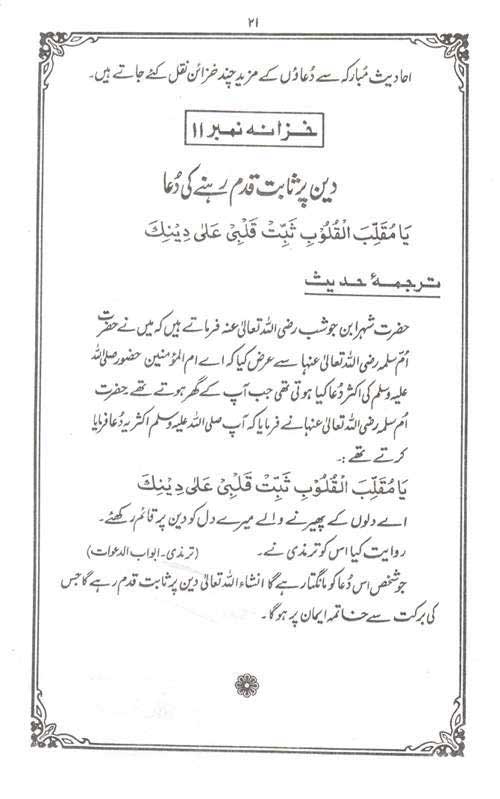
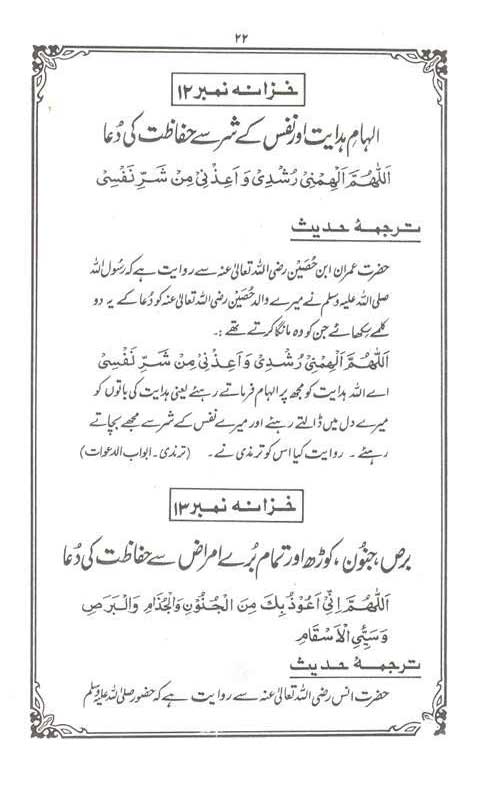
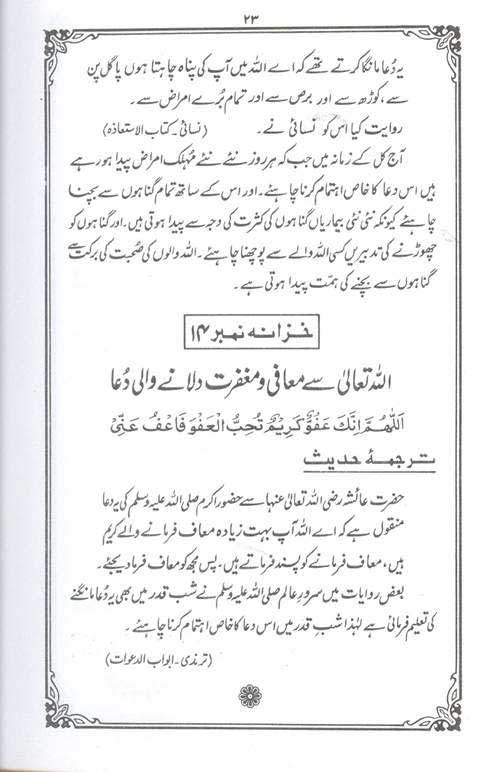
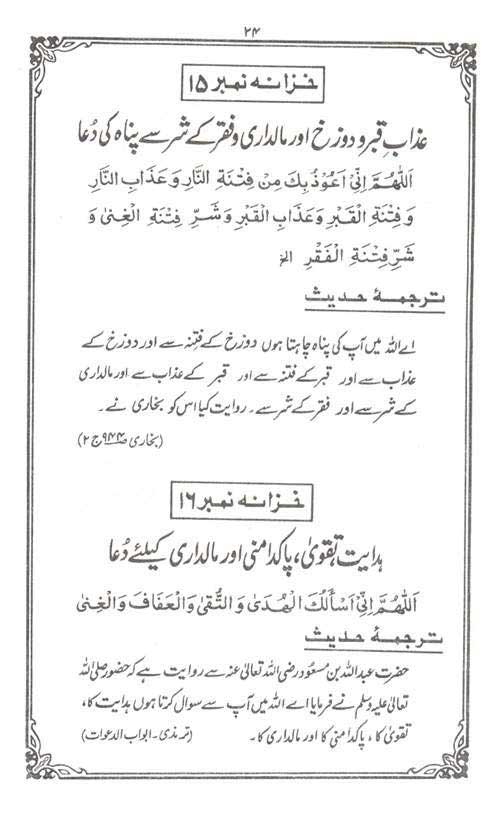
Khazana Hadees Shareef
Responsibilities Of A Muslim
The long-standing political and moral decline of the Muslim Ummah has resulted, among other things, in a serious distortion of our very concept of Islam itself. We have grown accustomed to viewing Islam as a mere “religion,” instead of using the original Qur’anic term “Deen.” This apparently minor change in semantics is actually a huge leap backward. This is because the word religion is commonly used in a rather narrow sense, its scope is limited to a set of dogmas, some rituals for worship, and a number of social customs to celebrate important life events. Deen, on the other hand, is a system of life in which human beings consciously surrender to the sovereignty of a higher authority, and live a life of total obedience to that higher authority. In this sense, the term Deen can be applied to monarchy, where the king is accepted as the final authority, or to democracy, where the people as a whole act as sovereign. Thus, when the term Deen is used for Islam, it obviously means a system of life where the Almighty God is worshipped and obeyed, not just in the narrow religious sense, but in a manner that includes all aspects of human of life.
A well-integrated set of beliefs describing the nature of existence as it really is (Iman), modes of worship including Salat, Zakat, Saum, and Hajj, as well as social customs and ceremonies all comprise indispensable and integral parts of Islam. However, in addition to these “religious” features, we are also provided by the Almighty God with all the relevant instructions regarding our social, economic, and political existence (generally considered to be the “secular” elements of life), and this is what really distinguishes Islam from other religions, say, Christianity or Buddhism. Unfortunately, the majority of our masses are simply, and perhaps blissfully, unaware of what it really means to be a Muslim; thus, their concept of religious duties is usually very narrow and limited. But, as Allama Iqbal has so correctly observed, you begin to shudder with the fear of accountability once you realize the tremendous responsibilities that come with being a Muslim.
When Islam loses its political authority, it is relegated and dethroned to the status of a mere religion — a private affair of the individual; and if any particular generation is to revive the teachings of Islam in the social, economic, and political spheres, then this is impossible without adopting the same methodology as was adopted by Prophet Muhammad (SAW). After the independence of the Muslim lands from direct subjugation by Western Imperialism, it was naively believed that since political authority now belongs to the Muslims, the next step, that of implementing Islamic values, won’t be all that difficult. However, it has been proved during the last half century or so that the ideal Islamic State is still very much a dream, and since no shortcuts are available, we have no alternative except to start at the very beginning. We must remind the Muslims of their responsibilities. The significance of this subject is quite clear: We cannot hope to achieve salvation in the Hereafter without fulfilling all our obligations. Moreover, we cannot even think about the revival of the Muslim Ummah and the Renaissance of Islam without first inculcating the true concept of our Divinely ordained obligations in a significant portion of the Ummah.
OUR FIRST OBLIGATION as Muslims is to develop real faith and true conviction (or Iman) in the teachings of the Qur’an as explained to us by Prophet Muhammad (SAW). Faith must not be a mere dogma that has little or nothing to do with the practical aspects of one’s life, but it must be a deeply-felt certitude that changes the whole system of values, ambitions, and behavior in favor of Islam. Iman can be gained by reading, comprehending, and pondering over the meaning of the Holy Qur’an with a genuine search for truth. Knowledge of the Arabic language is indispensable for this purpose.