TAG: Hajj
Hajj for Women: the Do’s and Don’ts
THE spirit of Haj is turning to Allah wholeheartedly in humble and passionate yearning and ardent love and devotion. This spirit should rule the hearts of all pilgrims at all times, regardless of gender differences.
Men and women during Haj also share equally in the various dos and don’ts. Both must refrain from all forms of intimate sexual contact with spouses. They also must shun all vain talks, wrangling, and quarrels.
Likewise, both males and females must absolutely avoid using any kind of perfumes or scents, clipping nails, removing, plucking, trimming or shaving of hair, etc.
It is, however, permissible for both males and females during ihram to bathe or take showers or wash.
Likewise, they are permitted to use ordinary shampoos, soaps or creams, lotions, etc. so long as these are not scented.
Specific issues or regulations that concern women exclusively during Haj can be listed as follows:
Unlike men, women are allowed to wear their normal clothes regardless of whether they are sewn or not. There are no restrictions whatsoever on the kind of clothes they can wear during the state of ihram so long as they are not dyed in saffron or scented. Thus it is permissible for them to wear even clothes with colors or designs; although women pilgrims may do well in keeping it simple and avoid attractive designs and colors. After all, it should be noted, the hallmark of Haj is simplicity and humility before the Creator.
Women, again as opposed to men, are also allowed to wear shoes, slippers or sandals as they choose.
Women, however, are not allowed to wear either face-veils or hand-gloves during ihram; they must not cover their faces while in a state of ihram.
Women who are menstruating should assume ihram after a bath and recite Talbiyah and engage in dhikr and dua. However, they must not offer Prayer.
Menstruating women can perform all of the rituals of Haj with the sole exception of Tawaf (going around the Kabah). As far as performing Tawaf is concerned, they should postpone it until such time that they are free from menses and have cleaned themselves through ghusl (bathing).
If, however, because of special circumstances beyond their control, they find themselves unable to stay in Makkah (for instance, they have no choice but to leave with the group because of inability to change or reschedule travel plans), then they are allowed to perform Tawaf while still menstruating after cleaning themselves and wearing pads, etc.
The above ruling is given by Imam Ibn Taymiyyah. It has been based on a valid principle of Islamic jurisprudence which states that any condition — upon which the validity of a certain act of worship is dependent — can be waived if a person cannot fulfill the same; and the act of worship thus performed will be considered as valid without it. An example for this is covering oneself during Prayer. Thus if a person finds himself unable to cover his awrah (what must be covered) because he could not find anything to wear, then he must still pray without covering himself and his prayer will still be considered as valid, although in ordinary circumstances such a Prayer will be considered as null and void.
The same rule applies to a menstruating woman who must leave Makkah because of special circumstances beyond her control. The normal condition of cleansing from menses for the validity of Tawaf is waived in her case, and her Haj will be considered as perfectly valid.
Finally, rules for women are relatively more relaxed in regards to throwing pebbles at the Jamrat in Mina (stone pillars). Thus women, as well as those who are weak and elderly, are allowed to leave Muzdalifah early before Fajr in order to perform the rite of throwing pebbles before the crowd arrives in Mina.
In conclusion, I must point out that while it is important to pay due attention to the formal aspects of Haj, one must never lose sight of the inner dimensions of Haj.
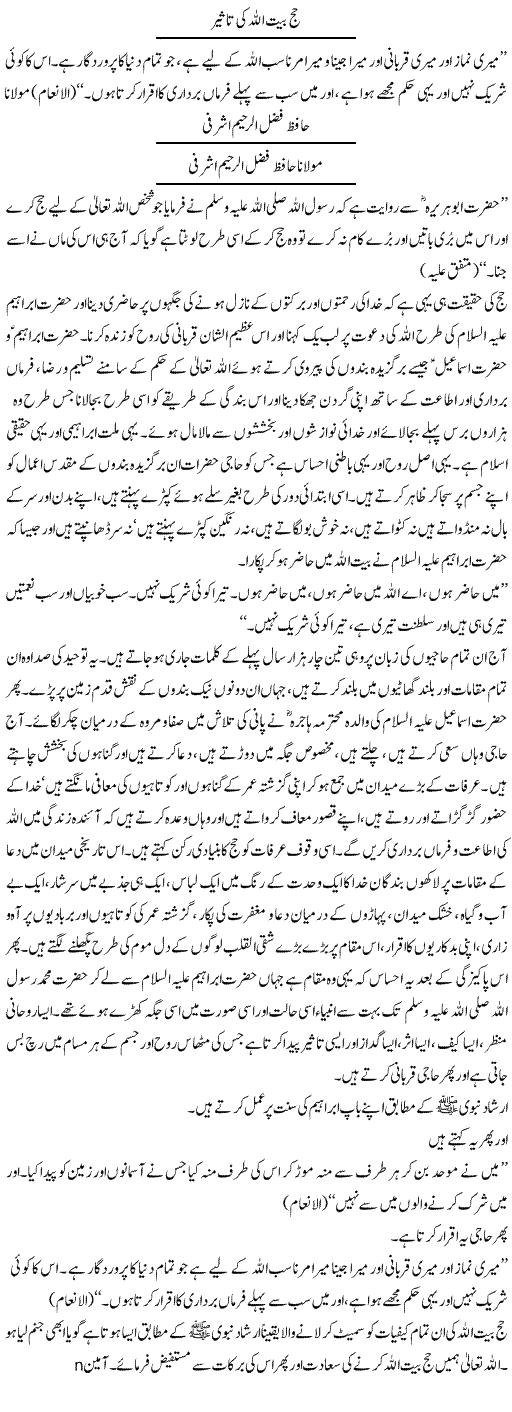
Hajj Bayt Allah Ki Taseer

Wisdom Behind Shaving the Head During Haj
The wisdom is that by shaving off one’s hair, one demonstrates one’s sincerity and humility to Almighty Allah without caring for one’s physical appearance.
This practice of shaving or clipping the hair is affirmed by the Qur’an, the Sunnah of the Prophet, and the consensus of the Muslim scholars.
Almighty Allah says: “Indeed Allah shall fulfill the true vision which He showed to His Messenger (peace be upon him) [ i.e. the Prophet saw a dream that he has entered Makkah along with his Companions, having their (head) hair shaved and cut short] in very truth…” (48:27)
Both Al-Bukhari and Muslim quote the Prophet (peace be upon him) as saying, “May Allah bless those who shaved (their head during Haj).” The Companions asked, “O Messenger of Allah, what about those who cut their hair short?” Thereupon the Prophet (peace be upon him) said, “May Allah bless those who shaved.” They repeated their question the third time, and again the Prophet said, “May Allah bless those who shaved.” When they asked him for the fourth time, “O Messenger of Allah, what about those who clip their hair short?” He said, “And (may Allah bless) those who clip their hair short.”
Shaving here means removing hair of the head with a razor, etc., or plucking them out. It suffices, however, to remove only as many as three hair. And cutting the hair short means cutting the length of one fingertip of the head’s hair.
However, the issue of which one is obligatory, between shaving or cutting hair short, is controversial among jurists. Most scholars hold that shaving or cutting the hair short is obligatory, and one failing to do so is to slaughter an animal in order to atone for this omission.
According to the Shafi’i school, it is an integral part of Haj.
Fazail E Hajj

The Prophet’s Acts Of Worship During Hajj
The Prophet’s acts of worship during Haj – I
Tranquility
In his Haj, nothing could divert the Prophet’s (peace be upon him) attention away from his rituals, or from showing submission and humility before Allah. Standing with his hands raised close to his chest, he privately offered his supplication for extended periods of time. Secondly, all of the Prophet’s (peace be upon him) movements were full of submission and surrender to Allah, Almighty.
He would walk quietly in reverence and tranquility going about his rituals. Jabir (may Allah be pleased with him) reported: “The Prophet (peace be upon him) performed Al-Ifadha in tranquility.” (Al-Bukhari)
Ibn ‘Abbas (may Allah be pleased with him) reported that as he and the Prophet (peace be upon him) were moving together on the Day of ‘Arafah, they heard loud noises, clattering and roars of camels. The Prophet (peace be upon him) then pointed his whip at the people and said: “Be quiet; haste is no indication of righteousness!” (Tirmidhi)
Doing plenty of good deeds
Not only did the Prophet (peace be upon him) enjoined good, he (peace be upon him) was also keen on doing the same during the Haj. This is manifest in his performance of all the recommended Haj rituals.
He performed Ghusl (ritual body wash) and wore perfume before assuming Ihram, marked and garlanded the sacrificial animal, and frequently recited the Talbiyah aloud until he (peace be upon him) had cast the Jamaratul-’Aqabah.
He also started Tawaf as soon as he entered the House, walked briskly in Tawaf, touched the two corners of the Ka’bah, offered two Rak’ahs of Tawaf behind Maqaam Ibrahim (Ibrahim’s station), supplicated Allah on the hills of Safa and Marwah, ran in the middle of the valley, supplicated upon touching the two corners and while throwing pebbles at the Jamaraat. (Paraphrased from Al-Bukhari and Muslim) There are many other acts that he (peace be upon him) performed.
Moderation and equanimity
Islam encourages moderation and censures exaggeration. In fact equanimity was the most significant attitude of the Prophet (peace be upon him) in the Haj. He (peace be upon him) abhorred exaggeration. He (peace be upon him) did neither too much nor too little. Two acts of worship can be stressed in this regard. Firstly, he (peace be upon him) adopted a wholesom middle course between his acts of worship and his responsibility as the leader of the Muslims. However, he (peace be upon him) did not neglect his duty to his wives and his household who needed care and affection. Secondly, he (peace be upon him) also took equal care of his body and soul.
This is a very important point, as the awe-inspiring surroundings of the Haj may compel many people to observe the spiritual and entirely forget the physical side of their being.
The Prophet (peace be upon him) however, took very good care of his body. For example, on Tarwiyah Day he (peace be upon him) moved closer to Mina in order to be near ‘Arafah (Sahih Muslim); slept during the nights of ‘Arafah and Muzdalifah (Al-Bukhari); took breakfast on the Day of ‘Arafah (Al-Bukhari); but did not offer supererogatory prayers. (Sahih Muslim)
He (peace be upon him) stayed in a dome made from the camel’s hair erected especially for him, moved between the sacred sites (Al-Bukhari), and performed some of the Haj rituals riding on camel’s back (Muslim). Furthermore, he even had someone who served and helped him. (Ibn Majah)
Giving up worldly life
The Prophet (peace be upon him) renounced the present life and rejected all that was not needed for the Hereafter. There are countless examples of his attitude of looking down upon the worldly life. Listed are but a few: He (peace be upon him) used an old, shabby camel saddled with a piece of velvet hardly worth four dirhams (silver currency). He (peace be upon him) allowed Usamah Ibn Zayd (may Allah be pleased with him) to ride behind him on his camel’s back from ‘Arafah to Muzdalifah, and allowed Al-Fadhl Ibn ‘Abbas (may Allah be pleased with him) to ride behind him from Muzdalifah to Mina. (Al-Bukhari)
The Prophet’s Acts Of Worship During Hajj
HE is the role model, we take our rites of Haj from him – the Prophet of Allah, peace and blessings of Allah be upon him. His educating and leading the pilgrims, as well as caring for his wives and household did not prevent him from worshiping Allah, or from showing his absolute submission to Him. This attitude took various forms, and here are some of the most significant examples:
Reaffirming Tawheed
Tawheed (Islamic monotheism) is the first fundamental principle of Islam that the Prophet (peace be upon him) affirmed and fostered. This was very much evident in his conduct while performing Haj. It was in his recitation of Talbiyah (saying Labbayka Allahumma labbayk), which is now like a symbol of Haj. It means that the act of Haj is offered to Allah, and Allah alone, without associating any partners with Him. The Prophet (peace be upon him) continued to recite Talbiyah from the moment he began the ritual, and until he had thrown pebbles at Jamratul-’Aqabah (Aqabah stone) on the Day of Sacrifice (i.e. Eid day).
Moreover, the Prophet (peace be upon him) observed strict devotion to Allah in all his deeds. He always asked Allah to help him avoid hypocrisy and showing-off. Anas (may Allah be pleased with him) reported that he heard the Prophet (peace be upon him) say: “O Allah, make my Haj (pilgrimage) free of hypocrisy and showing-off.” (Saheeh Muslim)
While he was on the hills of Safa and Marwah, the Prophet (peace be upon him), supplicated to Allah as narrated by Jabir, “The Prophet (peace be upon him) began by ascending As-Safaa until the Ka’ba was visible to him, then he faced Qiblah and said ‘Laa ilaaha illAllah, Allahu Akbar’ (There is no god worthy of worship but Allah, Allah is the greatest) and said, ‘There is no god worthy of worship but Allah, the One, there are no associates to Him; He is the Master of the universe, to Him we give thanks, He is the Omnipotent; there is no god worthy of worship but Allah, the One… ‘He repeated this three times until he reached Al-Marwah, where he did the same as he did on As-Safa.” (Saheeh Muslim)
The Prophet (peace be upon him) supplicated Allah on the Day of ‘Arafah saying as narrated in an authentic Hadith, “The best invocation is performed on the Day of ‘Arafah, and the best supplication ever offered by me or by previous prophets is: ‘There is no god worthy of worship but Allah, the One, there are no associates to Him; He is the Master of the universe, to Him we give thanks, He is the Omnipotent; there is no god but Allah, the One.’” (Sahih Muslim)
Repudiating the polytheists and their acts
In many of the Haj rituals, the Prophet (peace be upon him) insisted on acting differently from the polytheists and on following in the footsteps of our revered Patriarch Prophet Ibrahim (peace be upon him). This attitude culminated in his rejection of their actions in the sermon he delivered on the Day of ‘Arafah. “All Jaahiliyah (pre-Islamic) traditions lay trampled under my feet,” the Prophet (peace be upon him) declared. (Sahih Muslim)
Some of the most important rituals that the Prophet (peace be upon him) insisted on changing are as follows:
Talbiyah: The polytheists used to associate other gods with Allah when they said “Except one associate; he is yours; you own him and whatever he owns.” (Al-Bukhari)
The Prophet (peace be upon him) made Tawheed pure, and cast away the association of other gods with Allah, repudiating such practice.
Another example of the Prophet’s (peace be upon him) insistence on acting differently from the polytheists is seen in his stopping with the pilgrims at ‘Arafah, unlike the Quraish who used to stop at Muzdalifah, saying: “We do not perform Al-Ifadah (departure) except from Haram.” (Al-Bukhari)
Supplication and humility before Allah
Supplication (Du’a) has a special status in Islam as it aims at expressing total submissiveness, surrender and humility to Allah. The Prophet (peace be upon him) said: “Supplication is worship.” (Abu Dawood)
He would supplicate Allah, the Almighty, while in Tawaf, and while standing on the hills of Safa and Marwah. He also made lengthy supplications on the Day of ‘Arafah, riding on his camel’s back, raising his hands close to his chest as if he were an humble slave begging for Sadaqah (charity). He would remain in that condition from the moment he had chosen the spot at which he would stop after Salah (prayer) until sunset. He also did the same at Al-Mash’ar Al-Haraam (the Sacred Monument) in Muzdalifah right after he had offered the Fajr (dawn) prayer and almost until sunrise. (Al-Bukhari)
On the Days of Tashreeq, and when he had thrown pebbles at the first two Jamarat (ramy), he would face Qiblah, raise his hands, and make a prolonged supplication. (Al-Bukhari and Muslim)
The Prophet’s acts of worship during Haj – II
Tawaf Is A Cosmic Law
Allah Almighty says: [And He it is Who created the night and the day, and the sun and the moon. They float, each in an orbit. ] (Al-Anbiyaa’ 21: 33)
This glorious verse refers to a scientific fact concerning the system of the universe. Scientific discoveries have proved that we live in a huge universe that depends on revolution. The earth revolves round the sun once a year, the moon revolves around the earth once per lunar month, and the other planets of the solar system also revolve round the sun, each in its own orbit. Besides, most of these planets have moons that revolve around them, each, also, in its own orbit. Astronomers have discovered more than 60 of these moons so far.
The solar system, likewise, orbits a center of our galaxy, the Milky Way. This galaxy consists of more than 130 billion stars. Galaxies, in turn, revolve round a center that only Almighty Allah knows.
The law of revolution applies also to atoms, the smallest units of elements that cannot be seen even by microscopes. An atom is composed of a nucleus whose diameter is less than a millionth of a millimeter. An atom is surrounded by electrons that move round the atom in an orbit. Since all matter in the universe-whether solid, liquid, or gaseous-consists of atoms, this means that the law of revolution applies to everything: stars, planets, moons, animals, plants, sand, seas, air, and so on.
This includes cells as well. The cytoplasm in the cell moves around the nucleus.
There is a common factor between the orbital movements of all the objects referred to above, this is, their revolution is counterclockwise.
Contemplating the above lines, we come to realize that revolution is a cosmic law.
With a believer’s meditation upon such a scientific fact, another image of revolution is brought to one’s mind: the pilgrims’ circumambulation of the Ka`bah, which is a basic ritual of Hajj in Islam.
Circumambulating the Ka`bah is a symbolic act of worship, whose wisdom may be hidden form some. It indicates the believers’ utter submission to Almighty Allah alone. The pilgrims go to Hajj in response to the divine order that Prophet Abraham (peace and blessings be upon him) conveyed to people. Allah Almighty says: [And (remember) when We prepared for Abraham the place of the (holy) House, saying: Ascribe thou no thing as partner unto Me, and purify My House for those who make the round (thereof) and those who stand and those who bow and make prostration. And proclaim unto mankind the pilgrimage. They will come unto thee on foot and on every lean camel; they will come from every deep ravine. ] (Al-Hajj 22: 26-27)
This signifies that the Ka`bah is the spiritual center of the believers. It refers to the close bond that should be between a believer and his Lord. A believer turns toward the Ka`bah five times a day during the prescribed ritual Prayers.
A pilgrim circumambulates the Ka`bah as if he or she is a celestial body orbiting another greater body. Circumambulation of the Ka`bah is to be performed counterclockwise. This indicates that there is a joint factor between a pilgrim’s expressing his ultimate faith in Almighty Allah by circumambulating the Ka`bah in that way and between the cosmic law of revolution discussed above. This indicates that there is consistency between the obligations of worship in Islam and the natural laws that govern the universe, which indicates that they all belong to only one source, that is, Almighty Allah.
This proves the truthfulness of the call of Islam that there is no god but Almighty Allah. Thus, Islam is the true religion that provides humankind with a comprehensive view in conformity with the divine truth that is apparent in the natural laws of the universe.
By Prof. Dr. Ahmad Fouad Pasha
Lessons To Learn From The Prophet’s Hajj
There are four fundamental and practical principles of Islam: Prayers, Fasting, Poor-due (Zakah) and Haj. Of these each one has an “axis” round which the faith revolves.
Almighty Allah says in the Holy Qur’an: “The Haj (pilgrimage) is (in) the well-known (lunar year) months ( i.e. the 10th month, the 11th month and the first 10 days of the 12th month of the Islamic calendar). So whosoever intends to perform Haj therein (by assuming Ihram), then he should not have sexual relations (with his wife), nor commit sin, nor dispute unjustly during the Haj. And whatever good you do, (be sure) Allah knows it. And take a provision (with you) for the journey, but the best provision is At-Taqwa (piety, righteousness). So fear Me, O men of understanding.
“There is no sin on you if you seek the Bounty of your Lord (during pilgrimage by trading). Then when you leave Arafat, remember Allah (by glorifying His Praises, i.e. prayers and invocations) at the Masha’r-il-Haram. And remember Him (by invoking Allah for all good) as He has guided you, and verily, you were, before, of those who were astray.
“Then depart from the place whence all the people depart and ask Allah for His forgiveness. Truly, Allah is Oft-Forgiving, Most Merciful.” (2:197-99)
The Haj of Prophet Muhammad (peace be upon him) — and his everlasting message — is known as the Hijjat Al-Wida (the Farewell Pilgrimage). It is because, upon returning from Haj the Prophet (peace be upon him) left this world within three months. This Haj is also known with other names: It is called “Hijjat Al-Islam” because this is the only Haj that the Prophet performed after receiving the message of Islam.
It is also called “Hijjat Al-Balagh” because in this Haj the Prophet (peace be upon him) conveyed the final message of Islam. It is also called “Hijjat Al-Kamal and Hijjat At-Tamam” because in this Haj Allah revealed to the Prophet (peace be upon him) the good news that the message of Islam is perfected and Allah’s favor is fully granted to those who shall follow the way of Islam.
This Haj took place in the 10th Hijrah year. Many details about this Haj are available in the books of Ahadith and Seerah. One can prepare a whole diary of this Haj from Prophet’s departure and return to Madina.
The Prophet (peace be upon him) left Madina on 25th of Dhu’l Qa’dah. People kept joining him from all directions. When he arrived in Makkah, the number of those who joined him reached about 125,000 people. The Prophet explained to them at every step the basic rules and principles of Haj.
In Arafat he gave his famous sermon and then next day in Mina he repeated some of its points and gave some more points. The speech had many important aspects and it was communicated by different people in the crowd who would repeat after the Prophet (peace be upon him). The main theme of this famous speech can be summarized as: “Do not wrong any one.”
Here are some basic points of this speech:
“O People, do you know in what month, what day and in what city you are?” They said, “On a sacred day, in a sacred city and a sacred month.” He said, “Your blood, your properties and your honor is as sacred among you as the sacredness of this day of yours, this month of yours and this city of yours.”
Then he said, “Listen to me and you shall live (happily): Behold, do no injustice, Behold, do no injustice, Behold, do no injustice. ”
“It is not permissible to take the money of a Muslim without his/her good pleasure. Behold, every blood demand, every money demand or any special privilege that you held in the time of “ignorance” (before accepting Islam) are under my feet until the Day of Judgment. Every demand of interest is cancelled. You can only have your capital without doing wrong or being wronged. ”
“All people are equal like the teeth of the comb. All of you are descendants of Adam and Adam was created from dust. There is no superiority for an Arab over a non-Arab or for a white person over a black person except in the matters of piety.”
“A Muslim is a brother of another Muslim. All Muslims are one brotherhood. ”
“Behold, do not turn infidels after me by striking at the necks of each other. Behold, Satan has lost all hope that the people of Salah will worship him, but he shall still try to create dissensions among you. (So beware of Satan and his plots.) ”
“Be conscious of Allah concerning women. They are your helpmates. They have some rights on you and you have some rights on them. ”
“Behold, whosoever has any thing entrusted to him by someone else, he should give it back to the one who entrusted him.”
Then the Prophet (peace be upon him) spread his hands and he said, “Behold, I have conveyed. Behold, I have conveyed.” Then he said, “Let those who are present convey this message to those who are not here. Indeed some who may receive it later may follow it better than those who heard it.”
Here the Prophet (peace be upon him) emphasized the following principles:
* Honor the life, dignity and property of others.
* Do not do injustice and oppression.
* Be honest in your business and financial dealings.
* All human beings are equal.
* Muslims are brothers to each other.
* Do not fight each other.
* Avoid quarrels and disputes among yourselves.
* Recognize the rights of women.
* Fulfill the trusts.
* Convey the message of the Prophet (peace be upon him) to others.
This message was delivered more than 1,400 years ago and it is always needed. Muslims need it and the whole world needs it. This is the message that we have to live with and should convey to the world.
Eid al-Adha
It is a road-map to success and a reminder of the standard of excellence, great devotions and triumph of high achievements. It charts the direction in the battle of life for those who does actually strive to do deeds and reach for their goal, their prize. The promised prize that no human being could imagine the joys kept hidden as reward for all that they did, await at the end of the road. The eye has seen not, nor the ear heard, nor does the heart of man ever conceive.
Abraham was certainly a model of faith for the people, obedient to Allah and upright. Allah pay back people who do good and this event is one of the proofs of Allah mercy thus indeed do doers of goods rewarded.
A great event when Abraham and his son Ishmael passed the trial successfully. We offer remembrance of Allah’s blessings, celebrate His name and offer the eid salaat to give thanks for sending us guidance and map to tread through the life’s path.
There should be no room for emotions which go against the commands and prohibitions of Allah. Eid teach us to trust that He shall not give us more than what we can bear. He will either shield us from suffering or will give us unfailing strength to bear it. Was it not said to ‘follow My Guidance, no fear shall be on them, neither shall they sorrow’ Certainly Allah knows best and was best witness when Ishmael said:
“O my father! Tie my hands and legs so that I do not struggle.
Put a blindfold over your eyes so that you do not have to see me die
And tighten your cloak so that my mother does not see my blood splattered on your clothes. Make your knife sharp so that you can do your job quickly. That way I will feel no pain.”
Peace be upon Ibrahim. Indeed this was a clear trial.
Eid al-Adha is a light that shine our way near and far,
The love of Ibrahim for Allah was true, tested by fire to stay forever.
Devotion so endless, will always light the way.
It is a light that could shine the difficult ways in times of trials. We can do more than just lament the flaws of the Muslim Ummah, for a better world to live and make the word of Allah dominant in the world. If we can all sacrifice what we love most for Love of Allah as Ibrahim did to his son Ishmael. Only then we will know the power and wisdom of Eid al-Adha and deserve what Allah has promised, to grant succession and security after fear. If we can stand strong in the middle of trials and hardships, know that surely Allah help will find way to shine through.
This event also reminds us of one of the pillar of Islam, the hajj. It manifests a unique unity, dispelling all kinds of differences. Muslims from all corners of the world, wearing the same dress, respond to the call of Hajj in one voice and language: LABBAIK ALLA HUMMA LABBAIK (Here I am here I am O lord!).
Hajj is a great congress that gives an opportunity to Muslims all over the world to meet annually. The time, venue and even the invitation has been set by the One True God when Allah, the Almighty, said to Ibrahim:
“You call, and I will convey your call.”