
TAG: Human Rights
Husband And Wife: Mutual Rights And Obligations
In Islam the marriage of a man and a woman is not just a financial and physical arrangement of living together but a sacred contract, a gift of God, to lead a happy, enjoyable life and continue the lineage. The main goal of marriage in Islam is the realization of tranquility and compassions between the spouses. For the attainment of this supreme goal, Islam defines certain duties and rights for the husband and wife.
Piety is the basis of choosing the life partner. Several statements of Holy Qur’an and Sunnah prescribe kindness and equity, compassion and love, sympathy and consideration, patience and goodwill. The Prophet (peace be upon him), says: “The best Muslim is the one who is best to his family.” Also, he says, “… and the most blessed joy in life is a good, righteous wife.” (Reported by At-Tirmidhi)
The role of the husband revolves around the moral principle that it is his solemn duty to Allah to treat his wife with kindness, honor, and patience; to keep her honorably or free her from the marital bond honorably; and to cause her no harm or grief. Allah Almighty says : “…and live with them honorably. If you dislike them, it may be that you dislike a thing through which Allah brings a good deal of good.” (4:19)
The role of the wife is summarized in the verse that women have rights even as they have duties, according to what is equitable; but men have a degree over them. Allah Almighty says, “And they (women) have rights (over their husbands as regards living expenses) similar (to those of their husbands) over them (as regards obedience and respect) to what is reasonable, but men have a degree (of responsibility) over them. And Allah is All-Mighty, All-Wise.” (2:228)
This degree is usually interpreted by Muslim scholars in conjunction with another passage which states, among other things, that men are trustees, guardians, and protectors of women because Allah has made some of them excel others and because men expend of their means. Allah Almighty says: “Men are the protectors and maintainers of women, because Allah has made one of them to excel the other, and because they spend (to support them) from their means. Therefore the righteous women are devoutly obedient and guard in their husband’s absence what Allah orders them to guard. As to those women on whose part you see ill condct, admonish them (first), (next) refuse to share their beds (and last) and beat them (lightly, if it is useful). But if they obey you, seek not against them means (of annoyance). Surely, Allah is ever Most High, Most Great.” (4:34)
Since the Holy Qur’an and the Sunnah have commanded kindness to women, it is the husband’s duty to: consort with his wife in an equitable and kind manner; have responsibility for the full maintenance of wife, a duty which he must discharge cheerfully, without reproach, injury, or condescendence. Allah Almighty says: “Let the rich man spend according to his means; and the man whose resources are restricted, let him spend according to what Allah has given him. Allah puts no burden on any person beyond what He has given him. Allah will grant after hardship, ease. (65:7)
Components of maintenance:
Maintenance entails the wife’s incontestable right to lodging, clothing, nourishing, and general care and well-being.
The wife’s residence must be adequate so as to provide her with the reasonable level of privacy, comfort, and independence. The welfare of the wife and the stability of the marriage should be the ultimate goal.
What is true of the residence is true of clothing, food, and general care. The wife has the right to be clothed, fed, and cared for by the husband, in accordance with his means and her style of living. These rights are to be exercised without extravagance or miserliness.
Non-material rights:
A husband is commanded by the law of God to treat his wife with equity; respect her feelings, and to show her kindness and consideration.
The husband is also commanded not to show his wife any aversion or to subject her to suspense or uncertainty. He should not keep his wife with the intention of inflicting harm on her or hindering her freedom.
Let her demand freedom from the marital bond, if he has no love or sympathy for her.
Wife’s obligations:
The main obligation of the wife as a partner in a marital relationship is to contribute to the success and blissfulness of the marriage as much as possible. She must be attentive to the comfort and well being of her mate. She may neither offend him nor hurt his feelings. Perhaps nothing can illustrate the point better than the Qur’anic statement which describes the righteous people as those who pray saying: “… Our Lord! Bestow on us from our wives and our offspring the comfort of our eyes, and make us leaders of the Muttaqun (the pious).” (25:74)
This is the basis on which all the wife’s obligations rest and from which they flow. To fulfill this basic obligation, a wife must be faithful, trustworthy, and honest. She must not deceive her mate by deliberately avoiding conception lest it deprives him of legitimate progeny. She must not allow any other person to have access to that which is exclusively the husband’s right, i.e. sexual intimacy. She must not receive anyone in his home whom the husband does not like. She may not accept their gifts without his approval. This is probably meant to avoid jealousy, suspicion, gossip, etc., and also to maintain the integrity of all parties concerned.
The husband’s possessions are her trust. If she has access to any portion thereof, or if she is entrusted with any fund, she must discharge her duty wisely and thriftily. She may not lend or dispose of any of his belongings without his permission.
With respect to intimacy, the wife is to make herself desirable, to be attractive, responsive, and cooperative.
A wife may not deny herself to her husband; due consideration is, of course, given to health and decency.
Moreover, the wife is not permitted to do anything that may render her companionship less desirable or less gratifying. If she neglects herself, the husband has the right to interfere with her freedom to rectify the situation and ensure maximum self-fulfillment for both partners. She is not permitted to do anything on his part that may impede her gratification.
Maltreating Orphans: A Heinous sin
In Islam, a Muslim is encouraged to look after and take care of children who have no parents and to treat them justly. To ill-treat them or to treat them unjustly is one of the worst kinds of oppression that is totally prohibited in Islam.
Mistreatment or abuse of orphans is undoubtedly one of the gravest sins in the Qur’an.
1. Allah orders us to excel in rendering honorable treatment towards orphans; therefore, any failure or complacency on our part in this regard is reckoned as a most heinous offense and sin: Allah says, ( Nay, you do not treat the orphan honorably and generously!) (Al-Fajr 89: 17). In other words, by such an action we stand to incur Allah’s wrath. Elsewhere in the Qur’an, Allah explicitly warns us against inflicting any kind of harm or abuse on an orphan: ( As for the orphan do not oppress him (rather, pay him his due of kindness and loving care).) (Ad-Duha 93: 9).
2. Once someone complained to the Prophet (peace and blessings be upon him) that he often experienced hardness in his heart; the Prophet (peace and blessings be upon him) told that the remedy was to act kindly and gently towards orphans. He also said, “The best house is the one where orphans are cared for and treated most honorably and kindly.” By the same logic, the worst house is the one where orphans are abused or mistreated. He further warned those who abuse orphans, “O Allah! You be the witness that I consider any violation of the rights of orphan and woman as an enormity entailing serious consequences!” He also gave glad tidings to those who excel in their kindness towards the orphans, “I and the one who cares for the orphans excellently will be as close in Paradise as these two fingers of mine!”
3. When the Prophet saw one of his Companions who was new to Islam treating his servant roughly, the Prophet said, “They are your brothers whom Allah has entrusted you to your care; so be careful how you treat them. Remember, Allah has power over both of you!” What would the Prophet have told your friend who is abusing a helpless orphan! I cannot even imagine what would be his reaction!
4. The foremost sin in the Qur’an and the Sunnah, second only to shirk (associating partners with Allah), is zhulm (oppression, injustice). The Qur’an and the Sunnah are replete with texts that describe zhulm in all forms as the most abominable of all sins, entailing swift punishment from Allah. There is, however, no form of zhulm that can top the abuse of orphans, since they are the most helpless and vulnerable. Allah says, ( And for the unjust there is no helper (who shall save them against the wrath and punishment of Allah).” (Al-Hajj: 71); also, “(O Prophet) warn them of the near day when hearts will leap up to the throats and choke them; when the unjust will have no friend, nor any intercessor who will be listened to.) (Ghafir 40: 18)
5. Finally, your friend may do well by reflecting on the following authentic hadith:
“The Prophet (peace and blessings be upon him) once asked (his Companions): “Do you know the bankrupt person?” He repeated the question three times; the Companions replied, “The bankrupt person among us is the one who has no money.” The Prophet (peace and blessings be upon him) then said, “But the bankrupt person of my community is one who appears on the Day of Resurrection with lots of prayers, fasts and charities, but he has abused someone, slandered another, devoured someone’s wealth (unlawfully), shed another’s blood, and has beaten still another; so Allah will take rewards of his good deeds and give them to those who had been victimized by him; if all of his good deeds were exhausted before their dues were paid, their sins will be taken and imposed on him, and consequently, he will be thrown into the fire-pit!” (Reported by Muslim).
Prophet Muhammad – Marriage: The Right Course For Humanity
Islam encourages marriage making it the way to build a solid and well-knit society. It is the only legitimate way to satisfy the sexual desire which Islam accepts as natural and healthy. It does not approve of relations outside marriage. Marriage is the proper way to build a family, which is the basic unit of society. It urges people to choose good marriage partners, seeking God’s help in doing so. When the choice is made and the official steps have been taken, marital life should start with the remembrance of God.
It is recommended that when the bridegroom meets his bride for the first time after the wedding ceremony, he should place his hand on her forehead and say: “In the name of God. May God bless each of us for his and her partner.” The bridegroom should then say: “My Lord, grant me the best in her and the best that you placed in her nature. I appeal to You to protect me against her worst and the worst that you placed in her nature.” She should say the same prayer. No one should wonder at such a prayer at such a time. Every one of us has weaknesses that are better kept unexposed. Anyone who claims to be perfect suffers from great delusion. Even when the married couple are very close, the continuity of their love and happiness requires them to focus on their partners and to pray God to help them maintain their piety.
A unique feature of Islam is that it surrounds man’s natural needs and his satisfaction with remembering and glorifying God. When we eat or drink, we begin by mentioning God’s name. Likewise, when a married couple have sex, they should mention God’s name. The Prophet says: “When any of you is about to have sex with his wife, he should say: ‘Our Lord, protect us from Satan and protect what you grant us from him. Should a child be the result on this occasion, that child will not be harmed by Satan.”
While sex is a pleasurable pursuit, it is right that it must be kept within marriage so as to bring about a family, which requires steady striving. Such are the pleasures of this life: They are always attended by hard struggle. In this case it starts with the woman as she struggles through her pregnancy. She then endures the pains of childbirth and the burden of breast-feeding. The father has then to strive hard in order to provide for his family and bring up his children. Hence, it is important to always seek God’s help to relieve our pain and to facilitate our purpose. The Prophet taught us numerous prayers and supplications to ensure that. Let us quote a few: “My Lord, I seek Your grace. Do not leave me to my own devices for even a twinkle of an eye; and set all my affairs on the right course. There is no deity other than You.”
“My Lord, You are the Ever-Living, the Eternal Master of all. I urgently appeal to You to bestow Your mercy on me”.
“My Lord, there is no deity other than You. All glory be to You. I have been a wrongdoer.”
By making marriage the rule of life and the legitimate way to satisfy the sexual desire, Islam steers a middle way between religions that shun the sexual desire and urge their followers to suppress it, and permissiveness that makes everything acceptable. To suggest that suppression of the sexual desire is a mark of true piety is wrong and has no foundation. Likewise, permissiveness ushers numerous problems. It is only through a mutually caring relationship of marriage that man finds a happy middle way. Hence, this is the way approved by Islam.
-By SHEIKH MUHAMMAD AL-GHAZALI
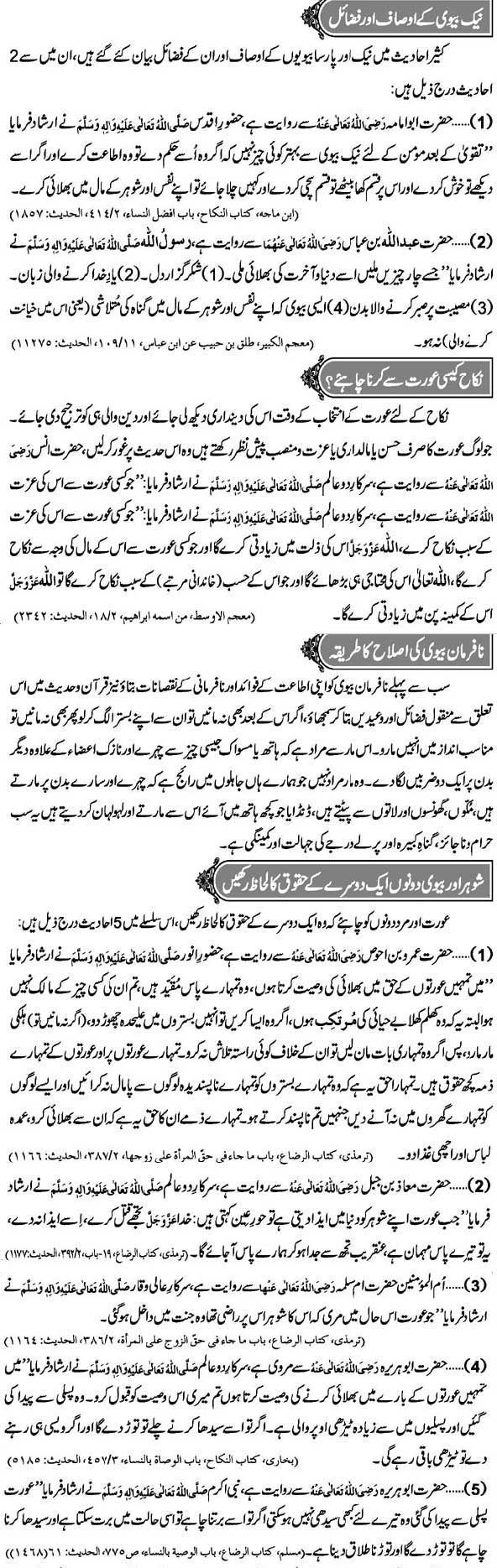
Naik Biwi Kay Fazail
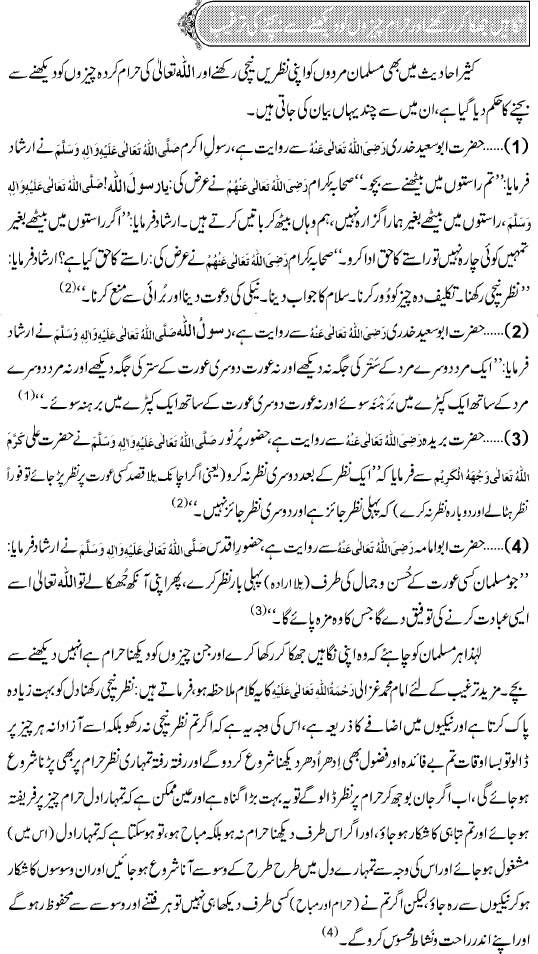
Nigahein Jhuka kar Rakhna Aur Haram Se Bachna
نگاہیں جھکاکررکھنےاورحرام چیزوں کو دیکھنے سے بچنے کی ترغیب
Beware Of The Supplication Of The Oppressed
[ALLAH’S Quran – 27:62] “Who responds to the oppressed when he calls out to Him, and relieves his suffering and who will make you inheritors of the earth? Then, is there a god besides God? How little you pay heed!”
The Prophet (Peace Be Upon Him) has said:
[Bukhari, Book #43, Hadith #628] “Narrated Ibn ‘Abbas: The Prophet sent Mu’adh to Yemen and said, “Be afraid, from the curse of the oppressed as there is no screen between his invocation and Allah.”
[Muslim, Book #001, Hadith #0027] “It is reported on the authority of Ibn ‘Abbas that Mu’adh said: The Messenger of Allah sent me (as a governor of Yemen) and (at the time of departure) instructed me thus:……………………………..Beware of the supplication of the oppressed for there is no barrier between him and Allah.”
Strengthening Mother Daughter Relationships
Your riches and your children may be but a trial, but in the Presence of Allah is the highest reward. (Quran 64:15)
What does it mean for a Muslim woman to have a daughter? What does it mean to have a Muslim mother? What duties do they have toward one another?
What does Islam say about the special relationship between mothers and daughters who are Believers?
In Islam, the female child is a gift to her mother because she has certain duties toward her. Likewise the mother has certain responsibilities to her daughter that can make treasure her mother. Let’s examine some of these points.
Daughter Duties
- Always remember what your parents, especially your mother, did for you all your life.
- Recognize the wisdom of age and experience, and even when you disagree, be respectful and humble to her.
- You must NOT obey your mother if she tells you to disobey Allah SWT or to break any of his commands.
- Use the art of negotiation – Use honey instead of vinegar. For example: “Mom, I cleaned my room and folded the clothes would you mind taking me to the mall?” Do something to please your mom and then make a polite request.
- Though we don’t like to think about it, daughters must be prepared to take care of their mothers when they become feeble and from old age just as their mothers cared for them when they were infants. Sons may offer financial support, but they are not likely to deal with the bed pans, the bathing, and the dressing. These will be the daughter’s duties.
- After she returns to Allah (SWT), if she did not have a chance to, you can make Hajj for her, pay zakat and sadaqah in her behalf, make up her fasts, and pray for her soul. Narrated Abdullah Ibn Abas : “A woman made a voyage and vowed that she would fast one month if Allah made her reach her destination with peace and security. Allah made her reach her destination with security but she died before she could fast. He daughter or sister (narrator was not sure) came to Rasulullah (SAAWS) and he commanded her to fast on her behalf .(Sunnan Abu-Dawood).”
Mothers Treatment Of Daughters
- Assume good intentions of your daughter. Try to excuse temporary thoughtlessness. Hadith advise us to make 70 excuses for the harm others do to us, and then blame ourselves for perhaps misunderstanding.
- Remember the big picture. Despite the small problems or disagreements, your daughter is basically good. Consider the fact that in the U.S. many girls who are her peers (both Muslim and non-Muslim) are sexually promiscuous, abusing drugs and alcohol, involved in criminal, gangrelated activities, getting pregnant, or being arrested. Ma Sha’Allah, if you look at the big picture, you will see that your daughter is really admirable.
- Learn how to discuss with her so that her challenges will not upset you. Learn to listen with your heart and stop interrupting her with khutbahs! She must feel free to talk to you at anytime about whatever may be troubling her. She must not feel that you will condemn her or that your love for her will be diminished if you find out that she is less than perfect and has made some mistakes. If you cannot be there for her, she will have to confide in negative peers who will mislead her.
- Search for solutions. Look for ways to make a compromise instead of insisting that she is completely wrong. Look for halal alternatives rather than simply saying that everything she wants to do is haram. For example, if she wants to go swimming at the beach, don’t just tell her “No, that’s haram!” You can instead help her arrange a swimming party for Muslim girls and women at an enclosed pool with female lifeguards, where everyone will dress modestly and share in the expense of renting the pool.
- Remember to cherish her. She is going to get married and move away before you know it. Do you really want to spend these few years you have together in your home arguing and embroiled in tension? If you expect her to someday want to bring your grandchildren to visit you, then you need to let her see how loving you really are, not how harsh. You are her ally more than her father because you are her only parent who can share with her an understanding of what it is to be a woman — from training bras to cramps, to butterflies in her stomach on her wedding day. Only you will fully understand and offer her a mothers unconditional love.
- Muslim women are expected to sacrifice for their daughters two hundred percent. When she is older, society, because of its sexism is going to give your daughter so many difficulties, and even, her husband may sometimes break her heart. She needs to be able to rely on you.It is narrated by the Prophet’s wife, ‘A’isha (RAA), that a woman entered her house with two of her daughters. She asked for charity but ‘A’isha could not find anything but a date, which she gave to her. The woman divided it between her two daughters and did not eat any herself. Then she got up and left. When the Prophet (SAAWS) came to the house, ‘A’isha told him about what had happened and he declared that when the woman will be brought to account (on the Day of Judgment) about her two daughters they will act as a screen for her from the fires of Hell.
Things You Must Never Say To Your Daughter
- “If you do that again, I’m going to kill you!” “I’m going to break your neck!” Don’t threaten physical harm. Threats only cause fear if you carry them out, and reduce your credibility if you do not.
- “Why can’t you be more like him/her?” Never compare your child to anyone else. She is Allah’s unique creation.
- “I told you so. You Should have listened to me.” Don’t rub salt in a wound. She’s already aware that she was wrong.
- “You are perfect!” “That’s the most beautiful artwork I’ve ever seen! You are the most beautiful girl in the world!” Praise breed arrogance and boastfulness. Instead, recognize her accomplishments but give credit to Allah who created her and gave her talents and abilities, by saying “Ma Sha’Allah”, and “Alhamdulillah.”
- “I heard that you did something bad, so I know you did it. You always cause trouble.” Don’t believe rumors. Always give your child a chance to explain her side. Suratul Hujurat tells us to ascertain the truth of any rumor coming to us.
- “You make me sick.” “I wish you were never born!” Suratul Hujurat says avoid sarcasm, suspicion, name-calling.
- “Oh!, you don’t mean that.” “it could always be worse.” “Hey, it’s really no big deal; why are you getting so upset?.” If something is upsetting your daughter, offer comfort, but do never try to make it seem insignificant. Her feelings are valid, and her emotional pain is real for her. Let her vent; then help her discover the lessons and solutions.
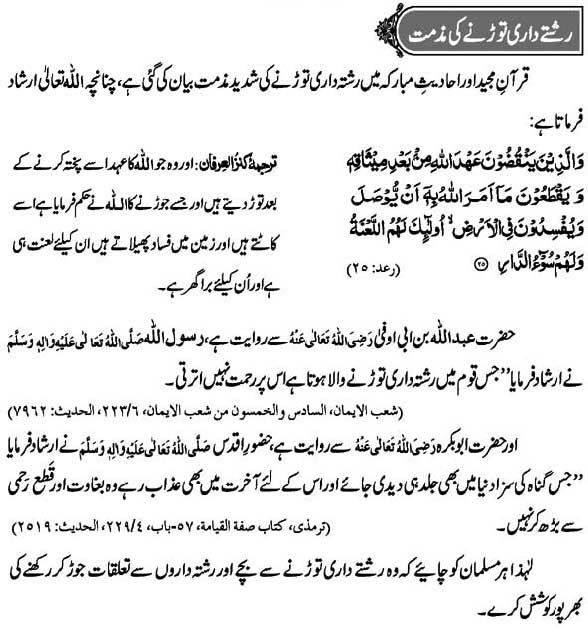
Rishtay Dari Tornay Ki Muzamat
رشتے داری توڑنے کی مزمت
Shohar Biwi Ka Bahmi Taluq