
TAG: Human Rights
Paradise At Her Feet
There is a tradition usually attributed to Prophet Muhammad (peace be upon him) which is variously interpreted to mean that the mother is responsible for teaching her children their religious obligations and good behavior that will win them Paradise; or it may mean that we earn Paradise by serving our mother throughout her life.
Either way, it shows the great esteem, honor and respect that Islam has for mothers. While the fourth commandment in the Bible is Honor thy father and thy mother, the Bible does not mention the mother separately as deserving good treatment.
The Quran, in contrast, gives special recognition to the mother s suffering in bearing and nursing her child: And We have enjoined on man (to be dutiful and good) to his parents.
His mother bore him in weakness and hardship upon weakness and hardship, and his weaning is in two years – give thanks to Me and to your parents. Unto Me is the final destination. (31:14).
Becoming a mother is one of the greatest joys of a Muslim woman.
Today in the Muslim world, even where many of the precepts of Islam are ignored, Westerners are often amazed at the gentle, loving treatment that parents receive. An Arab proverb says if you want to know how a man will treat his wife, look how he treats his mother.
Becoming a mother is one of the greatest joys of a Muslim woman. She knows that her child is both a gift and a trust from God.
She carries a great responsibility in raising a family, not only in caring for their physical needs, but also in educating them in their religion and morals.
For this and other reasons, Islam calls upon all Muslims, male and female, to be educated, for how can a woman teach her children when she herself is ignorant?
Islam also recognizes that, compared to the man, the woman is by nature more psychologically fitted to nurturing, more compassionate and patient.
For that reason, Islam decrees that husbands must maintain their wives and children, and it encourages mothers with young children to remain at home with their children rather than work outside the house. And, in case of divorce, custody of young children goes to the mother.
All this respect and honor goes to the mother, even if she is a non-Muslim, and also to maternal aunts.
Thus the woman does not cut from her own family when she marries, but her children continue to honor the kin relationships of both their mother and father.
Musalman Bhai Se Naraaz Rehna
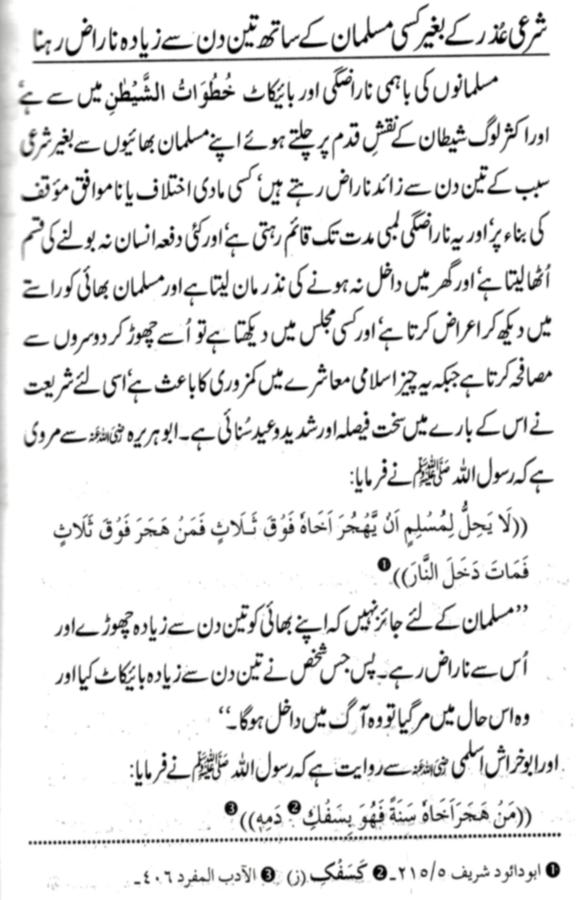
How To Win The Heart Of Husband?
10. Use your `Fitnah’ to win the heart of your husband
All women have the ornaments that Allah blessed them with. Use the beauty Allah – Azza wa Jal – has bestowed you with to win the heart of your husband.
9. When your husband comes home, greet him with a wonderful greeting
Imagine your husband coming home to a clean house, an exquisitely dressed wife, a dinner prepared with care, children clean and sweet smelling, and a clean bedroom – what would this do to his love for you? Now imagine what the opposite does to him.
8. Review the characteristics of the Hoor Al-Ayn and try to imitate them
The Qur’an and Sunnah describe the women in Jannah with certain characteristics. Such as the silk they wear, their large dark eyes, their singing to their husband, etc. Try it, wear silk for your husband, put Kohl in your eyes to `enlarge’ them, and sing to your husband.
7. Always wear jewelry and dress up in the house.
From the early years, little girls have adorned themselves with earrings and bracelets and worn pretty dresses – as described in the Qur’an. As a wife, continue to use the jewelry that you have and the pretty dresses for your husband.
6. Joke and play games with your husband.
A man’s secret: they seek women who are lighthearted and have a sense of humor. As Rasul Allah – sal Allahu alayhi wa sallam – told Jabir to marry someone who would make him laugh and he would make her laugh.
5. Thank your husband constantly for the nice things he does. Then thank him again.
This is one of the most important techniques, as the opposite is a characteristic of the women of hellfire.
4. An argument is a fire in the house. Extinguish it with a simple `I’m sorry’ even if it is not your fault.
When you fight back, you are only adding wood to the fire. Watch how sweetly an argument will end when you just say sincerely, “Look, I’m sorry. Let’s be friends.”
3. Always seek to please your husband, for he is your key to Jannah.
Rasul Allah – sal Allahu alayhi wa sallam – taught us that any woman who dies in a state where her husband is pleased with her shall enter Jannah. So .. please him.
2. Listen and Obey!
Obeying your husband is Fard! Your husband is the Ameer of the household. Give him that right and respect.
1. Make Dua to Allah to make your marriage and relationship successful.
All good things are from Allah. Never forget to ask Allah ta’ala for the blessing of having a successful marriage that begins in this Dunya and continues on – by the Mercy of Allah ta’ala – into Jannah.
And Allah knows best
Waldain Ki Rifat-O-Azmat
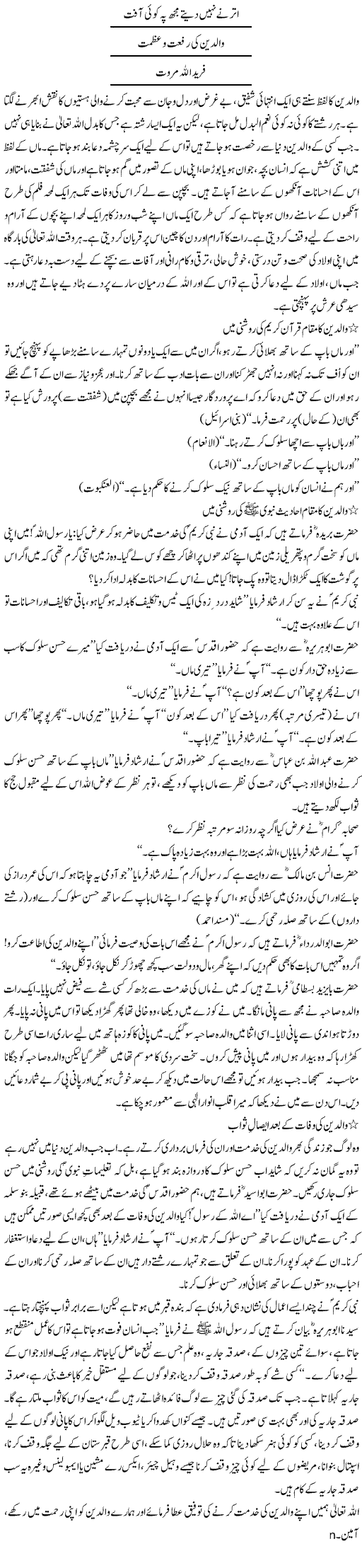
Waldain Ki Rifat-O-Azmat
Hasad: Aik Zahar Hai
Hasad: Aik Zahar Hai
Human Rights In Islam
ISLAM guarantees the basic rights of every living creature. The sanctity of human life is extremely sacred.
Prophet Muhammad (peace be upon him) said: “Truly your blood, your property, and your honor are inviolable.” (Al-Bukhari)
Allah said in the Qur’an:
“O mankind! We have created you from a male and a female and made you into nations and tribes that you may know one another. Verily, the most honorable of you with Allah is that (believer) who is pious. Verily, Allah is All-Knowing, Well-Acquainted (with all things).” (Qur’an, 49:13)
The human race is only for the purpose of identification in Islam, and it doesn’t give one superiority over another.
Prophet Muhammad (peace be upon him) said: “O people! Your God is one and your forefather (Adam) is one. An Arab is not better than a non-Arab and a non-Arab is not better than an Arab, and a red (i.e. white tinged with red) person is not better than a black person and a black person is not better than a red person, except through piety.” (Musnad Ahmad)
Allah has commanded to uphold justice and discharge the trust of people:
“Verily, Allah commands that you should render back the trusts to those, to whom they are due; and that when you judge between men, you judge with justice. Verily, how excellent is the teaching which He (Allah) gives you! Truly, Allah is Ever All-Hearer, All-Seer.” (Qur’an, 4:58)
“…And act justly. Truly, Allah loves those who are just.” (Qur’an 49:9)
“…and let not the enmity and hatred of others make you avoid justice. Be just: that is nearer to piety;…” (Qur’an 5:8)
The Prophet Muhammad (peace be upon him) said: “O People, beware of injustice, for injustice shall be darkness on the Day of Judgement.” (Saheeh Al-Bukhari).
Being Undutiful To Parents
As Muslims it is our duty to keep ourselves away from all sins; minor and major. This is based on the fact that the first priority for Muslims is to gain the pleasure of Allah the Almighty by doing what He likes and avoiding what He dislikes, irrespective of the gravity or the simplicity of the sin.
The first commandment in Islam as revealed to all the prophets is to worship Allah the Almighty and immediately after this comes the duty of being dutiful to parents
{Thy Lord has decreed, that you worship none save Him, and (that you show) kindness to parents.} (Al-Israa 17: 23).
Thus, Islam urges every Muslim to be dutiful to his parents, extending to them the kindest treatment possible.
Failing to treat parents kindly makes the person guilty of disobedience to parents as well as to Allah the Almighty.
Doing so may deprive him of the chance of being admitted to Paradise. Therefore, it goes without saying that disobedience to parents or mistreating them is the second major sin after Shirk (associating other beings with Allah).
The Prophet (peace and blessings be on him) was asked about the greatest sins. He said, “To join partners in worship with Allah; to kill a soul which Allah has forbidden to kill; and to be undutiful or unkind to one’s parents…“(Bukhari)
In another tradition, the Prophet (peace and blessings be on him) said, “The person who severs the bond of kinship will not enter Paradise.” (Al-Bukhari)
He also said, “The pleasure of Allah is in the pleasure of one’s parents and the wrath of Allah is in the wrath of one’s parents.” (Ibn Hibban)
Relationship Between Parent And Child In Islam
The relationship between parents and their children is one of the sacred human relationships to which Islam gives due attention. This relationship should be based on respect, giving, tenderness, and mercy.
The Holy Qur’an mentions this relationship in many Surahs (chapters), usually after mentioning Tawheed (Monotheism) as if Allah wants to inform people that being kind to one’s parents is the second important thing after believing in Allah: “Your Lord has decreed that you worship none but Him and that you be kind to parents. Whether one or both of them attain old age in your life, say not to them a word of disrespect, nor shout at them, but address them in terms of honor. And, out of kindness, lower to them the wing of humility, and say: “My Lord! Bestow on them Your Mercy even as they did bring me up when I was young.” (17:23-24)
You find a lot of parents in the West living in retirement homes who are only accompanied by their pets because their sons and daughters have totally forgotten them. You rarely find such cases in the Muslim world because Muslims do follow what the Holy Qur’an says regarding being grateful to one’s parents throughout their lives.
When one of the Companions asked Prophet Muhammad (peace be upon him), about the person who is entitled more to his companionship in this life to which Prophet Muhammad (peace be upon him), answered; “Your mother.” The man again said “Who else?” and the Prophet (peace be upon him) again said “Your mother.” The man asked, “And then who?” The Prophet (peace be upon him), said, “Your mother.” The man then asked, “Then who?” to which the Prophet said “Your father.” Muslim scholars said that Prophet Muhammad (peace be upon him), preferred the mother three times to the father because she is distinguished by three roles: pregnancy, delivery, and breast-feeding.
The Qur’an mentions a lot of positive examples of parent-child relationships such as the one between Prophet Yahya’s parents and this is clear when Allah praises Yahya in Surah Mariam, Mary: “And piety (for all creatures) as from Us, and purity: He was devout. And kind to his parents, and he was not overbearing or rebellious.” (Qur’an, 19:13-14) And in the same Surah, Prophet Isa, Jesus (peace be upon him says): “He has made me kind to my mother, and not overbearing or miserable.‘ (Qur’an, 19:32) In other words, the Holy Qur’an aims at instilling in the reader’s or listener’s mind the fact that being grateful and kind to one’s parents is the shortest way to win Allah’s approval.
Joining Ties Of Kinship
Relatives are those who are related to you through blood and close ties; such as the brother, the uncle, the aunt, or their children. Everyone who has a tie of relation with you has certain rights upon you in accordance with how closely they are related to you. Allah said regarding this: “And give to the relative his right.” (Qur’an, 17:26). Allah also said: “And worship Allah alone, and do not set up any partner to Him in worship, and be kind and good to the parents, and to the relatives.” (Qur’an, 4:36)
So it is obligatory upon everyone to treat his relatives in the best possible manner, and to support them in accordance with their needs, and what they seek of help and support. And this is what is enjoined by the Shariah, the ‘Aql (sound reasoning), and the Fitrah (natural disposition).
There are several textual evidence encouraging and urging Silat-ur-Rahim (joining the ties of kinship).
The Prophet (peace be upon him) said: “Whosoever believes in Allah and the Last Day let him keep the ties of kinship.” (Al-Bukhari, no. 6138)
Unfortunately, many people do not observe this right and transgress the bounds. Some of them do not seek to join ties with relatives or show kindness to them; neither through wealth, nor through good behavior, nor through the giving of occasional gifts and presents nor through rendering help to them in their times of need. Indeed, days and months may pass without even seeing or visiting them! Sometimes, rather than seeking to join ties of kinship, some people even intend to sever such ties, by trying to harm their relatives – either through words or actions. Such people may keep close ties with those who are not relatives, yet cut off ties with their relatives!
Others only maintain ties of relationship with those who maintain ties with them and cut off ties with those who cut off from them. So they are not really maintaining ties of relationship; they are only acting tit-for-tat.
The true waasil (one who keeps ties of kinship) keeps ties of relation for the sake of Allah – regardless of whether his relations keep ties with him or not.
The Prophet (peace be upon him) said: “The waasil is not the one who merely does so out of reciprocation. Rather, the waasil is the one who even when the relatives cut off from him, still maintains ties with them.” So a man asked: “O Messenger of Allah. I have relatives with whom I maintain ties of kinship, yet they cut off from me. I treat them kindly, yet they treat me in an evil manner. And I am forbearing and patient with them, yet they behave rudely and ignorantly towards me.” The Prophet (peace be upon him) said: “If the situation is as you say, then it is as if you are filling their mouths with sand. And Allah will continue to aid and support you as long as you continue doing what you are doing.” (Al-Bukhari, no. 5911)
If there were no other rewards for keeping ties of kinship, except that Allah keeps ties with the waasil in this world and the hereafter, and that He extends His Mercy due to it, and makes malters easier through it, and removes distress and anxieties by it, then that would be more than sufficient. However, along with this, Silat-ur-Rahim brings family and relatives close to one another, increases love and compassion between one another, and cultivates the habit of mutual help in times of ease and hardship. These are well-known things that are experienced on a daily basis. When ties of kinship are not maintained, then each one of the mentioned benefits turns into the opposite, and great harm comes to society.
– By Sheikh Muhammad Saleh Bin Al-Uthaymeen