
On Arrival
1. Ihram at Meeqat for those who have not put on Ihram earlier.
2. (i) Two Rakats Nafil and Niyah (Declaration of Intention) and Talbiyah must be performed for Hajj and Umrah combined (Qiran) or
ii)Two Rakats Nafil and Niyah and Talbiyah must be performed for Umrah only (Tamattu) or
iii) Two Rakat Nafil and Niyah and Talbiyah must be performed for Hajj only (Ifraad).
3. Tawaf Qudoom in Makkah (Arrival Tawaf).
4. Two Rakats Nafil /Drink Zamzam.
5. Sai’e
i) For Qiran, maintain Ihram until Hajj.
ii) For Tamathu, one can come out of the Ihram.
TAG: Ihram
Practical And Spiritual Advice For Those Going To Hajj
Alhamdulillah, we are upon that time of year once more when those who have been chosen by Allah to visit His blessed house and perform Hajj are preparing to leave by reading up on how to perform Hajj in the correct manner. Though this is good and necessary, I would like to propose some points regarding extra actions you can do to magnify your reward by the will of Allah, as well as to share with you some advice that is not commonly given.
1) From the moment you enter the state of iḥram, the best dhikr you could make is the Talbiyah,
لبيكاللهم لبيك،لبيك لا شريكلك لبيك، إنالحمدوالنعمة لكوالملك لاشريك لك
Some scholars have said that during this time, this dhikr is even better than reciting the Quran. You stop saying it when you begin umrah. You start again when you enter the state of iḥram for Hajj, and you stop once more when you throw the stones (jamarat) on the day of Eid.
It is narrated that when the saḥabah entered the state of iḥram, by the time they had traveled to الروحاء (one day’s travel from Madinah), they had lost their voices from the constant saying of the Talbiyah.[1] When saying the Talbiyah, be conscious that what you are saying is literally affirming your answer to Allah’s call so have this in the back of your mind whenever you are performing the Talbiyah so that you are constantly affirming your intention to carry out this great act of worship. What an honor it is and what a great matter you are embarking upon.
2) When you are on the plains of Arafah, sit down to conserve your energy, just as the Prophet (sall Allahu alayhi wasallam) sat on his camel, [2] and make plenty of dua, not stopping except to drink water, until the sun has set. These few hours are a once-in-a-lifetime opportunity, so do not let them pass easily. If you ever get stuck on what to say, then constantly repeat the best dua a person can make on the best occasion for them to make a dua (at Arafah), which is to say لااله الا اللهوحده لا شريكله له الملكوله الحمد وهوعلى كل شيقدير.
Be conscious that at this very moment, Allah is showing off to the Angels telling them “Look at my slaves”.[3] He is pleased with you at this very moment so seize this moment to ask Him what you desire, and do not waste this opportunity or your time. Making dua on the plains of Arafah is one of the greatest actions you can do in your entire life, [4] so stay away from the people and find a secluded spot or a place where no one you know is around you so there is nothing to distract you from seizing this moment.
– When you sleep in muzdalifah, wear a face mask. Depending on where you are, it may be very dusty, which will prevent you from sleeping properly (to get energy for the most eventful day) as well as probably make you feel ill.
– Contrary to what we are commonly told, you CAN slaughter the sacrificial animal yourself. After throwing the stones at the jamarat, follow the signs leading to the slaughterhouse (under 1hr walk). When you get near it, you will begin to see farms with animals. Pass these and go to the slaughterhouses, where you will not see any animals, just long (not tall) buildings with a booth at the front of each. Here you pay, receive a ticket and are able to enter to witness or carry out the slaughter yourself.
– Have you ever considered sacrificing a camel instead? It is the Sunnah that you sacrifice a camel, as that is the biggest and best sacrificial animal and is what the Prophet (sall Allahu alayhi wasallam) sacrificed. A few years ago this was not possible due to a disease spread within camels, but this may not be the case now.
– Have you ever considered sacrificing more than one animal? The Prophet (sall Allahu alayhi wa sallam) sacrificed 100 camels during his Hajj.[5] He knew that to sacrifice an animal is a part of Ḥajj and a form of glorification of Allah, and therefore sacrificed the best and the most he could. If you can afford it, sacrifice more than one animal, up to as many as you can afford. If you are reading this before you’ve set off, then take extra cash with you for this. Hajj is a once-in-a-lifetime opportunity, so glorify Allah and sacrifice the best you can give. The pious people would never haggle when buying a sacrificial animal, nor allow anyone to carry the sacrificial animal for them because they wanted to glorify Allah and show Him that they were exerting their best effort for His sake regardless of the cost. Their only concern was the reward.
– Get a data pack and save your location in Mina in Google Maps. You will constantly be leaving it for either Arafah or the Jamarat, so this will help you return easily without getting lost. Google Maps will also help if you decide to go to the slaughterhouse as you may not be able to return via the same route, and you will also need it on your return from tawaf al-ifadah.
– It is the Sunnah that after you throw the first two sets of stones at the jamarat on the 11th, 12th, and 13th of Dhul Hijjah that you make dua. The dua that the Prophet(sall Allahu alayhi wa sallam) made was equivalent to a person reciting Surah al-Baqarah i.e. about 1 hour.[6] The throwing of the stones is the only ritual act of Hajj made during these days so spend the extra time making dua because this opportunity only comes once in a lifetime (for most of us). Try to, at least once, make dua the length that the Prophet (sall Allahu alayhi wa sallam) used to make it and remember; dhikr of Allah is dua and you could therefore also repeat:
لااله الا اللهوحده لا شريكله له الملكوله الحمد وهوعلى كل شيقدير
– Glorify Allah and spend your time humbled before Him for choosing you to complete Hajj. When the Prophet (sall Allahualayhi wa sallam) entered Makkah as a victor, he entered with his head lowered out of humility before Allah.
– From the purposes of Hajj are to have Taqwa of Allah and to glorify Him.[7] With this in mind, do not become overwhelmed by logistics whilst neglecting the purpose of Hajj. Remember, you will not find the pleasure of Allah where you want, but rather where He wants, so even if you find yourself stuck in major congestion, or are delayed, or are prevented from making Sunnah acts such as kissing the black stone, it is all fine, as long as you are focusing on the purposes of Hajj which include glorifying Allah and having Taqwa.
– Never say, “Hajj cost me such and such”, rather glorify Allah, and be happy with what you have spent without showing any signs of displeasure. Imagine you are buying forgiveness of your sins, [8] with that money, and then ask yourself if it is not worth it.
I ask Allah to allow you to perform Hajj as He pleases, to accept it from you, and to allow us all to return to His house to perform Umrah and Hajj numerous times. Ameen.
Notes:
[1] Reported by Anas and Aisha (Radi Allahu anhuma) in al-Sunan al-Bayhaqi
[2] According to the famous hadith of Jabir in Sahih Muslim
[3] Reported by Abu Hurayrah (Radi Allahu anhu) recorded by Ahmed, Ibn Hibban andal-Hakim
[4] The Prophet (sall Allahu alayhi wa sallam) said, “The best dua is the one made on the day of Arafah.” Recorded in Tirmidhi and the Muwatta of Imam Malik
[5] Hadith of Jabir, as mentioned above
[7] Al-Quran 2:203 and 22:32
[8] Bukhari and Muslim
Contemplations On Hajj
You are set to depart to accomplish a great obligation. Make this journey to Allah’s House as Allah wants. Think of the next journey that is surely coming, the one that leads to the meeting of Allah, the Highest. This raises questions like What did I prepare for that Day? Am I following Allah’s Commands? Am I a follower of the Sunnah? Allah says: “And invoke not any other ilaah (god) along with Allah, none has the right to be worshipped but He, everything will perish save His Face, His is the Decision, and to Him (all) shall be returned.” [Soorah al-Qasas (28): 88]
When you equip yourself with enough provision to reach the sacred land of Makkah – remember your journey to Allah and the Hereafter where you will require the provision of your good deeds to reach your desired goal. Before you are death and grave, accounting and scales and al-Siraat followed by either Paradise or Hell. The blessed one will be he whom Allah saves, therefore follow the Command of Allah “and whatever good you do, (be sure) Allah knows it. And take a provision (with you) for the Journey, but the best provision is at-Taqwa.” [Soorah al-Baqarah (2): 197]
Putting on the two garments of Ihram should remind you of the moment of shrouding when your body will be wrapped and put in a grave. This prompts you to give up disobedience and sins, just as you abandoned your expensive clothes and dressed in two clean, white garments. Clean and purify your heart from all stains of sins and disobedience.
When you stand in meeqat, remember that there is still another meeqat that is sure to come soon. It is the meeqat (appointed meeting) on the Day of Resurrection: “Say (O Muhammad sallallahu alaihi wa-sallam): Verily, those of old, and those of later times. All will surely be gathered together for an appointed Meeting of a known Day.” [(57): 49-50]
Upon entering Makkah remember you are in a secure sanctuary: “Have We not established for them a secure sanctuary (Makkah), to which are brought fruits of all kinds, a provision from Ourselves, but most of the men know not.” [Soorah (28): 57]
Remember the sanctuary on the Day of Resurrection, which none can achieve except those who truly believe in Allah and avoid all kinds of Shirk because “It is those who believe (in the Oneness of Allah and worship none but Him Alone) and confuse not their Belief with Zulm (wrong, i.e. by worshiping others besides Allah), for them (only) there is security and they are guided.” [al-An’aam 6:81]
“If you were to join gods with Allah, truly fruitless will be your deeds.” [Soorah az-Zumar (39): 65] So, commit yourself to repentance, having a good opinion of Allah, hoping that Allah will grant you security from His Punishment.
When you enter al-Masjid al-Haraam, from one of the gates, now you see what you hoped to see for a long time. Thank Allah for making this possible and hope that He will grant you the greatest reward of seeing His Majestic Face on the Day of Reckoning. This thankfulness is not just to say ‘Al-Hamdulillah’, but also to obey His Commands during the Hajj and all your life through.
Kissing the Black Stone should install in your love for the Sunnah of Allah’s Messenger (sallallahu alaihi wa-sallam), remember the saying of Umar (radhi allahu anhu), “I know that you are a mere stone that can neither harm nor do any good. If I had not seen the Prophet (sallallahu alaihi wa-sallam) kissing you, I would have never kissed you.” [Saheeh al-Bukharee (1520) and others]
You start your Tawaaf; know that Tawaaf is a great time for magnifying Allah. Remember Him and busy yourself in Du’aa. Reflect upon the time when the Messenger of Allah (sallallahu alaihi wa-sallam) was prevented from doing the same what you are performing!! Then think how Allah’s Messenger (sallallahu alaihi wa-sallam) cleansed the House of Allah from every symbol signifying worship to others besides Allah. All idols were demolished! Ask Allah to make you steadfast on the correct belief and Path of the Salaf and make you die on the Deen al-Hanifiyyah.
Drink the water of Zam-Zam and supplicate to Allah and Glorify Him. Remember the blessing of Allah, which He has bestowed upon mankind in the form of this blessed water.
When you are in the Sa’ee (running between al-Safa’ and al-Marwa), contemplate on Hajrah, the mother of Isma’eel alaihis-salaam, when she asked her husband, Ibraheem alaihis-salaam: “Did Allah order you to do this (meaning leave me and my baby in the deserted area of Makkah)? When he (Ibraheem alaihis-salaam) replied in the affirmative, her strong belief, trust, and reliance on Allah was seen when she responded to him saying: “Then He (Allah) will not neglect us!!” This great statement of Haajar exemplifies the robust endurance, perseverance, and trust a Muslim should have in Allah. Here in the deserted Makkah was Hajrah with full conviction in Allah and there on the mountains was Ibraheem alaihis-salaam invoking Allah: “O our Rabb! I have made some of my offspring to dwell in a valley with no cultivation, by Your Sacred House, in order, O our Rabb that they may offer prayers perfectly, so fill some hearts among men with love towards them, and (O Allah) provide them with fruits so that they may give thanks.” [Soorah Ibraheem (14): 37] Allah answered the Du’aa of Ibraheem alaihis-salaam and valued the firm belief of Hajar – Men and fruit came to Makkah from different places and their son grew up to be a Prophet of Allah.
The Sa’ee and the struggle of Hajrah convey the lessons of Patience in adversity, and that man should turn to Allah, Who alone is the source of help. When a man remembers the struggle and patience of this woman, it makes it easier for him to bear his own problems.
Standing in Arafat (Wuqoof) and the crowd should remind you of the Day of Resurrection when all men from first to the last will stand in front of their Lord, barefooted, naked, and uncircumcised for fifty thousand years. Humble yourself to Allah and manifest your worship to Him alone. Determine to abandon all sins, rush to perform good deeds, and free yourself of all pride and arrogance.
Gather pebbles and when you are about to embark on stoning the jamaraat, remember the Hadeeth of Allah’s Messenger (sallallahu alaihi wa-sallam): “When you cast the small pebbles (i.e. at the jamaraat), it will be a light for you on the Day of Judgment.” [(Saheeh) by Shaikh al-Albanee in Silsilah al-Ahaadeeth as-Saheehah vol: 6, no: 2515] This stoning at the Jamaraat is a manifestation of Uboodiyyah because even if a man does not understand the complete reason and wisdom behind the stoning, he follows the Command of Allah in submission.
Before you perform the sacrifice, purify your intention because: “It is neither their meat nor their blood which reaches Allah, but it is your devotion that reaches Him.” [Soorah al-Hajj (22): 37] When you slaughter your Hady (sacrifice), remember the event when a father (Ibraheem (alaihi as-salaam) submitted to the Command of Allah and willingly agreed to sacrifice his only son (Isma’eel alaihis-salaam) who had grown and become a help for his old age. This teaches us to respond to the Command of Allah, just as Isma’eel did: “O my father! Do that which you are commanded Insha’Allah you will find me from the Saabireen (the patient ones).” [Soorah as-Saffat (37): 102]
After the completion of your Hajj, do not think that the remembrance of Allah has ended, carefully read what Allah says: “So when you have accomplished your Manaasik (i.e. the rites of Hajj) remember Allah as you remember your forefathers or with a far more remembrance.” [Soorah al-Baqarah (2): 200]
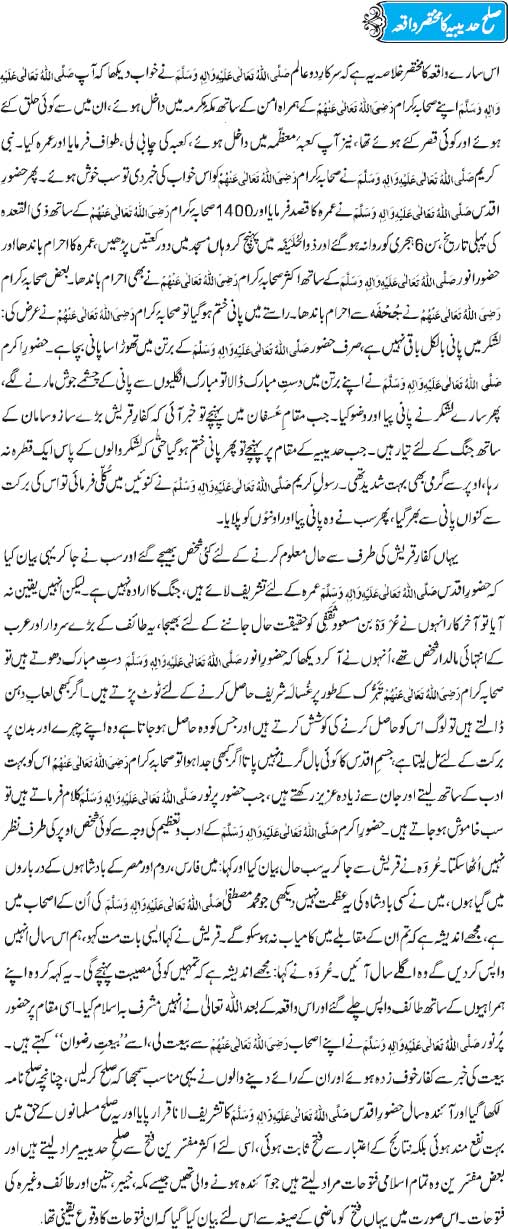
Sulah-e-Hudaibiya Ka Mukhtasar Waqia
Restrictions Of Ihram
The muhrim (one in ihram) is forbidden to do certain things because of having entered the state of Ihram.
The forbidden things are:
1) Shaving the hair of the head, because Allah says: “… And do not shave your heads until the Hady (animal, i.e. a sheep, a cow, or a camel) reaches the place of sacrifice…” (2:196)
Scholars have added that besides shaving the head, shaving any hair on the body as well as trimming or cutting one’s nails is also prohibited.
2) Using perfume after entering ihram, whether on one’s clothing or body, or in one’s food, or when washing the dead body (muhrim) or in any way whatsoever. The evidence for this being forbidden in ihram is the Hadith of the Prophet (peace be upon him), who said concerning a man whose camel trampled him to death, “Wash him with water and lotus leaves and shroud him in his two garments, but do not cover his head or perfume him with hanoot.” Hanoot is a mixture of perfumes that is usually applied to the dead body.
3) Sexual intercourse, because Allah says: “… So whosoever intends to perform Haj therein (by assuming Ihram), then he should not have sexual relations (with his wife), nor commit sin, nor dispute unjustly during the Haj…” (2:197)
4) Touching one’s wife with desire because this comes under the general meaning of the phrase, “he should not have sexual relations (with his wife),” and because it is not permissible for the muhrim to get married or to propose marriage – so it is more likely that it is also not permissible for him to touch his wife with desire.
5) Killing game (hunting), because Allah says: “O you who believe! Kill not game while you are in a state of Ihram [for Haj or Umrah (pilgrimage)]…” (5:95)
Cutting down trees is not haram for the muhrim, except for those trees within the amyal, i.e., the boundaries of the sanctuary. Cutting these trees is forbidden whether one is in ihram or not. Hence, it is permissible to cut down trees in Arafah even if one is in ihram, because the prohibition on cutting down trees is connected to the Haram (within the sanctuary), not ihram.
6) A prohibition applies exclusively to men is wearing shirts, hooded robes, trousers, turbans, and leather slippers, because the Prophet (peace be upon him) was asked about what the muhrim should wear. He answered, “He should not wear a shirt, hooded robe (burnous), trousers, a turban, or leather slippers.” But he (peace be upon him) made an exception for one who cannot find an izar (lower garment or waist wrapper). Such a person may wear trousers, and one who cannot find sandals may wear leather slippers.
A common perception is that wearing sewn garments means wearing clothes that have stitching in them, but that is not the case. What the scholars meant by that is wearing clothes that are tailored to fit the body or part of it, such as shirts and trousers. Hence, if a person wears a rida (upper garment) or izar (lower garment) with patches on it, that is permissible, but if he wears a woven shirt with no stitching, that is haram.
7) One of the prohibitions of ihram that applies only to women is the niqab, which refers to a veil that covers the face and leaves the eyes uncovered because the Prophet (peace be upon him) forbade that. A similar prohibition applies to the burqa. When a woman enters ihram, she should not wear a niqab or burqa.
With regard to the one who does any of these forbidden things out of forgetfulness or ignorance or because he or she is forced to do so, no expiation is due on them because Allah says: “And there is no sin on you concerning that in which you made a mistake, except in regard to what your hearts deliberately intend. And Allah is Oft-Forgiving, Most Merciful.” (33:5)
Concerning killing game or hunting, Allah says: “O you who believe! Kill not game while you are in a state of Ihram [for Haj or Umrah (pilgrimage)], and whosoever of you kills it intentionally, the penalty is an offering, brought to the Ka’bah, of an eatable animal ( i.e. sheep, goat, cow) equivalent to the one he killed…” (5:95)
Glossary Of Hajj Related Terms
Adhan: The call to prayer (salat); is usually issued from the minaret of a mosque.
Arafat: A desert location approximately nine miles east of Makkah where the pilgrim spends the 9th of Zul Hijjah as a rite of Hajj. The waqfa is performed at Arafat.
Ayyam ut Tashreeq: The 11th, 12th, and 13th days of the month of Zul Hijjah. On these days, the pilgrim performs Rummy in Mina.
Dum: Also known as khaffarah. This is the atonement required of a pilgrim for a willful violation of a prohibition or obligation whilst in the state of Ihram.
Eid ul-Adha: The festival of sacrifice performed on the 10th day of Zul-Hijjah. An animal such as a sheep or goat has been sacrificed as a commemoration of Prophet Ibrahim’s (PBUH) willingness to sacrifice his son Ishmael for God.
Ezaar: Lower cloth of Ihram.
Hajj: Hajj is one of the five pillars or central duties of Islam. It is a set of acts of worship to be performed in and around Makkah at least once in a lifetime by every Muslim satisfying certain conditions. There are three types of Hajj (see below).
Hajj ul Ifrad: The type of Hajj where the pilgrim pronounces his niyyah (i.e.intention) to perform only Hajj at Miqat while changing into Ihram.
Hajj ul Qiran: The type of Hajj where the pilgrim pronounces his intention to perform both Umra and Hajj together with the same Ihram at Miqat.
Hajj ut Tamattu: The type of Hajj where the pilgrim pronounces his intention to perform only Umra at Miqat when changing into Ihram. A second niyyah, and a second change into Ihram follow on the 8th of Zul Hijjah for the performance of the remaining rites of Hajj.
Hajar ul Aswad: The sacred Black Stone built into the southeast corner of the Kaaba at a height of approximately four feet. The stone does not belong to the geology of the region and is a part of the original construction of the Kaaba by Prophet Ibrahim (PBUH). The Black Stone was personally installed in the wall of the Kaaba by the Prophet Mohammed (PBUH) himself during its reconstruction following its destruction by a flash flood. The Prophet (PBUH) also kissed it during his Last (Farewell) Hajj. Thus, touching and kissing (Istilam) of Hajar ul Aswad during Umra and Hajj is considered sunnah.
Halq: The complete shaving of the head by the male pilgrim on the 10th of Zul Hijjah. This is the last thing he does before getting out of the state of Ihram. See Taqseer also. For female pilgrims, the requirements of Halq and Taqseer are satisfied if they trim their hair by approximately half an inch.
Haram ash Shareef: The mosque around the Kabah in Makkah, as well as the mosque in Medina. The latter, also known as Al-Masjid un Nabawi, contains within its premises the grave of Prophet Mohammed (PBUH).
Hateem: The area adjacent to the Kabah on its west side, is enclosed by a low semi-circular wall. Tradition has it that Hajar (wife of Prophet Ibrahim [pbuh]) is buried in this enclosure. It is highly recommended that the pilgrim should offer salat us sunnah and supplications to Allah in this area. However, this is not a part of the official rites of Hajj.
Idtiba: The mode of Ihram used during Tawaf ul Qudoom. The male pilgrim drapes one end of the top part of his Ihram over his left shoulder back-to-front. The other end goes across his back, under his right arm, across his front, and is finally draped over his left shoulder. Idtiba is not observed in any other type of Tawaf. Also, when the pilgrim offers salat us sunnah after Tawaf ul Qudoom or an obligatory salat during this Tawaf, he must cover both his shoulders. In other words, Idtiba is practiced only while actually performing Tawaf ul Qudoom. Female pilgrims wear no Ihram so that the question of Idtiba for them does not arise.
Ihram: The distinctive garb of the male pilgrim worn during Umra or Hajj. It consists of two pieces of white, plain, and unsewn cloth. One of the pieces (ezaar) is wrapped around the midriff to cover his body from just above his navel to his ankles, and the other (reda) is draped around his shoulders to cover the upper body. For ladies, their ordinary, and unpretentious clothes of daily wear constitute their Ihram.
Istilam: The act of kissing Hajar ul Aswad at the beginning and the end of every circumambulation (circuit) of the Kaaba during Tawaf. If it is not possible physically to kiss Hajar ul Aswad for any reason, the pilgrim may extend his hand to touch the Sacred Stone and then kiss his own hand. If even that is not possible, he may raise his hand towards Hajar ul Aswad and, thereafter, kiss his own hand.
Jamraat: The three stone pillars in Mina symbolically represent the locations where the devil (shaitan) attempted to tempt Prophet Ibrahim (PBUH) away from the path of Allah. The pilgrim symbolically stones these pillars on the 10th through to the 13th of Zul Hijjah in commemoration of the rejection of the devil by Prophet Ibrahim, and of his steadfastness to the cause of Allah. The Jamraat are located within a few hundred feet of one another in a line and are named as follows:
Jamrat ul Kubra: The last stone pillar in the line. This is also called Jamrat ul Uqabah.
Jamrat ul Oola: The first stone pillar in the line.
Jamrat ul Wusta: The second (middle) stone pillar in the line.
Kaaba: A cubic structure originally built by Prophet Ibrahim (PBUH) and his eldest son Ishmael. It is now housed within the Haram ash Shareef in Makkah. During Hajj, the essential rite of Tawaf is performed around the Ka’bah. Every day, millions of Muslims perform prayers (salat) facing the direction of the Ka’bah.
Kaffarah: Another name for Dum
Marwah: A rocky hillock located approximately one hundred yards from the Ka’bah inside Al Masjid ul Haram. The pilgrim performs the devotional rite of Sai between the hillocks of Safa and Marwah.
Mahram: The husband, or a male companion of a female pilgrim to whom her marriage is expressly prohibited by the shariah (e.g., father, brother, uncle, nephew, etc.) A woman must be accompanied by a Mahram for Umra and Hajj.
Makam-o-Ibrahim: The stepping stone used by Prophet Ibrahim (PBUH) during the original construction of the Ka’bah. The stone carries the imprints of his feet and is housed in a glass enclosure on the north side of the Kabah.
Masjid ul Haram: The mosque around the Kabah is also known as Haram ash Shareef.
Mes’aa: The stretch between Safa and Marwah. See also Sai.
Miqat: An imaginary boundary around Makkah. A prospective pilgrim cannot cross this boundary without first changing into Ihram. This boundary is anchored by different townships and localities in different directions (Zul Hulaifa in the north, Yalamlam in the south-east, Dhat Irq in the north-east, Juhfah in the north-west, Qarn ul Manazil in the east.) The pilgrim changes into Ihram at Miqat and pronounces his intention to perform Umra or Hajj. For people living inside the Miqat permanently, their place of residence is their Miqat.
Mina: A desert location approximately three miles east of Makkah where several rites of Hajj are performed.
Muallim: A knowledgeable professional who can guide the pilgrim during Hajj. Also called a Mutawwif.
Muhrim: A pilgrim in the state of Ihram
Multazam: The part of the Ka’bah between its door and Hajar ul Aswad. This is a specially sacred part of the Ka’bah. It is recommended that, if possible, the pilgrim should touch the Ka’bah at Multazam and offer supplications to Allah. However, this is not a part of the official rites of Hajj.
Mutamatti: One who has performed Hajj ut Tamattu.
Mutawwif: A knowledgeable professional who can guide the pilgrim during Hajj. Also called a Muallim.
Muzdalifah: A desert location approximately midway between Mina and Arafat. The pilgrim spends the night of the 10th of Zul Hijjah here.
Namira: A mosque in Arafat
Niyyah: Intention. All acts of worship are preceded by an appropriate niyyah.
Qarin: One who has performed Hajj ul Qiran
Qasr: The mode of shortened prayers is usually offered when on a journey.
Qibla: The direction (towards the Ka’bah) that Muslims face praying.
Ramal: The ritual where male pilgrims are required to walk briskly with their chests thrust forward and with their shoulders rolling slightly during the first three circuits of Tawaf ul Qudoom. Ladies are not required to practice Ramal
Reda’: The upper cloth of Ihram.
Rummy: The act of symbolically stoning the devil (shaitan) in Mina on the 10th through to the 13th of Zul Hijjah. This commemorates the tradition that Prophet Ibrahim (PBUH) was tempted three times by the devil but rejected all three of the devil’s attempts by stoning him and driving him away. These three locations are symbolized by three stone pillars (jamaraat) in Mina.
Safa: A small hillock approximately half a mile from the Kabah, inside Al-Masjid ul Haram. The pilgrim performs the act of Sai (or ‘running’) between Safa and Marwah.
Sai: The act of walking seven times back and forth between the rocky hillocks of Safa and Marwah. This act retraces the footsteps of Hajar (wife of Prophet Ibrahim), during her desperate search for water to quench the thirst of her infant son Ishmael after they were left in the desert by Prophet Ibrahim (pbuh) in response to a divine vision.
Salat: Obligatory or supererogatory prayers.
Shawt: One complete circumambulation, or circuit, of the Kabah. Each shawt (pl. ashwaat) starts and ends at Hajar ul Aswad. Seven ashwaat constitute one Tawaf.
Talbiyah ra: A recital of the following words by the pilgrim during Umra and Hajj:
Labbaik Allah humma labbaik Labbaik la sharika laka labbaik Innal hamda Wan-ni’mata Laka walmulk Laa sharika lak. Meaning: O my Lord, here I am at Your service, here I am. There is no partner with You, here I am. Truly the praise and the provisions are Yours, and so is the dominion and sovereignty. There is no partner with You.
How To Perform Umrah
THE Messenger of Allah (peace be upon him) said, “Umrah is an expiation for the time between it and the previous ‘Umrah, and an accepted Haj has no less a reward than Paradise.” (Al-Bukhari)
The person who intends to perform Umrah “clips his nails, trims his mustache, shaves his pubic hair, and plucks out the hairs of his armpits. Then he performs Ghusl (complete bathing), and the male pilgrim wears an Izar (lower garment affixed at the waist like a bath towel) and a Rida’ (a garment worn over the shoulders) that are both clean and white.” (Note: Women may enter the state of Ihram in any clothing within the Islamic guidelines)
After completing this and while approaching one of the Meeqat (marked posts around Makkah) for Haj and Umrah), he should enter the state of Ihram which is “the intention to enter into one of the two sacred rituals, Al-Haj or Al-‘Umrah.”
The state of Ihram has certain prohibitions; some of which are as follows:
• Wearing stitched clothing such as shirts, socks, hoods, and a thawb by men.
• Applying perfume.
• Shaving the hair or cutting it, even a little.
• Cutting the nails on either the hands or feet.
• Having sexual intercourse with one’s spouse and the actions that precede it like kissing.
The pilgrim should then begin the Talbiyyah (answering of the command) and continue it until he reaches Masjid Al-Haram.
The meaning of the wording for the Talbiyyah is: “I am here at Your service, O Allah; I am here at Your service. I am here at Your service; You have no partner; I am here at Your Service. Verily the Praise and the Blessings are Yours, and also the Sovereignty. You have no partner.”
When the pilgrim arrives at Masjid Al-Haram, he should proceed to the area of Tawaf (circumambulating the Ka’ba) being in a state of purity. He comes to the Black Stone and kisses it, touches it, or points to it if he is unable to reach it. He then begins Tawaf with the Ka’ba on his left performing Ar-Ramal (walking with a brisk trot) while making supplication to Allah. Whenever he passes the Yemeni corner, he touches it if he can. On reaching the Black Stone again, a circuit is complete. He repeats this procedure for two more circuits. For the remaining four circuits the pilgrim stops Ar-Ramal and walks at a normal pace with tranquility. A total of seven circuits must be completed during Tawaf.
After completing the Tawaf, the pilgrim should pray two Rak’ah (units) of Salah behind the Maqam (standing place) of Ibrahim reciting Surah Al-Kafiroon in the first unit and Surah Al-Ikhlaas in the second one. Thereafter, the pilgrim should proceed to the hill of As-Safa to begin Sa’ee which is “to walk between As-Safa and Al-Marwah.” He stands on As-Safaa, faces the Ka’ba, and supplicates to Allah for as long as he wishes. Then he walks to the hill of Al-Marwah moving quickly between the two green markers, making Du’a along the way. Arriving at Al-Marwah constitutes one unit.
Standing on Al-Marwah, he supplicates to Allah (facing the Ka’ba) for as long as he wishes. He then walks back to the hill of As-Safa increasing the pace between the two green markers and supplicating to Allah along the way. On arriving at As-Safa the second trip is completed. The pilgrim must make a total of seven units completing As-Sa’ee at the hill of Al-Marwah.
After completing the Sa’ee, the pilgrim must cut his hair to exit the state of Ihram. The male pilgrim may either shorten all of his hair or shave it off completely. The female pilgrim shortens her hair the length of a fingertip. This completes the Umrah.
Hajj Rites – In Short
8 Dhul Hijjah
- Days of Tarwiyyah
- Assume Ihram
- Go to Mina
- Pray 5 Salaat, start with Dhuhr (shortened, but not joined) stay until sunrise of 9th
9 Dhul Hijjah
- Day of Arafat. Go to Arafat
- Join and shorten Dhuhr and ‘Asr at the time of Dhuhr
- Make such Du’aa until sunset
- Leave after sunset for Muzdalifah
- Pray Maghrib and ‘Isha in Muzdalifah and spend night there
10 Dhul Hijjah
- Pray Fajr as early as possible then go to Mina before sunrise
- Pick up seven pebbles
- Stone Jamarat Al ‘Aqabah
- Do sacrifice
- Cut hair (partially out of Islam)
- Do Tawaf Al-Ifadah (and Sa’ee) before sunset (fully out of Ihram)
- Stay in Mina
11 Dhul Hijjah
- Pick up 21 pebbles
- Throw pebbles in afternoon at small, medium and big Jamarat
- Stay in Mina for night
12 Dhul Hijjah
- Pick up 21 pebbles
- Throw pebbles in afternoon at small, medium and big Jamarat
- Stay in Mina for night or leave before Sunset
13 Dhul Hijjah
- Optional – Pick up 21 pebbles
- Throw pebbles in afternoon at small, medium and big Jamarat
- Stay in Mina for night or leave before Sunset
Lessons To Learn From The Prophet’s Hajj
There are four fundamental and practical principles of Islam: Prayers, Fasting, Poor-due (Zakah) and Haj. Of these each one has an “axis” round which the faith revolves.
Almighty Allah says in the Holy Qur’an: “The Haj (pilgrimage) is (in) the well-known (lunar year) months ( i.e. the 10th month, the 11th month and the first 10 days of the 12th month of the Islamic calendar). So whosoever intends to perform Haj therein (by assuming Ihram), then he should not have sexual relations (with his wife), nor commit sin, nor dispute unjustly during the Haj. And whatever good you do, (be sure) Allah knows it. And take a provision (with you) for the journey, but the best provision is At-Taqwa (piety, righteousness). So fear Me, O men of understanding.
“There is no sin on you if you seek the Bounty of your Lord (during pilgrimage by trading). Then when you leave Arafat, remember Allah (by glorifying His Praises, i.e. prayers and invocations) at the Masha’r-il-Haram. And remember Him (by invoking Allah for all good) as He has guided you, and verily, you were, before, of those who were astray.
“Then depart from the place whence all the people depart and ask Allah for His forgiveness. Truly, Allah is Oft-Forgiving, Most Merciful.” (2:197-99)
The Haj of Prophet Muhammad (peace be upon him) — and his everlasting message — is known as the Hijjat Al-Wida (the Farewell Pilgrimage). It is because, upon returning from Haj the Prophet (peace be upon him) left this world within three months. This Haj is also known with other names: It is called “Hijjat Al-Islam” because this is the only Haj that the Prophet performed after receiving the message of Islam.
It is also called “Hijjat Al-Balagh” because in this Haj the Prophet (peace be upon him) conveyed the final message of Islam. It is also called “Hijjat Al-Kamal and Hijjat At-Tamam” because in this Haj Allah revealed to the Prophet (peace be upon him) the good news that the message of Islam is perfected and Allah’s favor is fully granted to those who shall follow the way of Islam.
This Haj took place in the 10th Hijrah year. Many details about this Haj are available in the books of Ahadith and Seerah. One can prepare a whole diary of this Haj from Prophet’s departure and return to Madina.
The Prophet (peace be upon him) left Madina on 25th of Dhu’l Qa’dah. People kept joining him from all directions. When he arrived in Makkah, the number of those who joined him reached about 125,000 people. The Prophet explained to them at every step the basic rules and principles of Haj.
In Arafat he gave his famous sermon and then next day in Mina he repeated some of its points and gave some more points. The speech had many important aspects and it was communicated by different people in the crowd who would repeat after the Prophet (peace be upon him). The main theme of this famous speech can be summarized as: “Do not wrong any one.”
Here are some basic points of this speech:
“O People, do you know in what month, what day and in what city you are?” They said, “On a sacred day, in a sacred city and a sacred month.” He said, “Your blood, your properties and your honor is as sacred among you as the sacredness of this day of yours, this month of yours and this city of yours.”
Then he said, “Listen to me and you shall live (happily): Behold, do no injustice, Behold, do no injustice, Behold, do no injustice. ”
“It is not permissible to take the money of a Muslim without his/her good pleasure. Behold, every blood demand, every money demand or any special privilege that you held in the time of “ignorance” (before accepting Islam) are under my feet until the Day of Judgment. Every demand of interest is cancelled. You can only have your capital without doing wrong or being wronged. ”
“All people are equal like the teeth of the comb. All of you are descendants of Adam and Adam was created from dust. There is no superiority for an Arab over a non-Arab or for a white person over a black person except in the matters of piety.”
“A Muslim is a brother of another Muslim. All Muslims are one brotherhood. ”
“Behold, do not turn infidels after me by striking at the necks of each other. Behold, Satan has lost all hope that the people of Salah will worship him, but he shall still try to create dissensions among you. (So beware of Satan and his plots.) ”
“Be conscious of Allah concerning women. They are your helpmates. They have some rights on you and you have some rights on them. ”
“Behold, whosoever has any thing entrusted to him by someone else, he should give it back to the one who entrusted him.”
Then the Prophet (peace be upon him) spread his hands and he said, “Behold, I have conveyed. Behold, I have conveyed.” Then he said, “Let those who are present convey this message to those who are not here. Indeed some who may receive it later may follow it better than those who heard it.”
Here the Prophet (peace be upon him) emphasized the following principles:
* Honor the life, dignity and property of others.
* Do not do injustice and oppression.
* Be honest in your business and financial dealings.
* All human beings are equal.
* Muslims are brothers to each other.
* Do not fight each other.
* Avoid quarrels and disputes among yourselves.
* Recognize the rights of women.
* Fulfill the trusts.
* Convey the message of the Prophet (peace be upon him) to others.
This message was delivered more than 1,400 years ago and it is always needed. Muslims need it and the whole world needs it. This is the message that we have to live with and should convey to the world.
Learning Hajj
Hajj is one of the best forms of worship and one of the most sublime deeds because it’s one of the pillars of Islam. A Muslim’s religion is incomplete without it. (Any) worship is only acceptable when the following is true:
One devotes it to Allah alone, with a desire for the Hereafter. It cannot be done with the intention of being seen among people or for worldly gain.
One follows the Prophet’s example, in words and deeds. This cannot be accomplished except by gaining knowledge of the Sunnah.
The three types of Hajj:
Tamattu: A pilgrim wears Ihram for Umrah only during the months of Hajj, which means when a pilgrim reaches Makkah, he/she makes Tawaf and Sa’i for Umrah. Then shaves or clips the hair. On the day of Tarwiya, which is the eighth of Dhul Hijja, the pilgrim puts on his Ihram for Hajj only and carries out all of its requirements.
Ifrad: A pilgrim wears Ihram for Hajj only. When he reaches Makkah, he performs Tawaf for his arrival and Sa’i for Hajj. He doesn’t shave or clip his hair as he doesn’t disengage from Ihram. Instead, he remains in Ihram till after he stones Jamrah Al-Aqaba on the Eid day. It is permissible for him to postpone his Sa’i for Hajj until after his Tawaf for Hajj.
Qiran: A pilgrim wears Ihram for both Umrah and Hajj or he wears Ihram first for Umrah, then makes intentions for Hajj before his Tawaf for Hajj. The obligations on one performing Ifrad are the same as those on one performing Qiran, except that the latter must slaughter whereas the former is not obligated to do so.
The best of the three forms is Tamattu. It is the form that the Prophet (peace be upon him) encouraged his followers to perform. Even if a pilgrim makes his intention to perform Qiran or Ifrad he is allowed to change his intention to Tamattu. He can do this even after he has performed Tawaf and Sa’i.
When the Prophet (peace be upon him) performed Tawaf and Sa’i during the year of the Farewell Hajj with his Companions, he ordered all those who hadn’t brought sacrificial animals to change their intention for Hajj into intention for Umrah. cut their hair, and disengage from Ihram till Hajj. He said, “If I hadn’t brought the sacrificial animal, I would have done what I have ordered you to do.”
– By Sheikh Muhammad Bin Saleh Al-Uthaymeen
– Excerpt from the book How to Perform the Rituals of Hajj and Umrah