
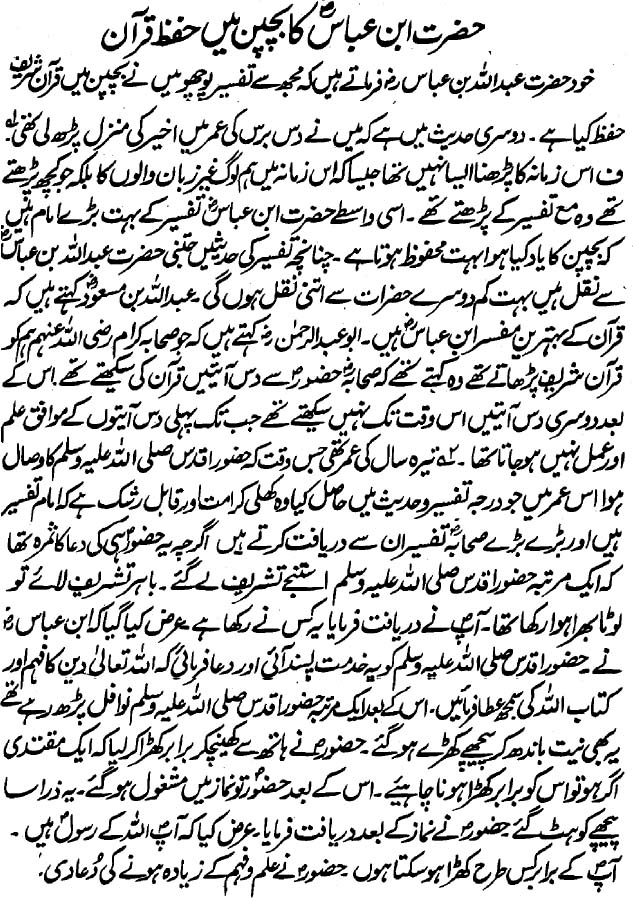
Hazrat Ibn Abbas (radi Allahu anhu) Ka Bachpan Mein Hifz-e-Quran
TAG: Imam
The Great Imam & Faqih of Basra: Abu Sa’eed Hasan al-Basri Alaihir raHmah
Al-Hasan ibn Abi al-Hasan Yasar Abu Sa’eed al-Basri was born at Madina al-Munawwarah in 21 (642), the son of a slave captured in Maisan who afterward became a client of the Prophet Mohammad’s Peace and Blessings of Allah be Upon Him secretary Zaid ibn Thabit. Brought up in Basra, he met many Companions of the Prophet including, it is said, seventy of those who fought at the Battle of Badr. He grew up to become one of the most prominent figures of his generation, being famous for his uncompromising piety and outspoken condemnation of worldliness in high places. While the Mo’tazelite theologians claim him as the founder of their movement (and ‘Amr ibn ‘Obaid and Wasel ibn ‘Ata’ are counted amongst his pupils), in Sufi hagiography he is revered as one of the greatest saints of early Islam.
The Salaf considered him to be one of the Abdaal. Sayyiduna Anas narrated that the Prophet SallAllaho Alaihi wa Sallam said: “The earth will never lack forty men similar to the Friend of the Merciful [Ibrahim Alaihis Salam], and through them people receive rain and are given help. None of them dies except Allah substitutes another in his place.” Qatada said: “We do not doubt that al-Hasan is one of them.” [Narrated by al-Tabarani in al-Awsat]
He died at Basra in 110 (728). Many of his speeches – he was a brilliant orator – and sayings are quoted by Arab authors and not a few of his letters have been preserved.
The conversion of Hasan al-Basri
The beginning of Hasan of Basra’s conversion was as follows. He was a jewel merchant and was called Hasan of the Pearls. He traded with Byzantium and had to do with the generals and ministers of Caesar. On one occasion, going to Byzantium he called on the prime minister and conversed with him for a while.
“We will go to a certain place,” the minister told him, “if you are agreeable.”
“It is for you to say,” Hasan replied. “I agree.”
So the minister commanded a horse to be brought for Sayyiduna Hasan al-Basri. He mounted with the minister, and they set out. When they reached the desert Hasan perceived a tent of Byzantine brocade, fastened with ropes of silk and golden pegs, set firm in the ground. He stood to one side. Then a mighty army, all accoutered in the panoply of war, came out; they circled the tent, said a few words, and departed. Philosophers and scholars to the number of nigh four hundred arrived on the scene; they circled the tent, said a few words, and departed. After that three hundred illumined elders with white beards approached the tent, circled it, said a few words, and departed. Thereafter more than two hundred moon-fair maidens, each bearing a plate of gold and silver and precious stones, circled the tent, said a few words, and departed.
Sayyiduna Hasan relates that astonished and filled with wonder, he asked himself what this might be.
“When we alighted,” he went on, “I asked the minister. He said that Caesar had a son of unsurpassable beauty, perfect in all the branches of learning and unrivaled in the arena of manly prowess. His father loved him with all his heart.”
Suddenly he fell ill so Hasan related on the authority of the minister. All the skilled physicians proved powerless to cure him. Finally, he died and was buried in that tent. Once every year people come out to visit him. First, an immense army circles the tent, and they say: “O prince, if this circumstance that has befallen thee had come about in war, we would have all sacrificed our lives for thee, to ransom thee back. But the circumstance that has befallen thee is at the hand of one against whom we cannot fight, whom we cannot challenge.” This they say, and then return.
The philosophers and the scholars come forward and say: “This circumstance has been brought about by one against whom we cannot do anything by means of learning and philosophy, science and sophistry. For all the philosophers of the world are powerless before him, and all the learned are ignorant beside his knowledge. Otherwise, we would have contrived devices and spoken words which all in creation could not have withstood.” This they say, and then return.
Next, the venerable elders advance, and say: “O prince, if this circumstance that has befallen thee could have been set right by the intercession of elders, we would all have interceded with humble petitions, and would not have abandoned thee there. But this circumstance has been brought upon thee by one against whom no mortal man’s intercession profits anything.” This they say, and depart.
Now the moon-fair maidens with their plates of gold and precious stones advance, circle the tent and say: “Son of Caesar if this circumstance that has befallen thee could have been set right by wealth and beauty, we would have sacrificed ourselves and given great money, and would not have abandoned thee. But this circumstance has been brought upon thee by one on whom wealth and beauty have no effect.” This they say, and return.
Then Caesar himself with his chief minister enters the tent, and says: “O eye and lamp of thy father, O fruit of the heart of thy father, O dearest beloved of thy father, what is in thy father’s hand to perform? Thy father brought a mighty army, he brought philosophers and scholars, intercessors and advisers, beautiful maidens, wealth, and all manner of luxuries; and he came himself. If all this could have been of avail, thy father would have done all that lay in his power. But this circumstance has been brought about by one before whom thy father, with all this apparatus, this army and retinue, this luxury and wealth and treasure, is powerless. Peace be upon you, till next year!” This he says, and returns.
These words of the minister so affected Hasan that he was beside himself. At once he made arrangements to return. Coming to Basra, he took an oath never to laugh again in this world, till his ultimate destiny became clear to him. He flung himself into all manner of devotions and austerities, such that no man in his time could exceed that discipline.
Hasan of Basra and Abu Amr
It is related that Abu Amr, the leading authority on the reading of the Qur’an al-Karim, was teaching the Quran one day when suddenly a handsome boy arrived to join his class. Abu Amr gazed at the child improperly, and immediately he forgot the whole Quran, from the Alif of “al-Hamd” to the Seen of “wa al-Naas”. A fire possessed him, and he lost all self-control. In this state, he called on Hasan of Basra and described to him his predicament.
“Master,” he wept bitterly, “such is the situation. I have forgotten the whole Quran.”
Sayyiduna Hasan was most distressed to hear of his situation. “Now is the season of the pilgrimage,” he said. “Go and perform the pilgrimage. When you have done that, repair to the mosque of Khaif. There you will see an old man seated in the prayer niche. Do not spoil his time, but let him be until he is disengaged. Then ask him to say a prayer for you.”
Abu Amr acted accordingly. Seated in a corner of the mosque, he observed a venerable elder and about him a circle of people seated. Some time passed; then a man entered, clad in spotless white robes. The people made their way before him, greeted him, and conversed together. When the hour of prayer arrived, the man departed and the people departed with him, so that the elder remained alone.
Abu Amr then approached and saluted him. “In Allah’s name, help me,” he cried.
And he described his predicament. The elder, much concerned, raised his eyes to heaven.
“He had not yet lowered his head,” Abu Amr recounted, “when the Quran came back to me. I fell down before him for joy.”
“Who recommended me to you?” the elder asked. “Hasan of Basra,” Abu Amr replied.
“Anyone who has an Imam like Hasan,” the old man commented, “what need has he of another? Well, Hasan has exposed me. Now I will expose him. He rent my veil, and I will rend his as well. That man,” he went on, “in the white robes who entered after the afternoon prayer and left before the rest, and the others did him reverence — that man was Hasan. Every day he prays the afternoon prayer in Basra and then comes here, converses with me, and returns to Basra for the evening prayer. Anyone who has an Imam like Hasan, why should he ask me for a prayer?”
Hasan of Basra and the Fire-worshiper
Hasan had a neighbour named Simeon who was a fire-worshipper. Simeon fell ill and was at death’s door. Friends begged Hasan to visit him; he called, to find him in bed, blackened with fire and smoke.
“Fear Allah,” Hasan counseled him. “You have passed all your life amid fire and smoke. Accept Islam, that Allah may have mercy on you.”
“Three things hold me back from becoming a Muslim,” the fire-worshipper replied. “The first is, that you speak ill of the world, yet night and day you pursue worldly things. Secondly, you say that death is a fact to be faced, yet you do not prepare for death. In the third place, you say that Allah’s manifestation shall be seen, yet today you do everything contrary to His good pleasure.”
“This is the token of those who know truly,” Hasan commented. “Now if believers act as you describe, what have you to say? They acknowledge the unity of Allah; whereas you have spent your life in the worship of fire. You who have worshipped fire for seventy years, and I who have never worshipped fire – we are both carried off to Hell. Hell will consume you and me. Allah will pay no regard to you; but if Allah so wills, the fire will not dare so much as to burn one hair of my body. For fire is a thing created by Allah, and the creature is subject to the Creator’s command. Come now, you who have worshipped fire for seventy years; let us both put our hands into the fire, then you will see with your own eyes the impotence of fire and the omnipotence of Allah.”
So saying, Hasan thrust his hand into the fire and held it there. Not a particle of his body was affected or burnt. When Simeon saw this he was amazed. The dawn of true knowledge began to break.
“For seventy years I have worshipped fire,” he groaned. “Now only a breath or two remains to me. What am I to do?”
“Become a Muslim,” was Hasan’s reply.
“If you give it to me in writing that Allah will not punish me,” said Simeon, “then I will believe. But until I have it in writing, I will not believe.”
Hasan wrote it down.
“Now order just witnesses of Basra to append their testimony.”
The witnesses endorsed the document. Then Simeon wept many tears and proclaimed the faith. He spoke his last testament to Hasan.
“When I die, bid them wash me, then commit me to the earth with your own hands, and place this document in my hand. This document will be my proof.”
Having charged Hasan thus, he spoke the attestation of faith and died. They washed his body, said the prayer over him, and buried him with the document in his hand. That night Hasan went to sleep pondering what he had done.
“How could I help a drowning man, seeing that I am drowning myself? Since I have no control over my fate, why did I venture to prescribe how Allah should act?”
With this thought he fell asleep. He saw Simeon in a dream glowing like a candle; on his head a crown, robed in fine raiment, he was walking with a smile in the garden of Paradise.
“How are you, Simeon?” Hasan inquired.
“Why do you ask? You can see for yourself,” Simeon answered. “Allah Almighty of His bounty brought me nigh His presence and graciously showed me His manifestation. The favors He showered upon me surpass all description. You have honored your guarantee; so take your document. I have no further need of it.”
When Hasan awoke, he saw that parchment in his hand.“Lord Almighty,” he cried, “I know well that what Thou doest is without cause, save of Thy bounty. Who shall suffer loss at Thy door? Thou grantest a Guebre of seventy years to come into Thy near presence because of a single utterance. How then wilt Thou exclude a believer of seventy years?”
Gems of Wisdom by Imam Hasan al-Basri Alaihir raHmah
That work that is free from wisdom becomes a burden. That silence that is free from wisdom is inattentiveness. That sight that is free from wisdom is disgraceful.
The magnificence of knowledge is with tolerance and that of tolerance is with knowledge.
The person who lives in the World safeguarding himself from the love of the World has benefited himself and others.
Sorrow gives the soul strength.
The freedom of sight and tongue imprisons the soul.
Whoever ALLAH SubHanuhu wa Ta’ala wished to disgrace becomes engrossed in the search for wealth.
Those people are truly afraid who are truly afraid of ALLAH SubHanuhu wa Ta’ala.
The punishment of this World is that your heart becomes dead.
There is no greater or bigger animal that is more foul-mouthed ruder and harsher than the Nafs.
Extracted From:
Tadhkirat al-Auliya (Memorial of the Saints)
by Sayyiduna Shaykh Farid al-Din al-‘Attar Alaihir raHmah
Musalman Hukmran Kay Haqooq
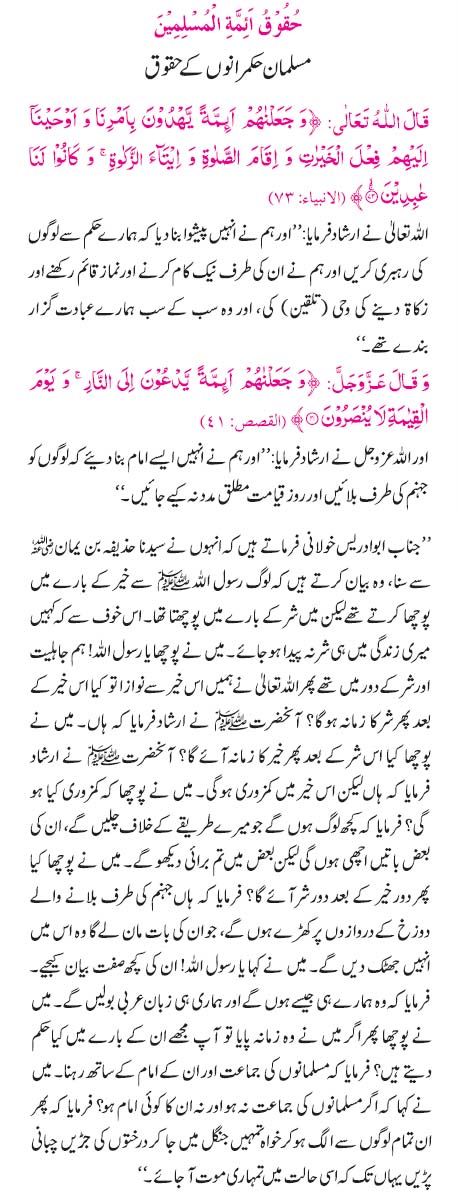
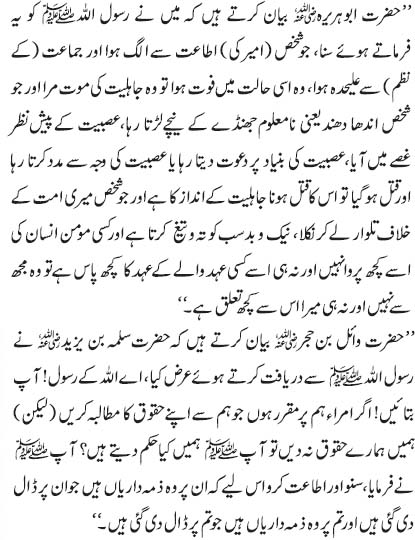
Musalman Hukmran Kay Haqooq
Memoirs From The Life Of Imam Ahmad
In an interesting book, Wada’ Ar-Rasul li ‘Ummatihi, Sheikh Al-Qahtani recalls the final words that Prophet Muhammad (peace be upon him) said on his deathbed.
After living a life of ibadah, da’wah, and jihad, the Prophet (peace be upon him) gathered the people around him on his deathbed and said, “I have left two things and you shall not go astray after them so long as you stick to them: the Book of Allah and my Sunnah.”
After the Prophet (peace be upon him) passed away, the Ummah was tested by people who tried to corrupt, discredit, or amputate the Sunnah from Islam. So, Allah – from His Mercy to this Ummah – raised up warriors that would stand in the face of the most vicious enemies of the Sunnah. Among those people that Allah raised was a young boy named Ahmad.
Ahmad lived in Baghdad over a thousand years ago. On cold winter nights, his mother, the blessed Mu’minah that she was, would awake long before Fajr to warm the water for her son. Then, again long before Fajr, she would wake him up to make Wudhu. Then she would wrap him in shawls and off through the molten dark alleys of Baghdad they would carefully make their way to the masjid.
There was no male to escort him (he was an orphan), so Ahmad’s mother would take him that early all by herself so he could get a good seat in the Hadith Halaqa after Fajr. Then she would wait for him long after the sun rose to safely escort him back home. Her son grew up to be one of these warrior defenders of the Sunnah, one of the four Imams of this religion, Imam Ahmad Bin Hanbal.
In his collection, Al-Musnad alone, he narrated from over 280 teachers. He grew up under the shade of the Sunnah and he lived the Sunnah. It was reported that he said, “I’ve never written a Hadith that I did not try to implement.”
He raised his children like this too. When you see other fathers throwing a baseball with their young Muslim children, remember this example: Abdullah, Imam Ahmad’s son, taught his students that when he was young, his father would play with him by saying, “Take any chapter you wish from the Musannaf of Wakee.’ Ask me any Hadith and I’ll tell you the chain of narrators, or tell me any chain of narrators and I’ll tell you the Hadith!”
He was challenged in his religion like few other humans have been challenged. Reading through his life, I came across an event that brought back sad memories. Imam Ahmad once prayed Asr and he sat down with his son in the masjid alone with another man by the name of Muhammad Bin Sa’eed Al-Khuttalee. Al-Khuttalee then remarked, “Did you (O Ahmad) tell the people to boycott Zayd Bin Khalaf?”
Imam Ahmad replied, “I received a letter from his people asking about his affair, so I replied explaining his madhhab and what he has innovated (in the Sunnah) and commanded that they not sit with him…”
Al-Khuttalee exploded in Imam Ahmad’s face, red with anger, “I’m going to make sure you go back to prison. I’m going to have them crush your ribs…”
The vulgarity grew louder and louder. Imam Ahmad turned to his son, “Don’t reply to what he says, and don’t speak to him.” Imam Ahmad took his sandals – Al-Khuttalee swearing from behind his back – and stepped away.
When Caliph Al-Mu’tasim heard that Imam Ahmad did not agree with him and his court Muftis on a specific (but important) issue, they brought him and questioned him in the courtyard of the Caliph. They would debate with him and like a gladiator with a spear, he would hit back with bigger and stronger arguments. The Muftis would shout, “O Caliph, he has committed Kufr!”
Al-Mu’tasim called the executioners. They stripped Imam Ahmad and each of the strongest guards would take turns lashing Imam Ahmad until he fell unconscious. Regardless of his state, they continued the lashing. The sun went down that day and Imam Ahmad had not relented in his faith. That day he became an icon for all followers of Sunnah.
Qutaybah said, “If you ever see someone who loves Imam Ahmad, know that he is a follower of the Sunnah.”
Al-Hasan Bin Arafah narrated that when he visited Imam Ahmad Bin Hanbal after he was whipped and tortured, the Imam told him, “Verily, I saw nothing more than people selling their religion and I saw scholars that were with me sell their faith. So I said to myself, ‘Who am I? What am I? What am I going to say to Allah tomorrow when I stand in front of Him and He asks me if I sold my religion like the others did?’ So I looked at the whip and the sword and chose them.”
Al-Hasan then asked, “Did you feel pain when they whipped you?”
He replied, “Yes, I felt the pain up to 20 lashes then I lost all feeling (they whipped him over 80 times). After it was over I felt no pain and that day I prayed Dhur standing.”
And in fact, he prayed as the blood soiled his clothes.
Al-Hasan ibn Arafah started weeping when he heard what had happened. Imam Ahmad questioned him, “Why are you crying? I did not lose my Iman. After that why should I care if I lose my life.”
Earlier when Imam Ahmad was being led off to the Caliph, people had tried to dissuade him from an almost certain execution. His student, Al-Marrudhi, had told him, “O teacher, Allah says, ‘Do not kill yourselves.’”
Imam Ahmad replied, “O Marrudhi, go outside and tell me what you see.”
Al-Marrudhi went to the wall of the Caliph’s court and saw an ocean of students with their pens and scrolls in their hands. He asked some of them, “What are you waiting here for?”
They said, “We are waiting to see what Ahmad will say and then transcribe it.”
Al-Marrudhi went back to Imam Ahmad and told him what he had seen. “O Marrudhi,” he said, “what shall I gain by misguiding all those people?”
Imam Ahmad lived a life of poverty. He would not even have food to eat. In this life of poverty, hardship, and trials, Abdullah asked his father one day, “My father, when will we ever have a respite?”
His father – one of the greatest revivers of the Sunnah, a role model for all Muslims, whose contribution continues to benefit students a thousand years on – looked him in the eye and said, “With the first step we take into Jannah.”
Heroes Of Islam: Imam Shafi’i
Muhammad ibn Idris ibn al-‘Abbas, al-Imam al-Shafi’i, Abu ‘Abd Allah al-Shafi’i al-Hijazi al-Qurashi al-Hashimi al-Muttalibi (d. 204), the offspring of the House of the Prophet (PBUH- peace be upon him), the peerless one of the great mujtahid imams and jurisprudent, the scrupulously pious ascetic and Friend of Allah, he laid down the foundations of fiqh (Islamic Law) in his Risala, which he said he revised and re-read four hundred times, then said: “Only Allah’s Book is perfect and free from error.”
He is the cousin of the Prophet (PBUH) descending from al-Muttalib who is the brother of Hashim, ‘Abd al-Muttalib’s father. Someone praised the Banu Hashim in front of the Prophet (PBUH), whereby he interlaced the fingers of his two hands and said: “We and they are but one and the same thing.”
Al-Nawawi (may Allah be pleased with him) listed some special merits of al-Shafi’i:
1, his sharing the Prophet’s (PBUH) lineage at the level of their common ancestor ‘Abd Manaf;
2, his birth in the Holy Land of Palestine and
3, upbringing in Mecca;
5, and his education at the hands of superlative scholars together with his own intelligence and knowledge of the Arabic language. To this Ibn Hajar (may Allah be pleased with him) added: the hadith (the sayings/doings) of the Prophet (scholars ), “O Allah! Guide Quraysh, for the science of the scholar that comes from them, will encompass the earth. O Allah! You have let the first of them taste bitterness, so let the latter of them taste reward.” Another hadith of the Prophet (scholars ) says: “Truly, Allah shall send forth for this Community, at the onset of every hundred years, someone who will renew their Religion for them.” The scholars agreed, among them Abu Qilaba (d. 276) and Imam Ahmad, that the first narration signified al-Shafi’i, and the second signified ‘Umar ibn ‘Abd al-‘Aziz and then al-Shafi’i.
Imam Shafi’i was born in Ghazza or ‘Asqalan in 150, the year of Abu Hanifa’s (may Allah be pleased with him) death, and moved to Mecca at the age of two, following his father’s death, where he grew up. He was early a skillful archer, then he took to learning language and poetry until he gave himself to fiqh, beginning with hadith. He memorized the Quran at age seven, then Imam Malik’s Muwatta at age ten, at which time his teacher would deputize him to teach in his absence. At age thirteen he went to see Malik, who was impressed by his memory and intelligence.
Malik ibn Anas and Muhammad ibn al-Hasan al-Shaybani were among his most prominent teachers and he took position against both of them in fiqh. Al-Shafi’i said: “From Muhammad ibn al-Hasan I wrote a camel-load.” Al-Hakim narrated from ‘Abd Allah ibn ‘Abd al-Hakam: “Al-Shafi’i never ceased to speak according to Malik’s position and he would say: ‘We do not differ from him other than in the way of his companions,’ until some young men spoke unbecomingly at length behind his back, whereupon al-Shafi’i resolved to put his differences with Malik in writing. Otherwise, his whole life he would say, whenever asked something: ‘This is what the Teacher said’ – h’dha qawl al-ustadh – meaning Malik.”
Al-Muzani said: “I never saw one more handsome of face than al-Shafi’i. If he grasped his beard it would not exceed his fist.” Ibn Rahuyah described him in Mecca as wearing bright white clothes with an intensely black beard. Al-Za’farani said that when he was in Baghdad in the year 195 he dyed his beard with henna.
Abu ‘Ubayd al-Qasim ibn Sallam said: “If the intelligence of an entire nation was brought together he would have encompassed it.” Similarly, al-Muzani said: “I have been looking into al-Shafi’i’s Risala for fifty years, and I do not recall a single time I looked at it without learning some new benefit.”
Al-Sakhawi in the introduction to his al-Jawahir wa al-Durar and others narrates that someone criticized Ahmad ibn Hanbal (may Allah be pleased with him) for attending the fiqh sessions of al-Shafi’i and leaving the hadith sessions of Sufyan ibn ‘Uyayna. Ahmad replied: “Keep quiet! If you miss a hadith with a shorter chain you can find it elsewhere with a longer chain and it will not harm you. But if you do not have the reasoning of this man [al-Shafi’i], I fear you will never be able to find it elsewhere.” Ahmad is also related by his students Abu Talib and Humayd ibn Zanjuyah to say: “I never saw anyone adhere more to hadith than al-Shafi’i. No one preceded him in writing down the hadith in a book.” The meaning of this is that al-Shafi’i possessed the understanding of hadith after which Ahmad sought, as evidenced by the latter’s statement: “How rare is fiqh among the scholars of hadith!” This is a reference to the hadith: “It may be one carries understanding (fiqh) without being a person of understanding (faq’h).” Sufyan himself would defer to al-Shafi’i in matters of tafsir (commentary of the Quran) and fatwa (Islamic verdicts). Yunus ibn Abi Ya’la said: “Whenever al-Shafi’i went into tafsir, it was as if he had witnessed the revelation.” Ahmad ibn Hanbal also said: “Not one of the scholars of hadith touched an inkwell nor a pen except he owed a huge debt to al-Shafi’i.”
Al-Shafi’i was known for his peculiar strength in Arabic language, poetry, and philology. Bayhaqi narrated:
[From Ibn Hisham:] I was al-Shafi’i’s sitting companion for a long time, and I never heard him use except a word which, carefully considered, one would not find (in its context) a better word in the entire Arabic language. . . . Al-Shafi’i’s discourse, in relation to language, is a proof in itself.
[From al-Hasan ibn Muhammad al-Za’farani:] A group of bedouins used to frequent al-Shafi’i’s gathering with us and sit in a corner. One day I asked their leader: “You are not interested in scholarship; why do you keep coming to sit with us?” They said: “We come to hear al-Shafi’i’s language.”
In the introduction of his compendium of Shafi’i fiqh entitled al-Majmu’ al-Nawawi mentions that al-Shafi’i used a walking stick for which he was asked: “Why do you carry a stick when you are neither old nor ailing?” He replied: “To remember I am only a traveler in this world.”
Bad-Mazhab Aur Fasiq Kay Peechay Namaz Kay Ahkam

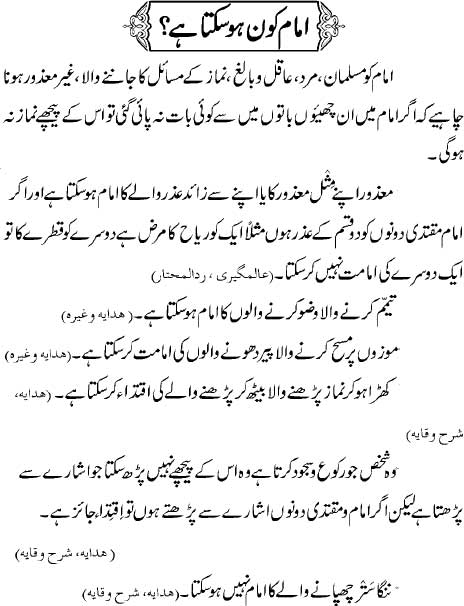
Imam Kon Ho Sakta Hai?
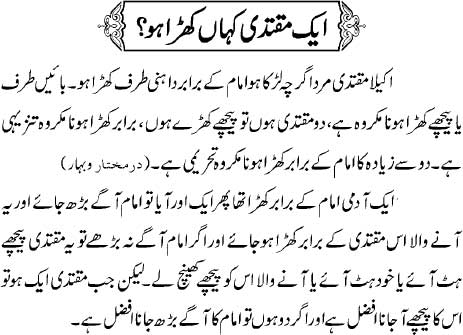
Namaz Mein Muqtadi Kahan Khara Ho?
Racing The Imam In Prayer
Congregational prayer is one of the most important aspects of Islamic worship. It helps to bring people in the same locality together so that they would know each other and establish friendly and close relations. Moreover, their frequent meetings at prayer times give them a chance to learn more of one another’s work and what they can provide. Thus, they will seek to get what they need from within their own neighborhood. Furthermore, congregational prayer instills discipline within the community. When people take instructions from the imam during worship, which is a bond between each individual and God, they learn the value of discipline in their lives.
Stressing the importance of discipline in prayer, the Prophet (peace be upon him) says, as quoted by Abu Hurayrah: “When a person lifts his head before the imam, does he not fear that God will make his head like that of a donkey, or that He will make him look like a donkey?” (Related by al-Bukhari).
This is the strongest form used by the Prophet to emphasize the importance of following the imam in all actions, and not to go ahead of him. The Prophet said: “I am your imam. Therefore, do not go before me in bowing, prostration or standing up.” He also said: “An imam is appointed so that he is followed.” However, people are often impatient. When the Prophet noticed that his admonition in this respect has not given its desired results, he stated the hadith we are discussing, warning of a stern punishment on the Day of Judgement. Thus, a person who races the imam in prayer runs the risk of having a changed shape marking him out among all people. We should emphasize here that this is merely a warning, and it does not follow that everyone who does not abide by the order to follow the imam will be changed in form. Such a person, however, exposes himself to this risk.
A question arises here about the validity of the prayer when a person moves ahead of the imam in congregational prayer. Scholars have expressed different views, going into considerable detail. They agree that it is forbidden to precede the imam in any action. Everyone in the congregation is required to follow the imam, not to precede him. It is indeed reprehensible to do any movement or say any words of the prayer at the same time as the imam, except for the first takbeer, which signals the beginning of the prayer.
What worshippers in the congregation are required to do is to follow the imam. When he signals a move, they make it shortly after he has signaled it, and before he has gone to the next move. If a person delays moving until the imam has completed the next action and went into the following one, then that person’s prayer is invalid. To explain: We stand to read the Quran, then bow, then stand up again, then go into prostration. If the imam bows and stands up while someone in the congregation remains standing because he wants to finish his recitation, then that person’s prayer is invalid. If he bows when the imam is still bowing, his prayer remains valid but his action is not correct. He should follow the imam.
A violation of this instruction that is often done by worshippers occurs in the last prostration. The imam signals moving to the last sitting for tashahhud. Yet we see people remaining in prostration for a whole minute or longer. This is absolutely wrong and they run the risk of making their prayer invalid.
– by Adil Salahi
An Exalted Example Of Character
The uniqueness of the Prophet Muhammad (peace be upon him) is that he was not only a great person in his own time, but he is great for all times, for all people of any race, color, nationality or geographical location. His example was good for the 7th century Arabs and it is good also for the humanity living now at the beginning of this 21st century. He is an excellent example for the rich and poor, for young and old, for rulers and ruled, for the most intelligent as well as the most common people. Allah sent him as His Prophet for all humanity.
Allah says in the Quran: Say (O Muhammad, peace be upon him) O mankind! Verily, I am sent to you all as the Messenger of Allah – to Whom belongs the dominion of the heavens and the earth. La ilaha illa Huwa (none has the right to be worshiped but He). It is He Who gives life and causes death. So believe in Allah and His Messenger (Muhammad, peace be upon him), the Prophet who can neither read nor write ( i.e. Muhammad, peace be upon him) who believes in Allah and His Words[(this Quran), the Taurat (Torah) and the Injil (Gospel) and also Allah’s Word: Be! and he was, i.e. Isa (Jesus) son of Maryam (Mary), peace be upon him], and follow him so that you may be guided. (Al-A raf 7: 158)
Prophet Muhammad (peace be upon him) practiced what he preached. He very carefully and meticulously followed the Quran, Allah s Word that was revealed to him. He followed and lived the Quran at every moment in every detail of his life. His life was the reflection of Allah s Words. He became the Quran in person, the embodiment of the Quran, or one may even say in a metaphorical sense the Word in flesh. It is reported in a Hadith: Sad ibn Hisham said that he askedAishah, Prophet’s wife (Allah be pleased with her) Tell me about the character of the Prophet (peace be upon him). She said, His character was the Quran. (Musnad Ahmad, Hadith No. 24139)
Some of His attributes
The morality of the Prophet (peace be upon him) was not restricted to just a few moral attributes but included diverse traits and aspects of life. He was kind, compassionate, caring, generous, and humble, but he was also strong, brave, eloquent, wise and insightful. He was a great planner, organizer, and thinker, yet he was also a man of faith, trust and devotion to Allah. He was involved and active with his family and community but he did not neglect his prayers, fasting and devotion to Allah. Actually, he prayed so much that no one prayed like him. He was exemplary as a teacher, preacher, Imam, leader, statesman, judge, and commander of the armies as well as a husband, father, grandfather, businessman, neighbor, and friend.
Before he received the honor of nubuwwah (Prophethood), he was known among the people of Makkah as As-Sadiq Al-Amin, the most honest and trustworthy person. He kept this character throughout his life. He never broke a pledge or promise. Even his enemies could not accuse him of being dishonest.
He was a most humble person. He used to mingle with the poor and sit with them. He stopped people from standing up for him. He used to sit wherever there was a place available in an assembly and never sought a prominent or elevated place. The newcomers sometimes would not know who was the Prophet among the people. When he entered the city of Makkah as a conqueror leading a big army, he entered in a most humble manner. In a unique demonstration of humility, his forehead was touching the saddle of his camel!
A mercy to mankind
He was the most merciful person. Allah called him (a mercy to the Alamin (mankind, jinn, and all that exists ) – Al-Anbiya 21: 107. He was merciful to his family, followers, friends, and even enemies. He was merciful to young and old, to humans and to animals. Those who persecuted him in Makkah and killed his relatives and his followers, when they were defeated in the battles and brought as captives, were forgiven by him. He did not ever take revenge or retaliated. He was the most forgiving person.
Constancy was a very important aspect of his moral behavior. Once he established some good way or practice he used to follow it and adhere to it always. He used to say: The dearest deed to Allah is the one that is performed regularly, even if it was a little. (Al-Bukhari, No. 5983)
His names:
The Prophet (peace be upon him) has many names reflecting his attributes and qualities. Some of the most beautiful names of the Prophet (peace be upon him) mentioned in both the Quran and Hadith are the following:
Muhammad (the praised one), Ahmad (most praiseworthy), Hamid (the giver of praise and thanks), Ar-Rasul (the Messenger), An-Nabi (the Prophet), Shahid (the witness), Rashid (the righteous), Bashir (the giver of good news), Nadhir (the warner), Da’i (the caller to Allah), Hadi (the guide), Mahi (the remover of evil), Fatih (the conqueror), Ra’uf (the compassionate), Rahim (the merciful), Mujtaba (the chosen one), Mustafa (the selected one), Murtada (the well-pleasing in the sight of Allah), As-Sadiq (the truthful), Al-Amin (the trustworthy), Musaddiq (the confirmer of truth), Habibullah (Allah s beloved one), Safiullah (the one selected by Allah), Najiullah (the one protected by Allah), Shakur (the most grateful one), Karim (the noble one), Hakim (the wise one), Sayyid (the leader), Siraj Munir (the shining lamp), Jawwad (the generous one), `Adil (the Just), and Khatam Ar-Rusul (the final Messenger). May peace and blessings of Allah be upon him!