
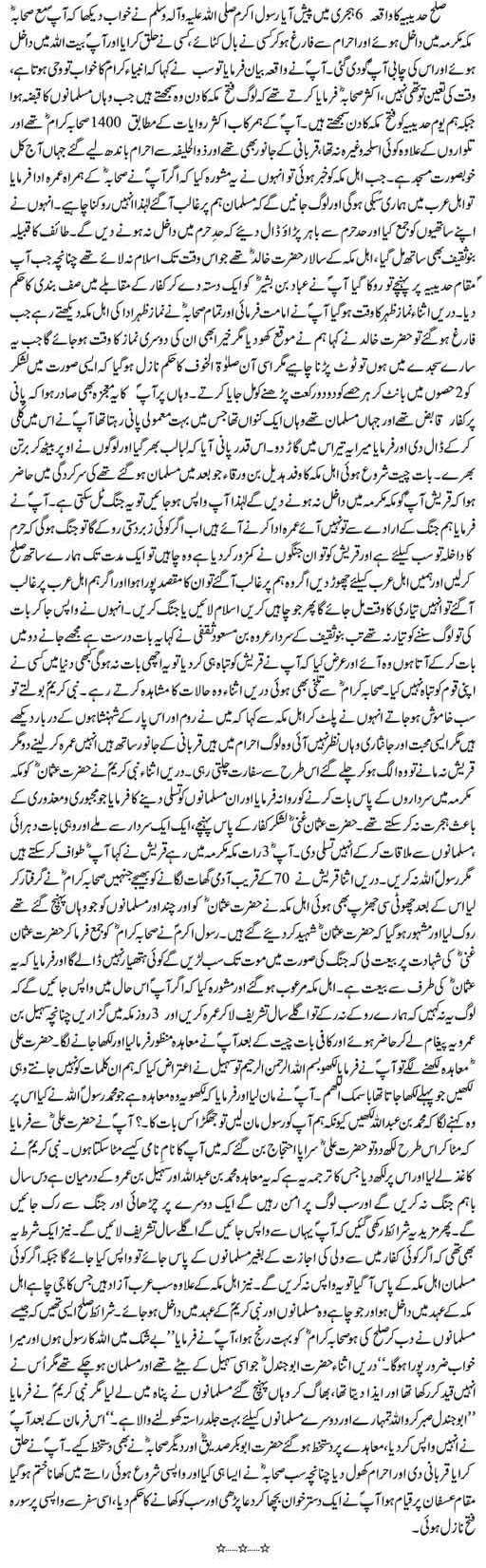
Sulah Hudaibiya
TAG: Makkah
Musab Bin Umayr: The First Ambassador Of Islam
MUSAB was born into a wealthy family headed by a mother whose strength of personality and dominating character were well-known in Makkah. Musab was given everything a young person could dream of. He wore the most fashionable clothes and shoes, mixed with the most popular and notable people in his area, and was greatly admired by all. Added to this was his natural personality: he was a good communicator; he had a bright intelligent mind; he was quick and alert and so was allowed to attend the most prestigious meetings with intelligent, elderly, and noble people. Musab had everything a young person of his time could ever dream of. So what could ever make him consider giving it all up?
Musab had grown up without fear of anything or anyone. He was sure of himself, kind, confident, and clever but nevertheless, he was just a human being. The one thing that Musab feared was his own mother. She was a strong and fierce woman and was well-known as such. After considering his situation for some time Musab decided to keep his acceptance of Islam a secret for a while until the best way showed itself. In the meantime, he continued to visit the house of Al-Arqam where he received knowledge about Islam and learned the Qur’an.
Makkah was full of spies and informants and so it wasn’t long before Musab’s comings and goings were noted and reported. His mother wanted to beat him and degrade him to compensate herself for the sorrow and humiliation she felt. But then she thought of something better and perhaps more lasting. She ordered her servants to take her son and bind him tightly; keeping him a prisoner in his own home.
As usual, Musab remained calm but sought the first opportunity to escape. Allah the Almighty opened the way for him and he left with a group of Muslims who were heading for Abyssinia seeking safety there from the persecution of the Makkans. So Musab left his mother, his home, his wealth, and the city of his childhood and headed off to the unknown. His sure and strong faith in Allah made him strong, determined, and peaceful.
Forgiving Nature of The Prophet
One of the great qualities of Prophet Muhammad (peace be upon him) was that he never took revenge on anyone for personal reasons and always forgave even his firm enemies. His wife `Aishah reported that Allah s Messenger was not unseemly or obscene in his speech, nor was he loud-voiced in the streets, nor did he return evil for evil, but he would forgive and pardon. The people of the Quraysh rebuked him, taunted and mocked him, beat him, and abused him. They tried to kill him and when he left for Madinah, they waged many wars against him. Yet when he entered Makkah victorious with an army of 10,000, he did not take revenge on anyone. He forgave all. Even his deadliest enemy, Abu Sufyan, who had fought so many battles against him, was forgiven, as was anyone who stayed in his house.
Prophet Muhammad (peace be upon him) also pardoned the leaders of Ta’if, who had engaged ruffians to pelt him with stones when he visited that town to invite them to Islam.
Abdullah Ibn Ubayy, the leader of the hypocrites of Madinah, worked all his life against Prophet Muhammad (peace be upon him) and Islam and left no stone unturned in trying to defeat his mission. He withdrew his 300 supporters in the Battle of Uhud, which almost broke the backbone of the Muslims. He engaged in intrigues and acts of hostility against the Prophet of Islam and the Muslims.
An Abyssinian slave who had killed Prophet Muhammad s (peace be upon him) beloved uncle Hamzah in the Battle of Uhud was also forgiven when he embraced Islam after the Conquest of Makkah. The wife of Abu Sufyan, who had cut open Hamzah’s chest and torn his liver and heart into pieces in the Battle of Uhud, quietly came to the Prophet (peace be upon him) and accepted Islam. He recognized her but did not say anything. She was so impressed by his magnanimity and stature that she said, O Allah s Messenger, no tent was more deserted in my eyes than yours; but today no tent is dearer in my eyes than yours.
Habar Ibn Al-Aswad was another vicious enemy of Prophet Muhammad (peace be upon him) and of Islam. He had inflicted a grievous injury on Zaynab, daughter of the Prophet (peace be upon him). She was pregnant when she emigrated from Makkah to Madinah. The polytheists of Makkah obstructed her and Habar Ibn Al-Aswad intentionally threw her down from the camel. She was badly hurt and miscarried as a result. Habar committed many other crimes as well. He wanted to run away to Persia but then he came to Prophet Muhammad (peace be upon him), who forgave him.
Prophet Muhammad (peace be upon him) was all for forgiveness and no amount of crime or aggression against him was too great to be forgiven by him. He was a complete example of forgiveness and kindness.
He always repelled evil with good, for, in his view, an antidote was better than poison. He believed and practiced the precept that love could foil hatred and aggression could be won over by forgiveness. He overcame the ignorance of the people with the knowledge of Islam, and the folly and evil of the people with his kind and forgiving treatment.
With his forgiveness, he freed people from the bondage of sin and crime and also made them great friends of Islam. He was an exact image of the following verse of the Qur’an: The good deed and the evil deed cannot be equal. Repel (the evil) with what is better (i.e. Allah orders the faithful believers to be patient in the time of anger, and to excuse those who treat them badly) then verily he, between whom and you there was enmity, (will become) as though he was a close friend (Fussilat 41:34).
Serving The Interests Of The Community
Among all the wives of the Prophet (peace be upon him), Umm Salamah (radiAllahu anha) was perhaps the one who was most sensitive to the interests of the community. She shared the hopes and difficulties of her fellow Muslims at both the individual and the community levels. We saw how she expressed their feelings to the Prophet when the Muslims were told that they could not go to Makkah for their worship rituals and had to return home. Her advice to the Prophet on that day took away all the strain and ensured their compliance with his orders.
After the Tabuk expedition, a few Muslims who did not join the Muslim army tied themselves up in the mosque, as a sign of repentance. They were untied when it was time for prayer, and then they tied themselves up again when the obligatory prayer had finished. They were uncertain about what judgment was to be made in their cases. Their self-imposed restraint was a gesture of their repentance. One of them was Abu Lubabah (Radi Allahu Anhu).
As the Prophet was at Umm Salamah’s home one night, just before the dawn prayer, he received revelations that included the Verse that says: “There are others who have acknowledged their sins, after having mixed righteous deeds with evil ones. It may well be that God will accept their repentance. God is Much-Forgiving, Ever-Merciful.” (9: 102)
The Prophet smiled and Umm Salamah (radiAllahu anha) asked him why he smiled. He said: “God has accepted Abu Lubabah’s repentance.” She asked him: “May I be the one who gives him the good news?”
She opened her door and looked inside the mosque. She said: “Abu Lubabah! Rejoice, for God has accepted your repentance.” Some people rushed to release him, but he refused, saying that he would beg them not to do so, for he wanted the Prophet to release him. We see how she was so pleased for someone who was totally unrelated to her. She shared his joy at the happy news.
Many years later, when the Muslim community went through the very difficult days that saw the assassination of the third Caliph, Uthman (Radi Allahu Anhu), and a serious split in the community, another wife of the Prophet, Ayesha (radiAllahu anha), was about to leave Madinah, marching at the head of an army that sought to gather support for their stand.
Umm Salamah objected to this attitude. She went to Ayesha (radiAllahu anha) and counseled her against going. She said it was wrong for a widow of the Prophet to embark on such a course of action.
As for her own position in those days, she was totally supportive of Ali (Radi Allahu Anhu), the fourth Caliph. She went to him and said: “I would have joined your army, but I know that such an action would be in disobedience of God’s orders and I believe you would not accept it from me. However, this is my son, Omar. He is dearer to me than my own life. He will join you and will fight for your cause.”
Her position then was characteristic of the great insight that enabled her to gauge what best served the interests of the Muslim community.
Umm Salamah (radiAllahu anha) lived long after the Prophet. In fact, she was the last of the Prophet’s wives to die. Her death took place in the year 61, and she was buried at Al-Baqee, the burial place of many of the Prophet’s companions in Madinah.
By: Adil Salahi
Hajj A Model For Life
The blessed days of Hajj are approaching, and Muslim pilgrims are traveling to the holy sites. The memories and spirituality of Hajj are really moving. Pilgrims cannot help but have tears in their eyes while observing this magnificent gathering that is heading to the House of Allah in total submission and devotion. The pilgrims supplicate humbly, asking Allah to wipe off their sins, accept their Hajj, and grant them happiness in this world and the hereafter.
But should all of these awe-inspiring feelings be restricted to a few days of Hajj? I always think of Hajj as a journey intended to guide us on how to lead our larger journey of life. It is the model after which Muslims should pattern their lives. This connection between Hajj and life is very important; after all, both of them are journeys that need special preparation and should have special goals.
Take, for example, the first steps pilgrims take in preparation for their Hajj journey. They pay off their debts and bathe themselves. The lesson here is that our lives should be based on purity and cleanliness. How beautiful life would be if each and every one of us tried to adhere to this principle? If only everyone tried to steer clear of anything that may taint their beliefs or blemish their relations with Allah. Of course, it may happen that Muslims commit a sin or succumb to Satan’s whispers, but once such a thing occurs, they hasten to “clean” and “wash” their spirits. Just as they wear pure and clean clothes for their Hajj journeys, they are keen to meet Allah after the journey of life with a pure and clean heart.
“Labbayk, Allahumma, labbayk. Here I am, O Allah, at Your service.” This eternal call, chanted by millions of pilgrims every year, gives us further inspiration. The pilgrims respond to Allah’s call with pleasure, paying no heed to the trouble they may undergo; they come to Him declaring in words and in deeds their submission to His commands, their unconditional obedience to His orders, their love of what He loves, and paying their honor to what He honors. This is the spirit that Muslims should keep throughout their entire lives. Labbayk, Allahumma, labbayk. This is not merely a ritual phrase to be uttered in Hajj and then forgotten afterward, rather, it is a motto for every Muslim, a way of life.
After hours, even longer days, and months of travel, pilgrims reach Makkah and cool their eyes with the sight of the holy sites. Throughout their observances of Hajj, in their movements from place to place, and from rite to rite, Muslims recall great scenes of sacrifice by their great forbears, such as Prophet Ibrahim (peace be upon him) and his family, Prophet Muhammad (peace be upon him) and his noble companions. These glorious scenes inspire us and motivate us to face the challenges of life with a bold heart as well as to rise up to our responsibility of working and sacrificing in defense of our religion and for the advancement of our Ummah.
Journey Of A Lifetime
Hajj is performed from the 8-13 of Dhul-Hijjah. The Manasik (rites) of Haj At-Tamattu’ is described below and has been summarized on the right. Early on the morning of 8th Dhul Hijjah, the Day of Tarwiyah, the pilgrim assumes Ihram for Hajj as he did for Umrah, but says “Labbayk Allahumma Hajjan” and begins reciting the Talbiyyah. All the rules of Ihram which applied to Umrah also hold for Hajj. He then proceeds to Mina where he spends the day in worship and performs Dhuhr, Asr, Maghrib, and Isha shortened but not joined. He spends the night there.
After Fajr on 9th Dhul Hijjah, the Day of Arafah, he leaves for `Arafah. At the time of Dhuhr, he prays Dhuhr and `Asr shortened and combined with one Adhan and two Iqamah. He remains there until Maghrib, standing with hands raised in supplication anywhere within the boundaries of Arafah.
After sunset, he proceeds to Muzdalifah where he performs Maghrib and Isha shortened and combined with one Adhan and two Iqamah. He then goes to sleep until Fajr. After performing Fajr at its earliest time on the 10th Dhul Hijjah, the Day of Sacrifice, he leaves Muzdalifah before sunrise and returns to Mina. He continues reciting the Talbiyah.
He collects seven pebbles and does a stoning of the Big Jamarah sometime between sunrise and night, standing with Makkah to his left and Mina to his right. He says “Allahu Akbar” with each stone throw. The slaughter must be done and then he may partially come out of the state of Ihram by shaving the head or cutting the hair for men and trimming the hair for women.
Perform Tawaf Al-Ifadah walking normally, then do Sa`ee. One is now completely out of Ihram. On the 11th-13th Dhul Hijjah, the Days of Tashreeq, one stays in Mina and performs stoning of the three Jamarat each day between Zawal (the sun is at its peak) and night – 21 pebbles must be collected for this. The smallest Jamarah is stoned first, then the medium, then the big one. After stoning at the first two, one may face the Qiblah and supplicate to Allah. On the 13th after stoning the Jamarat one leaves Mina.
One must perform the Farewell Tawaf prior to leaving Makkah. This completes the Manasik of Hajj. May Allah grant all pilgrims Hajj Mabroor (an accepted Haj, the reward of which is nothing but Jannah).
5 Things About Battle Of Badr
The Battle of Badr took place on the seventeenth of Ramadan, two years after Prophet Muhammad’s (peace be upon him) Hijrah (emigration) to Madina. Here’s more information about the battle, which was the first armed conflict that the Muslims were ever engaged in.
- The Muslims went out of Madina to investigate a caravan that was returning to Makkah from Syria, not intending to engage in battle. The caravan escaped, but its leader Abu Sufyan managed to send word to Makkah, asking for forces to come and protect the caravan.
- The Makkan tribes marched with an enormous army of 1,000 men, 100 horses, 700 camels, and luxurious provisions to last for several days, while the Muslims numbered 313 ill-equipped men on 70 camels and a few horses.
- Led by the Prophet (PBUH), the Muslims marched forward and at the suggestion of a companion, Hubab Bin Mundhir, encamped south on the nearest water well, restricting the Makkans’ access to water.
- The Battle of Badr is one of the few battles explicitly mentioned in the Qur’an: “And Allah has already made you victorious at Badr when you were a weak little force. So fear Allah much that you may be grateful.” Qur’an: 3:123
- Many important Makkan leaders were killed or taken prisoner in this battle, the most noteworthy of whom was Abu Jahl, the archenemy of Islam. The Battle of Badr strengthened the Muslims’ status in Arabia as a strong force and consolidated the Muslims’ faith.
Five Pillars Of Islam
What Are the Five Pillars of Islam?
1) The Testimony of Faith
2) Prayer
3) Giving Zakat (Support of the Needy)
4) Fasting during the Month of Ramadan
5) The Pilgrimage to Makkah
The Five Pillars of Islam are the framework of Muslim life. They are the testimony of faith, prayer, giving zakat (support of the needy), fasting during the month of Ramadan, and the pilgrimage to Makkah once in a lifetime for those who are able.
1) The Testimony of Faith:
The testimony of faith is saying with conviction, “La ilaha illa Allah, Muhammadur rasoolu Allah.” This saying means “There is no true god (deity) but ALLAH, and Muhammad is the Messenger (Prophet) of ALLAH.” The first part, “There is no true god but ALLAH,” means that none has the right to be worshiped but ALLAH alone and that ALLAH has neither partner nor son. This testimony of faith is called the Shahada, a simple formula that should be said with conviction in order to convert to Islam. The testimony of faith is the most important pillar of Islam.
2) Prayer:
Muslims perform five prayers a day. Each prayer does not take more than a few minutes to perform. Prayer in Islam is a direct link between the worshiper and ALLAH. There are no intermediaries between ALLAH and the worshiper.
In prayer, a person feels inner happiness, peace, and comfort, and that ALLAH is pleased with him or her. The Prophet Muhammad (S.A.W.W) said: {Bilal, call (the people) to prayer, let us be comforted by it.} Bilal was one of Muhammad’s (S.A.W.W) companions who was charged to call the people to prayers.
Prayers are performed at dawn, noon, mid-afternoon, sunset, and night. A Muslim may pray almost anywhere, such as in fields, offices, factories, or universities.
3) Giving Zakat (Support of the Needy):
All things belong to ALLAH, and wealth is therefore held by human beings in trust. The original meaning of the word zakat is both ‘purification’ and ‘growth.’ Giving zakat means ‘giving a specified percentage on certain properties to certain classes of needy people.’ The percentage which is due on gold, silver, and cash funds that have reached the amount of about 85 grams of gold and held in possession for one lunar year is two and a half percent. Our possessions are purified by setting aside a small portion for those in need, and, like the pruning of plants, this cutting back balances and encourages new growth.
A person may also give as much as he or she pleases as voluntary alms or charity.
4) Fasting the Month of Ramadan:
Every year in the month of Ramadan, all Muslims fast from dawn until sundown, abstaining from food, drink, and sexual relations.
Although the fast is beneficial to health, it is regarded principally as a method of spiritual self-purification. By cutting oneself off from worldly comforts, even for a short time, a fasting person gains true sympathy with those who go hungry, as well as growth in his or her spiritual life.
5) The Pilgrimage to Makkah:
The annual pilgrimage (Hajj) to Makkah is an obligation once in a lifetime for those who are physically and financially able to perform it. About two million people go to Makkah each year from every corner of the globe. Although Makkah is always filled with visitors, the annual Hajj is performed in the twelfth month of the Islamic calendar. Male pilgrims wear special simple clothes which strip away distinctions of class and culture so that all stand equal before ALLAH.
Pilgrims praying at the Haram mosque in Makkah
Pilgrims praying at the Haram mosque in Makkah. In this mosque is the Kaaba (the black building in the picture) which Muslims turn toward when praying. The Kaaba is the place of worship that ALLAH commanded the Prophets Abraham and his son, Ishmael, to build.
Hajj
