
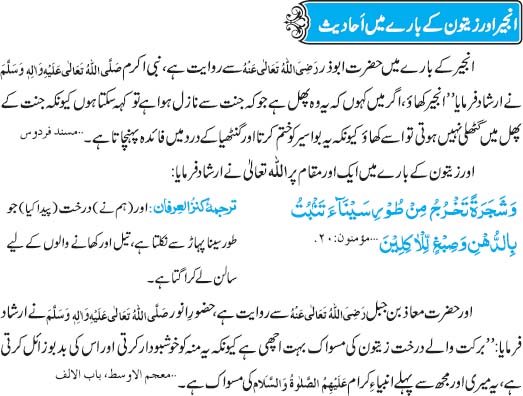
Anjeer Aur Zaitoon Kay Barey Mein Hadith
TAG: Miswak
Miswak Has Medicinal Properties That Toothpaste Lacks
A study has revealed that the ‘Miswak’ – or teeth cleaning sticks commonly used in Arab and Asian countries have greater value than toothbrushes and toothpaste.
A group of dentists at King Saud University (KSU) has done a study revealing the medicinal properties of ‘Miswak’, while ‘Miswak sales go up considerably in Ramadan. The study suggests that the beneficial effects for oral hygiene and dental health for those using ‘Miswak’ are equal to, if not greater, those of a toothbrush and toothpaste.
“Miswak has many medicinal properties and can fight plaque, the recession of gums, tooth wear, bleeding gums, and periodontal pocket depths,” said the study, adding that the repeated process of using them releases fresh sap and silica (a hard glossy mineral), which acts as an abrasive material for the removal stains.
The study was conducted by a group of dentists led by Dr. Khaled Almas. The study explains that the Miswak also releases a substance that soothes toothache. “It is also used to prevent smoking in adults and thumb sucking in children. It may also improve appetite and regulate peristaltic movements of the gastrointestinal tract,” said the study.
This is about the growing sales of Miswak, especially during Ramadan. Mubarak Al-Oraizi, a Miswak seller in Riyadh, said: “Miswak sales have gone up in Ramadan, especially in Makkah and Madinah by nearly 300 percent.”
Arif Aleem, a Bangladeshi salesman, who sits in front of a Riyadh Masjid, said: “This is our season, and we do brisk business in Ramadan every year. For me, it is fun sitting near the Masjid, praying and talking to people, watching people coming and going, and at the same time making money.”
“And We send down from the Qur’an that which is a healing and a mercy to those who believe…” [‘Quran’ Surat Al-Isra’ 17:82].
Miswak Ki Sunnatien

Miswak Ki Sunnatien
Hadiths: Health And Hygiene
Health and cleanliness and hygiene occupy a great part of Islam’s attention incomparable to any other religion. While some nations adopted such beliefs as abandoning self-care and cleanliness to attain high spiritual ranks, Islam made it obligatory to clean oneself properly in preparation for daily prayers.
In fact, caring for one’s hygiene is not only deemed a good habit in Islam but also rendered into rituals that constitute part of the faith itself. As mentioned above, a Muslim is required to be clean when performing daily Prayers, which include properly cleansing oneself after using the toilet and practicing ablution. In some cases, a full body bath is obligatory such as after spouses’ intimacy.
That is not strange for Islam cares about the well-being of humans both in the world and in the hereafter. A healthy firm believer is better in the sight of Allah than a weak one as the former is more qualified to fulfill the objectives of Islam and serve humanity. Moreover, the great encouragement for cleaning teeth as shown in the hadiths below reveals to what extent Islam was careful even for personal health and hygiene details.
This collection of hadiths presents only some examples of Islam’s stance on health and hygiene:
Cleanliness is part and parcel of faith
1. Abu Malik Al-Ash`ari (may Allah be pleased with him) reported that the Messenger of Allah (peace and blessings be upon him) said: “Purity is half of iman (faith).”
Tooth brushing is highly recommended
2. `A’ishah (may Allah be pleased with her) reported that the Prophet (peace and blessings be upon him) said, “The miswak (a twig used for tooth brushing) cleanses and purifies the mouth and pleases the Lord.” (An-Nasa’I and Ibn Khuzaimah; authenticated by Al-Albani)
3. Abu Hurairah (May Allah be pleased with him) reported that the Messenger of Allah (peace and blessings be upon him) said, “Were it not that I might overburden my followers, I would have commanded them to use the miswak before every prayer.” (Al-Bukhari and Muslim)
Personal hygiene is a human nature
4. Abu Hurairah (may Allah be pleased with him) reported that the Prophet (peace and blessings be upon him) said: “Five practices are of the fitrah (natural disposition): circumcision, shaving the pubic region, clipping the nails and cutting the mustaches short.” (Al-Bukhari and Muslim)
Rituals on Muslims’ best day
5. Abu Dharr (may Allah be pleased with him) reported that the Prophet (peace and blessings be upon him) said: “Whoever takes a bath on a Friday and does it well, and purifies himself and does it well, and puts on his best clothes, and puts on whatever Allah decrees for him of the perfume of his family, then comes to the mosque and does not engage in idle talk or separate (pushing between) two people; he will be forgiven for (his sins) between that day and the previous Friday.” (Ibn Majah and authenticated by Al-Albani)
Keep environment clean
6. Mu`adh (may Allah be pleased with him) reported that the Prophet warned, “Beware of the three acts that cause you to be cursed: relieving yourselves in shaded places (that people utilize), in a walkway or in a watering place.” (Ranked sound, hasan, by Al-Albani)
7. Abu Dharr Al-Ghafari (may Allah be pleased with him) reported that the Prophet (peace and blessings be upon him) said, “Removing harmful things from the road is an act of charity (sadaqah).” (Authenticated by Al-Albani)
Using medicine is encouraged
8. Usamah ibn Sharik (may Allah be pleased with him) narrated: I came to the Prophet (peace and blessings be upon him) and his Companions were sitting as (quiet as) if they had birds on their heads. I saluted and sat down.
The desert Arabs then came from here and there. They asked: Messenger of Allah, should we make use of medical treatment?
He replied: “Make use of medical treatment, for Allah has not made a disease without appointing a remedy for it, with the exception of one disease, namely old age.” (Abu Dawud and authenticated by Al-Albani)
Be strong and healthy
9. Abu Hurairah (May Allah be pleased with him) narrated that the Messenger of Allah (peace and blessings be upon him) said, “A strong believer is better and dearer to Allah than a weak one, and both are good. Keenly pursue what benefits you, seek help only from Allah, and do not give up. If something befalls you, do not say, ‘If only I had done otherwise,’ but rather say, ‘Allah so determined and did as He willed,’ for ‘if only’ opens the door to Satan’s work.” (Al-Bukhari)
Overeating is not healthy
10. Al-Miqdam (may Allah be pleased with him) narrated that the Prophet (peace and blessings be upon him) said: “A human being has not filled any vessel worse than [his] stomach. A few bites are sufficient to support his back. If it is inevitable (i.e. eating a lot because he likes eating), then a third for food, a third for drink, and third for his breath” (Imam Ahmad and At-Tirmidhi and authenticated by Al-Albani)
By Muhammad Fathi
Rules: Sunnah In Ablution(Wudu)
Q. How is it to perform ablution (Wudu) without its intention?
A. If without the intention of ablution, one falls in the river, or one keeps standing in the rain so that water passes over all the parts which are necessary for the ablution, it will be considered that the ablution is done for saying prayers. But there will be no blessings for the ablution.
Q. How to make intention (Niyyah) for ablution (Wudu)?
A. Intention implies the making-up of one’s mind at the start of ablution; having the intention of removing impurity, and becoming clean for saying the prayers properly. Such thoughts mean ‘intention’ i.e. ‘Niyyah’ for the ablution.
Q. Is it necessary to express the intention (Niyyah) in words?
A. No, it is not necessary. However, if said in words, that too will be correct.
Q. With ablution intact, if fresh ablution is performed, what should be the ‘intention’ (Niyyah) for that?
A. The sole intention of performing ablution-over-ablution should be to enhance the blessings of Allah and to earn more benefits.
Q. Must one say the complete Tasmiah in ablution?
A. It is equally permissible to recite:
BISMIL LAHIR RAHMAN NIR RAHIM (or)
BISMIL LAHIL ‘ALIYIL ‘AZIM VAL HAMDU LIL LAHI ‘ALA DINIL ISLAM (or)
BISMIL LAHI WAL HAMDU LIL LAHI i.e., in any of the above three ways
Q. How is it to use a tooth-stick (Miswak) and what is its method?
A. Brushing the teeth with a tooth-stick (Miswak) is ‘Sunnah Mu’akkadah’ i.e. Emphasized Sunnah. It has many blessings and very many benefits. It may be had from the root of a bitter tree, or its twig e.g., Peelo’s root, or a stick from the Neem tree, not more than 8 inches in length. It should be rinsed before and after use. First brush the teeth from the right side, followed by those on the left. The teeth should be brushed thrice, using fresh water each time.
Q. What is the opinion about gargling?
A. Gargling is an act of Sunnah, both during bath and ablution It should not be done if one is Fasting. During Fasting, only rinse the mouth with a handful of water using the right hand.
Q. How to put water into the nostrils?
A. Hold water in the scooped right hand close to the nose. After this, sniff water into the nostrils (taking care not to let it reach the brain). If one is Fasting, the water should not be sniffed. Instead, it should be put into the nostrils with the hand. Gargling and sniffing water into the nostrils are both Sunnah-mu’akkadah of the Holy Prophet (Peace be upon him).
Q. Which part of the beard should be combed (to do Khalal) according to the Sunnah?
A. It is Sunnah to comb (to do Khalal with fingers) the lower and middle (part) of the beard. And it is obligatory (Fard) to wash hair on the face adjoining the skin.
Q. How to comb the fingers i.e., to do Khalal of the fingers?
A. Khalal of the fingers means that the fingers of both hands should be rubbed against each other and shaken in a manner that they are interwoven. The Khalal of the toe is done by the little finger of the left hand beginning from the little toe of the right foot and ending with the little toe of the left foot.
Q. How to perform the Massah of the whole head?
A. Wet both hands, and place them on both sides of the hair at the forehead. Move both palms and fingers, to the back of the head, up to the nape. Then return hands, ensuring that the whole head is covered.
Q. Must fresh water be used for the Massah of the ears?
A. No, the water taken for the Massah of the head would do. use index finger for Massah inside the ears. The thumb should be used for the outside of the ear.
Q. Is it Sunnah or Mustahab (desirable) to start the ablution from the right side?
A. Some religious scholars hold it as Sunnah, while others regard it as desirable (Mustahab).
Q. How to perform Massah on the back of the neck (nape)?
A.The neck should be wiped with the back of fingers of both the hands. It is an innovation (Bi’dah) to do Massah on the throat.
Q. What are the other procedures in ablution?
A. There are many procedures for ablution. For example, the following are desirable:
- Putting the wet tip of the small finger into the ear holes.
- Performing ablution before the time of prayer.
- Rubbing parts of the body while washing them.
- Moving the ring on the finger.
- Refraining from gossiping about worldly affairs.
- Avoid splashing water on the face (with force).
- Not using too much water for ablution.
- Reciting Tasmiah while washing each part of the body.
- Sending Darud on the Holy Prophet (Peace be upon him) after ablution.
- Reciting Kalima of Shahadah, and reciting the following Dua after ablution:
ALLA HUMMAJ ‘ALNI MINAT-TAW-WABINA WAJ ‘ALNI MINAL MUTATAHIRIN - Drinking the left-over water of ablution while standing.
- Offering two Rakahs of prayer after ablution, known as TAHI YAT UL WUDU (Thanksgiving for the ablution), etc.
Sunnah Of Miswak

Jumma Mubarak Kay Masnoon Amaal
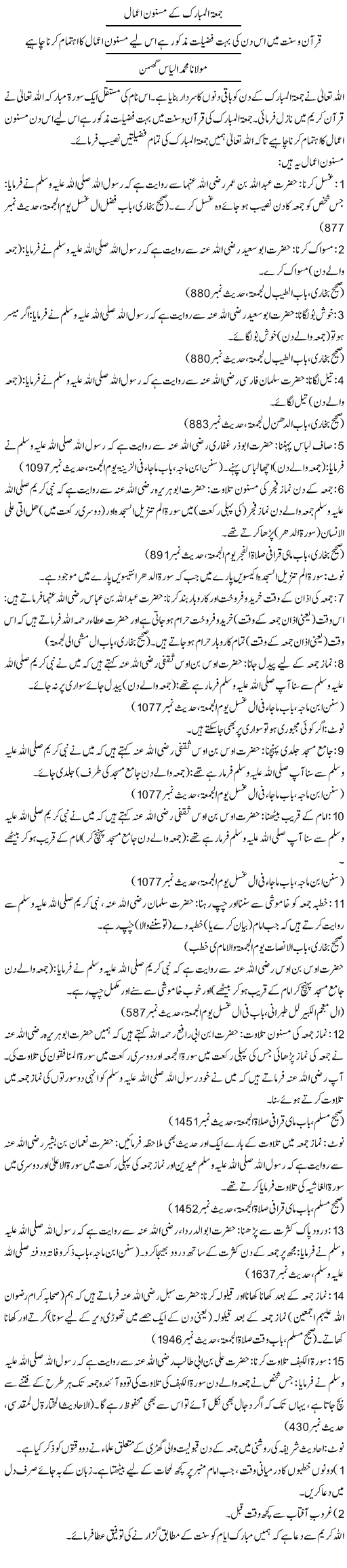
Do Miswak As Much Possible
Narrated by Hazrat Aisha Ummul Mu’minin, Transmitted by Abu Dawud
Allah’s Messenger (Sal-allahu-aleihi-wassallam) said “Ablution water and tooth-stick were placed by the side of the Prophet (Sal-allahu-aleihi-wassallam). When he got up during the night (for prayer), he relieved himself, then he used the tooth-stick”.
Narrated by Abu Huraira, Transmitted by Sahih Bukhari
Hazrat Aisha said, “The Prophet said, ‘It (i.e. Miswak) is a purification for the mouth and it is a way of seeking Allah’s pleasures.’ [Vol 3:#154]
Narrated by Zayd ibn Khalid al-Juhani’, Transmitted by Tirmidhi, Abu Dawud. (Mishkat)
I heard Allah’s Messenger (Sal-allahu-aleihi-wassallam) saying: If it were not burdensome upon my Ummah I would have commanded them to use miswak at every prayer and to delay the night prayer till the third part of the night is over. [390]
Narrated by Hazrat Anas, Transmitted by Sahih Bukhari
Allah’s Apostle I said, “I have told you repeatedly to (use) the Miswak. (The Prophet put emphasis on the use of the Miswak). [Vol 2:#13]
Narrated by Hazrat Aisha Ummul Mu’minin, Abu Dawud transmitted it.
The Prophet (Sal-allahu-aleihi-wassallam) did not get up after sleeping by night or by day without using the tooth-stick before performing ablution.
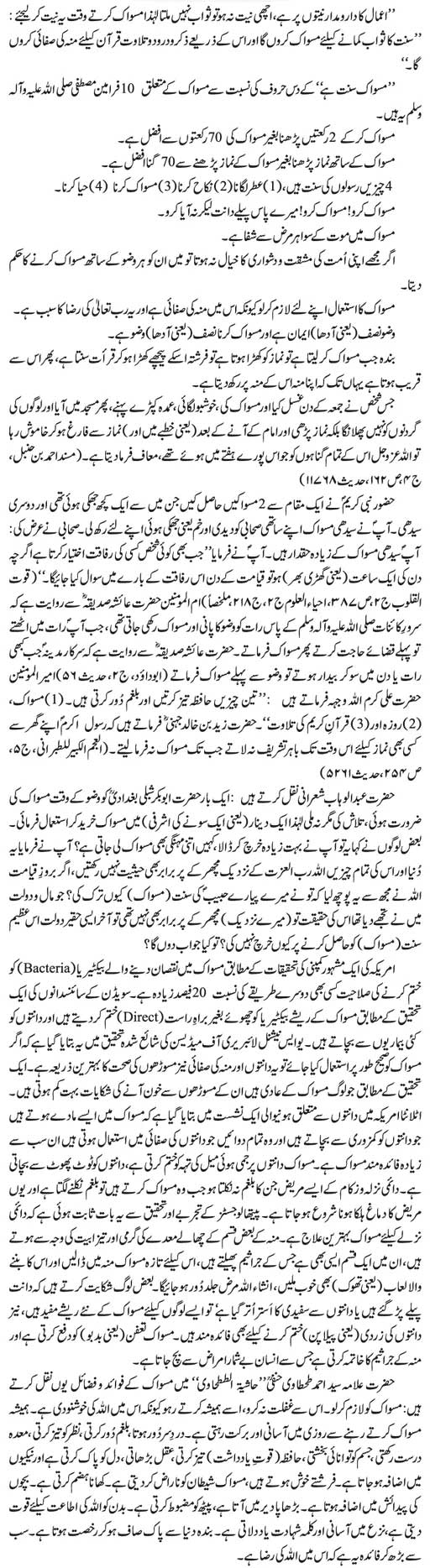
Miswak Ki Fazeelat
50 Things To Be Done During Hajj
[..1] Smile in another Muslims face
[..2] Say Salam to strangers
[..3] Shake someone’s hand and ask about their health
[..4] Buy tea for someone
[..5] Offer to get someone’s groceries
[..6] Sit with a Hajj group from another country and ask about Islam in their village
[..7] Carry someone’s bags for them
[..8] Guide someone ill to the infirmary
[..9] Shun vain talk
[10] Recite talbiyah loudly, encouraging others
[11] On the days of Eid, walk through the tents reciting Talbiyah loudly reminding others
[12] Gather stones for people
[13] Offer to throw on behalf of unable Hajjis
[14] Guide people to the Jamarat
[15] Lower your gaze
[16] Remind people of the lives of the Sahaabah
[17] Read Qur’an with the Tafseer
[18] Do the authentic Dhikr of the morning and evening
[19] Make dua during your Sajdah
[20] Stand to the side of a gate and offer people water/tea as they leave