
- Niyyat – Make an intention to perform Wudu in one’s mind for the purpose of worshipping Allah Subhanahu wa ta’ala.
- Bismillah – Invoking Allah at the start of Wudu by saying Bismillah (in the Name of Allah)
- Hands – Wash the hands 3 times up to the wrists with water, allowing water to run between the fingers.
- Mouth – Rinsing the mouth with water three times. The mouth must be empty of food.
- Nose – Cleaning one’s nostrils by sniffing water in and then out 3 times.
- Face – Clean the face 3 times from the top of the forehead down to the chin and from ear to ear.
- Arms – Wash the arms three times, from the elbows. Right arm first, then left.
- Head – Moisten the hands and pass them over the head from the forehead to the back of the neck (over the head), and from there back to the forehead. Never wet the neck. Then wipe the earlobes with the fore-fingers cleaning the inside of the ears and the thumbs cleaning the external side.
- Feet – Finally wash both feet beginning with the right first, up to the ankles. The feet should be rubbed while washed and water must run between the toes. No part of the foot remains dry.
TAG: Prayer
Don’t Rush Through Prayer
We truly appreciate the value of something when we are deprived of it – either temporarily or irrevocably. Owing to a recent accident, I was compelled to say my prayers while sitting down, and like many others who are unable to bow down due to physical disabilities or old age, I realized the value of one of the pillars of prayer which many of us tend to rush through or neglect in ordinary circumstances: the Ruku’ (bowing/genuflection).
Obligation of Ruku
The acts of bowing and prostrating in prayer are commanded in the Qur’an and made obligatory upon the believers:
“O you who believe! Bow down and prostrate yourselves and serve your Lord.” (Qur’an, 22:77)
“Behold! The angels said: ‘O Mary! Allah has chosen you and purified you – chosen you above the women of all nations. O, Mary! Worship your Lord devoutly: Prostrate thyself, and bow down (in prayer) with those who bow down.’” (Qur’an, 3:42-43)
In a Hadith (narration) the Prophet (peace be upon him) advised “the one who prayed badly”, saying, “Indeed, the prayer of one of you is not complete until he makes an excellent ablution as Allah has commanded him to … then he celebrates Allah’s greatness, praises and glorifies Him, then recites the Qur’an as much as is easy for him from what Allah has taught him and allowed him, then says Takbeer (Allahu-Akbar) and makes Ruku’ (and places his hands on his knees) until his joints are at ease and relaxed.” (Abu Dawood and An-Nasai’)
In another narration, Abu Qatadah (may Allah be pleased with him) related that the Prophet (peace be upon him) said, “The worst people are the thieves who steal part of the prayer.” He was asked how this was done, and he replied, “The one who does not complete his bowings and prostrations,” or he said, “The one who does not straighten his back during his bowings and prostrations.” (Ahmad, At-Tabarani, Ibn Khuzaimah and Al-Hakim)
Abu Mas’ud Al-Badri (may Allah be pleased with him) reported that the Prophet (peace be upon him) said, “The prayer of one who does not straighten his back in his bowing and prostration is not accomplished.” [Narrated by “the five,’’ [narrators] and Ibn Khuzaimah, Ibn Hibban, at-Tabarani, and al-Baihaqi]
The Companion Hudhayfah Bin Yaman (may Allah be pleased with him) saw someone who did not straighten his back during his bowings and prostrations and told him, “You have not prayed. And if you were to die, you would not die on the way of Allah and His Messenger.” (Al-Bukhari)
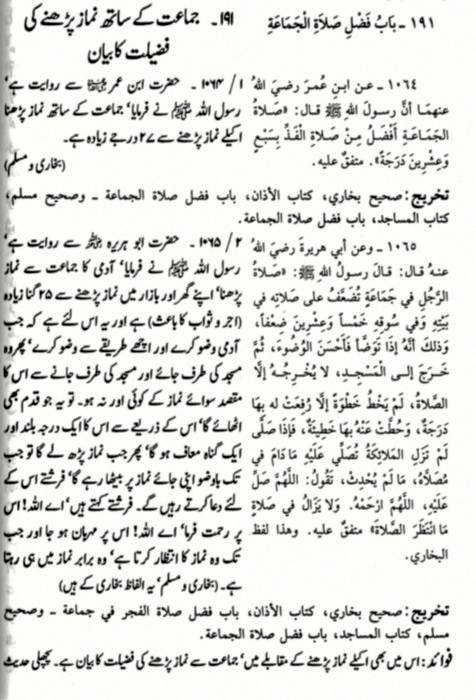
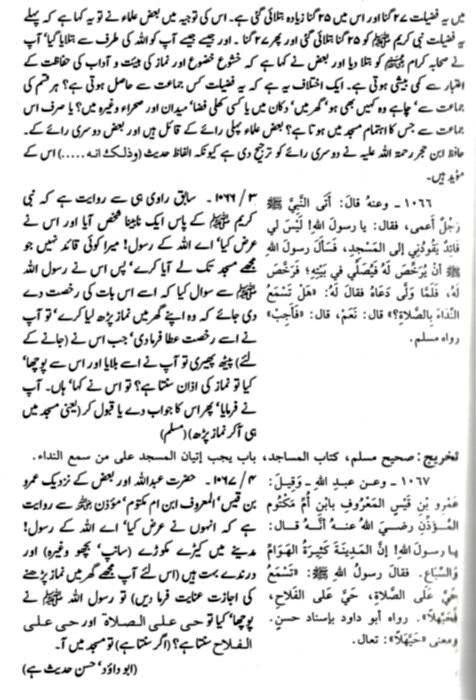
Namaz Ba Jamat Ki Fazeelat
Ikhlas – A Commandment of Allah
Say (O Muhammad, peace be upon him): “Verily, my Salat (prayer), my sacrifice, my living, and my dying are for Allah, the Lord of the Alamin (mankind, jinn, and all that exist). He has no partner. And of this, I have been commanded, and I am the first of the Muslims.“ (Qur’an, 6:162-163)
In defining Ikhlas (sincerity), Al-Jurjani said it is not to seek any audience for your deeds other than Allah.
Allah said: “Who has created death and life that He may test you which of you is best in deed. And He is the All-Mighty, the Oft-Forgiving.” (Qur’an, 67:2)
Commenting on this verse, Al-Fudayl Ibn ‘Iyaadh said, “It is those deeds that are most correct and most sincere.”
The students asked, “What are deeds that are correct and sincere?”
He replied, “If a deed is done sincerely, yet is not done correctly, it will not be accepted. And if a deed is done correctly, but not sincerely for Allah, it will not be accepted. It must be done sincerely and correctly. Sincerely – for Allah alone. Correctly – in accordance with the Sunnah.”
What contradicts Ikhlas
Riyaa’ – to perform an act of worship with the intention of showing it off to people, seeking their praise.
Sum’ah – verbal statements that a person makes for the sake of people. An example of someone making ballooned talks just so others will think highly of him.
‘Ujb – when a person becomes impressed with the ‘great’ deeds he has done.
All these are viruses that can kill our deeds and turn them against us on the Day of Resurrection.
Ya’qoob Al-Makfoof Rahimahullah used to say, “The sincere one is he who hides his good deeds in the same way that he would hide his bad.”
Insincerity is something very dangerous and can lead a person to ruin.
Ibnul Qayyim Rahimahullah said, “Deeds without sincerity are like a traveler who carries dirt in his water jug. The carrying of it burdens him and it brings no benefit.”
May Allah make us all from those whose deeds are done in accordance with the Sunnah, deeds that are done sincerely for His sake alone.
Five Special Privileges For Muslims
Jabir ibn Abdullah quotes the Prophet (peace be upon him) as saying: “I have been given five privileges which were not given to anyone before me: I have been supported by fear traveling a month ahead of me; the earth has been assigned to me as a place of worship and a source of purification.
“Anyone from my community may pray wherever he is when prayer is due. War gains have been made lawful to me while they were not made lawful to anyone before. I have been allowed to intercede on behalf of my followers. Prophets before me used to be sent to their own local communities while I am sent to all mankind.” (Related by Al-Bukhari).
The Prophet outlines these five privileges, acknowledging God’s favors and expressing his gratitude. He is in no way boasting about them. He is also highlighting them to his community so that they will remain grateful to God for them.
The first privilege is that the Prophet was supported by fear being struck into the hearts of his enemies.
A question arises here: Is this privilege special for the Prophet only or extended to his community in later generations? There is no clear indication given by the Prophet on this point.
Many scholars are of the view that it is special for the Prophet only, but some of them say that it applies to the Muslim community in all generations, provided that it adheres to Islam in all its affairs.
The second privilege concerns prayer, which is an essential element in all divine religions. The Prophet says: “There is no goodness in a religion that does not include prayer.”
The Prophet stresses here the fact that Muslims offer their prayers anywhere and can use the earth for dry ablution if they have no water.
This is an important privilege because earlier prophets had to offer their prayers in their temples or special places of worship. We all make use of this privilege all the time.
We conduct our congregational prayers in mosques, as well as in our places of work, schools, colleges, or at home.
A Muslim who works all day long in an office or a factory where there are hundreds of employees who are non-Muslims can easily take a few minutes to offer his prayers at his place of work, without disrupting his work.
Merits Of Offering Five Daily Prayers
Let me start by saying that there are many passages in the Qur’an, which directly order us to obey Allah and His messenger. When we take Islam as our way of life, we are voluntarily surrendering to the commands of Allah and we are choosing to follow the practice (sunnah) of the prophet (peace be upon him).
In Surah Al-Isra verse 78, we are told:
Perform As-Salat (Iqamat-as-Salat) from mid-day till the darkness of the night (i.e. the Zuhr, Asr, Maghrib, and Isha prayers), and recite the Qur an in the early dawn. Verily, the recitation of dawn Qur an (i.e. the morning – Fajr prayer) is ever witnessed.
Then, from the time the sun declines, which is mid-day, until the darkening of the night, includes Zuhr (noon prayer), Asr (evening prayer), Maghrib (sunset prayer), and Isha (night prayer). These five prayers were revealed to Prophet Muhammad (peace be upon him) on the Isra a and Mi`raj and were performed by him in their specified number of rak’aas. He also taught them to Muslims, who performed them in that sequence and form ever since.
There is no secret in the number of prayers. It is simply that they are related to the course of the day and relevant to the different states of nature (day and night) that are linked to the biological clock of any Muslim. Thus, the Muslim is in continuous connection with God, throughout the different phases of the day. The day starts with Fajr (dawn) prayers, to renew the oath of worship and obedience. Then, the workday of a Muslim society should start after that. Zuhr is in the middle of the day, and Asr is a bit later. As for Maghrib, it is with sunset and Isha is when the night falls.
The prayer times are also related to the manners and times of rest in social life. There are verses in the Qur’an, which say that before Fajr, after Zuhr, and after Isha, Muslim parents are allowed a time of privacy and that other family members should respect that. Also, a Muslim is encouraged to perform prayers with a group of Muslims (jama a), these are also times of social gathering in mosques. Such gatherings are where people can simply meet and discuss their communal affairs and grass root lobbying, for societal causes. The number of prayers is simply appropriate for such social structures, relations, neighborhoods, and community ties. It is also suitable for the special structure of worship, which connects the Muslim to his Creator throughout the long day.
In a modern economy, where family members are located in different areas and where the workplace introduces new forms of communication and personal relations, the times of prayers re-formulate these relations. They remind people of their relation to Allah and to each other as well.
Hence, the competitive capitalist atmosphere of modern businesses is rendered milder. The embedded values of submission to Allah and remembering the hereafter and the socio-religious bond of Islam, keep the balance of the human self intact. One should read in our current global economy how the daily routine can result in the corrosion of character. Herein, the wisdom and philosophy of the five daily prayers in Islam, gain new meanings and implications.
Do Not Get Frustrated When There Is Delay In Accepting Your Supplications
Abu Hurairah (May Allah be pleased with him) reported: The Messenger of Allah (PBUH), “The supplication of every one of you will be granted if he does not get impatient and say (for example): `I supplicated my Rubb but my prayer has not been granted’.” [Al-Bukhari and Muslim].
The narration of Muslims is: “The supplication of a slave continues to be granted as long as he does not supplicate for a sinful thing or for something that would cut off the ties of kinship and he does not grow impatient.” It was said: “O Messenger of Allah! What does growing impatient mean?” He (PBUH) said, “It is one’s saying: `I supplicated again and again but I do not think that my prayer will be answered.’ Then he becomes frustrated (in such circumstances) and gives up supplication altogether.”
Abu Umamah (May Allah be pleased with him) reported: The Messenger of Allah (PBUH) was asked: “At what time does the supplication find the greatest response?” He (PBUH) replied, “A supplication made during the middle of the last part of the night and after the conclusion of the obligatory prayers.” [At-Tirmidhi].
`Ubadah bin As-Samit (May Allah be pleased with him) said: The Messenger of Allah (PBUH) said, “Whenever a Muslim supplicates Allah, He accepts his supplication or averts any similar kind of trouble from him until he prays for something sinful or something that may break the ties of kinship.” Upon this, someone of the Companions said: “Then we shall supplicate plenty.” The Messenger of Allah (PBUH) said, “Allah is more plentiful (in responding).”
[At-Tirmidhi].
Commentary: We learn from this Hadith that prayer (supplication) is beneficial to us in any case, because Almighty Allah either grants the prayer we make, or if the supplication is not being accepted, He removes some future trouble that was destined for us, or He grants us in full in the Hereafter.
A Muslim should never feel shy of praying to Allah. In fact, he should persistently pray because there is no end to His Treasures.
Ibn `Abbas (May Allah be pleased with them) said: The Messenger of Allah (PBUH) used to say when he was in distress: “La ilaha illallahul-Azimul-Halim. La ilaha illallahu Rabbul-`Arshil-`Azim. La ilaha illallahu Rabbus-samawati, wa Rabbul-ardi, wa Rabbul-`Arshil-Karim. (None has the right to be worshiped but Allah the Incomparably Great, the Compassionate. None has the right to be worshiped but Allah the Rubb of the Mighty Throne. None has the right to be worshiped but Allah the Rubb of the heavens, the Rubb of the earth, and the Rubb of the Honorable Throne).”
[Al-Bukhari and Muslim].
Commentary: The only medicine in a time of distress is the remembrance of Allah Whose Help alone should be sought. This Du`a contains words that glorify Allah and exalt Him far above all else. It is desirable to recite these words when one is in distress as this is exactly what the Prophet (PBUH) used to recite in such situations
Benefits Of Night Worship
The special character, which distinguishes the month of Ramadan from the rest of the year is derived from the type of action we do during this month, be they obligatory or voluntary. We have spoken about fasting and the reasons for making it obligatory, as well as the role it plays in the building of the special character, which the nation of Islam has. We have pointed out that fasting has much to do with the preparation of Muslims for the task assigned to them by God, namely, conveying the divine message of Islam to mankind. Although fasting is the main thing, we do in Ramadan, it is only the obligatory part. There are other aspects of worship, which we associate with Ramadan in one way or another and which contribute to its distinctive characteristics.
Every Muslim knows that emulating the Prophet (peace be upon him) in any action he did during the 23 years of his mission is strongly recommended. It goes without saying that some of these actions we must do since they are Islamic duties. What is not obligatory and has been done by the Prophet constitutes a recommended practice, which earns a reward if done by any Muslim. When we look at what the Prophet did in Ramadan, we find that he was exceptionally charitable in this blessed month. In order to appreciate his generosity, we need to remember that the Prophet was the most generous of people at all times. He never hesitated to give away whatever he had, trusting always that God will give him more for his charity. In Ramadan, however, he was exceedingly charitable, with no limits to his generosity.
Moreover, prayer, which is the mainstay of Islamic worship, and indeed the Islamic faith, receive even stronger emphasis during Ramadan. When you go anywhere in the Muslim world during Ramadan, you find that mosques witness some unusual activity during this month. Worshippers gather for a late congregational prayer, which is offered after Isha, the night prayer, and takes much longer than any of the five obligatory prayers offered daily. Nevertheless, this worship exercise is not obligatory. We do it, following the guidance of the Prophet. It is authentically reported that he came out into the mosque one night during Ramadan and a group of his companions joined him in a congregational prayer. He did the same on the following two nights with the congregation increasing every night. On the fourth night, the mosque was overcrowded, but the Prophet did not come out. In the morning, when he came out for the obligatory dawn prayer, Fajr, said to his companions that he was aware of their presence. He simply did not want to come out because he feared that this worship might become obligatory to them. He wanted to keep it voluntary. However, the indication is clear that congregational night worship during Ramadan is strongly recommended.
Teach Kids To Do Good
It is one of Allah’s blessings to the Muslim that He enables him to fast in the daytime of Ramadan and spend his nights in prayer. It is a month in which good deeds are multiplied and people are raised in status when Allah frees some of His servants from the Hellfire. So the Muslim should strive to make the most of this month to attain the goodness it brings; he should hasten to worship Allah night and day.
Such great blessing of Allah is obvious in considering people who have been deprived of tasting the sweetness of this month because of sickness, death, or misguidance! A Muslim must make use of this blessed month to get his children accustomed to the ethics and morals of fasting.
A Muslim must make the most of his time during this month. He has an unavoidable duty toward his children, to raise them well and bring them up properly, to urge them to do all kinds of good deeds and make them get used to that. A child usually grows up in the manner to which the parents make him or her accustomed.
During the blessed days of Ramadan, fathers and mothers have a great role to play in seizing this good occasion for their own benefit and for that of their children, and we can offer parents the following advice:
1. Check on the children’s fasting and encourage those who fall short in this regard.
2. Remind them about the real nature of fasting, and that it is not just giving up food and drink, but it is a means of attaining taqwa (piety), and that it is an opportunity for sins to be forgiven and expiated.
It was reported by Abu Hurairah (Allah be pleased with him) that the Messenger of Allah (peace be upon him) ascended the pulpit and said Ameen: It was said to him, “O Messenger of Allah, why did you do that?” He said, “Jibreel (Aleh Salam) said to me, ‘May Allah curse a person who lets Ramadan elapse without having his sins forgiven,’ and I (Prophet Muhammad) said, ‘Ameen.’ Then he said, ‘May Allah curse the one who lives to see his parents grow old, one or both of them, but he does not enter Paradise,’ and I said, ‘Ameen.’ Then he said, ‘May Allah curse the one in whose presence you (the Prophet) are mentioned and he does not send blessings upon you,’ and I said, ‘Ameen. ‘ (Reported by Ibn Khuzaymah, At-Tirmidhi, Ahmad, and Ibn Hibban)
3. Teach them the manners and rules of eating, such as eating with the right hand from what is directly in front of them, reminding them that extravagance is haram (unlawful) and harmful to the body.
4. Don’t let them spend too long eating iftar so that they don’t miss performing Maghrib prayer in the congregation.
5. Remind them about the situation of the poor and destitute who cannot find even a morsel of food to satisfy their hunger. Remind them of the situation of those who have migrated or are fighting in jihad for the sake of Allah in all places.
Why Our Dua’s Are Not Answered
IBRAHEEM IBN Adham (may Allah have mercy on him), a teacher and a companion of Sufyaan Ath-Thawree (d. 161H), was asked, “We supplicate, and we are not answered.”
So he replied:
- You know Allah, yet you do not obey Him.
- You recite the Qur’an, yet you do not act according to it.
- You know Satan, yet you have agreed with him.
- You proclaim that you love Muhammad (peace be upon him), yet you abandon his Sunnah.
- You proclaim your love for Paradise, yet you do not act to gain it.
- You proclaim your fear of the Fire, yet you do not prevent yourselves from sins.
- You say “Indeed death is true”, yet you have not prepared for it.
- You point out the faults with others, yet you do not look at your faults.
- You eat of what Allah has provided for you, yet you do not thank Him.
- You bury your dead, yet you do not take a lesson from it.