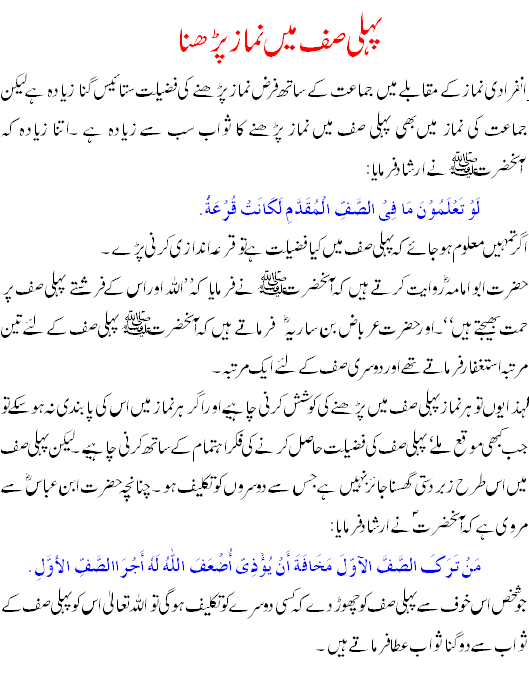
Pehli Saf Main Namaz Perhna
TAG: Prayer
How To Attain ‘Al-Khushoo’ In Our Prayers
How is it possible for us to gain ‘Al-Khushoo’ (Humility) in and outside of the prayer and during the recitation of the ‘Quran’?
‘Al-Khushoo’ is the essence and core of the prayer. And it means the presence and attendance of the heart! And that the heart of the person who is praying does not wander left and right.
However … if the person senses something that will divert him away from (this) Al-Khushoo’ then he must seek refuge with Allah from the Outcast Shaytaan just as the *Prophet*…[sallahu ‘alayhi wasallam ]instructed us to do!
And there is no doubt that the ‘Shaytaan’ is extremely assiduous in spoiling all acts of worship, especially the ‘Salah’ which is the most superior act of worship after the Two Testimonies.
Thus, the ‘Shaytaan’ comes to the ‘Musalli’ (Praying individual) and says …or whispers Remember this and that and he causes him to indulge in thoughts and ideas that are of no benefit and which leave his head soon as he concludes from the prayer…
Therefore it is upon a person that he strives with the… utmost ambition to devote himself towards Allah the Mighty and Majestic, and if he feels anything from these misgivings and devilish insinuations to seek refuge with Allah from the Outcast ‘Shaytaan’ whether he is Raki’ (bowing), in the ‘Tashahhud’, sitting, or standing or in any position from his prayer.
Lastly, the greatest means that will aid one in attaining Al-Khushoo’ in the prayer is … that he Visualizes himself standing in front of Allah and that he is confiding in his Lord ALLAH {Subhanahu wa Ta’ala.}
{‘In Shaa Allah’}
[Source:-Footnotes:*Muslim( 2203).*Bukhari #608 and *Muslim #291 ]
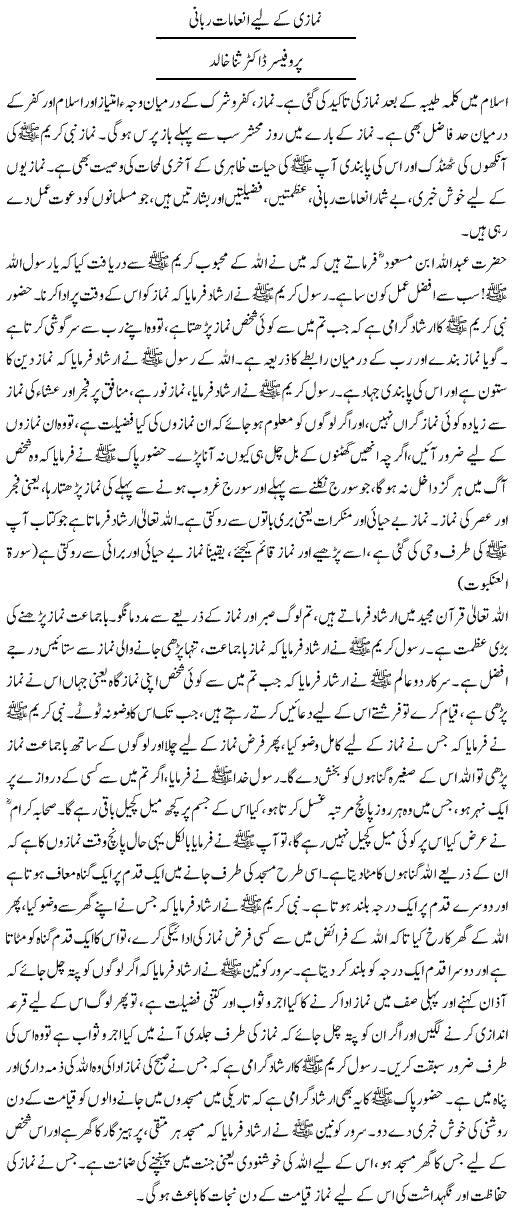
Namazi Ke Liye Inamat e Rabbani

Namazi Ke Liye Inamat e Rabbani
Prayer Is Better Than Sleep
When young Muslims meet others for the first time and find out that they are Muslim, often one of the very first questions they ask each other is, “Do you pray?” It’s as if this is their touchstone to see if the person they have met is a real Muslim or not. Calling yourself Muslim is one thing, being a Muslim is something else.
Praying five times a day is at the heart of Islam. It is one of the things that distinguishes a Muslim from everyone else in the world; that all the activities of life can be made significant by the cycle of prayer and praise which we offer to Almighty Allah. So why, then, do we have such a problem being faithful to prayer?
My first Umrah was one of the most important experiences of my life and it had its effects on me. Being so close to the Kaaba was a deeply moving experience. Being at the very place where our beloved Prophet (peace be upon him), like all the prophets before him, had walked and prayed, was amazing.
One of the things that hit me most about being in Makkah, among so many others, was when the call to prayer sounded for Fajr, the Dawn prayer. Thousands of people appeared from every direction and headed toward the Kaaba for prayer.
Getting up in the middle of the night wasn’t difficult at all, because the experience of praying at the Kaaba was so moving. At the time, moving with the vast crowd, I couldn’t help thinking about what it is usually like back home.
Those getting up and going to the mosque for the dawn prayer are certainly a minority, aren’t they? Away from Makkah, it is all too easy to ignore the Adhan completely and stay in the comfort of one’s bed.
At special times like Ramadan, or when we go on pilgrimage, it seems so much easier to be faithful to prayer and to take Islam so much more seriously. How many of us, for example, attended Tarawih Prayers in the mosque during Ramadan, even though we might occasionally miss one or two of the obligatory prayers?
It’s one of life’s paradoxes that we want so much to be good, and yet we find ourselves falling into the same old traps and doing things we later regret. How odd we are as human beings! We can quite happily sit in front of the television for hours or sit idly chatting on the Internet to no one in particular, yet we can’t manage to set aside 10 minutes to pray.
Importance Of Prayer
The importance of prayer in Islam cannot be understated. It is the first pillar of Islam that the Prophet, may Allah praise him, mentioned after mentioning the Testimony of Faith, by which one becomes a Muslim. It was made obligatory upon all the prophets and for all peoples. Allah has declared its obligatory status under majestic circumstances. For example, when Allah spoke directly to Prophet Moses, He said,
“And I have chosen you, so listen to that which is inspired to you. Verily, I am God! There is none worthy of worship but I, so worship Me and offer prayer perfectly for My remembrance.” (Quran 20:13-14)
Similarly, the prayers were made obligatory upon the Prophet Muhammad during his ascension to heaven. Furthermore, when Allah praises the believers, such as at the beginning of the chapter entitled ‘al-Muminoon’ (The Believers), one of the first descriptions He states is their adherence to the prayers.
Once a man asked the Prophet about the most virtuous deed. The Prophet stated that the most virtuous deed is prayer. The man asked again and again and for the first three times, the Prophet answered, “The prayer,” then on the fourth occasion he stated, “Jihad in the way of Allah.”
The importance of prayer is demonstrated in many of the Prophet’s statements. For example, the Prophet (peace be upon him) said,
“The first matter that the slave will be brought to account for on the Day of Judgment is the prayer. If it is sound, then the rest of his deeds will be sound. And if it is incomplete, then the rest of his deeds will be incomplete.”
The importance of the prayers lies in the fact that no matter what actions one performs in his life, the most important aspect is one’s relationship to Allah, that is, one’s faith (Imaan), Allah-consciousness (taqwa), sincerity (ikhlas) and worship of Allah (ibaadah). This relationship with Allah is both demonstrated and put into practice, as well as improved and increased, by prayer. Therefore, if the prayers are sound and proper, the rest of the deeds will be sound and proper; and if the prayers are not sound and proper, then the rest of the deeds will not be sound and proper, as the Prophet himself stated.
The Greatest Gift Which We Received Because of Miraaj
When Miraaj took place, our Prophet (PBUH) received the greatest gift one can ever imagine.
He (PBUH) got to meet our Creator, our Sustainer, Allah SWT himself.
What more can one ask?
But what gift did we (the prophet’s ummah / meaning us) receive?
Did we get flowers/food/fruits/gold/clothes / etc?
No.
Those are materialistic things and we also have them back on our earth.
When the Prophet (PBUH) came back and told his sahabah, they all were very happy on receiving their gift sent by Allah SWT himself.
What gift did the sahaba receive?
The gift to pray compulsory Salah five times a day at fixed hours.
Five times a day…Oh my God.
But consider this, at first Allah SWT first gave His order of offering 50 salah’s a day.
As the Prophet was going back, he (PBUH) was asked by Prophet Moosa (PBUH): What gift did Allah SWT give your ummah?
To which our Prophet (PBUH) replied: Allah SWT has ordered to pray 50 salahs per day.
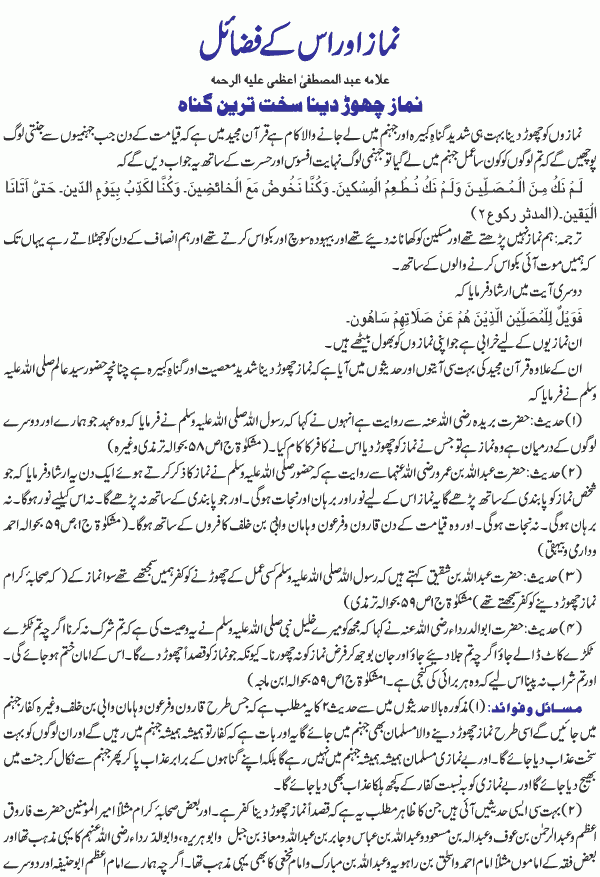
Namaz kay Fazail

Virtues Of Salaah
1. Abu Hurayra Radiyallahu ‘anhu said, “I heard the Messenger of Allah, may Allah bless him and grant him peace, say, ‘What do you think would happen if there was a river by someone’s door in which he washed five times every day? Do you think that any dirt would remain on him?’ They said, ‘Not a scrap of dirt would remain on him.’ He said, ‘That is a metaphor of the five prayers by which Allah wipes out wrong actions.'”
2. Jabir ibne-’Abdullah Radiyallahu ‘anhuma narrates that Nabi Sallallahu alaihi wasallam said: ‘The key to Paradise is Salat and the key to Salat is Wuzu’. (Musnad Ahmad)
3. Anas Radiyallahu ‘anhu narrates that Rasulullah Sallallahu ‘alaihi wasallam said: ‘The comfort and delight of my eyes has been placed in Salat.’ (Nasai).
4. Hanzalah Al Usaidi Radiyallahu ‘anhu narrates that Rasulullah Sallallahu ‘alaihi wasallam said: ‘The person who guards the five times Salat, its Wuzu, its prescribed time, its proper Ruku’ and Sujud, while perceiving it to be the Right of Allah on him, he is forbidden upon Fire.’ (Musnad Ahmad)
5. Abu Qatadah ibne-Rib’i Radiyallahu ‘anhu reported that Rasulullah Sallallahu ‘alaihi wasallam narrates in a Hadith Qudsi that Allah ‘Azza wa Jall has said:’ Verily, I have enjoined upon your Ummah five times Salat, and I have taken upon myself an oath that anyone who observes them at their appointed time, I shall admit him into Paradise; if anyone does not offer them regularly, there is no such guarantee from Me for him (I may punish him or forgive him).'(Abu Dawud)
Namaaz Mutarjam


Friday Explained By The Prophet (Peace Be Upon Him)
“O you who believe! when the call is made for (the Congregational) Prayer on Friday then hasten to extol the name of Allah and leave off all business. That is best for you if you only knew.” [ALLAH’S Quran – 62:9]
The Prophet (Peace Be Upon Him) has said:
1. [Sunan Abudawud, Book #3, Hadith #1051] Narrated Abdullah ibn Amr: The Prophet (peace be upon him) said: The Friday prayer is obligatory on him who hears the call.
2. [Sunan Abudawud, Book#3, Hadith #1062] Narrated Tariq ibn Shihab: The Prophet (peace be upon him) said: The Friday prayer in congregation is a necessary duty for every Muslim, with four exceptions; a slave, a woman, a boy, and a sick person.
3. [Sunan Abudawud, Book #1, Hadith #0342] Narrated Hafsah, Ummul Mu’minin: The Prophet (peace be upon him) said: It is necessary for every adult (person) to go for (saying) Friday (prayer), and for everyone who goes for Friday (prayer) washing is necessary.
4. [Bukhari, Book #13, Hadith #6] Narrated Abu Huraira: Allah’s Apostle (p.b.u.h) said, “Any person who takes a bath on Friday like the bath of Janaba and then goes for the prayer (in the first hour i.e. early), it is as if he had sacrificed a camel (in Allah’s cause); and whoever goes in the second hour it is as if he had sacrificed a cow; and whoever goes in the third hour, then it is as if he had sacrificed a horned ram; and if one goes in the fourth hour, then it is as if he had sacrificed a hen; and whoever goes in the fifth hour then it is as if he had offered an egg. When the Imam comes out (i.e. starts delivering the Khutba), the angels present themselves to listen to the Khutba.”
5. [Bukhari, Book #13, Hadith #51] Narrated Abu Huraira: The Prophet said, “When it is a Friday, the angels stand at the gate of the mosque and keep on writing the names of the persons coming to the mosque in succession according to their arrivals. The example of the one who enters the mosque in the earliest hour is that of one offering a camel (in sacrifice). The one coming next is like one offering a cow and then a ram and then a chicken and then an egg respectively. When the Imam comes out (for Jumua prayer) they (i.e. angels) fold their papers and listen to the Khutba.”