TAG: Prayer
Laylat al-Qadr
[Sahih Al-Bukhari : Volume 3, Book 32, Number 232]
Narrated Ibn ‘Umar (Radi Allah Anhu) : Some men amongst the companions of the Prophet Muhammad (sal-Allahu- alleihi-wasallam ) were shown in their dreams that the night of Qadr was in the last seven nights of Ramazan. Allah’s Messenger (sal-allahu- alleihi-wasallam ) said, “It seems that all your dreams agree that (the Night of Qadr) is in the last seven nights, and whoever wants to search for it should search in the last seven nights of Ramazan.”
[Sahih Al-Bukhari : Volume 3, Book 32, Number 233]
Narrated Abu Salama (Radi Allah Anhu): I asked Abu Sa’id (Radi Allah Anhu) about the Night of Qadr and he said, “We practiced Itikaf in the middle third month of Ramazan with Prophet Muhammad (sal-allahu- alleihi-wasallam ). In the morning of the 20th of Ramazan, the Prophet Muhammad (sal-allahu- alleihi-wasallam ) came to and addressed us and said, ” I was informed of the date of the Night of Qadr but I was caused to forget it, or I forget, so search it in the last ten nights of the month of Ramazan.”
[Sahih Al-Bukhari : Volume 3, Book 32, Number 238]
Narrated ‘Ibn Abbas (Radi Allah Anha): The Allah’s Messenger (sal-allahu- alleihi-wasallam ) said, “Look for the Night of Qadr in the last ten nights of Ramazan on the night when nine or seven or five nights remain out of the last ten nights of the Ramazan.”
[Sahih Al-Bukhari: Volume 3, Book 32, Number 239]
Narrated Ibn Abbas (Radi Allah Anha) in this quotation: Allah’s Messenger (sal-allahu- alleihi-wasallam ) said, “The Night of Qadr is in the last ten nights of the month of Ramazan either on the first nine or in the last (remaining) seven nights of Ramazan.”
[Sahih Al-Bukhari : Volume 3, Book 32, Number 241]
Narrated ‘Aisha (Radi Allah Anhu): With the start of the last ten days of Ramazan, Allah’s Messenger (sal-allahu- alleihi-wasallam ) used to tighten his waist-belt (i.e. hard work) and used to offer Salat (Prayer) all the night, and used to keep his family awake for the Salat (prayers).
Basic Beliefs Of Muslims
Islam is based upon five “pillars” that represent the bedrock upon which all else is based. The first pillar, which makes one a Muslim, is called the shahadah, meaning, “testimony” or “witnessing.” It is fulfilled by declaring to two witnesses the foundational creed of Islam: This means, “I witness that there is nothing worthy of worship except God and that Muhammad is God’s messenger.” The first part of the testimony is a belief that God is unique with no partners. Thus, nothing in creation can be associated with God, as creation has no real substantiation without the sustaining power of God. Indeed, creation is not God nor does it have any eternal qualities of the divine that are worthy of worship. Rather, creation is a theater of divine manifestations. Creation is seen as a place where analogies of the divine reveal themselves. The intellect of a person is the vehicle given by God to discern this truth about creation as indicated by several verses in the Qur’an.
The second part of the declaration, Muhammad is the messenger of God, acknowledges the means through which this understanding of God has come. All prophets are special human beings capable of refracting divine light, acting like prisms that allow others to see it. The intensity of direct divine light is something only a prophet can bear. Muslims believe that the revelation given to Prophet Muhammad (peace be upon him) is like a refracted green light, which lies in the middle of the light spectrum. Muslims consider Islam to be the most balanced of the prophetic dispensations, the “middle way.” The Prophet Muhammad’s life is considered to be moderate and exemplary for both men and women. He abhorred extremes saying, “Beware of extremism in your religion.” After the Qur’an, the Prophet’s practice, or sunnah, is the second most important authority in Islam.
The second pillar of Islam is prayer. While people may supplicate anytime they wish to do so, there is a specific prayer every adult Muslim, female and male, is obliged to perform five times a day. The times are determined by the perceived movement of the sun as a way of reminding people of the temporal nature of the world. Thus, each day is considered to be a microcosm of one’s own life: the dawn prayer as one’s coming into the world, the midday prayer as the end of youth, the afternoon prayer as old age, the sunset prayer as death, and the evening prayer as the beginning of the descent into the darkness of the grave and returning to the dawn prayer as the awakening and resurrection of the dead. After the testimony of faith, prayer is considered the most important pillar.
The third pillar of Islam is paying zakah, an obligatory alms given once every lunar year from the standing capital of every responsible adult. It is one-fortieth of a person’s liquid assets. According to the Qur’an, zakah is distributed among eight categories of people, the two most important recipients being the poor and the needy.
The fourth pillar is fasting the entire lunar month of Ramadan, and it begins with the sighting of the new crescent for that month. Fasting entails abstaining from food, drink, and sexual relations from dawn to sunset and is obligatory on adults healthy enough to do so.
The fifth pillar is the Hajj, or pilgrimage to Makkah. Muslims believe Makkah to be the site of the first house of worship built by the Prophet Adam and his wife Eve and then restored millennia later by the Prophet Abraham and his son, the Prophet Ishmael. At the end of his mission, the Prophet Muhammad restored its monotheistic purpose by destroying the 365 idols in it that the Arabs had been worshiping prior to Islam. The rituals performed in the pilgrimage follow the footsteps of Abraham and his second wife Hagar. The Hajj culminates on a vast desert plain where approximately 3 million pilgrims from almost every country on Earth gather every year and prepare for standing before God on the Day of Judgment.
Calling Upon Allah In Dua (Supplication)
Allah the most compassionate says in the Holy Quran, “Call on Me. I will answer your prayer, but those who are too arrogant to serve Me will surely find themselves humiliated in Hell” (40:60).
Allah the Exalted, has said: “And your Lord says: Pray unto me: and I will hear your prayer” (Quran 40:60),
“Call upon your Lord humbly and in secret” (Quran 7:55),
“When My servants question thee concerning Me, I am indeed close (to them): I listen to the prayer of every suppliant when he calleth on Me” (Quran 2:186),
“Is not He (best) who listens to the (soul) distressed when it calls on Him, and who relieves its suffering.” (Quran 27:62)
Dua’s are never wasted
Aisha radhiallaahu anha said, “No believer makes Dua and it is wasted. Either it is granted here in this world or deposited for him in the Hereafter as long as he does not get frustrated.”
Allah’s anger at those who don’t make dua
In fact, it is even wrong to never make Dua, “Whosoever does not supplicate to Allah, He will be angry with Him.” [Saheeh Jaami`as-Sagheer #2414]
Dua is a weapon for the believers
Rasullullah is reported to have said, “Dua is the weapon of a Muslim”.
Dua for ones brother in his absence
“The supplication that gets the quickest answer is the one made by one Muslim for another in his absence.” [Abu Daw’ud and Tirmidhi]
So let us build a close relationship with Allah by making much dua to him. He loves it when his slave calls upon him and it angers him if his slave does not call upon him.
Let us have full hope that our dua’s will be accepted and if you think they won’t they know Allah is keeping the rewards for you in the hereafter and those rewards are so great that one would wish that none of their duas were excepted in this world just so that one can gain all the rewards for their duas in the next world.
The Prophet’s Night Journey: Incidents And Significance
AS far as the issue of the Prophet’s (peace be upon him) night journey (Al-Israa’ and Al-Mi’raj) is concerned, we’d deal with it from the following dimensions:
1. Its time and incidents
As for its exact date, it is still controversial and no consensus has been reached. However, the majority of scholars are in favor of a date between 16-12 months prior to the Prophet’s (PBUH) migration to Madina.
It was during this period that the Prophet (PBUH) was made to undertake a night journey from the Kaaba to Al-Masjid Al-Aqsa in Jerusalem. Then he was borne to the celestial regions where he witnessed the seven Heavens, met the Prophets (of yore and saw the remarkable signs of divine majesty about which the Qur’an says: “The sight (of Prophet Muhammad, peace be upon him) turned not aside (right or left) nor it transgressed beyond the limit (ordained for it). Indeed he (Muhammad, peace be upon him) did see of the Great Signs, of his Lord.”(Surah 53: 17-18)
The occurrence of the event at that time was meant to confer honor upon the Prophet (PBUH). It signified something like viands of higher regale in order to console and alleviate the feelings of distress caused to him by the persecution of the pagans at Taif. After the incident of Al-Israa’ and Al-Mi’raj, the Prophet (PBUH) told the people about his nocturnal journey, but the Quraysh mocked him and shook their heads in disbelief stating that it was inconceivable and beyond the bounds of reason. When Abu Bakr (Allah be pleased with him) saw the Quraysh accusing the Prophet (PBUH) of falsehood, he said, “What makes you wonder about it? If he said this, then it must be true. By Allah, he tells me that the revelation is sent down to him from Heaven in a flash or in an instant during the day or night and I believe him. This is even more unimaginable and difficult than what seems to astound you.”
2. Real significance of Al-Israa’ and Al-Mi’raj
The journey of Al-Israa’ and Al-Mi’raj did not occur in a routine or ordinary run of things. It was only to demonstrate the profound phenomena of the Kingdom of Allah in the Heavens and the earth to the Prophet (PBUH) of Islam. More than that, such a prophetic journey of tremendous importance alludes to a number of other significant and complex realities of far-reaching concern to humanity.
The two Qur’anic chapters (Surahs) of Al-Israa’ and An-Najm revealed in connection with this Heavenly journey indicate that Muhammad (peace be upon him) was charged with the office of prophethood for both the Houses of Allah, those in Jerusalem and Makkah, and was sent as the leader of the East and the West or the entire human race until the end of time.
As the inheritor of all the Prophets (peace be upon them all) of old, he represented the fulfillment and consummation of mankind’s religious development. His nightly journey from Makkah to Jerusalem expresses, in a figurative way, that his personality conformed and alluded to the oneness of Al-Masjid Al-Haram at Makkah and Al-Masjid Al-Aqsa at Jerusalem. That all the Prophets (peace be upon them all) arrayed themselves behind him in Al-Masjid Al-Aqsa shows that the doctrine of Islam, preached by him, was final, universal and all-comprehensive, meant for every class and section of human society throughout the ages.
The event is, at the same time, indicative of the comprehensiveness of the prophethood of Muhammad (PBUH) and the place accorded to his followers in the great task of humanity’s guidance and the distinctive character of his message.
Frankly speaking, the incident of Al-Israa’ and Al-Mi’raj represents a demarcation line between the regional, limited, and variable rules of divine guidance entrusted to the Prophets of old and the global, comprehensive, and abiding principles of faith conferred on the universal leader of the human race. Had the Prophet (peace be upon him) been a sectional or regional guide, a national leader, the savior of any particular race or the restorer of the glory of any particular people, there would have been no need to honor him with the ascension to the Heavens nor would he have been required to perceive the hidden phenomena of the Heavens and the earth. Nor would it have been necessary to create a new link between the celestial and the earthly boundaries of the Divine Kingdom; in that case, the confines of his own land, his surroundings environs, and the times would have been sufficient enough and there would have been no need for him to divert his attention to any other land or country. Neither his ascension to the most sublime regions of the Heavens and to the “Lote-Tree of the Farthest Limit” or even the nocturnal journey to the far-away Jerusalem, then in the grip of the powerful Christian Empire of Byzantium, would have been necessary at all.
The Journey of Al-Israa’ and Al-Mi’raj of the Prophet (PBUH) was a divine proclamation that he had nothing to do with the category of national or political leaders whose endeavors are limited to their own country and nation, for they serve the nations and races to which they belong and a product of their time, they serve the need of a particular juncture. The Prophet (PBUH) of Islam, on the contrary, belonged to the luminous line of the Messengers of Allah (peace be upon them all) who communicate the inspired message of Heaven to the earth. They are links between Allah and His creatures.
3. The prescription of prayer
On this occasion, Allah made 50 prayers a day obligatory for the Prophet (PBUH) and his followers. The Prophet (PBUH) constantly implored Allah for the reduction of the prayers until the Lord was also pleased to limit these to only five times daily. The Lord was also pleased to declare that whoever properly performs these five-times daily prayers would be recompensed for all the 50 daily prayers enjoined earlier.
Allah With The Patient
[ALLAH’S Quran – 2:153] “O you who believe! seek assistance through patience and prayer; surely Allah
is with the patient.”
The Prophet (Peace Be Upon Him) has said :
[Bukhari, Book #70, Hadith #547] “Narrated Abu Huraira: Allah’s Apostle said, “The example of a believer is that of a fresh tender plant; from whatever direction the wind comes, it bends it, but when the wind becomes quiet, it becomes straight again. Similarly, a believer is afflicted with calamities (but he remains patient till Allah removes his difficulties.) And an impious wicked person is like a pine tree which keeps hard and straight till Allah cuts (breaks) it down when He wishes.”
Prophet Yunus (Alaih Assalaam)
Prophet Yunus(Alaih Assalaam) was sent by Allah to a big town where the people had forgotten Allah’s orders and did many things which Allah had forbidden. You should believe only in Allah and obey only Him, Yunus told them. You should worship Him alone and do good, otherwise, a severe punishment will come upon you!
But Yunus(Alaih Assalaam) soon discovered that the people did not want to listen to him. He left the tow. Afterward, Yunus decided to go across the sea and boarded a ship for the voyage. But when the ship was in the middle of the ocean, Yunus (Alaih Assalaam) suffered a great misfortune. He was thrown overboard and swallowed up by an enormous fish. Fortunately, though, the fish had swallowed Yunus (Alaih Assalaam) in one big gulp, so he landed in its stomach unhurt.
It was very dark inside the fish’s stomach, and Yunus (Alaih Assalaam) grew very fearful. In his loneliness, he started to think over what had happened in the town and came to realize that he should not have acted so hastily and in such a quick-tempered manner. Instead, he should have stayed and kept on speaking to the people and ask them to return to Allah.
In this despair, Yunus (Alaih Assalaam) started to pray with all his heart to Allah. He said “O Allah, there is no God apart from You. You alone do I praise and honor. I have done wrong; if You do not help me, I shall be lost forever.”
Allah hears the prayers of those who pray to Him and those who believe in Him. Allah heard Yunus’s prayer, and he caused Yunus (Alaih Assalaam) to come out of the fish’s stomach, and to be swept by the waves of the sea onto the shore. Poor Yunus (Alaih Assalaam) was in a terrible state and lay on the shore, weak, ill and helpless. He felt dreadfully miserable, but Allah caused a tree to grow and this tree provided Yunus (Alaih Assalaam) with shade and nourishing fruits. Before long, Yunus (Alaih Assalaam) had recovered his health and strength.
When he was better, Allah sent Yunus (Alaih Assalaam) back to the town. This time, though, the people there listened to Yunus (Alaih Assalaam) when he told them: You should believe in Allah and worship Him alone. You must do good.
Azwaj-e-Mutaharat Aur Ahadith Ka Bayan

Saying Of Prophet Muhammad (SAW)
Signs of True Love with Allah
Volume 4, Book 54, Number 431:
Narrated Abu Huraira: The Prophet said, “If Allah loves a person, He calls Gabriel saying, ‘Allah loves so-and-so; O Gabriel! Love him.’
Gabriel would love him and make an announcement amongst the inhabitants of Heaven. ‘Allah loves so-and-so, therefore you should love him also,’ and so all the inhabitants of the Heaven would love him, and then he is granted the pleasure of the people on the earth.”
The reality of Devine Inspirations on Prophet saws
Volume 4, Book 54, Number 438:
Narrated Aisha: Al Harith bin Hisham asked the Prophet, “How does the divine inspiration come to you?” He replied, “In all these ways: The Angel sometimes comes to me with a voice which resembles the sound of a ringing bell, and when this state abandons me, I remember what the Angel has said, and this type of Divine Inspiration is the hardest
on me; and sometimes the Angel comes to me in the shape of a man and talks to me, and I understand and remember what he says.”
Duty of Angels
Volume 4, Book 54, Number 441:
Narrated Ibn Abbas: Allah’s Apostle asked Gabriel, “Why don’t you visit us more often than you do?” Then the following Holy Verse was revealed (in this respect):– “And we (angels) descend not but by the order of your Lord. To Him belong what is before us and what is behind us, and what is between those two and your Lord was never forgetful.” (19.64)
Volume 4, Book 54, Number 442:
Narrated Ibn Abbas: Allah’s Apostle said, “Gabriel read the Qur’an to me in one way (i.e. dialect) and I continued asking him to read it in different ways till he read it in seven different ways.”
Origin of Prayer
Volume 4, Book 54, Number 444:
Narrated Ibn Shihab: Once Umar bin Abdul Aziz delayed the ‘Asr prayer a little. ‘Urwa said to him, “Gabriel descended and led the prayer in front of the Prophet ” On that ‘Umar said, “O Urwa! Be sure of what you say.” “Urwa, “I heard Bashir bin Abi Masud narrating from Ibn Masud who heard Allah’s Apostle saying, ‘Gabriel descended and led me in prayer; and then prayed with him again, and then prayed with him again, and then prayed with him again, and then prayed with him again, counting with his fingers five prayers.”
Importance of Tuheed, Oneness of Allah
Volume 4, Book 54, Number 445:
Narrated Abu Dhar: The Prophet said, “Gabriel said to me, ‘Whoever amongst your followers die without having worshipped others besides Allah, will enter Paradise (or will not enter the (Hell) Fire).” The Prophet asked. “Even if he has committed illegal sexual intercourse or theft?” He replied, “Even then.”
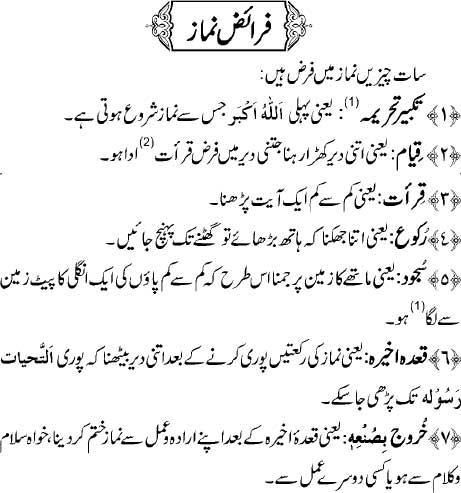
Bareek Kapron Mein Aurat Ki Namaz