

TAG: Sahaba
Adi ibn Hatim Ki Herani
Biography Of A Woman Of Paradise
We do not know precisely how the young Abyssinian girl ended up for sale in Makkah. We do not know her ‘roots’, who her mother was, her father, or her ancestors. There were many like her, boys and girls, Arabs and non-Arabs, who were captured and brought to the slave market of the city to be sold.
A terrible fate awaited some who ended up in the hands of cruel masters or mistresses who exploited their labor to the full and treated them with the utmost harshness.
A few in that inhuman environment were rather more fortunate. They were taken into the homes of more gentle and caring people.
Barakah, the young Abyssinian girl, was one of the more fortunate ones. She was saved by the generous and kind Abdullah, the son of Abd al-Muttalib. ‘She became the only servant in his household and when he was married, to the lady Aminah, she looked after her affairs as well.
Two weeks after the couple were married, according to Barakah, Abdullah’s father came to their house and instructed his son to go with a trading caravan that was leaving for Syria. Aminah was deeply distressed and cried:
“How strange! How strange! How can my husband go on a trading journey to Syria while I am yet a bride and the traces of henna are still on my hands.”
Abdullah’s departure was heartbreaking. In her anguish, Aminah fainted. Soon after he left, Barakah said: “When I saw Aminah unconscious, I shouted in distress and pain: ‘O my lady!’ Aminah opened her eyes and looked at me with tears streaming down her face. Suppressing a groan she said: “Take me to bed, Barakah.”
“Aminah stayed bedridden for a long time. She spoke to no one. Neither did she look at anyone who visited her except Abd al-Muttalib, that noble and gentle old man. “Two months after the departure of Abdullah, Aminah called me at dawn one morning and, her face beaming with joy, she said to me:
“O Barakah! I have seen a strange dream.” “Something good, my lady,” I said.
“I saw lights coming from my abdomen lighting up the
mountains, the hills, and the valleys around Makkah.” “Do you feel pregnant, my lady?”
“Yes, Barakah,” she replied. “But I do not feel any discomfort as other women feel.” “You shall give birth to a blessed child who will bring goodness,” I said.
So long as Abdullah was away, Aminah remained sad and melancholic. Barakah stayed at her side trying to comfort her and make her cheerful by talking to her and relating stories. Aminah however became even more distressed when Abd al-Muttalib came and told her she had to leave her home and go to the mountains as other Makkans had done because of an impending attack on the city by the ruler of Yemen, someone called Abrahah. Aminah told him that she was too grief-stricken and weak to leave for the mountains but insisted that Abrahah could never enter Makkah and destroy the Kabah because it was protected by the Lord. Abd al-Muttalib became very agitated but there was no sign of fear on Aminah’s face. Her confidence that the Kabah would not be harmed was well-founded. Abrahah’s army with an elephant in the vanguard was destroyed before it could enter Makkah.
Day and night, Barakah stayed beside Aminah. She said: “I slept at the foot of her bed and heard her groans at night as she called for her absent husband. Her moans would awaken me and I would try to comfort her and give her courage.”
The first part of the caravan from Syria returned and was joyously welcomed by the trading families of Makkah. Barakah went secretly to the house of Abd al-Muttalib to find out about Abdullah but had no news of him. She went back to Aminah but did not tell her what she had seen or heard in order not to distress her. The entire caravan eventually returned but not with Abdullah.
Later, Barakah was at Abd al-Muttalib’s house when news came from Yathrib that Abdullah had died. She said: “I screamed when I heard the news. I don’t know what I did after that except that I ran to Aminah’s house shouting, lamenting for the absent one who would never return, lamenting for the beloved one for whom we waited so long, lamenting for the most beautiful youth of Makkah, for Abdullah, the pride of the Quraysh.
“When Aminah heard the painful news, she fainted and I stayed by her bedside while she was in a state between life and death. There was no one else but me in Aminah’s house. I nursed her and looked after her during the day and through the long nights until she gave birth to her child, “Muhammad”, on a night in which the heavens were resplendent with the light of God.”
When Muhammad was born, Barakah was the first to hold him in her arms. His grandfather came and took him to the Kabah and with all of Makkah, celebrated his birth. Barakah stayed with Aminah while Muhammad was sent to the badiyah with the lady Halimah who looked after him in the bracing atmosphere of the open desert. At the end of five years, he was brought back to Makkah and Aminah received him with tenderness and love and Barakah welcomed him “with joy, longing, and admiration”.
When Muhammad was six years old, his mother decided to visit the grave of her husband, Abdullah, in Yathrib. Both Barakah and Abd al-Muttalib tried to dissuade her. Aminah however was determined. So one morning they set off- Aminah, Muhammad, and Barakah huddled together in a small hawdaj mounted on a large camel, part of a huge caravan that was going to Syria. In order to shield the tender child from any pain and worry, Aminah did not tell Muhammad that she was going to visit the grave of his father.
The caravan went at a brisk pace. Barakah tried to console Aminah for her son’s sake and much of the time the boy Muhammad slept with his arms around Barakah’s neck.
The caravan took ten days to reach Yathrib. The boy Muhammad was left with his maternal uncles of the Banu Najjar while Aminah went to visit the grave of Abdullah. Each day for a few weeks she stayed at the grave. She was consumed by grief.
On the way back to Makkah, Aminah became seriously ill with fever. Halfway between Yathrib and Makkah, at a place called al-Abwa, they stopped. Aminah’s health deteriorated rapidly. One pitch dark night, she was running at a high temperature. The fever had got to her head and she called out to Barakah in a choking voice.
Barakah related: “She whispered in my ear: ‘O Barakah, I shall depart from this world shortly. I commend my son Muhammad to your care. He lost his father while he was in my abdomen. Here he is now, losing his mother under his very eyes. Be a mother to him, Barakah. And don’t ever leave him.’
“My heart was shattered and I began to sob and wail. The child was distressed by my wailing and began to weep. He threw himself into his mother’s arms and held tightly onto her neck. She gave one last moan and then was forever silent.”
Barakah wept. She wept bitterly. With her own hands, she dug a grave in the sand and buried Aminah, moistening the grave with whatever tears were left in her heart. Barakah returned with the orphan child to Makkah and placed him in the care of his grandfather. She stayed at his house to look after him. When Abd al-Muttalib died two years later, she went with the child to the house of his uncle Abu Talib and continued to look after his needs until he was grown up and married the lady, Khadijah.
Barakah then stayed with Muhammad and Khadijah in a house belonging to Khadijah. “I never left him and he never left me,” she said. One day Muhammad, may Allah bless him and grant him peace, called out to her and said: “Ya Ummah!” (He always called her “Mother”.) “Now I am a married man, and you are still unmarried. What do you think if someone should come now and ask to marry you?” Barakah looked at Muhammad and said: “I shall never leave you. Does a mother abandon her son?” Muhammad smiled and kissed her head. He looked at his wife Khadijah and said to her: “This is Barakah. This is my mother after my own mother. She is the rest of my family.”
Barakah looked at the lady Khadijah who said to her: “Barakah, you have sacrificed your youth for the sake of Muhammad. Now he wants to pay back some of his obligations to you. For my sake and his, agree to be married before old age overtakes you.”
“Whom shall I marry, my lady?” asked Barakah. “There is here now Ubayd ibn Zayd from the Khazraj tribe of Yathrib. He has come to us seeking your hand in marriage. For my sake, don’t refuse.”
Barakah agreed. She married Ubayd ibn Zayd and went with him to Yathrib. There she gave birth to a son whom she called Ayman and from that time onwards people called her “Umm Ayman” the mother of Ayman.
Her marriage however did not last very long. Her husband died and she returned once more to Makkah to live with her “son” Muhammad in the house of the lady Khadijah. Living in the same household at the time was Ali ibn Abi Talib, Hind (Khadijah’s daughter by her first husband), and Zayd ibn Harithah.
Zayd was an Arab from the tribe of Kalb who was captured as a boy and brought to Makkah to be sold in the slave market. He was bought by Khadijah’s nephew and put in her service. In Khadijah’s household, Zayd became attached to Muhammad and devoted himself to his service. Their relationship was like that of a son to a father. Indeed when Zayd’s father came to Makkah in search of him, Zayd was given the choice by Muhammad of either going with his father or staying with him. Zayd’s reply to his father was:
“I shall never leave this man. He has treated me nobly, as a father would treat his son. Not a single day have I felt that I am a slave. He has looked after me well. He is kind and loving towards me and strives for my enjoyment and happiness. He is the noblest of men and the greatest person in creation. How can I leave him and go with you?… I shall never leave him.”
Later, in public Muhammad proclaimed the freedom of Zayd. However, Zayd continued to live with him as part of his household and devoted himself to his service.
When Muhammad was blessed with prophethood, Barakah and Zayd were among the first to believe in the message he proclaimed. They bore with the early Muslims the persecution which the Quraysh meted out to them.
Barakah and Zayd performed invaluable services to the mission of the Prophet. They acted as part of an intelligence service exposing themselves to the persecution and punishment of the Quraysh and risking their lives to gain information on the plans and conspiracies of the mushrikin.
One night the mushrikun blocked off the roads leading to the House of al-Arqam where the Prophet gathered his companions regularly to instruct them in the teachings of Islam. Barakah had some urgent information from Khadijah which had to be conveyed to the Prophet. She risked her life trying to reach the House of al-Arqam. When she arrived and conveyed the message to the Prophet, he smiled and said to her:
“You are blessed, Umm Ayman. Surely you have a place in Paradise.” When Umm Ayman left, the Prophet looked at his companions and asked: “Should one of you desire to marry a woman from the people of Paradise, let him marry Umm Ayman.”
Ali the companions remained silent and did not utter a word. Umm Ayman was neither beautiful nor attractive. She was by now about fifty years old and looked rather frail. Zayd ibn al-Harithah however came forward and said:
“Messenger of Allah, I shall marry Umm Ayman. By Allah, she is better than women who have grace and beauty.”
Zayd and Umm Ayman were married and were blessed with a son whom they named Usamah. The Prophet, may Allah bless him and grant him peace, loved Usamah as his own son. Often he played with him, kissed him, and fed him with his own hands. The Muslims would say: “He is the beloved son of the beloved.” From an early age, Usamah distinguished himself in the service of Islam and was later given weighty responsibilities by the Prophet.
When the Prophet migrated to Yathrib, henceforth to be known as al-Madinah, he left Umm Ayman behind in Makkah to look after certain special affairs in his household. Eventually, she migrated to Madinah on her own. She made the long and difficult journey through the desert and mountainous terrain on foot. The heat was killing and sandstorms obscured the way but she persisted, borne along by her deep love and attachment for Muhammad, may God bless him and grant him peace. When she reached Madinah, her feet were sore and swollen and her face was covered with sand and dust.
“Ya Umm Ayman! Ya Ummi! (O Umm Ayman! O my mother!) Indeed for you is a place in Paradise!” exclaimed the Prophet when he saw her. He wiped her face and eyes, massaged her feet, and rubbed her shoulders with his kind and gentle hands.
At Madinah, Umm Ayman played her full part in the affairs of the Muslims. At Uhud, she distributed water to the thirsty and tended the wounded. She accompanied the Prophet on some expeditions, to Khaybar and Hunayn for example.
Her son Ayman, a devoted companion of the Prophet was martyred at Hunayn in the eighth year after the Hijrah. Barakah’s husband, Zayd, was killed at the Battle of Mutah in Syria after a lifetime of distinguished service to the Prophet and Islam. Barakah at this time was about seventy years old and spent much of her time at home. The Prophet, accompanied by Abu Bakr and Umar often visited her and asked: “Ya Ummi! Are you well?” and she would reply: “I am well, O Messenger of Allah so long as Islam is.”
After the Prophet, may Allah bless him and grant him peace, had died, Barakah would often be found with tears in her eyes. She was once asked, “Why are you crying?” and she replied: “By Allah, I knew that the Messenger of Allah would die but I cry now because the revelation from on high has come to an end for us.”
Barakah was unique in that she was the only one who was so close to the Prophet throughout his life from birth to death. Her life was one of selfless service in the Prophet’s household. She remained deeply devoted to the person of the noble, gentle, and caring Prophet. Above all, her devotion to the religion of Islam was strong and unshakable. She died during the caliphate of Uthman. Her roots were unknown but her place in Paradise was assured.
Tajdar e Risalat (PBUH) Aur Sahaba Karam (RA) Ki Dunya Say Kinara Kashi
Khulfa-e-Rashideen
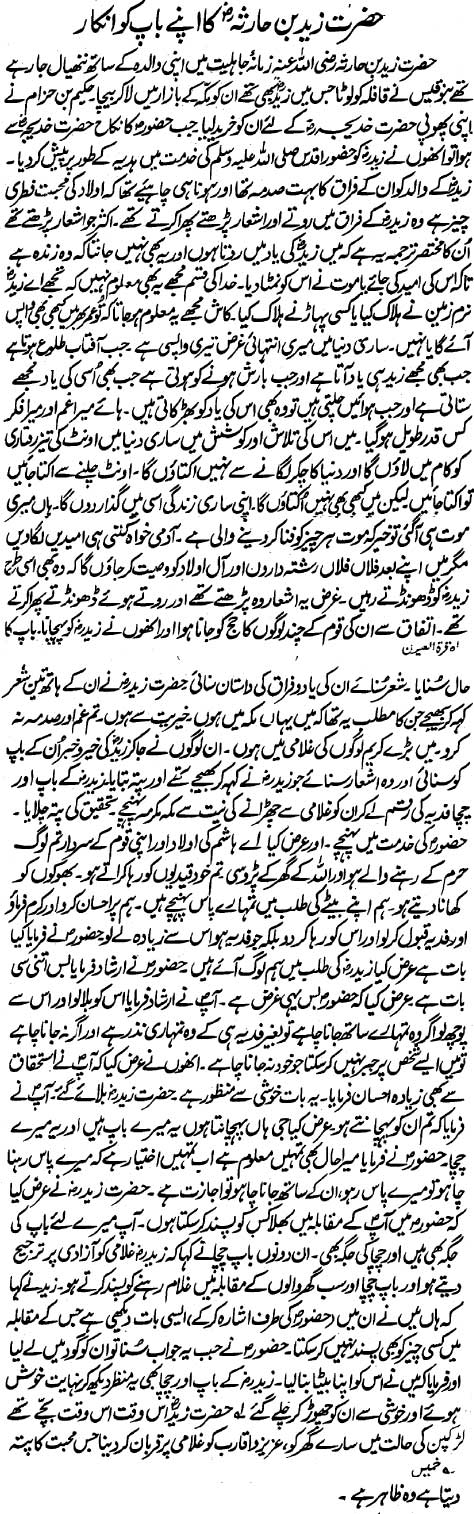
Zaid Bin Harisah (RA) Ka Apne Baap Ko Inkaar
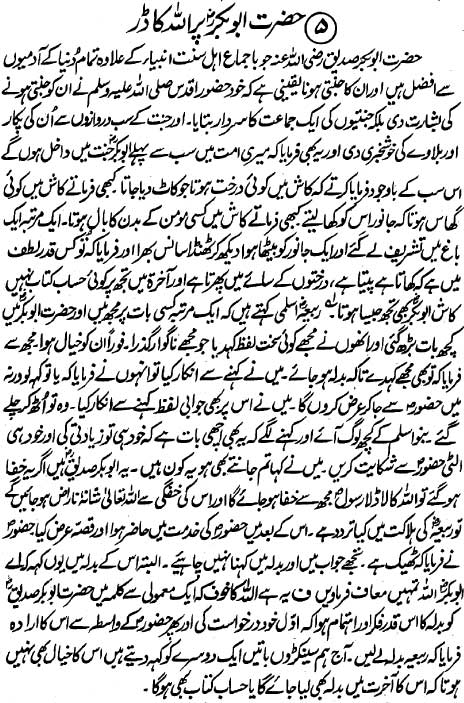
Abu Bakr (RA) Par Allah Ka Dar
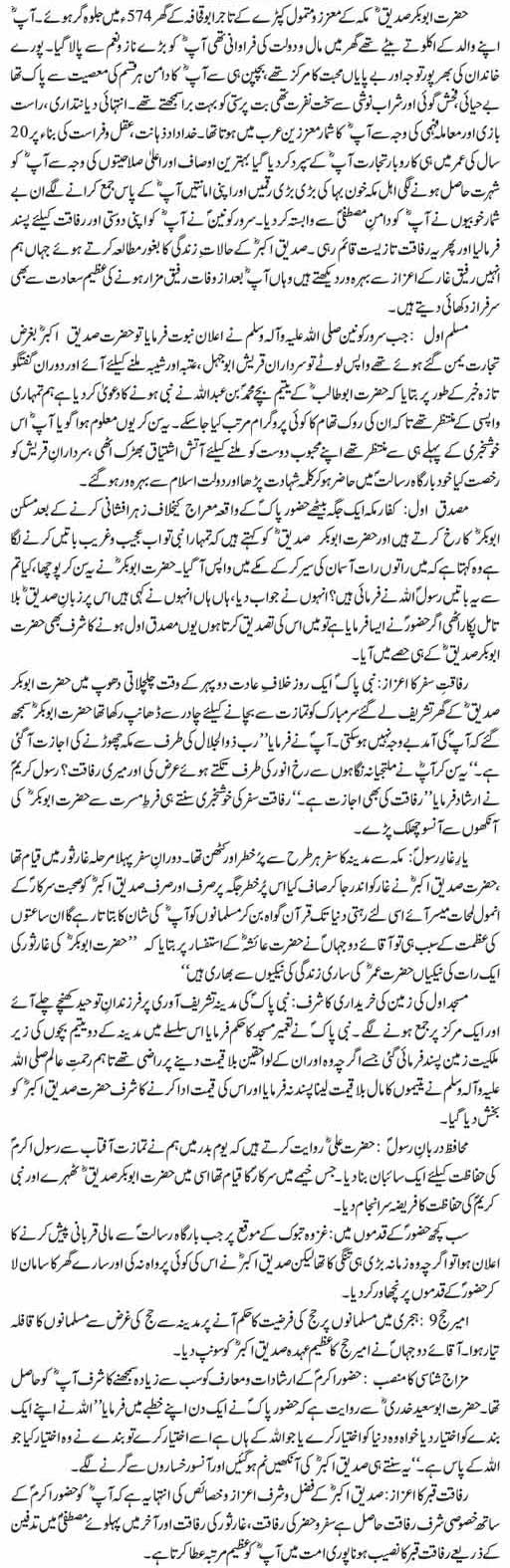
Khasais Siddique e Akbar
Seerat e Hazrat Syedna Siddique e Akbar (Hisa Chaharam)

by Mufti Munib ur Rehman
Wfe Of Abu Bakr Siddique And The Mother Of ‘Aishah
She was the wife of Abu Bakr Siddique and the mother of ‘Aishah. Thus she was the Prophet’s [sallallahu Alayhi wa sallam] mother-in-law. Her son, ‘Abdur-Rahman bin Abu Bakr Siddique, was an excellent horseman, and master strategist in war. It was she who taught him the meaning of valor and courage. Her real name was Zainab, but she came to be known by her family name. She was a patient and tolerant lady who did not jump to hasty conclusions but gave matters deep thought. This was evident in the way she handled the incident when people of loose tongues and small minds accused ‘Aishah of adultery. When her husband explained to her the teachings of Islam she did not linger with doubts about giving up the religion of her forefathers. She immediately saw the greatness of Islam and accepted it.
She was brought up in an area of Arabia known as Sarat. When she grew up she married a young man from her tribe named ‘Abdullah bin Harith bin Sakhbarah Azdi. She had a son by him, who was named Tufail bin ‘Abdullah. They then moved to Makkah, where he became the partner and companion of Abu Bakr Siddique. However, soon after this, ‘Abdullah bin Harith passed away, and his widow and son were left with no support. Seeing her precarious condition Abu Bakr Siddique married her. Umm Rooman was very happy in her marriage and soon, a son, ‘AbdurRahman, and a daughter, ‘Aishah was born. Before he came into the fold of Islam, Abu Bakr Siddique was married to Qateelah bint Abdul-‘Uzza by whom he already had a daughter Asma’ and a son, ‘Abdullah.
Umm Rooman had accepted Islam in its earliest days. It is written in Tabaqat Ibn Sad that Umm Rooman accepted Islam in the very early days in Makkah. She swore allegiance at the hand of the Prophet [sallallahu alayhi wa sallam] himself and then migrated with the blessed group of immigrants.
When she witness the terrible atrocities committed by the Quraish against the Muslims she would suffer and weep for the innocent victims, but she gained courage when she saw the moral strength and exemplary sacrifice of her husband for the cause of Islam. She drew inspiration from him and found peace in his presence.
The Prophet [sallallahu Alayhi wa sallam] also used to exhort his faithful followers not to waver, but to be patient and hold steadfast to their faith, for they would surely in the Hereafter be rewarded with Paradise.
During this long period, Umm Rooman remained an image of patience, forbearance, courage, and bravery. Most of her time was spent in earnest supplications and prayers to Allah. When she saw her husband’s devoted efforts for the propagation of Islam she expressed her admiration and gave him moral support. She devoted her time to the nurturing of her children in the traditions of Islam. The Prophet [sallallahu Alayhi wa sallam] often used to visit the house of his illustrious follower, Abu Bakr Siddique. He would advise Umm Rooman to keep encouraging and instilling the love of goodness in ‘Aishah. Khadijah passed away three years before the migration of the Prophet [sallallahu alayhi wa sallam] to Madinah. The Prophet [sallallahu alayhi wa sallam] spent a year as an unmarried person He then married Aisha at the command of Allah as delivered by the Angel Jibril, that on three consecutive nights he saw her in his dreams. The Angel Jibril brought a picture of hers wrapped in a silken cloth and told him that this was an image of his bride. When he removed the cover he saw that it was her image. ‘Aishah was elated to hear that she was chosen to be the Prophet’s [sallallahu alayhi wa sallam] wife by Allah himself. Khawlah bint Hakim told him there were two proposals for him, that of ‘Aishah bint Abu Bakr Siddique and Saudah bint Zam’ah. He accepted both, and thus Umm Rooman’ had the honor of becoming his mother-in-law.
When the Prophet [sallallahu alayhi wa sallam] was ordered by Allah to migrate to Madinah he went to the house of his closest friend and Companion, Abu Bakr Siddique. Without any questions or hesitation, he prepared to accompany the Prophet [sallallahu alayhi wa sallam]. He packed a few things and took all the cash there was in the house. He left his father, wife, and children in the trust and care of Allah and set off for an unknown and unseen destination.
It was a very tough time for Umm Rooman she was separated from her husband; and there was a lack of money for household expenses since he had taken all the available cash with him. But what predominated all other thoughts in her mind were supplications to Allah and for the safe arrival of the Prophet [sallallahu alayhi wa sallam] and her husband in Madinah. On reaching their destination safely, she and her family were told to follow Madinah.
When they reached Al-Madinah they stayed at the house of Abu Bakr Siddique arranged for his family. And it was from this house that ‘Aishah left as a bride to the Prophet’s [sallallahu alayhi wa sallam] house. Thus this house became the focal point for the revelations of Allah. Umm Rooman expressed great happiness at the thought that her daughter would be one of those who joined the ranks of the blessed.