TAG: Sahaba
Great Muslims: Mu’adh Bin Jabal
MU’ADH Bin Jabal was a young man growing up in Yathrib as the light of guidance and truth began to spread over the Arabian Peninsula.
He was a handsome and imposing character with black eyes and curly hair and immediately impressed whoever he met. He was already distinguished for the sharpness of his intelligence among young men of his own age. The young Mu’adh became a Muslim at the hands of Musab Bin Umayr, the daiyah (missionary) whom the Prophet (peace be upon him) had sent to Yathrib before the Hijrah. Mu’adh was among the seventy-two Yathribites who journeyed to Makkah, one year before the Hijrah (immigration), and met the Prophet at in his house and later again in the valley of Mina, outside Makkah, at Aqabah. Here the famous second Aqabah Pledge was made at which the new Muslims of Yathrib, including some women, vowed to support and defend the Prophet at any cost. Mu’adh was among those who enthusiastically clasped the hands of the blessed Prophet then and pledged allegiance to him.
As soon as Mu’adh returned to Madina from Makkah, he and a few others of his age formed a group to remove and destroy idols from the houses of the Mushrikeen (polytheists) in Yathrib. One of the effects of this campaign was that a prominent man of the city, Amr Bin Al-Jumuh, became a Muslim.
When the noble Prophet reached Madinah, Mu’adh Bin Jabal stayed in his company as much as possible. He studied the Qur’an and the laws of Islam until he became one of the most well-versed of all the companions in the religion of Islam.
Wherever Mu’adh went, people would refer to him for legal judgments on matters over which they differed. This is not strange since he was brought up in the school of the Prophet himself and learnt as much as he could from him. He was one of the best pupils of the best teacher. His knowledge bore the stamp of authenticity. The best certificate that he could have received came from the Prophet himself when he said: “The most knowledgeable of my ummah (nation)in matters of Halal (lawful) and haram (unlawful) is Mu’adh Bin Jabal.”
One of the greatest of Mu’adh’s contributions to the Ummah of Muhammad was that he was one of the group of six who collected the Qur’an during the lifetime of the Prophet. Whenever a group of companions met and Mu’adh was among them, they would look at him with awe and respect on account of his knowledge. The Prophet and his two caliphs after him placed this unique gift and power in the service of Islam.
After the conquest of Makkah, the Quraysh embraced Islam en masse. The Prophet immediately saw the need of the new Muslims for teachers to instruct them in the fundamentals of Islam and to make them truly understand the spirit and letter of its laws. He appointed Attab Bin Usay as his deputy in Makkah and he asked Mu’adh Bin Jabal to stay with him and teach people the Qur’an and instruct them in the religion.
Sometime after the Prophet had returned to Madina, messengers of the kings of Yemen came to him announcing that they and the people of Yemen had embraced Islam. They requested that some teachers should be with them to teach Islam to the people. For this task the Prophet commissioned a group of competent Duaat (missionaries) and made Mu’adh Bin Jabal their leader. He then put the following question to Mu’adh:
“According to what will you judge?”
“According to the Book of God,” replied Mu’adh.
“And if you find nothing therein?”
“According to the Sunnah of the Prophet (pbuh) of God.”
“And if you find nothing therein?”
“Then I will exert myself (exercise ijtihad) to form my own judgment.”
The Prophet (pbuh) was pleased with this reply and said: “Praise be to God Who has guided the messenger of the Prophet (pbuh) to that which pleases the Prophet (pbuh).”
The Prophet personally bade farewell to this mission of guidance and light and walked for some distance alongside Mu’adh as he rode out of the city. Finally he said to him:
“O Mu’adh, perhaps you shall not meet me again after this year. Perhaps when you return you shall see only my mosque and my grave.” Mu’adh wept. Those with him wept too. A feeling of sadness and desolation overtook him as he parted from his beloved Prophet, peace and blessings of God be on him.
The Prophet(pbuh)’s premonition came true. The eyes of Mu’adh never beheld the Prophet(pbuh) after that moment. The Prophet(pbuh) died before Mu’adh returned from Yemen.
There is no doubt that Mu’adh wept when he returned to Madinah and found there was no longer the blessed company of the Prophet (pbuh).
Mu’adh went to Palestine. There Mu’adh fell ill with an infectious disease. As he was near death, he turned in the direction of the Kabah and repeated this refrain: “Welcome Death, Welcome. A visitor has come after a long absence . . .” And looking up to heaven, he said: “O Lord, You know that I did not desire the world and to prolong my stay in it . . . O Lord, accept my soul with goodness as you would accept a believing soul…”
He then passed away, far from his family and his clan in the service of God.
Tabi kay Fazail

Hazrat Abu Bakr Siddique(Radi Allah Unho)
Early Life
Sayyiduna Abu Bakr (radi Allahu anhu’s) real name was Abdullah, and he was given the title of “As Siddique” or”Testifier to the Truth.” His father, ‘Uthman, was known as Abu Quhafah and his mother, Salma, was known as Ummul Khair. He was two and a half years younger than Sayyiduna Rasulullah (sallal laahu alaihi wasallam).
He was the first among the Sahaba to accept Islam. He accompanied Sayyiduna Rasulullah (sallal laahu alaihi wasallam) during the Hijrah to Madinatul Munawwarah. Sayyiduna Abu Bakr (radi Allahu anhu) was a merchant. He freed many slaves, including Sayyiduna Bilal (radi Allahu anhu) and Sayyiduna Umayyah bin Qahaf (radi Allahu anhu). He participated in all the battles in which Sayyiduna Rasulullah (sallal laahu alaihi wasallam) had to fight the Kuffar.
Sayyiduna Abu Bakr (radi Allahu anhu) loved his faith more than anything else. At the Battle of Badr, his son, Sayyiduna Abdur Rahman (radi Allahu anhu), was fighting on the side of the Kuffar. After accepting Islam, Sayyiduna Abdur Rahman (radi Allahu anhu) said to his father, “O Father, at Badr, you were twice under my sword, but my love for you held my hand back.” To this, Sayyiduna Abu Bakr (radi Allahu anhu) replied, “Son, if I had you only once under my sword, you would have been no more.” He was so uncompromising in his faith.
At the time of the Battle of Tabuk, he donated all his wealth to the war effort, and when Sayyiduna Rasulullah (sallal laahu alaihi wasallam) asked him, “What have you left for your family,?” he replied, “Allah and His Rasool (sallal laahu alaihi wasallam).”
As A Caliph
After his election as the Caliph, Sayyiduna Abu Bakr (radi Allahu anhu) addressed the Muslims with these words:
“O People! I have been chosen by you as your leader, although I am no better than any of you. If I do any wrong, set me right. Listen, truth is honesty and untruth is dishonesty. The weak among you are the powerful in my eyes, as long as I do not give them their dues. The powerful among you are weak in my eyes, as long as I do not take away from them what is due to others.
“Listen carefully, if people give up striving for the Cause of Almighty Allah, He will send down disgrace upon them. If people become evil-doers, Almighty Allah will send down calamities upon them.
“Obey me as long as I obey Allah and His Rasul (sallal laahu alaihi wasallam). If I disobey Allah and His Rasul (sallal laahu alaihi wasallam), you are free to disobey me.”
Such was the first Caliph of Islam. Indeed, the world would be a better place to live in, if we had leaders like Sayyiduna Abu Bakr (radi Allahu anhu).
Sayyiduna Abu Bakr (radi Allahu anhu) now sent Sayyiduna Usamah (radi Allahu anhu) on the expedition to Syria to fight the Romans, even though he had to attend to all the internal problems of the Islamic State.
The news that Sayyiduna Rasulullah (sallal laahu alaihi wasallam) had passed away, made some new Muslims think that the Islamic State would crumble and they refused to pay the Zakaah. These new Muslims could not yet get used to their faith and its requirements until then. Sayyiduna Abu Bakr (radi Allahu anhu) declared, “By Allah! Even if a single thread is due from a man, he must give it. If he refuses, I will declare war against him.”
Passes Away
Sayyiduna Abu Bakr (radi Allahu anhu) fell ill at this time and passed away on the 21st of Jamadi-ul-Aakhir 13 A.H. (22 August 634). His rule lasted 2 years and 3 months. He was 63 years old.
One of the many contributions of Sayyiduna Abu Bakr (radi Allahu anhu) was the collection and compilation of the Holy Quran.
Personal Life
He lived a very simple, pious and upright life. He was a true servant of Almighty Allah and a meticulous follower of Sayyiduna Rasulullah (sallal laahu alaihi wasallam).
He wore ordinary clothes and his meals were very simple. He attended to house-hold work and would go out at night and seek the poor and destitute. Humility and modesty were the keynotes of his character. He felt embarrassed when people showered praises on him or showed him immense respect. He often fasted during the day and spent the whole night in Salaah and meditation. He was a great orator and a master of genealogy (one who can trace a person’s family line). In personal life, he was a Saint. He used all his powers to promote the interest of Islam and the good of people.
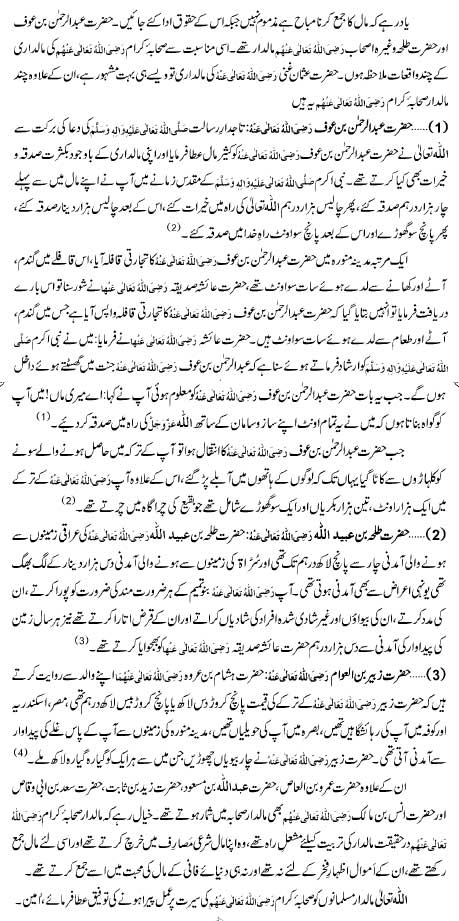
Maal Jama Karney Ka Hukam Aur Sahaba Kay Waqiyat

A Loving Father
While Abu- Dardaa (R.A. – may Allah be pleased with him) was in Damascus, Muawiyah ibn Abi Sufyan, its governor, asked him to give his daughter in marriage to his son, Yazid. Abu- Dardaa did not agree. Instead he gave his daughter in marriage to a young man from among the poor whose character and attachment to Islam pleased him. People heard about this and began talking and asking: Why did Abu- Dardaa refuse to let his daughter marry Yazid? The question was put to Abu- Dardaa himself and he said: “I have only sought to do what is good for ad-Dardaa (his daughter).”
How?” inquired the person.
“What would you think of ad-Dardaa if servants were to stand in her presence serving her and if she were to find herself in palaces the glamour of which dazzled the eyes? What would become of her religion then?” (He desired to protect her and her faith from the pomp and glitter that world has to offer).
Amazing father Subhan Allah.
Prophet Muhammad: Great People Flock To A Great Man
The early companions of the Prophet (peace be upon him), who accepted Islam in its early days when it was opposed by the powerful, the rich and the nobles of their community, were a group of great men.
It is only a person of high caliber that accepts a message that declares at the outset that it aims to change the life of individuals and society, doing so only after he examines it carefully, sets aside hostile propaganda and identifies its merits. Hence, we are not surprised that this elite group included a long line of great people. Yet they exhibited different aspects of greatness. Among them there were those who excelled as military commanders and those who were superior in moral courage. Some were distinguished by high family descent, yet were personally of high caliber. Others showed nobility of character. Some had great minds and souls, but lacked the material means to achieve the sort of distinction they deserved, while others came to Islam from a highly distinguished social position. What brought them all together was their profound faith in Islam and their love of Prophet Muhammad (peace be upon him).
When a person excels in a particular field, it will not be surprising that his closest friends would be interested in that field. An excellent sportsman will attract people who are enthusiastic about sport, whether they play a particular game or are simply viewers who enjoy watching it. A scholar will attract only those who are interested in learning and reading. Indeed, a great Prophet will be surrounded by pious people, just like Jesus had his group of disciples. In the case of Prophet Muhammad (peace be upon him) we find that great people who excelled in a wide spectrum of areas getting very close to him. Every one found with him what responded to his own greatness. None felt out of place with him. In fact, it is very difficult to say that a particular type of greatness was closer to him. All these people felt very close. What is more is that they recognized their own differences and respected each other’s excellence. When they were called upon to provide leadership in different areas, they proved to be great indeed. With the Prophet, however, they were close friends, followers and supporters. Each one was ready to lay down his life for the Prophet’s sake.
How could he maintain such friendships with so many different types and characters? The answer is that he loved every one of them, and he was sincere in his love. He reciprocated their good feelings, giving always much more than he received. Moreover, he was always ready to point out their goodness and to acknowledge their favors. Referring to his closest companion, he said: “Abu Bakr is the one who has done me the greatest favors ever. He supported me with his life and property, and he gave me his daughter to marry.” He also said: “Abu Bakr and Umar are to me like my sight and hearing.” Mentioning some of his companions, he said: “God has commanded me to love four people telling me that He loves them. Ali is one of them. The others are Abu Dharr, Al-Miqdad and Salman.”
His love of mankind was exemplary. He never retaliated for a personal injury, physical or mental. He was always ready to pardon anyone who took a hostile attitude to him. Indeed, he pardoned someone who lifted up his sword aiming to kill him, when that person’s sword fell off. Whenever there was a chance to make peace with an enemy, he immediately took that chance. Hence, it is not surprising that even his most hardened enemies often spoke highly of his nobility and integrity.
– By Adil Salahi
Hazrat Umm e Mabad

Hazrat Abdullah Bin Abbas (R.A)

Women Companions Of Prophet Umm Al-Dahdah: Islamic Values In Action
Among the most important values Islam implants in the minds of its followers are those that formulate the Islamic perception of our present life. Islam makes clear that this life is a test. If we pass this test, then we are ushered into a life of pure happiness in the hereafter.
Those of us who fail the test sink into perpetual misery. While Islam wants us to work hard in order to build a high standard of life worthy of man, the creature, God has placed in charge of earth, it also aims to give us the right perspective, viewing this life and all that it offers as transitory. Hence, all possessions and life itself can be sacrificed for a higher goal.
Umm Al-Dahdah and her husband and family were among the early Muslims from Madinah. After Islam began to establish itself in Madinah, the Prophet (peace be upon him) sent his companion, Musab ibn Umair, to teach the new Muslim converts there the Qur’an and how to lead an Islamic life. Among the first people to convert to Islam at the time was Thabit ibn Al-Dahdah, his wife Umm Al-Dahdah and their entire family.
When the Prophet immigrated to Madinah with his companions from Makkah, the process of learning about Islam among the Ansar took a much faster pace. The people there tried to catch up with their brethren from Makkah in understanding Islamic principles and putting them into effect.
Thabit read the Qur’anic verse that says: “Who will offer God a generous loan, which He will repay in multiples and will generously reward him?” (57: 11) He said to the Prophet: “How come God asks us for a loan when He is in no need for anyone?” The Prophet said: “He wants it so that He will admit you to heaven in return.”
Thabit said: “If I give a loan to my Lord, will He guarantee me heaven as well as to my children?” The Prophet said that it was so. Thabit said: “Give me your hand. I have two orchards: one in the highland and one in the lowland. I have no other possession. I am making them both a loan to God.”
The Prophet said: “Make one of them for God and hold on to the other for your family’s living.” Thabit said: “Then be my witness that I am making the better one for God. It is an orchard that contains 600 date trees.” The Prophet said: “Then God will reward you for it with admission into heaven.”
What Thabit did was exceptional by any standard. Yet what was his wife’s attitude? We can imagine any woman’s reaction when her husband tells her that he donated half his property to a noble cause. She would naturally think of the effect of such donation on her children’s lives. Yet Umm Al-Dahdah said to her husband: “You have done a profitable deal.”
She immediately gathered her children who were in that orchard, emptied their pockets of any dates they had gathered, and even took whatever was in their hands. She told them that that orchard no longer belonged to them.
In the Battle of Uhud, when Muslims were in chaos, Thabit was one of the few who remained steadfast. He gathered a group of the Ansar fighters around him and fought hard to repel the unbelievers’ attack. They were heavily outnumbered by enemy forces.
He was one of the Muslim martyrs. When the news of his death was broken to his wife, she did not lament, because she knew that a martyr remains alive in heaven. She was keen to know that the Prophet was safe. When she saw him, she said: “Any tragedy is light, as long as you are safe.”
We see her attitude toward sacrificing life and property. In both cases she was exemplary, demonstrating that Islamic values were deeply rooted in her heart.