
Bukhari Shareef Ka Taruf
TAG: Sahih al-Bukhari
Imam Bukhari: The Founder Of Hadith Science
Imam Bukhari is a name that creates a sense of reverence and respect in every Muslim’s heart. He was one of the greatest scholars of Islam and the founder of Hadith science. His prestigious compilation named Jame Al-Sahih is regarded as the second authentic book of Islam after the Holy Qur’an.
It was in the second century Hijrah when most of the Sahaba who had learned Islam from the Holy Prophet (peace be upon him) directly were diminishing one after another. The last of the Prophet’s companions passed away in 110 A.H. Subsequently, a possibility of misquoting the Prophet (peace be upon him) by some people with vested interest was quite apparent. So it was essential to collect and authenticate true Hadiths without the sponsorship of any ruling authority, regional or national. It was a gigantic work to collect all the prevailing statements and to classify them into the relevant categories, as authentic, good, poor, and false.
This was a great task, which Imam Bukhari, a non-Arab from Khorasan, shouldered. He spent 16 years searching, collecting, and refining the material of Hadith. Not only this, he fixed the most rigid rules to evaluate and authenticate any circulating Hadith. Thus he is known as the Founder of Hadith science. The rest of his life was spent teaching and propagating the Hadith literature. One of his students, Imam Muslim, rose to the second position in the world in the Hadith compilation.
Imam Bukhari was born in Bukhara in 196 A.H. (810 A.D.) now in Uzbekistan). His father died when he was still young. He had lost his sight in infancy but his mother’s prayers and invoking blessed him a sharp sight and sharp memory that enabled him to read and write in the moonlight and if he had read or heard something, it would remain in his memory forever.
He memorized the Holy Qur’an at the age of 9. Then began to learn Hadith from scholars of his region. At the age of 18, he traveled to Makkah and stayed there for 16 years collecting Hadiths. He visited Egypt and Syria twice, Basra four times, spent many years in Hijaz, and went to Kufa and Baghdad many times. It is said that he learned about 600,000 Hadith from more than 1,000 scholars.
While returning to Bukhara after 16 years he began to compile Jame Al Sahih. He judged 7,275 Hadith from his large collection and arranged them in 93 chapters. Though Imam Bukhari wrote many books, he shot to prominence because of Tarikh Al-Kabeer, Adab Al-Mufrad, and Sahih Al-Bukhari. The first one he wrote in full moon nights at the Prophet’s Mosque in Madinah. Imam Bukhari had a very sharp memory. He memorized 70,000 Hadiths at an early age and later in his life, this figure reached 300,000. Among those 100,000 Hadiths were Sahih and 200,000 were Hasan, Da`îf, etc.
In 250 A.H. he settled at Neshapur where he met Muslim ibn Al Hujjaj as his disciple who compiled Sahih Al-Muslim which is regarded only second to Bukhari in the Muslim world.
Imam Bukhari’s book on Hadith is regarded as the top of Sahah Sitta which are the most authentic six books of Hadith collected during 200-300 AH. These are:
• Sahih Bukhari by Imam Bukhari (D. 256 A.H.),
• Sahih Muslim by Muslim ibn Al Hujjaj (D. 261 A.H.),
• Sunan Al-Sughra by Al-Nasa’i (D. 302 A.H.)
• Sunan Abu Dawood by Abu Dawood (D. 274 A.H.)
• Jami Al-Tirmidhi by Al-Tirmidhi (D. 278 A.H.)
• Sunan ibn Majah by Ibn Majah (D. 273 A.H.)
Hafiz Ahmad bin Adi has described that when Imam Bukhari reached Baghdad, the leading scholars tried to test him and mixed 100 Hadith between the narrators’ chain and the text and gave to 100 persons to ask the authenticity of such Hadiths. Imam Bukhari said he never heard any Hadith like this. Then he repeated the incorrect Hadith as quoted by each questioner and then recited the corrected Hadith for each person separately. The people were astonished at the depth of his knowledge and paid great respect to him.
Imam Bukhari was a rich person but he lived the life of a very simple man giving most of his income to the poor. Mohammed Hatim Warraq, one of his disciples said that when Imam was establishing a Sarai (inn) near the city of Bukhara, he was laying bricks with his own hands. When Warraq said to him, leave this job for me, he replied, “On the Day of Judgment this work will be of benefit to me.” Regarding his worship, it is said that Imam recited the entire Qur’an daily in Ramadan and recited one-third of it in the night prayers.
In 250 A.H., Imam Bukhari moved to Neshapur where he was well received. Imam Muslim Neshapuri said he had never seen such a grand reception given to any scholar or ruler. Imam Bukhari began his lectures, which were attended by thousands. His popularity irritated the local ruler and Imam Bukhari decided to leave Neshapur for Bukhara where again he was received with great enthusiasm. He began his lectures and also established a school for regular teaching. But after some time due to differences with the local ruler, he decided to leave his hometown for Samarqand.
But when he was still a few miles away from the city he was prevented from entering it. When he found he had no place to go, he prayed to Almighty Allah saying, “O Allah, the Earth despite its grandeur is becoming narrow for me and is troubling me greatly. So take me back to You.” His prayers were answered and he died at Khartang, a place between Samarqand and Bukhara. It was on the night of Eid Al-Fitr, the first night of Shawwal 256 A.H. He is buried in Muhammad Al-Bukhari mausoleum at Khartang near Samarkand, in Uzbekistan
“Abd Al-Wahid ibn Adam Awaysi states: ‘I saw the Holy Prophet (peace be upon him) in a dream standing with a group of Sahaba and asked, ‘For whom are you waiting?’ He replied, ‘For Bukhari.’ After a few days, I heard the news of Imam Bukhari’s death. He had died at the very moment that I saw the Prophet (PBUH) in my dream.”
Sahih Al Bukhari is regarded as the most authentic collection of Hadiths, which covers almost all aspects of human life in providing proper guidance from the Holy Prophet. As for piety, Imam Al-Bukhari never wrote any Hadith in this book without performing two rakah salat of guidance from Allah and when he was sure of its authenticity, only then he wrote it in the book.
Imam Bukhari lived for 62 years only but during his span of life, he did a marvelous work, which has been guiding the Ummah for the last 1,200 years. Tens of commentaries have been written on his treatise and hundreds of scholars are teaching Bukhari to thousand of students daily around the world. May Almighty Allah grant him the best reward.
– by ABU TARIQ HIJAZI
Do Not Shed Blood Of Muslims
Narrated by Abdullah (Radhiallaho anho): Allah’s Messenger (sallallaahu ‘alaihi wasallam) said, “The blood of a Muslim who confesses that none has the right to be worshiped but Allah and that I am His Apostle, cannot be shed except in three cases: In Qisas for murder, a married person who commits illegal sexual intercourse and the one who reverts from Islam (apostate) and leaves the Muslims.“ Sahih Al-Bukhari Vol. 9 : No. 17
Killing an innocent non-Muslim under Muslim protection
Narrated by Abdullah bin Amr (Radhiallaho anho): Allah’s Messenger (sallallaahu ‘alaihi wasallam)said, “Whoever killed a Mu’ahid (a person who is granted the pledge of protection by the Muslims) shall not smell the fragrance of Paradise though its fragrance can be smelt at a distance of forty years (of traveling).” Sahih Al-Bukhari Vol. 9 : No. 49
Irshad-e-Nabvi

Irshad-e-Nabvi
The Minor Signs Of The Last Day
Qiyamah will come when…
Hadhrat Abu Musa Ash’ari (R.A.) narrates that Rasulallah (Sallallahu Alayhi Wassallam) said, “Qiyamah will come…
When it will be regarded as a shame to act on Quranic injunctions.
When untrustworthy people will be regarded as trustworthy and the trustworthy will be regarded as untrustworthy.
When it will be hot in winter.
When the length of days is stretched, i.e. a journey of a few days is covered in a matter of hours.
When orators and lecturers lie openly.
When people dispute petty issues.
When women with children come displeased on account of them bearing offspring, barren women remain happy on account of having no responsibility for offspring.
When oppression, jealousy, and greed become the order of the day.
When people blatantly follow their passions and whims.
When lies prevail over the truth.
When violence, bloodshed, and anarchy become common.
When immorality overtakes shamelessness and is perpetrated publicly.
When legislation matters pertaining to Deen is handed over to the worst elements of the Ummat, and if people accept them and are satisfied with their findings, then such persons will not smell the fragrance of Jannat.
When the offspring become a cause of grief and anger (for their parents).
The following is part of a lengthy Hadith narrated by Hadhrat Abdullah Ibn Mas’ood (R.A.) when he inquired from Rasulallah (Sallallahu Alayhi Wassallam) about the Signs of Qiyamah.
Music and musical instruments will be found in every home.
People will indulge in homosexuality.
There will be an abundance of illegitimate children.
There will be an abundance of critics, tale carriers, back-biters, and taunters in society.
People will establish ties with strangers and sever relations with their near and dear ones.
Hypocrites will be in control of the affairs of the community and evil, immoral people will be at the helm of business establishments.
The Masjid will be decorated, but the hearts of the people will be devoid of guidance.
The courtyards of Masjids will be built beautifully and high mimbars (pulpits) will be erected.
Gangsters and evil people will prevail.
Various wines will be consumed excessively.
Auf bin Malik (R.A.) says: I came to Rasulullah (Sallallahu Alayhi Wasallam) while he was in his skin tent during the Tabuk expedition. He said to me, “Count six things before the advent of Qiyamah:
1 My death
2 The conquest of Jerusalem
3 Mass deaths amongst you people, just as when sheep die in large numbers during an epidemic
4 Abundance of wealth to such an extent that if a person were to be given a hundred Dinars he will still not be satisfied
5 General anarchy and bloodshed, that no Arab household will be spared from it
6 Then a life of peace as a result of a peace agreement between you and the Banil Asfaar
(Romans) which they will break and attack you with a force consisting of eighty flags and under each flag will be an army of twelve thousand men.” (Hadith: Sahih Bukhari).
IRAQ and SYRIA
Abu Nadhrah says: “We were sitting in the company of Jabir bin Abdullah (R.A.) when he said: ‘Soon the people of IRAQ will neither receive any food (grain) nor any money.'” We asked, “Why would such a thing happen?” He replied, “Because of the non-Arabs.” (i.e they will prevent food from going into Iraq, in the form of “sanctions” to this day.) He then said: “Soon the people of Shaam (SYRIA) will neither receive any money nor grain.” We asked why this would happen. He replied: “Because of the Romans (christians).”
CONCEITED PEOPLE:
Hadhrat Abbas (R.A) narrates that Rasulallah (Sallallahu Alayhi Wassallam) has said, “Islam will spread far and wide, across the seas. Horses will cross the land and seas in the cause of Jihaad. Then a time will come wherein a group of people will emerge which recites the Quraan. They will claim,
‘We have recited the Quraan and is there anyone who understands the Quraan better than us? There is NO ONE more proficient than us in the study of the Quraan.’
Then Rasulallah (Sallallahu Alayhi Wassallam) asked the Sahaba, “Do you see any good in their claims?” The Sahaba replied, “No”. Rasulallah (Sallallahu Alayhi Wassallam) said, “But these conceited claimants will be from my Ummah and will be the fuel of the Fire.”
from “Signs of Qiyamah” (excerpts)
by Mohammed Ali Ibn Zubair Ali
The Greatest Gift Which We Received Because of Miraaj
When Miraaj took place, our Prophet (PBUH) received the greatest gift one can ever imagine.
He (PBUH) got to meet our Creator, our Sustainer, Allah SWT himself.
What more can one ask?
But what gift did we (the prophet’s ummah / meaning us) receive?
Did we get flowers/food/fruits/gold/clothes / etc?
No.
Those are materialistic things and we also have them back on our earth.
When the Prophet (PBUH) came back and told his sahabah, they all were very happy on receiving their gift sent by Allah SWT himself.
What gift did the sahaba receive?
The gift to pray compulsory Salah five times a day at fixed hours.
Five times a day…Oh my God.
But consider this, at first Allah SWT first gave His order of offering 50 salah’s a day.
As the Prophet was going back, he (PBUH) was asked by Prophet Moosa (PBUH): What gift did Allah SWT give your ummah?
To which our Prophet (PBUH) replied: Allah SWT has ordered to pray 50 salahs per day.
La Haula Wala Quwata Illa Billah

Narrated Abu Musa (Radi Allah Anhu): While we were with Allah’s Apostle (sal-allahu-alleihi-wasallam) in a holy battle, we never went up a hill or reached its peak or went down a valley but raised our voices with Takbir. Allah’s Apostle (sal-allahu-alleihi-wasallam) came close to us and said, “O people! Don’t exert yourselves, for you do not call a deaf or an absent one, but you call the All-Listener, the All-Seer.” The Prophet (sal-allahu-alleihi-wasallam) then said, “O ‘Abdullah bin Qais! Shall I teach you a sentence that is from the treasures of Paradise? ( It is): ‘La haula wala quwata illa billah. (There is neither might nor power except with Allah).” [Sahih Bukhari: Volume 8, Book 77 ‘Al-Qadar’, Number 607]
Punishments For Not Paying Zakah
Narrated Abu Huraira (radi’Allahu anhu) : Allah’s Apostle (sall’Allahu alaihi wa sallam) said, “Anyone whom Allah has given wealth but he does not pay its zakat, then, on the Day of Resurrection, his wealth will be presented to him in the shape of a bald-headed poisonous male snake with two poisonous glands in its mouth and with two black spots over the eyes. it will encircle itself around his neck and bite him over his cheeks and say, “I am your wealth; I am your treasure.”
Then the Prophet (sall’Allahu alaihi wa sallam) recited this Divine Verse:–
“And let not those who covetously withhold of that which Allah has bestowed upon them of His Bounty.”
(3.180)
{Sahih Bukhari}
(Book #60, Hadith #88) (Book #24, Hadith #486)
Narrated Abu Dhar (radi’Allahu anhu) : Once I went to him (the Prophet ) and he (sall’Allahu alaihi wa sallam) said, “By Allah in Whose Hands my life is (or probably said, ‘By Allah, except Whom none has the right to be worshipped) whoever had camels or cows or sheep and did not pay their zakat, those animals will be brought on the Day of Resurrection far bigger and fatter than before and they will tread him under their hooves and will butt him with their horns, and (those animals will come in a circle): When the last does its turn, the first will start again,
and this punishment will go on till Allah has finished the judgments amongst the people.”
{Sahih Bukhari}
(Book #24, Hadith #539)
Abu Huraira (radi’Allahu anhu) reported
Allah’s Messenger (sall’Allahu alaihi wa sallam) as saying: “If any owner of gold or silver does not pay what is due on him when the Day of Resurrection would come, plates of fire would be beaten out for him; these would then be heated in the fire of Hell and his sides, his forehead, and his back would be cauterized with them. Whenever these cool down, (the process is) repeated during a day the extent of which would be fifty thousand years, until judgment is pronounced among servants, and he sees whether his path is to take him to Paradise or to Hell.
It was said: Messenger of Allah, what about the camel? He (sall’Allahu alaihi wa sallam) said: If any owner of the camel does not pay what is due on him, and of his due in that (camel) is (also) to milk it on the day when it comes down to the water. When the Day of Resurrection comes
a soft sandy plain will be set for him, as extensive as possible, (he will find) that not a single young one is missing, and they will trample him with their hoofs and bite him with their mouths. As often as the first of them passes him, the last of them would be made to return during a day
the extent of which would be fifty thousand years, until judgment is pronounced among servants and he sees whether his path is to take him to Paradise or to Hell. It was (again) said:
Messenger of Allah, what about cows (cattle) and sheep? He (sall’Allahu alaihi wa sallam) said: If any owner of the cattle and sheep does not pay
what is due on them, when the Day of Resurrection comes a soft sandy plain would be spread for them, he will find none of them missing, with twisted horns, without horns or with a broken horn, and they will gore him with their horns and trample him with their hoofs. As often as the first of them passes him the last of them would be made to return to him during a day the extent of which would be fifty thousand years until judgment would be pronounced among the servants. And he would be shown his path leading him to Paradise or to Hell…”
Sahih Muslim (Book #005, Hadith #2161)
If Allah Wants To Do Good To Somebody, He Afflicts Him With Trials
[Sahih Bukhari: Volume 7, Book 70, Number 548]
Narrated Abu Huraira (Radi Allah Anhu): Allah’s Apostle (sal-allahu- alleihi-wasallam ) said, “If Allah wants to do good to somebody, He afflicts him with trials.

[Sahih Bukhari: Volume 7, Book 70, Number 545]
Narrated Abu Sa’id Al-Khudri and Abu Huraira (Radi Allah Anhu): The Prophet Muhammad (sal-allahu- alleihi-wasallam ) said, “No fatigue, nor disease, nor sorrow, nor sadness, nor hurt, nor distress befalls a Muslim, even if it were the prick he receives from a thorn, but that Allah expiates some of his sins for that.”

[Sahih Bukhari: Volume 7, Book 70, Number 547]
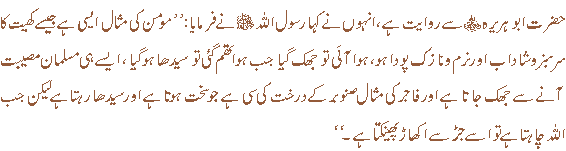
Narrated by Abu Huraira (Radi Allah Anhu): Allah’s Apostle (sal-allahu- alleihi-wasallam ) said, “The example of a believer is that of a fresh tender plant; from whatever direction the wind comes, it bends it, but when the wind becomes quiet, it becomes straight again. Similarly, a believer is afflicted with calamities (but he remains patient till Allah removes his difficulties. ) And an impious wicked person is like a pine tree which keeps hard and straight till Allah cuts (breaks) it down when He wishes.”
Establishment Of The Hour (Qiyamah)

“Surely they who recite the Book of Allah and keep up prayer and spend out of what We have given them secretly and openly, hope for a gain which will not perish.”

Establishment of the Hour (Qiyamah)
[Sahih Bukhari : Volume 9, Book 88, Number 237]
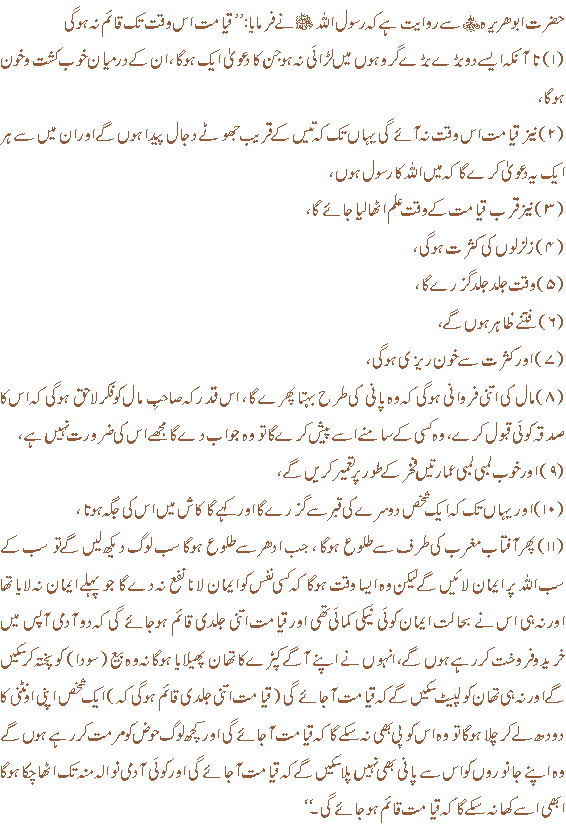
Narrated Abu Huraira (Radi Allah Anhu): Allah’s Apostle(sal-allahu-alleihi-wasallam) said, “The Hour will not be established
(1) till two big groups fight each other whereupon there will be a great number of casualties on both sides and they will be following one and the same religious doctrine,
(2) till about thirty Dajjals (liars) appear, and each one of them will claim that he is Allah’s Apostle,
(3) till the religious knowledge is taken away (by the death of Religious scholars)
(4) earthquakes will increase in number
(5) time will pass quickly,
(6) afflictions will appear,
(7) Al-Harj, (i.e., killing) will increase,
(8) till wealth will be in abundance —- so abundant that a wealthy person will worry lest nobody should accept his Zakat, and whenever he will present it to someone, that person (to whom it will be offered) will say, ‘I am not in need of it,
(9) till the people compete with one another in constructing high buildings,
(10) till a man when passing by the grave of someone will say, ‘Would that I was in his place,
(11) and till the sun rises from the West. So when the sun will rise and the people will see it (rising from the West) they will all believe (embrace Islam) but that will be the time when: (As Allah said,) ‘No good will it do to a soul to believe then, if it believed not before, nor earned good (by deeds of righteousness) through its Faith.’ (6.158) And the Hour will be established while two men spreading a garment in front of them but they will not be able to sell it, nor fold it up, and the Hour will be established when a man has milked his she-camel and has taken away the milk but he will not be able to drink it, and the Hour will be established before a man repairing a tank (for his livestock) is able to water (his animals) in it, and the Hour will be established when a person has raised a morsel (of food) to his mouth but will not be able to eat it.”