TAG: sake of Allah
A Most Beautiful Character
Those who suppress their anger, and forgive other people assuredly, Allah loves those who do good.? (3:134)
Bukhaaree and Muslim relate that Abdullaah ibn Amr (radee Allaahu anhu – may Allah be pleased with him) said: The Messenger of Allah, (sall-Allaahu alayhi wa sallam may the peace & blessings of Allah be upon him) was never immoderate or obscene. He used to say, ‘Among those who are most beloved to me are those who have the best character’.
They also narrate that Aa’ishah (radee Allaahu anhaa – may Allah be pleased with her) said: ‘Never was the Messenger of Allah (sall-Allaahu alayhi wa sallam) given the choice between two things without choosing the easier of them, as long as it entailed no sin. If it did entail sin, he was of all people the most remote from it. Never did he seek revenge for something done against himself; but when the sanctity of Allah was challenged, he would take vengeance for His sake alone.’
The meaning of a good character is the inclination of the soul towards gentle and praiseworthy acts. This may take place in one’s personal actions for Allah Most High, or in actions that involve other people. In the former case, the slave of Allah has an open and welcoming heart for His commandments and prohibitions and does what He has imposed on him happily and easily, and abstains from the things which He has forbidden him with full contentment, and without the least dissatisfaction. He likes to perform optional good acts and abstains from many permitted things for the sake of Allah Most High whenever he decides that to abstain in that way he would be closer to perfect slavehood to Him. This he does with a contented heart, and without feeling any resentment or hardship.
When he deals with other people, he is tolerant when claiming what is his right, and does not ask for anything which is not; but he discharges all the duties which he has towards others. When he falls ill or returns from a trip, and no-one visits him, or when he gives a greeting which is not returned, or when he is a guest but is not honoured, or intercedes but is not responded to, or does a good turn for which he is not thanked, or joins a group of people who do not make room for him to sit, or speaks and is not listened to, or asks permission of a friend to enter, and is not granted it, or proposes to a woman, and is not allowed to marry her, or ask for more time to repay a debt, but is not given more time, or asks for it to be reduced, but is not permitted this, and all similar cases, he does not grow angry, or seek to punish people, or feel within himself that he has been snubbed, or ignored; neither does he try to retaliate with the same treatment when able to do so, but instead tells himself that he does not mind any of these things, and responds to each one of them with something which is better, and closer to goodness and piety, and is more praiseworthy and pleasing. He remembers to carry out his duties to others just as he remembers their duties towards himself so that when one of his Muslim brethren falls ill he visits him if he is asked to intercede, he does so, if he is asked for a respite in repaying a debt he agrees, and if someone needs assistance he gives it, and if someone asks for favourable terms in a sale, he consents, all without looking to see how the other person had dealt with him in the past, and to find out how other people behave. Instead, he makes “what is better” the imam (leader) of his soul, and obeys it completely.
Good character may be something which a man is born with, or it may be acquired. However, it may only be acquired from someone who has it more firmly rooted in his nature than his own. It is well known that a man of sensible opinion can become even more sensible by keeping the company of intelligent and sensible people and that a learned or a righteous man can learn even more by sitting with other people or learning or righteousness; therefore it cannot be denied that a man of beautiful character may acquire an even more beautiful character by being with people whose characters are superior to his own.
And Allah gives success!
By: Imaam al-Bayhaqi
I’ll Never Beat A Slave Again
Let’s listen to this story narrated by Abu Mas’ood Al-Badri, a Companion of Prophet Muhammad (peace be upon him): I was beating a slave of mine with a whip, then I heard a voice behind me saying, “Remember, Abu Mas’ood!” I did not recognize the voice because I was so angry, but when he drew close to me I saw that it was the Messenger of Allah (peace be upon him), and he was saying, “Remember, Abu Mas’ood; remember, Abu Mas’ood!” I threw the whip aside and he said, “Remember, Abu Mas’ood, that Allah has more power over you than you have over this slave.”
I said, “I will never beat another slave again.” And saying this, he set the slave free for the sake of Allah. At this, the Prophet (peace be upon him) said, “If you had not done so, you would have been touched by the Fire.” (Sahih Muslim)
My eyes were pricked with tears when I read this Hadith. No less marvelous than the soft, yet effective admonition of the Prophet (peace be upon him) is the soft-heartedness and sincerity of the Companion. Subhan Allah! He narrated this incident in spite of the fact that it showed him in a bad light so that future generations would record the teachings of the Prophet (peace be upon him), learn from his mistake, and remember to be mindful of their Lord in similar situations.
Yet, little do we remember!
Horrific incidents of the physical abuse of maids surface with depressing regularity in national newspapers and are featured in the international media, evoking widespread outrage and dismay, and in certain cases, play right into the hands of biased media outlets trying to tar Islam and Muslims with the brush of ‘barbarism’.
The fact is, the Prophet (peace be upon him) not only taught us to honor the rights of servants through the verses of the Qur’an and his personal actions and words during his lifetime, he strenuously urged Muslims to do so even with his last breath! He emphasized the kind treatment of servants to such an extent that it is reported by Ali (may Allah be pleased with him) that the last words spoken by the Prophet at the time of his death were, “The prayer! The prayer! Fear Allah concerning your slaves and servants!” (Al-Adab Al-Mufrad Al-Bukhari)
The early Muslims took these words to heart and followed them to a T. Thus, we have records like that of Al-Ma’roor Bin Suwayd, who said, “I saw Abu Dharr (may Allah be pleased with him) wearing a hullah (a suit of two garments) and his slave was wearing something similar. I asked him about that and he said that he had insulted a man in the time of the Messenger of Allah (peace be upon him) by saying disparaging words about his mother. The man went to the Prophet (peace be upon him) and told him about that, and the Prophet (peace be upon him) said, “You are a man who still has something of Jahiliyyah (pre-Islamic period of Ignorance) in you. They are your brothers and servants whom Allah has placed under your authority. Anyone who has his brother under his authority, let him feed him the same food as he eats and dresses him in the same clothes as he wears, do not overwhelm them with work and if you give them work to do, then help them with it.” (Al-Bukhari and Muslim)
In his exegesis in the book ‘Fath Al-Bari’, Al-Hafiz ibn Hajar said, “This Hadith shows that it is forbidden to insult slaves or speak disparagingly of those who bore them. We are enjoined to treat them well and be kind to them. Although it speaks of slaves, this includes employees and other workers. It also shows that we should not feel superior to another Muslim or look down on him.”
Yet, little do we remember!
Similarly, the successors of the early Muslims were mindful of these rights. There is an account of the righteous Caliph Umar Bin Abdul Aziz who was attended to by a slave, who fanned him as he slept. After a while, the slave was overcome by sleep and dozed off. When the Caliph awoke and realized that she was sleeping, he took the fan from her hand and fanned her so she would feel cool. When she awoke, she saw that he had the fan and was taken aback and expressed surprise at his action. He said, “You are a human-like me, and the heat affects you just as it affects me.”
Another of the early Muslims once became severely angry with his slave and was about to punish him when the slave said, quoting a verse from the Qur’an: “[Allah has praised] those who repress their anger.” The man said: “I have repressed my anger.” The slave said: “[Allah has praised] those who pardon others.” The man said, “I have pardoned you.” The servant said, “Allah loves those who do Ihsan (excellent deeds).” Thereupon the man said, “You can go now, you are free for the sake of Allah.”
It is a sorry reflection of the state of our faith and the hardness of our hearts that in spite of regularly receiving admonitions in this regard, and even warnings of the awful retribution of neglecting these obligations, we continue unabated. Abu Hurayrah (may Allah be pleased with him) narrated that the Prophet (peace be upon him) said, “Allah says: ‘There are three whose opponent I will be on the Day of Resurrection: a man who makes a promise in My name then breaks his word, a man who sells a free man and consumes his price, and a man who employs another and benefits from him (his labor), then does not give him his wages.’”
(Al-Bukhari)
Yet, little do we remember!
Food and dress similar to what one wears, payment of agreed-upon wages before “the sweat of his efforts dries” , not being taxed with work beyond capacity and most of all – forgiveness and leniency with their mistakes and kind treatment – are the fundamental rights of servants in Islam, enjoined upon the Muslims in numerous well-known narrations of the Prophet.
. “Food and dress are the right of the slave and he should not be assigned to the task which may be beyond his capacity.”
. “They are your brothers (the slaves and servants). Allah has placed them under your authority. So he who has a brother under him should feed him and clothe him as he himself does, and should not take from him any work that is beyond his power. If he does tell him to do such work then he should also join in it – (and help him).”
. “When your slave or servant prepares food for you and lays it for you – while he has suffered the inconvenience of heat and smoke when cooking – you should ask him to sit down and share the meal. If the food is in a small quantity (and cannot suffice) at least give him a morsel or two therefrom (at least a little).”
. Once a person came to the Prophet (peace be upon him) and asked, “O Prophet of Allah! To what extent should we forgive the mistakes and faults of our slaves and servants?” The Prophet (peace be upon him) remained silent whereupon the man repeated this question. The Prophet (peace be upon him) again remained silent and when the man asked for the third time, he replied “Seventy times a day.”
. “Whoever beats a slave or servant unjustly, revenge will be taken from him on the Day of Judgment.”
When we send salutations upon the Prophet (peace be upon him), we testify that he conveyed the message, fulfilled the trust, advised the Ummah (Muslim nation) sincerely, and strove in (the religion of) Allah as much as is due.
Now, the onus is on us to follow suit.
– By Rahla KhanI
- September, 22
- 4866
- Human Rights
- More
What Are The Signs Of Allah’s Love For His Slave?
All Praises be to Allah
Putting light on a serious and weighty matter, which none attain but very few of the righteous slaves of Allah.
The love of Allah is “the status for which the righteous compete and strive… It is the nourishment of hearts and souls… the delight of the eyes… It is the life of which one who is denied it is dead… the light which the one who loses it is in deep darkness… the healing of which the one who is denied is sick… the joy which the one who is deprived of it lives in distress and pain…
It is the spirit of faith and good deeds… by means of which one may draw closer to Allah… which, when it is absent, one is like a body in which there is no soul.”
O Allah, make us among those whom You love.
The love of Allah has signs and causes which are like the key to the door. These causes include the following:
1 Following the guidance of the Prophet (peace and blessings of Allah be upon him). Allah says in His Holy Book (interpretation of the meaning):
“Say (O Muhammad to mankind): If you (really) love Allah, then follow me (i.e. accept Islamic Monotheism, follow the Qur’an and the Sunnah), Allah will love you and forgive you your sins. And Allah is Oft-Forgiving, Most Merciful”
[Aal ‘Imraan 3:31]
2-5 Being humble towards the believers and stern towards the kaafirs, waging jihad for the sake of Allah, and not fearing anyone or anything but Him. Allah has mentioned these qualities in a single verse, in which He says (interpretation of the meaning):
“O you who believe! Whoever from among you turns back from his religion (Islam), Allah will bring a people whom He will love and they will love Him; humble towards the believers, stern towards the disbelievers, fighting in the way of Allah, and never fear of the blame of the blamers”
[al-Maa’idah 5:54]
In this verse, Allah describes the attributes of those whom He loves, the first of which is: humility and not being arrogant towards the Muslims, and being stern towards the kaafirs, and not humbling or humiliating oneself before them. They (the ones whom Allah loves) strive for the sake of Allah, against the Shaytaan, the kuffaar, the hypocrites, and the evildoers, and they strive against their own selves (jihad al-nafs). They do not fear the blame of any blamer, because so long as they are following the commands of their religion, he will not care about anyone who mocks him or blames him.
6 Doing naafil (supererogatory) acts of worship. Allah says – according to a hadeeth Qudsi – “My slave keeps drawing near to me by means of supererogatory acts of worship until I love Him.” Supererogatory acts of worship include naafil prayers, charity, ‘Umrah, Hajj, and fasting.
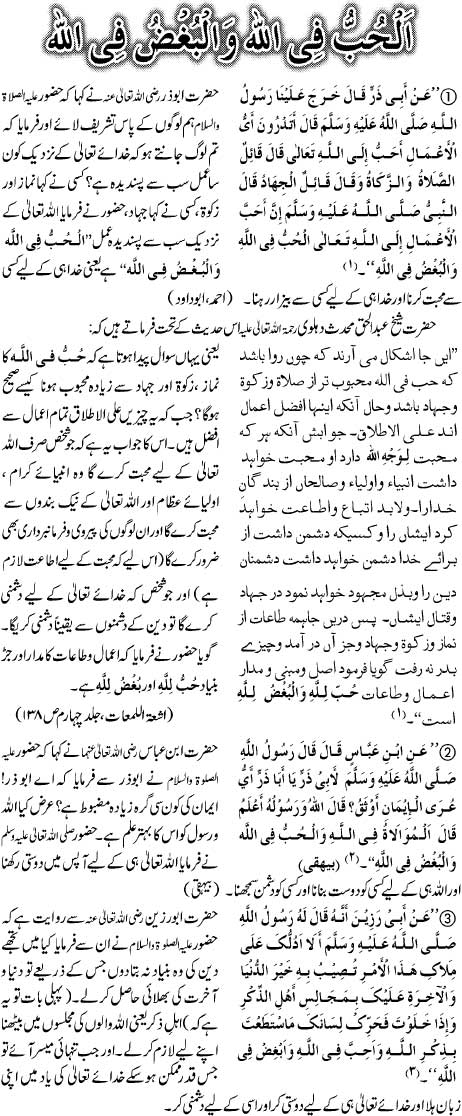
8-12 Loving, visiting one another, helping one another (financially), and offering sincere advice to one another for the sake of Allah.
These attributes were mentioned in a single hadeeth in which the Messenger (peace and blessings of Allah be upon him) narrated that his Lord said: “My love is guaranteed for two who love one another for My sake; My love is guaranteed for two who visit one another for My sake; My love is guaranteed for two who help one another (financially) for My sake; My love is guaranteed to two who uphold ties with one another for My sake.”
Narrated by Ahmad, 4/236 and 5/236; al-Tanaasuh by Ibn Hibbaan, 3/338; the two ahaadeeth were classed as Saheeh by Shaykh al-Albaani in Saheeh al-Targheeb wa’l-Tarheeb, 3019, 3020, 3021.
What is meant by “two who visit one another for My sake” is that they only visit one another for the sake of Allah, seeking thereby His pleasure for their loving one another for His sake or cooperating in worshipping Him.
From al-Muntaqa Sharh al-Muwatta’, hadeeth 1779.
13 Being tested. Calamities and disasters are a test for a person, and this is a sign that Allah loves him because this is like a medicine: even though it is bitter, but still, you offer the medicine, despite its bitterness, to the one whom you love; and Allah’s is the highest description. According to a Saheeh hadeeth: “The greatest reward comes from the greatest trial. When Allah loves people, He tests them, and whoever accepts it gains the pleasure of Allah, and whoever complains earns His wrath.
Narrated by al-Tirmidhi, 2396; Ibn Maajah, 4031; classed as Saheeh
For calamities to befall the believer is better than punishments being stored up for him in the Hereafter. How can it be otherwise when he is raised in status and his bad deeds are erased thereby? The Prophet (peace and blessings of Allah be upon him) said: “When Allah wills good for His slave, He hastens his punishment in this world, and when He wills bad for His slave, He withholds his sins until he comes with them on the Day of Resurrection.”
Narrated by al-Tirmidhi, 2396; classed as Saheeh
The scholars have explained that the one from whom calamities and trials are withheld is the hypocrite, for Allah withholds [his punishment] in this world, so as to bring him with all his sins on the Day of Resurrection.
O Allah, make us among those whom You love.
If Allah loves you, do not ask about the good that you will attain and the virtue that you will acquire… it is sufficient for you to know that you are beloved of Allah. The great fruits of the love of Allah for His slave are as follows:
1 People will love him and he will be accepted on earth, as it says in the hadeeth narrated by al-Bukhaari (3209): “When Allah loves a slave, He says to Jibreel, ‘I love so-and-so, so love him,’ so Jibreel loves him and then calls out to the people of heaven, ‘Allah loves so-and-so, so love him,’ and the people of heaven love him, and then acceptance is placed in the Earth for him.”
2 What Allah has mentioned in the hadeeth Qudsi of the great virtues of those whom He loves. It was narrated that Abu Hurayrah said: The Messenger of Allah (peace and blessings of Allah be upon him) said: “Whosoever shows enmity to someone devoted to Me, I shall be at war with him. My servant draws not near to Me with anything more loved by Me than the religious duties I have enjoined upon him, and My servant continues to draw near to Me with supererogatory works so that I shall love him. When I love him I am his hearing with which he hears, his seeing with which he sees, his hand with which he strikes, and his foot with which he walks. Were he to ask [something] of Me, I would surely give it to him and were he to ask Me for refuge, I would surely grant him it. I do not hesitate about anything as much as I hesitate about [seizing] the soul of My faithful servant: he hates death and I hate hurting him.” Narrated by al-Bukhaari, 6502.
This hadeeth Qudsi includes a number of benefits of Allah’s love for His slave:
(i) “I am his hearing with which he hears” i.e., he does not listen to anything but that which Allah loves.
(ii) “his seeing with which he sees” i.e., he does not see anything but that which Allah loves.
(iii) “his hand with which he strikes” i.e., he does not do anything with his hand but that which Allah loves.
(iv) “and his foot with which he walks” i.e., he does not go towards anything but that which Allah loves.
(v) “Were he to ask [something] of Me, I would surely give it to him” i.e., his du’a’s are heard and his requests are granted.
(vi) “and were he to ask Me for refuge, I would surely grant him it” i.e., he is protected by Allah from all things…
We ask Allah to help us to please Him.
And Allah knows best.
What Is Hajj?
The pilgrimage (Hajj) is
1) One of the most important pillars of Islam.
2) A principal means of obtaining proximity to the Almighty.
3) One of the most difficult physical forms of worship.
4) So, vital that one who does not perform Hajj will be barred from Heaven.
The main aim of human creation is to recognize God and attain a stage of acquaintance and love for Him and this depends on the purity and loftiness of the human soul. i.e. The purer the soul becomes the more love will it have for the Almighty.
This stage of love can be attained by abstaining from desires and refraining from worldly pleasures and distractions, and by exerting oneself in the rigorous self-training activities for the sake of God, and, remembering him continuously. For this purpose, the Almighty has legislated certain forms of worship (Ibadat).
a) Those involving the expenditure of wealth for His sake e.g. Zakat and Khums which serve to sever the deep attachments to worldly possessions.
b) Those involving abstinence from desires and pleasures e.g. fasting.
c) Those related to His remembrance and diverting total attention towards Him e.g. Salat/Namaaz.
But Hajj involves all these and more, such as
i) Leaving one’s hometown.
ii) Physical exertion.
iii) Expenditure of wealth.
iv) Renewal of the covenant with God.
v) Circumambulation (Tawaaf).
vi) Supplication (Dua).
vii) Prayers (Salat/Namaaz).
And others like throwing pebbles, running between Safaa and Marwah, etc.
Those who wonder at these actions do not realize that when we do not know the hidden meanings and reason of certain commands, we manifest more complete obedience and total submission to the Absolute Master in carrying out those orders. Those actions whose secrets we have been successful in understanding, our soul, besides obeying the Master’s commands, is also inclined and pleased in performing them. Thus, it is only for Hajj that the Holy Prophet (S.A.W.) is reported to have said, “O Almighty, I have responded to your call for Hajj with complete submission and humility.”
Furthermore, the Hajj constitutes the congregation of people from all parts of the world, in the place where revelation was repeatedly sent down to the Holy Prophet (S.A.W.), where the beloved (Khaleel) of God resided, where angles used to descend every now and then. In fact, it is the holy place, which has been the abode of the majority of the Prophets.
Here the leader of the Holy Prophet (S.A.W.) was born, his holy feet walked, and the Almighty has chosen it for His house so that people should pray towards it. He has sanctified its surroundings and has kept Arafah at the beginning of the Holy Land. He has prohibited hurting animals and uprooting vegetation therein as a mark of respect to the holiness of the land. He has designed it to be like the throne of Kings so that visitors from far-off lands, disheveled and dusty, should remain there in humility to the Absolute Monarch realizing the fact that He is above all needs of time and space. While such a congregation leads to new acquaintances, meeting with virtuous personalities, and stimulates a quicker response to supplications (Dua), it invariably reminds of the Holy Prophet (S.A.W.) and his efforts at spreading the Word of God. In this way, one attains the purity of the soul.
The intention for Hajj
1. The intention (Niyyah) must be pure and sincere for the sake of God only, but not for any other worldly motives, such as,
1) Showing off (Riyaa).
2) Avoiding rebukes for not performing Hajj.
3) Fear of poverty for it is known that one who does not perform Hajj is afflicted with poverty.
4) Business prospects, etc.
All these other motives destroy the sincerity (Ikhlaas) of the deeds and deprive one of the promised rewards. It is foolish to undertake all this rigor and expense only to end up in Damnation because the motive was adulterated.
2. One should sincerely repent of past sins and clear all the dues, (Huquq-un-Naas), and cleanse himself of all distractions so that the mind is easily turned towards God. One should write his will and prepare for the journey to the Hereafter as he leaves his house, relatives, friends, and possessions behind.
3. One should remember the majesty of the House and the Absolute Owner, and that one has chosen to leave family, friends, and possessions for the lofty and noble purpose of visiting a House, which the Almighty has designed as a sanctuary for all people. Hence this journey differs from all other worldly journeys. The pilgrim is one of those who have responded willingly to the invitation made by the Almighty’s messenger.
4. The pilgrim should free himself of all matters, which tend to worry him so his total attention is towards the Almighty.
5. Any financial loss or physical affliction in this journey should be greeted happily, for, it is a sign of acceptance of Hajj.
6. The Pilgrim should ensure his earnings are acquired through lawful means and he should be liberal in expenditure, not extravagant (Israaf) though. But spending for the needy and deserving is not extravagance as it has been reported that there is no goodness in extravagance and no extravagance in goodness!
7. He should behave courteously towards his fellow travelers, smiling and talking gently with them, avoiding harsh words, abuses, or vain talk. He should be humble to the other guests of the Almighty. Magnanimity does not only mean not to hurt others but also to endure when others hurt.
8. He should be disheveled and dusty, avoid cosmetics or any cause of pride and beauty, and if possible, travel on foot, especially from Makkah to Mina, Masher, and Arafah, not as a means to avoid extra expenses (in which case, transport is better!) rather for exerting oneself for the sake of God, except if it affects other worship (Ibadat) or supplication (Dua).
The Signs of Allah’s Love For A Person
The signs of Allah’s love for a person are as follows :
1. When Allah loves someone he puts them under trials ( the more righteous they are, the harder the trials) in order to purify them.
2. When Allah loves someone, he gives them the “understanding” of the religion of Islam.
3. Whomever Allah loves, he deviates them and their heart from disobedience and sins…
In a Hadith Qudsi (Sacred Hadith), the Prophet (SAWS) met Abu Huraira Radhiallahu anhu narrated that Allah’s Messenger Salallahu alaihi wa Salam said that Allah said:
I will declare war against him who shows hostility to a pious worshipper of mine
And the most beloved things with which My slave comes nearer to Me is what I have enjoined upon him;
and My worshipper keeps on coming closes to Me through performing Nawafil (praying or doing extra deeds besides what is (obligatory) till I love him, When I love him I become his sense of hearing with which he hears, and his sense of sight with which he sees, and his hands with which he grips, and his legs with which he walks; and if he asks Me, I will give him, and if he ask My Protection (Refuge), I will Protect him. Narrated by Al-Bukhari.
In a Hadith Qudsi (Sacred Hadith), the Prophet (SAWS) mentioned that Allah (SWT) said, Myself, Mankind and Jinn are in a great serious state. I create them, then they worship other gods that they make for themselves; I bless them with my bounties, then they thank someone else for what I sent them; My Mercy descends to them while their evil deeds ascend to Me; I endear them with my gifts even though I have no need to any of them while they alienate themselves from Me with their sins even though they are desperate for my help. Whoever returns to Me, I accept him no matter how far he is; and whoever turns away from Me, I approach him and call on him. Whoever leaves a sin for my sake, I reward him with many gifts and whoever seeks to please Me, I seek to please him. Whoever acknowledges My Will and Power in whatever he does, I make the iron bend for his sake.
My dear people are those who are with Me. Whoever thanks Me, I grant him more blessings; whoever obeys Me, I raise him and endear him more.
Whoever disobeys Me, I keep the doors of My Mercy open for him; if he returns to Me, I bestow him with My Love since I love those who repent and purify themselves for My Sake. If he does not repent, I still treat him by putting them in hardship to purify him. Whoever favors Me over others, I favor them over others. I reward every single good deed ten times over or seven hundred times over to countless times over.
I count every single bad deed as one unless the person repents and asks for My Forgiveness in which case I forgive even that one. I take into account any little good deed and I forgive even major sins.
My Mercy supersedes My Anger; My Tolerance supersedes My Blame; My Forgiveness supersedes My Punishment as I am more merciful with My slaves than a mother with her child.
From Madarij Al-Salikeen by Ibn-Qayem Al-jawzyia
Hazrat Suhaib Razi Allah Tala Anha

Da’wah Tip: Get Over Fear Of People
Almost all early chapters of the Qur’an that were revealed in Makkah when Prophet Muhammad (peace be upon him) had just been appointed as a messenger of Allah had short but profound verses. Despite their size, the verses had deep meanings.
One such chapter or Surah is Al-Muddaththir (74), which gives an interesting set of instructions to the overwhelmed Prophet who was lying wrapped up in his garments trembling with fear after meeting Archangel Gabriel for the first time.
For a caller to Islam, these compact, meaningful instructions carry a deep, important message as to what his or her priorities should be when conveying the message of Islam to the world.
“O you (Muhammad) enveloped in garments! Stand up and warn!”
Al-Bukhari and Muslim confirm that this short Surah was revealed when the Prophet returned to his family after seeing Angel Gabriel in his real form and size. He came home trembling and asked his family to wrap him up in garments.
Allah instructs His Prophet (peace be upon him) to stand up and warn those around him. The first lesson for the Da’ee who embarks on this noble mission is that he or she should stop fearing people. Take a stand and start warning others confidently. Low self-confidence, shyness, and fear are but obstacles in the way of Da’wah.
“And magnify your Lord!”
To proclaim the greatness of Allah is essential for the Da’ee since it reminds him or her of who he or she is doing this work for. Allah is the Greatest and He doesn’t need anyone’s worship or submission; He doesn’t even need anyone to convey His Deen to others. However, by magnifying our Creator, we acknowledge our position as utter slaves before Him and in return, we feel confident enough to deliver His message to others.
“And purify your garments!”
To convey Islam to others, one needs to appear before them at some point or the other – either by engaging in a discussion or by delivering a lecture. Also, a representative of Islam must wear garments that are thoroughly clean, as the essence of this faith lies in spiritual and physical cleanliness. Clean clothes are also a prerequisite for worship such as prayer. Sa’eed Bin Jubayr said concerning this verse, “This means to purify your heart and your intentions.’”
“And keep away from Al-Rujz (idols)!”
The meaning of the word Rujz, when prefixed by “Al”, points towards the impurity of polytheism or shirk. Ibn Abbas said, “Al-Rujz are idols, so keep away from them.” This view was supported by Mujahid, Ikrimah, Qatadah, Al-Zuhri and Ibn Zayd.
A Da’ee of Islam should be free from any kind of affinity, proximity, or sympathy – either spiritual or physical – for Shirk. Therefore, figures, faces, or idols of any form that are venerated or whose attributes are equated with those of Allah should be permanently and irreversibly abolished from the hearts and minds.
“And give not a thing in order to have more.”
The next instruction for the proactive caller towards Islam is to never seek some material benefit in return for the Da’wah. The Da’ee should do his work only for the sake of Allah and should never remind the people of his or her favors in order to amass wealth or beget other favors. The stories of the prophets in the Qur’an underscore sincerity. Even if the preaching of some Prophets won few – or no – followers, they never gave up the mission. Rather, they continued selflessly for the sake of Allah.
“And be patient for the sake of your Lord!”
Last but not least, the Da’ee must bear the inevitable opposition, antagonism, hatred, evil plotting, and downright harmful endeavors of his enemies with patience. Da’wah is a path that is thorny and difficult, dotted with tests of the caller’s sincerity towards Allah and his steadfastness in facing the obstacles that his opponents throw his way. Again, his patience must be solely for Allah’s sake, not for the sake of gaining people’s approval or pleasure.
The Qur’an is a guide and light for every being to come till the Day of Judgment. Its message and meanings are deep and worthy of reflection. Even though this Surah was revealed to our Prophet Muhammad centuries ago, the message lives on for us to ponder on and incorporate into our lives.
– By Sadaf Farooqi
Ref: Tafsir Ibn Kathir
Hadith Collection
1. “Be in this world as if you were a stranger”
Hadith 8.425 Narrated by Mujahid (Radhiallah hu Taala anhu)
‘Abdullah bin ‘Umar (Radhiallah hu Taala anhu) said, “Allah’s Apostle (sallallaahu alayhi wa sallam) took hold of my shoulder and said, ‘Be in this world as if you were a stranger or a traveler.” The sub-narrator added: Ibn ‘Umar (Radhiallah hu Taala anhu) used to say, “If you survive till the evening, do not expect to be alive in the morning, and if you survive till the morning, do not expect to be alive in the evening, and take from your health for your sickness, and (take) from your life for your death.”
2. Hoping for long life and worldly pleasures
Hadith 8.426 Narrated by Abdullah (Radhiallah hu Taala anhu)
The Prophet (sallallaahu alayhi wa sallam) drew a square and then drew a line in the middle of it and let it extend outside the square and then drew several small lines attached to that centerline, and said, “This is the human being, and this, (the square) in his lease of life, encircles him from all sides (or has encircled him), and this (line), which is outside (the square), is his hope, and these small lines are the calamities and troubles (which may befall him), and if one misses him, another will snap (i.e. overtake) him, and if the other misses him, a third will snap (i.e. overtake) him.”
Hadith 8.427 Narrated by Anas bin Malik (Radhiallah hu Taala anhu)
The Prophet (sallallaahu alayhi wa sallam) drew a few lines and said, “This is (man’s) hope, and this is the instant of his death, and while he is in this state (of hope), the nearer line (death) comes to Him.”
3. Asking Allah for new lease of life at sixty
Hadith 8.428 Narrated by Abu Huraira (Radhiallah hu Taala anhu)
The Prophet (sallallaahu alayhi wa sallam) said, “Allah will not accept the excuse of any person whose instant of death is delayed till he is sixty years of age.”
Hadith 8.429 Narrated by Abu Huraira (Radhiallah hu Taala anhu)
I heard Allah’s Apostle (sallallaahu alayhi wa sallam) saying, “The heart of an old man remains young in two respects, i.e., his love for the world (its wealth, amusements and luxuries) and his incessant hope.”
Hadith 8.430 Narrated by Anas bin Malik (Radhiallah hu Taala anhu)
Allah’s Apostle (sallallaahu alayhi wa sallam) said, “The son of Adam (i.e. man) grows old and so also two (desires) grow old with him, i.e., love for wealth and (a wish for) a long life.”
4. Deeds for the sake of Allah
Hadith 8.431 Narrated by Utban bin Malik Al Ansari (Radhiallah hu Taala anhu)
Who was one of the men of the tribe of Bani Salim: Allah’s Apostle (sallallaahu alayhi wa sallam) came to me and said, “If anybody comes on the Day of Resurrection who has said: La ilaha illal-lah, sincerely, with the intention to win Allah’s Pleasure, Allah will make the Hell-Fire forbidden for him.”
Hadith 8.432 Narrated by Abu Huraira (Radhiallah hu Taala anhu)
Allah’s Apostle (sallallaahu alayhi wa sallam) said, “Allah says, ‘I have nothing to give but Paradise as a reward to my believer slave, who, if I cause his dear friend (or relative) to die, remains patient (and hopes for Allah’s Reward).”
5. Competing against each other
Hadith 8.433 Narrated by Amr bin Auf (Radhiallah hu Taala anhu)
(An ally of the tribe of Bani ‘Amir bin Lu’ai and one of those who had witnessed the battle of Badr with Allah’s Apostle (sallallaahu alayhi wa sallam)) Allah’s Apostle (sallallaahu alayhi wa sallam) sent Abu ‘Ubaida bin Al-Jarrah (Radhiallah hu Taala anhu) to Bahrain to collect the Jizya tax. Allah’s Apostle (sallallaahu alayhi wa sallam) had concluded a peace treaty with the people of Bahrain and appointed Al ‘Ala bin Al-Hadrami (Radhiallah hu Taala anhu) as their chief; Abu Ubaida (Radhiallah hu Taala anhu) arrived from Bahrain with the money. The Ansar heard of Abu ‘Ubaida’s (Radhiallah hu Taala anhu) arrival which coincided with the Fajr (morning) prayer led by Allah’s Apostle (sallallaahu alayhi wa sallam). When the Prophet (sallallaahu alayhi wa sallam) finished the prayer, they came to him. Allah’s Apostle (sallallaahu alayhi wa sallam) smiled when he saw them and said, “I think you have heard of the arrival of Abu ‘Ubaida and that he has brought something.” They replied, “Yes, O Allah’s Apostle (sallallaahu alayhi wa sallam)!” He said, “Have the good news and hope for what will please you. By Allah, I am not afraid that you will become poor, but I am afraid that worldly wealth will be given to you in abundance as it was given to those (nations) before you, and you will start competing with each other for it as the previous nations competed for it, and then it will divert you (from good) as it diverted them.”
Hadith 8.434 Narrated by Uqba bin Amir (Radhiallah hu Taala anhu)
The Prophet (sallallaahu alayhi wa sallam) went out and offered the funeral prayer for the martyrs of the (battle of) Uhud and then ascended the pulpit and said, “I am your predecessor and I am a witness against you. By Allah, I am now looking at my Tank-lake (Al-Kauthar) and I have been given the keys of the treasures of the earth (or the keys of the earth). By Allah! I am not afraid that after me you will worship others besides Allah, but I am afraid that you will start competing for (the pleasures of) this world.”
Hadith 8.435 Narrated by Abu Said Al Khudri (Radhiallah hu Taala anhu)
Allah’s Apostle (sallallaahu alayhi wa sallam) said, “The thing I am afraid of most for your sake, is the worldly blessings which Allah will bring forth to you.” It was said, “What are the blessings of this world?” The Prophet (sallallaahu alayhi wa sallam) said, “The pleasures of the world.” A man said, “Can the good bring forth evil?” The Prophet (sallallaahu alayhi wa sallam) kept quiet for a while till we thought that he was being inspired divinely. Then he started removing the sweat from his forehead and said, “Where is the questioner?” That man said, “I (am present).” Abu Sa’id (Radhiallah hu Taala anhu) added: We thanked the man when the result (of his question) was such. The Prophet (sallallaahu alayhi wa sallam) said, “Good never brings forth but good. This wealth (of the world) is (like) green and sweet (fruit), and all the vegetation which grows on the bank of a stream either kills or nearly kills the animal that eats too much of it, except the animal that eats the Khadira (a kind of vegetation). Such an animal eats till its stomach is full and then it faces the sun and starts ruminating and then it passes out dung and urine and goes to eat again. This worldly wealth is (like) sweet (fruit), and if a person earns it (the wealth) in a legal way and spends it properly, then it is an excellent helper, and whoever earns it in an illegal way, he will be like the one who eats but is never satisfied.”
Hadith 8.436 Narrated by Zahdam bin Mudarrib (Radhiallah hu Taala anhu)
‘Imran bin Husain (Radhiallah hu Taala anhu) said: The Prophet (sallallaahu alayhi wa sallam) said, “The best people are my contemporaries (i.e., the present (my) generation) and then those who come after them (i.e., the next generation).” Imran (Radhiallah hu Taala anhu) added: I am not sure whether the Prophet (sallallaahu alayhi wa sallam) repeated the statement twice after his first saying. The Prophet (sallallaahu alayhi wa sallam) added, “And after them there will come people who will bear witness, though they will not be asked to give their witness; and they will be treacherous and nobody will trust them, and they will make vows, but will not fulfill them, and fatness will appear among them.”
Hadith 8.437 Narrated by Abdullah (Radhiallah hu Taala anhu)
The Prophet (sallallaahu alayhi wa sallam) said, “The best people are those of my generation, and then those who will come after them (the next generation), and then those who will come after them (i.e. the next generation), and then after them, there will come people whose witness will precede their oaths, and whose oaths will precede their witness.”
Hadith 8.438 Narrated by Qais (Radhiallah hu Taala anhu)
I heard Khabbab (Radhiallah hu Taala anhu), who had branded his abdomen with seven brands, saying, “Had Allah’s Apostle (sallallaahu alayhi wa sallam) not forbidden us to invoke Allah for death, I would have invoked Allah for death. The companions of Muhammad (sallallaahu alayhi wa sallam) have left this world without taking anything of their reward in it (i.e., they will have perfect reward in the Hereafter), but we have collected of the worldly wealth what we cannot spend but on earth (i.e. on building houses).”
Hadith 8.439 Narrated by Qais (Radhiallah hu Taala anhu)
I came to Khabbab (Radhiallah hu Taala anhu) while he was building a wall, and he (Khabbab (Radhiallah hu Taala anhu)) said, “Our companions who have left this world, did not enjoy anything of their reward therein, while we have collected after them, much wealth that we cannot spend but on earth (i.e., on building).”
Hadith 8.440 Narrated by Khabbab (Radhiallah hu Taala anhu)
We migrated with the Prophet (sallallaahu alayhi wa sallam). (This narration is related to the chapter on migration).
6. ‘O men! Certainly, the Promise of Allah is true”
Hadith 8.441 Narrated by Ibn Abbas (Radhiallah hu Taala anhu)
I brought water to Uthman bin ‘Affan (Radhiallah hu Taala anhu) to perform the ablution while he was sitting on his seat. He performed the ablution in a perfect way and said, “I saw the Prophet (sallallaahu alayhi wa sallam) performing the ablution in this place and he performed it in a perfect way and said, “Whoever performs the ablution as I have done this time and then proceeds to the mosque and offers a two-Rak’at prayer and then sits there (waiting for the compulsory congregational prayers), then all his past sins will be forgiven.” The Prophet (sallallaahu alayhi wa sallam) further added, “Do not be conceited (thinking that your sins will be forgiven because of your prayer).”
7. The righteous people will die
Hadith 8.442 Narrated by Mirdas Al Aslami (Radhiallah hu Taala anhu)
The Prophet (sallallaahu alayhi wa sallam) said, “The righteous (pious people will depart (die) in succession one after the other, and there will remain (on the earth) useless people like the useless husk of barley seeds or bad dates.”
Sincerity: The Most Important And Difficult Act Of Worship
The Hadith of intention is usually the first in most books of Hadith. Ibn Daqiq Al-Id expounds on it in his explanation of Imam Nawawi’s 40 Hadith.
Umar Bin Al-Khattab (may Allah be pleased with him) said: I heard the Messenger of Allah (peace be upon him) say: “Actions are but by intention and every man shall have but that which he intended.
Thus he whose migration was for Allah and His messenger, his migration was for Allah and His messenger, and he whose migration was to achieve some worldly benefit or to take some woman in marriage, his migration was for that for which he migrated.” (Al-Bukhari and Muslim)
This Hadith is great in its benefit and importance. It has been said that Islam revolves around it. Some scholars said it is one-third of knowledge because actions involve the heart, tongue, and limbs. So the intention of the heart is one-third of that.
Other scholars said Islam is encompassed in three Ahadith: This one, the Hadith “The Halaal is clear, the Haraam is clear and between them are doubtful matters…,” and the Hadith “Whoever innovates in this religion that which is not from it will have his actions rejected (by Allah).”
The word “by” (in the sentence “actions are but by intention”) means that the acceptance and correctness of any action depend upon the intention behind it.
An action which is apparently good, such as giving money to charity, will be rejected if the intention behind it is wrong. Giving charity to show off is one such example. The Prophet (peace be upon him) narrated from Allah that if a person performs an act for Allah’s sake and also for the sake of someone else, then Allah will reject the deed entirely and leave the whole of that deed for the partner the person made (with Allah). This shows us how grave the sin of Shirk is – it is the only sin that Allah will never forgive.
In the Hadith, the words “shall have” means that the person will be rewarded only for what he intended. If a person did the Hijrah with a wrong intention, then he would not be rewarded with Hijrah (for Allah’s sake).
The word “actions” refers to those actions which are part of the Shariah of Islam.
Thus, any action of the Shariah – such as Wudhu, Ghusl, Tayammum, Salah, Zakat, Fasting, Haj, I’tikaf, or any other act of worship – will not be accepted and rewarded unless it is performed with the correct intention.