

Saal Bhar Ke Rozon Ka Sawab
TAG: Shawwal
Fasting Six Days Of Shawwal After Ramadan
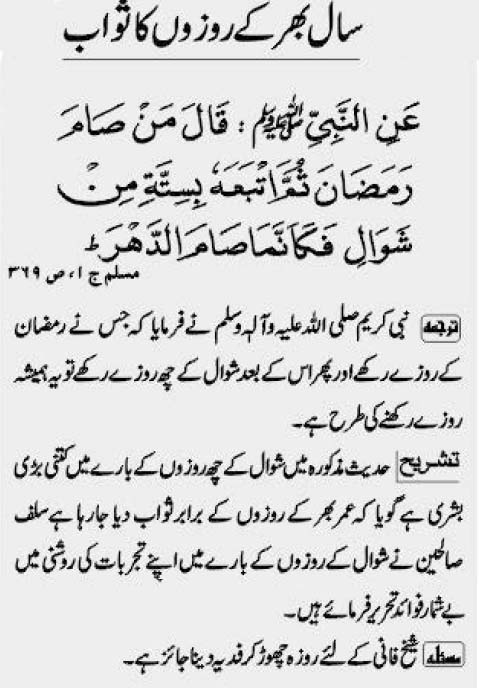
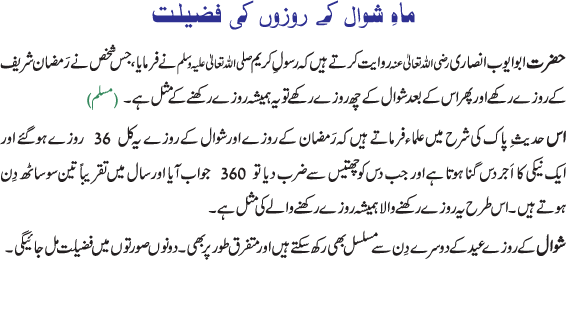
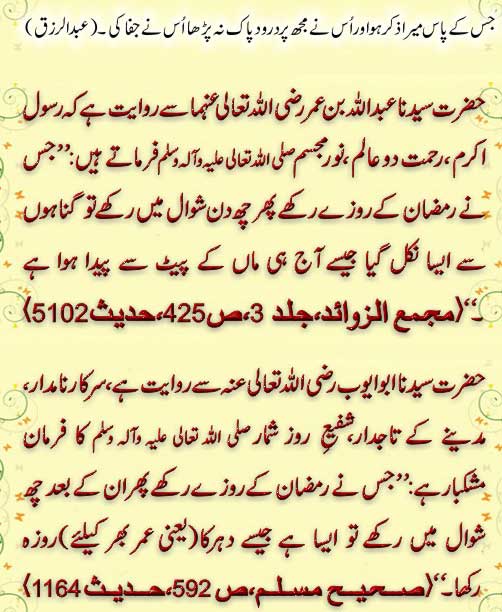
Sayyiduna Ayyub (Allah be pleased with him) relates that the Messenger of Allah (blessings and peace be upon him, his family, and companions) said, “Whoever fasts Ramadan and follows it with six days from Shawwal it is as if they fasted the entire year.” [Muslim, Abu Dawud, Tirmidhi, and Ibn Majah; Ahmad transmitted it from Jabir, Muntaqa]
Sayyiduna Thawban (Allah be pleased with him) relates that the Messenger of Allah (blessings and peace be upon him, his family, and companions) said, “Whoever fasts Ramadan, and then six days after Eid, it is an entire year. Whoever does a good deed shall have ten times its reward.” [Ibn Majah, Muntaqa]
Important Notes:
1. Based on this, the majority of the fuqaha, including the Hanafi, Shafi`i, and Hanbali school, have held that it is recommended to fast six days of the month of Shawwal. [Radd al-Muhtar; Mughni al-Muhtaj Shah al-Minhaj; Kashshaf al-Qina]
- It is permitted to fast these six days separately throughout the month, or consecutively, after Eid al-Fitr.
-
It is prohibitively disliked (makruh tahriman) and sinful to fast on Eid day itself. [Radd al-Muhtar]
-
The Shafi’is and Hanbalis state that it is superior to make the six fasts consecutive[Minhaj, Ghayat al-Muntaha]. Khatib al-Shirbini explains the reasoning as being,
“To hasten to do the good, and because of the problems inevitable in delaying,”
such as becoming lazy and not fulfilling this sunnah in the end, though he points out that the sunnah is fulfilled by both consecutive and non-consecutive fasting of six days in Shawwal. [Mughni al-Muhtaj]
The later Hanafi scholars differed as to which is better, fasting the six days consecutively or non-consecutively, though neither is disliked and both fulfill the sunnah. [Radd al-Muhtar]
However, it would be agreed that those who fear not fulfilling the recommendation due to laziness, forgetfulness, or other excuses, should hasten to fast the six days consecutively immediately after Eid al-Fitr.
- The reward is akin to having fasted obligatory fasts the entire year days, according to Buhuti, Shirbini, and others.
Sayyiduna Abu Hurayra (Allah be pleased with him) said that the Prophet (Allah bless him & give him peace) said, “The strong believer is better and more beloved to Allah than the weak believer, though there is good in both. Be avid for that which benefits you. Rely on Allah and do not deem yourself incapable…” [Muslim:4816, Ibn Majah:76, Ahmad:8436]
Imam Nawawi (Allah have mercy on him) explained that the ‘strength’ in this hadith refers to, “One’s determination and ability in matters of the next life.”
And Allah alone gives success!!
References:
Ibn Abidin, Radd al-Muhtar ala al-Durr al-Mukhtar, Vol. 2, Page 125
Shirbini, Mughni al-Muhtaj Sharh al-Minhaj, Vol. 2, Page 184-185
Buhuti, Kashshaf al-Qina, Vol. 2 Page 237-238
Mah-e-Shawal Kay Rozon Ki Fazeelat
Mah-e-Shawal Kay Rozon Ki Fazeelat
Shawwal: What To Do On Eid Night, Eid Day, And During The Month?
Beginning of the Ashur-ul-Hajj
Shawwal is the first of the three months named “Ashhur al-Hajj” (i.e. the months of Hajj). Although the major acts of Hajj are normally performed in the first ten days of Zulhijjah, the whole period starting from the first of Shawwal up to the 10th of Zulhijjah is held to be the period of Hajj because some acts of Hajj can be performed any time during this period. For example, the Tawaf-ul-qudum, followed by the Sai’ of Hajj cannot be performed before Shawwal, while it can be performed any day after the beginning of Shawwal. Similarly, an ‘Umrah performed before Shawwal cannot be treated as the ‘Umrah of Tamattu: while the ‘Umrah performed in Shawwal can be affiliated to the Hajj, making it a Hajj of Tamattu: Moreover, the ihram of Hajj should not be started before Shawwal, because it makruh. For these reasons these three months have been named the ‘months of Hajj’ and the month of Shawwal has the distinction of being the first of these.
Eid-ul-Fitr
The second meritorious aspect of Shawwal is that it has been chosen by Allah Almighty for the celebration of “Eid-ul-Fitr”, one of the only two annual festivals recognized by the Shari’ah. This happy day is designed by the Shari’ah as a sign of gratefulness by the Muslims for the accomplishment of Ramadan and as an immediate reward by Allah for those who spent the month of Ramadan fasting and performing other forms of ‘ibadah.
Instead of commemorating an event from the past, the Shari’ah has prescribed the first of Shawwal as an annual festival for the Muslims at an occasion when they themselves accomplish a great ‘ibadah. This approach reminds the Muslims that they should not rely only on the accomplishments of their ancestors, rather, they should themselves perform meritorious acts to please their Creator.
In prescribing the ways to celebrate a happy day, Islam has adopted another unique approach. The festivals of other religions or nations normally comprise some acts of rejoicing and enjoyment. The whole happy day is normally spent dancing, singing, and playing.
In contrast, Islam has prescribed a simple yet graceful way to observe a happy day. First of all, it is mandatory for all the well-off Muslims to start their day by paying “Sadaqat-ul-Fitr” to the poor of their society, so that they, too, may enjoy the day along with others, and may not be worried about earning their livelihood at least on that day of happiness.
After paying the “Sadaqat-ul-fitr”, the Muslims are required to proceed to an open place where they can offer the Eid prayer collectively. In this way, they are supposed to present themselves before their Creator and offer two rak’ats of this special type of Salah, which makes them receive blessings from Allah and start their celebration with these divine blessings.
After the Salah also, they are supposed to rejoice in the day in a responsible manner, without violating the limits prescribed for them and never indulging in the acts prohibited by Allah.
Keeping this point in view, we will now discuss specific rules prescribed for observing the day of Eid-ul-fitr.
The Night Preceding ‘Eid-ul-Fitr’
It had been the practice of the Prophet, Sall-Allahu alayhi wa sallam, that he would not sleep in the night preceding the day of Eid-ul-Fitr. This night has been named in a Hadith as the Night of Reward (Lailatul Jaiza). Almighty bestows his rewards on those who have spent the month of Ramadan abiding by the dictates of Shari’ah, and all their prayers on this night are accepted. Therefore, it is desirable to perform nafl prayers on this night. The Prophet, Sall-Allahu alayhi wa sallam, is reported to have said:
Whoever stands up (in worship) in the nights preceding the two Eids expecting rewards from his Lord, his heart will not die when the other hearts will die. (Ibn Majah)
To benefit from this opportunity, one should perform as much worship on this night as he can, and should pray for all his needs and desires.
Before Going to Eid Prayer
The following acts are prescribed as Sunnah at the beginning of the day of ‘Eid-ul-Fitr before proceeding to the Eid prayer:
1. To wake up early in the morning.
2. To clean one’s teeth with a Miswaak or a brush.
Khutbah: The Address of ‘Eid-ul-fitr
In this Salah, Khutbah is a Sunnah and is delivered after the Salah, unlike the Salah of Jumu’ah where it is Fard and is delivered before the Salah. However, listening to the Khutbah of ‘Eid Salah is wajib or necessary and must be heard in perfect peace and silence.
It is a sunnah that the Imam begins the first Khutba by reciting takbirs ‘Allahu Akbar’ nine times and the second Khutbah by reciting it seven times.
Six Fasts in the Month of Shawwal
It is commendable to keep six fasts in the month of Shawwal. The Prophet, Sall-Allahu alayhi wa sallam, has said:
Whoever completes the fasts of Ramadan then adds to them the fast of six days in the month of Shawwal, it will carry the thawab of fasting for the whole year. (Sahih Muslim)
This hadith had described the great thawab of six fasts of this month. Therefore, the Muslims should take this opportunity of acquiring such an enormous reward from Allah. It is preferable to start these fasts from the 2nd of Shawwal and keep fasting up to the 7th of it. However, if, they are kept on other days, it is hoped that the requirement of the above hadith may also be fulfilled.
What Should One Do On EID Day
Our beloved Prophet say “The person who say Subhan-Allah-e-wa-bai Hamdehe 300 times on Eid day & conveying reward of this virtuous deed to all Muslims who have been died, then Allah will gave one thousand lights (Anwaar) in the grave of every Muslims and after death the person who say will also revive one thousand lights (Anwaar)”. (Mukashifat-alquloob by Imaam Ghazali)
EID MUBARAK
Anas (RA), a companion of prophet Muhammad (peace be upon him) reported that when the Prophet Muhammad (PBUH) migrated from Makkah to Madinah, the people of Madinah used to have two festivals. On those two days they had carnivals and festivity. Prophet Muhammad (PBUH) asked the Ansaar (the Muslims of Madinah) about it. They replied that before Islam they used to have carnivals on those two joyous days. The Prophet Muhammad (PBUH) told them: ‘Instead of those two days, Allah has appointed two other days which are better, the days of Eid-al-Fitr and Eid-al-Adha.’ (Hadith)
EID-UL-FITR is celebrated on the first day of Shaw’waal, at the completion of Ramadan. Shaw’waal is the 10th month of the Islamic calendar. The Eid-al-Fitr is a very joyous day; it is a true Thanksgiving Day for the believing men and women. On this day Muslims show their real joy for the health, strength and the opportunities of life, which Allah has given to them to fulfill their obligation of fasting and other good deeds during the blessed month of Ramadan.
Sunnah of Eid
- Wake up early.
- Prepare for personal cleanliness, take care of details of clothing, etc.
- Take a Ghusl (bath) after Fajr.
- Brush your teeth.
- Dress up, putting on best clothes available, whether new or cleaned old ones.
- Use perfume (men only).
- Have breakfast on Eid-al-Fitr before leaving for prayer ground. On Eid-al-Adha, eat breakfast after
Salaat or after sacrifice if you are doing a sacrifice. - Pay Zakaat-al-Fitr before Salaat-al-Eid (on Eid-al-Fitr).
- Go to prayer ground early.
- Offer Salaat-al-Eid in congregation in an open place except when whether is not permitting like rain, snow,
etc. - Use two separate route to and from the prayer ground.
- Recite the following Takbir on the way to Salaat and until the beginning of Salaat-al-Eid:
Allaho-Akber, Allaho-Akber. La ila-ha ill-lal-lah. Allaho-Akber, Allaho-Akber. Wa-lilahill hamd.(Allah is great, Allah is great. There is no god but Allah. Allah is great, Allah is great. And all praises
are for Allah).
How to offer Eid prayer:
Ibn Abbass (RA) reported: ” I participated in the Eid-ul-Fitr prayer with the Messenger of Allah (saw), Abu Bakr (RA), Umar (RA) and Uthman (RA), and all of them held Eid prayer before Khutbah, and then the
Prophet Muhammad (saw) delivered the Khutbah (sermon).” ( Muslim )
Who should go to the prayer ground & offer Eid Prayer:
Umm Atiyah (RA) reported: “The Messenger of Allah (saw) commanded us to bring out on Eid-al-Fitr and
Eid-al-Adha, young women, hijab-observing adult women and the menstruating women. The menstruating women stayed out of actual Salaat but participated in good deeds and Duaa (supplication). I (Umm Atiyah) said to the Holy Prophet (saw): Oh! Messenger of Allah, one does not have an outer garment. He replied: Let her sister cover her with her garment.” ( Muslim )
On the Eid day, every believing man, woman and child must go to the prayer ground and participate in this
joyous occasion.
Structure of Eid prayer:
Eid prayer is wajib (strongly recommended, just short of obligatory). It consists of two Rakaat (units) with
six additional Takbirs. It must be offered in congregation. The prayer is followed by the Khutbah.
(Note from Maqsud: Eid prayer is sunnah according to other Fiqahs, only Hanafi consider it as wajib)
The Khutbah is part of the worship and listening to it is Sunnah. During the Khutbah, the Imam must remind
the community about its responsibilities and obligations towards Allah, fellow Muslims and the fellow human beings. The Imam must encourage the Muslims to do good and ward off evil. The Muslim community must also be directed to the state of the community and the Ummah at large and the feelings of sacrifice and Jihaad should be aroused in the community. At the conclusion of the prayer the Muslims should convey greetings to each other, give reasonable gifts to the youngsters and visit each other at their homes. Muslims should also take this opportunity to invite their non-Muslims neighbors, co-workers, classmates and business acquaintances to Eid festivities to expose them to Islam and Muslim culture.
Shawwal Ke Rozay Ki Fazeelat
Six Fasts In The Month Of Shawwal
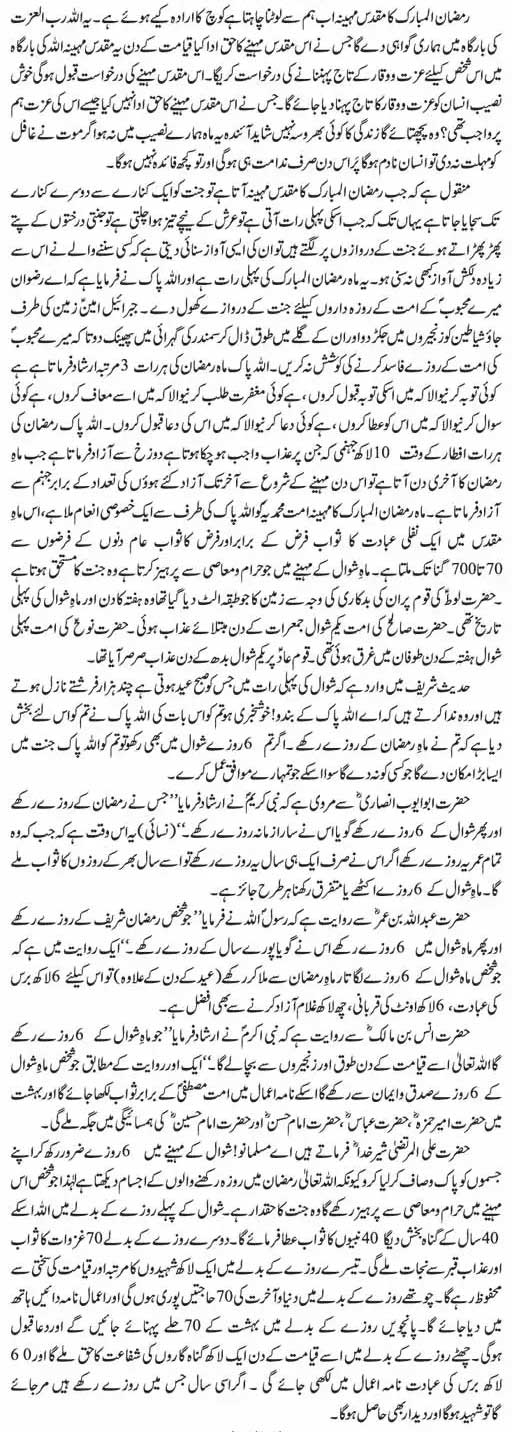
It is commendable to keep six fasts in the month of Shawwal. The Prophet, Sall-Allahu alayhi wa sallam, has said:
Whoever completes fasts of Ramadan then adds to them the fast of six days in the month of Shawwal, it will carry the thawab of fasting for the whole year. (Sahih Muslim)
This hadith had described the great thawab of six fasts of this month. Therefore, the Muslims should take this opportunity of acquiring such an enormous reward from Allah. It is more preferable to start these fasts from the 2nd of Shawwal and keep fasting up to the 7th of it. However, if, they are kept in other days, it is hoped that the requirement of the above hadith may also be fulfilled.
Umar Bhar Kay Rozay
Be Quick In Doing Good
Allah (SWT) says in Qur’an: ‘And be quick in the race for forgiveness from your Lord, And for a Garden whose width is that of The Heavens And The Earth, Prepared for the Righteous.’ (3:133)
‘Go in Competition for Good deeds.’ (2:138)
By viewing these ayats of the Qur’an we can see that Allah(SWT) has ordered Muslims to rush towards performing good deeds. To such an extent that one should ‘compete’ with others in its application.
It is not unlawful to compete in matters in Deen, yet today we have taken the opposite approach and are competing with each other in worldly matters, which by no means is lawful, in most instances to the disregard of all religious obligations.
RasulAllah (saw) said: ‘In the matter of worldly resources always look at those who are at a lower level than you. In matters relating to religion, keep the company of those who are superior to you, and at a higher level than you.’ (Tirmizi)
Only through Obedience to the commands of Allah(SWT) and the Sunnah of RasulAllah (saw) can one obtain ‘peace and prosperity’ in both worlds.
Imam Shafi(RA) used to say: ‘Peace & prosperity are one thing and the means of peace & prosperity are another.’ This is because these two qualities in the life of a Muslim are a gift itself from Allah(SWT).
Abu Hurairah(RA) relates that RasulAllah(SWT) said: ‘ Make haste to do good deeds before the arrival of 7 things, as after their arrival the opportunity to do good will not be available: poverty, affluence, illness, old age, death, Dajjal, Qiyamah.’
The meaning is one should not defer good deeds for tomorrow as there is no telling what tomorrow may hold. Allah(SWT) is the one who does as he wishes, who’s to say he will give guidance to us tomorrow for good deeds or Islam even?
Dear Brothers and Sisters let us continue with the good deeds we were carrying out in the month of Ramadan throughout the year so that we may become close to Allah (SWT).
Six fasts in the month of Shawwal.
It is commendable to keep six fasts in the month of Shawwal. RasulAllah(saw) has said: ‘Whoever completes fasts of Ramadan then adds to them the fast of six days in the month of Shawwal, it will carry the reward of fasting for the whole year.’
(Muslim) Note: these fasts can be kept consecutively or separately throughout the month of Shawwal. May Allah(SWT) guide us to carry out good deeds in abundance, May Allah(SWT) accept our actions and Duas, save us from his displeasure through his infinite Mercy in this world and the next. Aameen. Al-Kauthar.
Mufti Yusuf Danka Al-Kauthar
Three Types Of Hajj
Hajj Al-Qiran – At a Meeqat, in the months of Hajj, one enters into Ihram for Hajj and Umrah at the same time, not coming out of the state of Ihram until the Day of Sacrifice (10th Dhul Hijjah). Alternatively, one may enter into Ihram for Umrah and before beginning the Tawaf, the intention of Ihram for Hajj may be made. The Sa`ee may be done after the Tawaf of Umrah or left to be done after Tawaf Al-Ifadah. One performing this type of Hajj is called a Qarin.
Hajj Al-Ifrad – At a Meeqat, in the months of Hajj, one enters into Ihram for Hajj alone. Like the Qarin he remains in the state of Ihram until the 10th Dhul Hijjah. It is not obligatory for him to sacrifice an animal. No Umrah is required.
Hajj At-Tamattu’ – Many Scholars consider this the best type of Hajj, as it is what the Prophet (peace be upon him) urged his Companions to do. One performing this type of Hajj is called a Muttamatti. This involves performing Umrah first during any of the months of Hajj (Shawwal, Dhul Qada, and the first ten days of Dhul Hijjah), removing the Ihram clothes after Umrah, and then reassumes the Ihram state for Hajj on the eighth day of Dhul Hijjah of the same year.
Note: For those who choose to do At-Tamattu’ or Al-Qiran, a mandatory sacrifice is required from them during the days of Eid. Those who live in Makkah are exempted from this requirement.