TAG: Shirk
The Horrendous Sin Of Adultery
ADULTERY means sexual intercourse between a man and a woman not married to one another. It is immaterial whether it is adultery (where the participants are married people) or fornication (when they are unmarried). Islam regards adultery in any case as a great sin.
There are many verses of the Qur’an and Prophetic statements with regard to this issue and we relate just a few below. Each indicates the seriousness of adultery and makes it crystal clear that there is no room for it being an acceptable behavior in Islam. Allah says in the Qur’an :”Do not come near to adultery. Verily, it is a faahisha (a great and shameful sin) and an evil way (that leads someone to Hell unless Allah forgives him.” (Al-Israa’ 17:32)
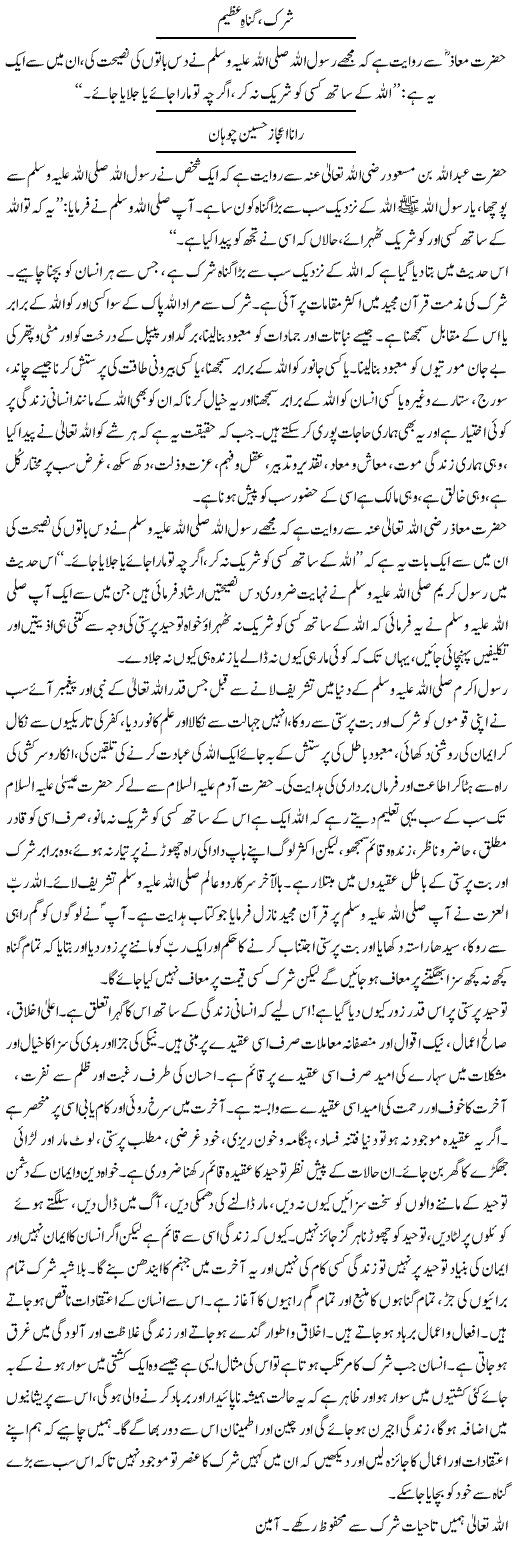
Prophet Muhammad (peace be upon him) said: “There is no sin after Shirk (associating partners to Allah) greater in the sight of Allah than a drop of semen which a man places in the womb which is not lawful for him.” (Al-Bukhari, Kitabul-Hudood).
also said: “The adultery of the legs is walking (with bad intention towards a woman who is not lawful for a man) and the adultery of the hands is touching and patting (such a woman) and the adultery of the eyes is the passionate glance.” (Al-Bukhari).
Abu Umamah narrated: A certain young man came to the Prophet (peace be upon him) and said “O Messenger of Allah permit me to commit adultery.”
The Companions were annoyed at this arrogant attitude of his and with no attempt at concealment of their feelings in this behalf, berated him, and demonstrated open disgust for his insolent request.
The Prophet (peace be upon him) asked the young man to come closer and he did so. Then he asked him to take a seat and he obeyed.
The Prophet (peace be upon him) then started to ask him: “Would you like such (i.e. adultery) for your mother?” He (the man) replied, “No, by Allah. May Allah sacrifice me for you.”
The Prophet said, “Other people do not like it either for their mothers. Would you then like it for your daughter (i.e. adultery)?” He replied, “No by Allah. May my life be sacrificed for you.”
The Prophet, “Others too do not like it for their daughters. Would you like if for your sister.
He replied, “No by Allah. May my life be sacrificed for you.” The Prophet said, “Other people do not like it for their sisters. Would you like it for your paternal aunt?”
He replied, “No by Allah. May my life be sacrificed for you.” The Prophet said, “Other people dislike it for their paternal aunts. Would you like it for your maternal aunt?”
He replied, “No by Allah. May my life be sacrificed for you.”
The Prophet said, “Others too do not like it for their maternal aunts.”
He (the narrator) then said, “He (the Prophet) then put his hand on the man’s chest and said, “Oh Allah forgive his sin, cleanse his heart, and make chaste his private parts.”
Thereafter the young man never even looked at anything (prohibited by Allah that includes adultery as well) (Ahmed).
The Sinners Among the Believers Will Enter Paradise
(i) They will be brought forth from Hell and will enter Paradise by means of intercession.
Muslim reports from Abu Sa’eed that the Messenger of Allah (saw) said:
“The people of Hell will remain there, never dying, and never living. But there are people who will enter Hell because of their sins, and will be killed therein, so that they become like coals. Permission will be granted for intercession to be made, and they will be brought forth in groups and spread on rivers of Paradise, and it will be said, “O people of Paradise, pour water on them. Then they will grow like seeds in the silt left by a flood”. [Muslim, Kitaab al-Imaan, Baab as-Shafa’ah wa Ikhraaj al-Muwahiddin min an-Naar, 1/172]
Muslim also reports from Jaabir ibn ‘Abdullaah that the Messenger of Allah (saw) said, “Some people will be brought out of the Fire, having been burnt all over except for their faces, and they will enter Paradise”. [Muslim, Kitaab al-Imaam, Baab adna Ahl al-Jannah Manzilatan, 1/178]
The people of Paradise will call these people who are brought out of Hell and admitted to Paradise, al-Jahannamiyyoon. al-Bukhaari reports from ‘Imraan ibn Husayn (ra) that the Prophet (saw) said, “Some people will be brought out of Hell through the intercession of Muhammad (saw). They will enter Paradise and will be known as al-Jahannamiyyoon.” [Sahih al-Bukhaari, Kitaab ar-Riqaaq, Baab Sifaat al-Jannah wan-Naar, Fath al-Baari, 11/418. They are also mentioned in a hadith narrated from Jaabir by Muslim, 1/179 and al-Bukhaari from Anas, Fath al-Baari 11/416]
According to another sahih hadith narrated by Jaabir: “The Prophet (saw) said, “They will be brought out of the Fire through intercession, as if they are tha’areer”. I asked, “What are tha’areer?” He said, “Daghabis [snake cucumbers]”. [al-Bukhaari, Kitaab ar-Riqaaq, Baab Sifaah al-Jannah wan-Naar, Fath al-Baari, 11/416]
Muslim reports a lengthy hadith from Abu Hurayrah, in which the Prophet (saw) describes the Hereafter, and in which he says: “…When Allah (swt) has finished judging mankind, and wants to bring whomever He wills out of Hell by His Mercy, He will order angels to bring forth those upon who He wishes to bestow His mercy of the people who never associated anything in worship with Allah (swt), and who said, “Laa ilaaha illaah Allah”. The angels will recognize them in Hell, and will known them by the mark of sujood on their foreheads. The Fire will consume all of a man except the mark of sujood which Allah (swt) has forbidden the Fire to consume. They will be brought forth, having been burned in the Fire, the water of life will be poured on then, and they will grow like seeds left by still after a flood”. [Saheeh Muslim, Kitaab al-Imaan, Baab ar-Ru’yah, 1/299, no. 182]
Man Has A Free Will In Islam
Before assigning to man this vicegerency (Khilafat), Allah made it clear to him that He alone is the Lord, the Ruler, and the Deity. As such, the entire universe and all the creatures in it (including man) should submit to Him alone.
Man must not think himself totally free and must realize that this earth is not his permanent abode.
He has been created to live on it only for a probationary period and, in due course, he will return to his Lord, to be judged according to the way he has spent that period.
The only right course for man is to acknowledge Allah as the only Lord, the Sustainer, and the Deity, and to follow His guidance and His commands in all he does.
His sole objective should be to merit the approval of Allah.
If man follows a course of righteousness and godliness (which he is free to choose and follow) he will be rewarded in this world and the next: in this world he will live a life of peace and contentment, and in the Hereafter he will qualify for the heaven of eternal bliss, Al-Jannah. If he chooses to follow the course of godlessness and evil (which he is equally free to choose and follow), his life will be one of corruption and frustration in this world, and in the life to come, he will face the prospect of that abode of pain and misery which is called Hell.
After making this position clear, Allah placed man on earth and provided the very first human beings (Adam and Eve) with guidance as to how they were to live.
Thus man’s life on this earth did not start in utter darkness. From the beginning, a bright torch of light was provided so that humanity could fulfill its glorious destiny.
The very first man received revealed knowledge from Allah Himself and was told the correct way to live.
This code of life was Islam, the attitude of complete submission to Allah, the Creator of man and the whole universe. It was this religion that Adam, the first man, passed down to posterity.
But later generations gradually drifted away from the right path.
Either they lost the original teachings through negligence or they deliberately adulterated and distorted them. They associated Allah with innumerable human beings, material objects, and imaginary gods. Shirk (polytheism) became widespread. They mixed up the teachings of Allah with myths and strange philosophies and thus produced a jumble of religions and cults; and they discarded the God-given principles of personal and social morality, the Shariah.
Although man departed from the path of truth, disregarded or distorted the Shariah, or even rejected the code of Divine guidance, Allah did not destroy them or force them to take the right course. Forced morality was not in keeping with the autonomy He had given to man. Instead, God appointed certain good people from among the human society itself to guide men to the right path.
These men believed in Allah and lived a life of obedience to Him. He honored them with His revelations, giving them the knowledge of reality. Known as prophets, blessings, and peace be on all of them, they were assigned the task of spreading Allah’s message among men.
kalma Tauheed Ki Fazeelat
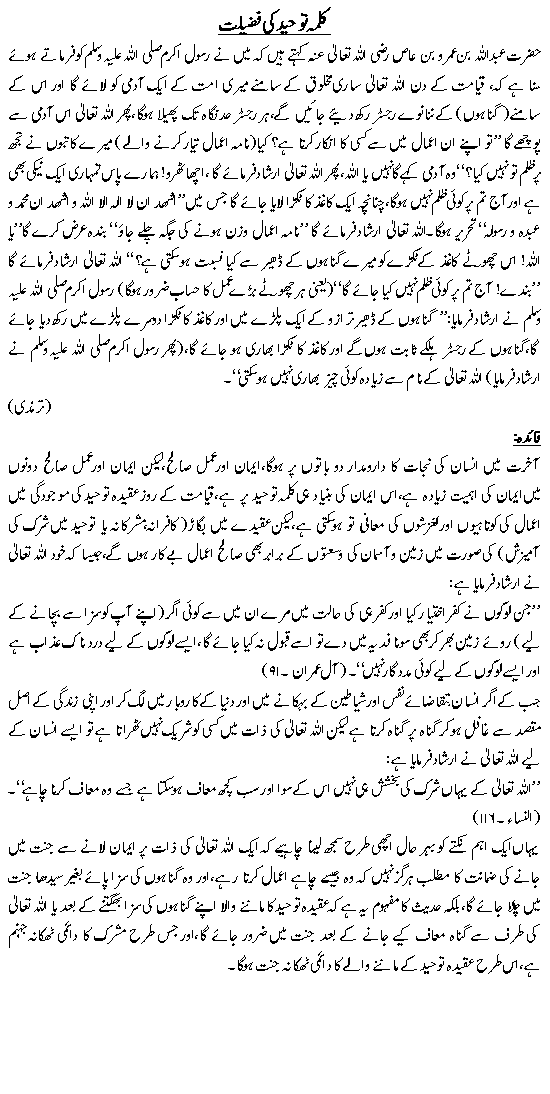
kalma Tauheed Ki Fazeelat
What Is Iman And Kufr?
- Iman is to accept every word of Sayyiduna Rasoolullah (sallal laahu alaihi wasallam) as the absolute truth and to testify whole-heartedly the reality and truth of Sayyiduna Rasoolullah (sallal laahu alaihi wasallam).
- One who observes the above would be called a Muslim, that is, if any of his words, actions or conditions does not reject, insult or falsify Allah Ta’ala and His Rasool (sallal laahu alaihi wasallam).
- If you reject one aspect, which you know that to believe is part of Islam, then this is Kufr. For example, to reject Qiyamat, Angels, Jannat, Jahanum, Hisab, or not to believe that Salaah, Saum, Zakaah, or Hajj is Fardh (obligatory) would make one out of the folds of Islam.
- It is also Kufr not to believe that the Holy Quran is the Words of Allah Ta’ala.
- To insult the Holy Ka’aba, the Holy Quran, or any of the Prophets or Angels is also Kufr.
- To degrade any of the Sunnats (actions of the Holy Prophet sallal laahu alaihi wasallam), to make jokes of the orders of Shari’ah (Islamic law), or to reject or suspect it untrue any known and recognized aspects of Islam is also definitely Kufr.
- To be a Muslim you have to, together with faith and belief, also pledge your status as a Muslim.
- One must pledge his faith unless there is a difficulty, for example, if you cannot speak, or to speak would mean to lose your life or would lose a part of the body, then it is not necessary to pledge your faith with your tongue. However, it is always best and a means of great reward not to say anything against Islam even to save your life.
Farman-e-Elahi