

Siddique Kay Liye Hai Khuda Ka Rasool (PBUH) Bus!
TAG: Siddique
Khasais Siddique e Akbar
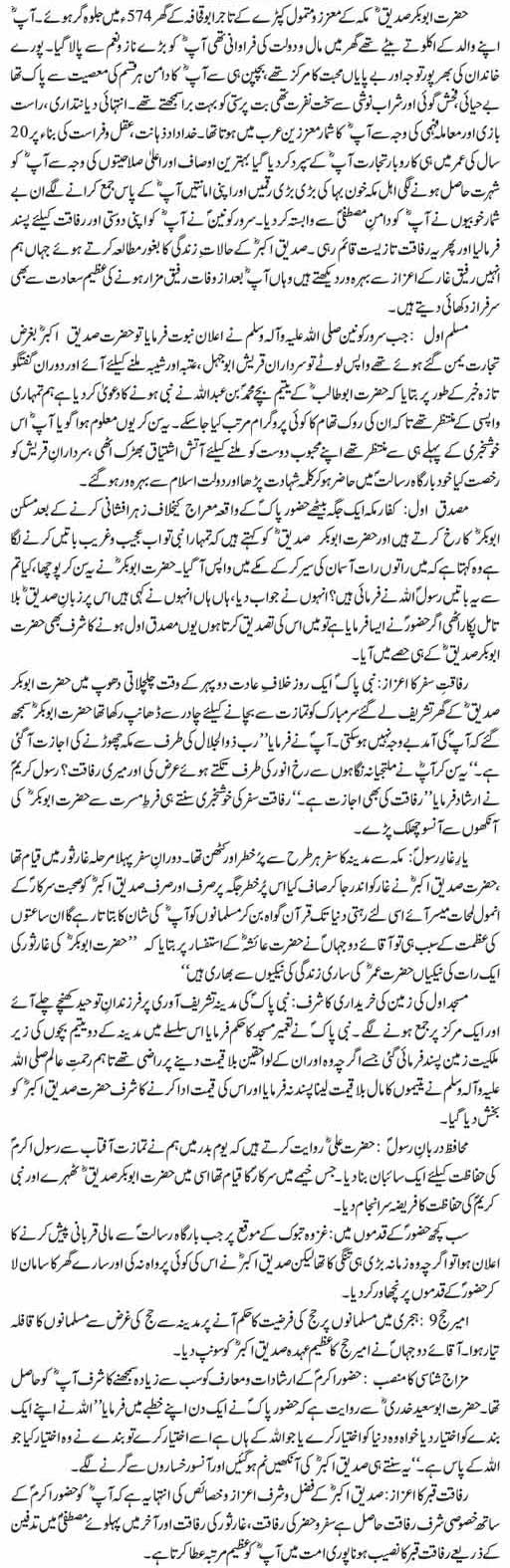
Seerat e Hazrat Syedna Siddique e Akbar (Hisa Chaharam)

by Mufti Munib ur Rehman
Seerat e Hazrat Syedna Siddique e Akbar (Hisa Soam)

by Mufti Munib ur Rehman
Seerat e Hazrat Syedna Siddique e Akbar (Hisa Doam)

by Mufti Munib ur Rehman
Seerat e Hazrat Syedna Siddique e Akbar (Hisa Awal)

by Mufti Munib ur Rehman
The Holy Prophet Muhammed Sallallahu Alayhi Wa Aallam – I Have Been Sent As A Qasim
The Holy Prophet Muhammed Sallallahu Alayhi wa sallam is the Distributor(Qasim) for the Ummah and the Atta is from Allah.
Sahih Bukhari Book 25, Number 5317:
Jabir b. ‘Abdullah reported that a child was born to one of the persons amongst us and he decided to give him the name of Muhammad We said: We will not allow you to give the name after the name of Allah’s Messenger (may peace be upon him) until you ask him (the Holy Prophet). So he (that person) came and said (to the Holy Prophet): A child was born in my house and I wanted to give him the name (of Muhammad) after the name of Allah’s Messenger, whereas my people did not allow me that I should name him after that (sacred) name until I have asked Allah’s Apostle (may peace be upon him) in this connection, whereupon he said: Give him the name after my name but do not call him by my kunya, for I have been sent as a Qasim as I distribute amongst you.
Sahih Bukhari Book 25, Number 5317:
Some people argue that here Qasim only means the distribution of Zakat and spoils of the war and it is only limited to that, but in this hadith, the Holy Prophet Muhammed Sallallahu Alayhi wa sallam said that he was sent as a Qasim, which clearly signifies that purpose of this attribute “Qasim” is not just distribution of zakat and spoils of war, but Allah’s blessing are doled out to us through the Holy Prophet Muhammed Sallallahu Alayhi wa sallam, He is the door from which we get Allah’s blessings, whether it be in this world or the next.
The distribution of Shafaath is also through him on the day of judgment, Allah will give Shafaath to the Holy Prophet Muhammed Sallallahu Alayhi wa sallam and it is distributed to all by him
To clarify this point I am extracting the incident when Abu Bakr Siddique anhu radi Allahu taala gave his entire wealth to the Holy Prophet Muhammed Sallallahu Alaihi Wa Sallam, The Holy Prophet Muhammed Sallallahu Alaihi Wa Sallam had already refused another Sahabi’s wealth when he gave everything because one must also keep wealth to take care of himself and his family and it is a Muslims fard, but he only accepted Siddique E Akbar’s sacrifice because of the level of Imaan of Siddique E Akbar, who said I have left Allah and his Rasool in my home.
I have left the source (Allah) and the means (the Holy Prophet) of the distribution of wealth in my home.
This is described by Allama Sir Syed Muhammed Iqbaal
The poem from Allama Iqbal is as follows
“To the companions, one day the Holy Prophet(Sallallahu Alayhi wa sallam) appealed, O You of wealth, give in the path of righteousness,
Hearing the command Umar(radiallahu taala anhu) rose with immense desire,
for that day several thousand dirhams he did acquire
he thought to himself compared to Siddique(radiallahu taala anhu) today, my steed will surely lead the way
To the trusted Prophet(Sallallahu Alayhi wa sallam) His Riches he did give
, an act of selflessness for the dependent, he took the initiative
The Master of the World (Sallallahu Alayhi wa sallam) Enquired,
O Umar (radiallahu taal anhu) For whom the passion for the truth is the solace of the heart
For your own family, what did you leave? , What is in their right, the kinsmen must receive
Umar(radiallahu taal anhu) replied, Half the riches to the women and children would suffice,
The rest assigned to the Ummah in sacrifice,
By then the friend of Apostleship arrives
From Whom Love and affection derives
With his sincere nature, he brings forth,
All that in the worlds eye has worth
The Prophet said the concern for the family you must not dismiss
Then replied the secret keeper of love and bliss
From you do the eyes of the moon and the stars get their light
It is your being that is the means for the distribution of livelihood
The Candle is sufficient for the Moth
The Flower to the nightingale,
for Siddique(radiallahu taala anhu) The Messenger of Allah is Sufficient
Sayyiduna Abu Baqr Siddeeq (Radi Allahu Anhu) The First Caliph Of Islam
Early Life
Sayyiduna Abu Bakr (radi Allahu anhu’s) real name was Abdullah, and he was given the title of “As Siddique” or “Testifier to the Truth.” His father, ‘Uthman, was known as Abu Quhafah and his mother, Salma, was known as Ummul Khair. He was two and a half years younger than Sayyiduna Rasoolullah (sallal laahu alaihi wasallam).He was the first among the Sahaba to accept Islam. He accompanied Sayyiduna Rasoolullah (sallal laahu alaihi wasallam) during the Hijrah to Madinatul Munawwarah. Sayyiduna Abu Bakr (radi Allahu anhu) was a merchant. He freed many slaves, including Sayyiduna Bilal (radi Allahu anhu) and Sayyiduna Umayyah bin Qahaf (radi Allahu anhu). He participated in all the battles in which Sayyiduna Rasoolullah (sallal laahu alaihi wasallam) had to fight the Kuffar.
Sayyiduna Abu Bakr (radi Allahu anhu) loved his faith more than anything else. At the Battle of Badr, his son, Sayyiduna Abdur Rahman (radi Allahu anhu), was fighting on the side of the Kuffar. After accepting Islam, Sayyiduna Abdur Rahman (radi Allahu anhu) said to his father, “O Father, at Badr, you were twice under my sword, but my love for you held my hand back.” To this, Sayyiduna Abu Bakr (radi Allahu anhu) replied, “Son, if I had you only once under my sword, you would have been no more.” He was so uncompromising in his faith.
At the time of the Battle of Tabuk, he donated all his wealth to the war effort, and when Sayyiduna Rasoolullah (sallal laahu alaihi wasallam) asked him, “What have you left for your family,?” he replied, “Allah and His Rasool (sallal laahu alaihi wasallam).”
As Caliph
After his election as the Caliph, Sayyiduna Abu Bakr (radi Allahu anhu) addressed the Muslims with these words: “O People! I have been chosen by you as your leader, although I am no better than any of you. If I do any wrong, set me right. Listen, truth is honesty and untruth is dishonesty. The weak among you are the powerful in my eyes, as long as I do not give them their dues. The powerful among you are weak in my eyes, as long as I do not take away from them what is due to others.
“Listen carefully, if people give up striving for the Cause of Almighty Allah, He will send down disgrace upon them. If people become evil-doers, Almighty Allah will send down calamities upon them.
“Obey me as long as I obey Allah and His Rasul (sallal laahu alaihi wasallam). If I disobey Allah and His Rasul (sallal laahu alaihi wasallam), you are free to disobey me.”
Such was the first Caliph of Islam. Indeed, the world would be a better place to live in, if we had leaders like Sayyiduna Abu Bakr (radi Allahu anhu).Sayyiduna Abu Bakr (radi Allahu anhu) now sent Sayyiduna Usamah (radi Allahu anhu) on the expedition to Syria to fight the Romans, even though he had to attend to all the internal problems of the Islamic State.
The news that Sayyiduna Rasoolullah (sallal laahu alaihi wasallam) had passed away, made some new Muslims think that the Islamic State would crumble and they refused to pay the Zakaah. These new Muslims could not yet get used to their faith and its requirements until then. Sayyiduna Abu Bakr (radi Allahu anhu) declared, “By Allah! Even if a single thread is due from a man, he must give it. If he refuses, I will declare war against him.”
Rengades And Imposters
Some others became imposters and renegades. Tulaiha, Musailimah, Maalik bin Nuwairah, Aswad Ansi, and a woman named Sajah claimed that they were prophets and caused a great deal of confusion. Sayyiduna Abu Bakr (radi Allahu anhu) was quick to take action against these imposters.
Sayyiduna Khalid bin Walid (radi Allahu anhu) was sent to deal with Tulaiha who fled to Syria and later became a Muslim. Maalik bin Nuwarah was killed. Sayyiduna Ikramah (radi Allahu anhu) and Sayyiduna Surahbil (radi Allahu anhu) were sent to take action against Musailimah, but they were defeated. Sayyiduna Abu Bakr (radi Allahu anhu) sent Sayyiduna Khalid bin Walid (radi Allahu anhu) to tackle the notorious Musailamah who married Sajah. In the fight that followed, Sayyiduna Wahshi (radi Allahu anhu) killed Musailamah. Musailamah and Aswad Ansi also claimed to be prophets while Sayyiduna Rasoolullah (sallal laahu alaihi wasallam) was alive. Aswad was killed by the Muslims of Yemen.
Sayyiduna Abu Bakr (radi Allahu anhu’s) swift and bold steps saved the Islamic State from the serious danger of chaos and confusion. He could now attend to other urgent problems.
Era of Conquests
During his Khilaafat, Sayyiduna Abu Bakr (radi Allahu anhu) had to take action against the Iranian Empire. The Emperor of Iran, Khusrou Parvez, was killed by his son, Shirooya, and the whole empire fell into chaos and disorder. Hurmuz, the Persian governor of Iraq, was very hostile to the Arabs and he was also cruel to the Muslims living in that area.
Sayyiduna Abu Bakr (radi Allahu anhu) sent Sayyiduna Muthamia (radi Allahu anhu) to take action against the Iranians in Iraq. His forces were not enough and Sayyiduna Khalid bin Walid (radi Allahu anhu) was then sent with reinforcements. The Muslim army captured vast areas of the Iranian Empire in several battles.
Sayyiduna Abu Bakr (radi Allahu anhu) then turned his attention to the Romans who were causing trouble in the North-West frontier. Sayyiduna Abu Bakr (radi Allahu anhu) sent 4 separate armies under Sayyiduna Ubaidah bin Jarrah, Sayyiduna Amr Ibnul As, Sayyiduna Yazid bin Abu Sufyaan and Sayyiduna Surahbil bin Hasnal (radi Allahu anhumul ajma’in) to deal with the Roman power.
The four armies joined into one unit to face the Romans more effectively. The Romans had amassed 150 000 soldiers, but the total Muslim army was only 24 000. Reinforcements were requested. Sayyiduna Abu Bakr (radi Allahu anhu) asked Sayyiduna Khalid bin Walid (radi Allahu anhu) to take charge of the Iraqi front and Sayyiduna Muthanna (radi Allahu anhu) to rush to the Syrian front to help fight the huge Roman army. The armies met in Yarmuk after Sayyiduna Abu Bakr (radi Allahu anhu) passed away. In this battle, the Romans were totally defeated.
Passes Away
Sayyiduna Abu Bakr (radi Allahu anhu) fell ill at this time and passed away on the 21st of Jamadi-ul-Aakhir 13 A.H. (22 August 634). His rule lasted 2 years and 3 months. He was 63 years old.
One of the many contributions of Sayyiduna Abu Bakr (radi Allahu anhu) was the collection and compilation of the Holy Quran.
Personal Life
He lived a very simple, pious, and upright life. He was a true servant of Almighty Allah and a meticulous follower of Sayyiduna Rasoolullah (sallal laahu alaihi wasallam). He wore ordinary clothes and his meals were very simple. He attended house-hold work and would go out at night and seek the poor and destitute. Humility and modesty were the keynotes of his character. He felt embarrassed when people showered praises on him or showed him immense respect. He often fasted during the day and spent the whole night in Salaah and meditation. He was a great orator and a master of genealogy (one who can trace a person’s family line). In his personal life, he was a Saint. He used all his powers to promote the interest of Islam and the good of people.
The Gate Of Iman- Hazrat Abu Bakr Siddique radiallahu taala anhu
Sahih Bukhari Volume 1, Book 8, Number 455
Narrated by Abu Said Al-Khudri
The Prophet delivered a sermon and said, “Allah gave a choice to one of (His) slaves either to choose this world or what is with Him in the Hereafter. He chose the latter.” Abu Bakr wept. I said lo myself, “Why is this Sheikh weeping, if Allah gave choice to one (of His) slaves either to choose this world or what is with Him in the Here after and he chose the latter?” And that slave was Allah’s Apostle himself. Abu Bakr knew more than us. The Prophet said, “O Abu Bakr! Don’t weep. The Prophet added: Abu- Bakr has favored me much with his property and company. If I were to take a Khalil from mankind I would certainly have taken Abu Bakr but the Islamic brotherhood and friendship is sufficient. Close all the gates in the mosque except that of Abu Bakr.
The way of Love , Ishq E Rasool is the gate of the way to Allah , All who achieved communion with Allah , came through the way of love , this is way of Abu Bakr Siddique radi allahu taala anhu and the way of Success ,
He was among the first person to endorse and accept the Apostleship of the Holy Prophet Muhammed Salalaahu Alaihi wasallam.
His deep love and reverence for the Holy Prophet Muhamed Salalaahu Alaihi wasallam earned him some of the highest honors
He Always led the prayer in the absence of The Holy Prophet Muhammed Salalaahu Alaihis wasallam
Sahih Bukhari Volume 1, Book 11, Number 633 :
Narrated by Al-Aswad
“We were with ‘Aisha discussing the regularity of offering the prayer and dignifying it. She said, ‘When Allah’s Apostle fell sick with the fatal illness and when the time of prayer became due and Adhan was pronounced, he said, ‘Tell Abu Bakr to lead the people in prayer.’ He was told that Abu Bakr was a soft-hearted man and would not be able to lead the prayer in his place. The Prophet gave the same order again but he was given the same reply. He gave the order for the third time and said, ‘You (women) are the companions of Joseph. Tell Abu Bakr to lead the prayer.’ So Abu Bakr came out to lead the prayer. In the meantime the condition of the Prophet improved a bit and he came out with the help of two men one on each side. As if I was observing his legs dragging on the ground owing to the disease. Abu Bakr wanted to retreat but the Prophet beckoned him to remain at his place and the Prophet was brought till he sat beside Abu Bakr.” Al-A’mash was asked, “Was the Prophet praying and Abu Bakr following him, and were the people following Abu Bakr in that prayer?” Al-A’mash replied in the affirmative with a nod of his head. Abu Muawiya said, “The Prophet was sitting on the left side of Abu Bakr who was praying while standing.”