

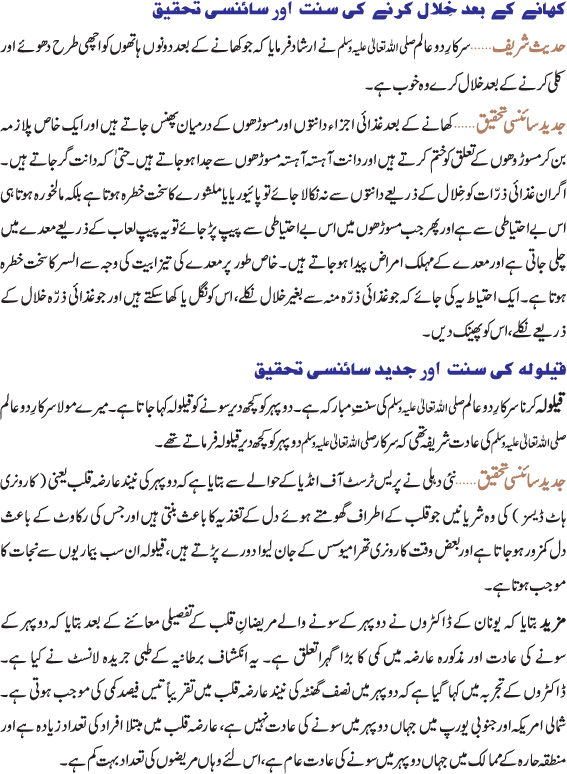
Method Of Eating And Science
TAG: Sunnah
Ikhlas – A Commandment of Allah
Say (O Muhammad, peace be upon him): “Verily, my Salat (prayer), my sacrifice, my living, and my dying are for Allah, the Lord of the Alamin (mankind, jinn, and all that exist). He has no partner. And of this, I have been commanded, and I am the first of the Muslims.“ (Qur’an, 6:162-163)
In defining Ikhlas (sincerity), Al-Jurjani said it is not to seek any audience for your deeds other than Allah.
Allah said: “Who has created death and life that He may test you which of you is best in deed. And He is the All-Mighty, the Oft-Forgiving.” (Qur’an, 67:2)
Commenting on this verse, Al-Fudayl Ibn ‘Iyaadh said, “It is those deeds that are most correct and most sincere.”
The students asked, “What are deeds that are correct and sincere?”
He replied, “If a deed is done sincerely, yet is not done correctly, it will not be accepted. And if a deed is done correctly, but not sincerely for Allah, it will not be accepted. It must be done sincerely and correctly. Sincerely – for Allah alone. Correctly – in accordance with the Sunnah.”
What contradicts Ikhlas
Riyaa’ – to perform an act of worship with the intention of showing it off to people, seeking their praise.
Sum’ah – verbal statements that a person makes for the sake of people. An example of someone making ballooned talks just so others will think highly of him.
‘Ujb – when a person becomes impressed with the ‘great’ deeds he has done.
All these are viruses that can kill our deeds and turn them against us on the Day of Resurrection.
Ya’qoob Al-Makfoof Rahimahullah used to say, “The sincere one is he who hides his good deeds in the same way that he would hide his bad.”
Insincerity is something very dangerous and can lead a person to ruin.
Ibnul Qayyim Rahimahullah said, “Deeds without sincerity are like a traveler who carries dirt in his water jug. The carrying of it burdens him and it brings no benefit.”
May Allah make us all from those whose deeds are done in accordance with the Sunnah, deeds that are done sincerely for His sake alone.
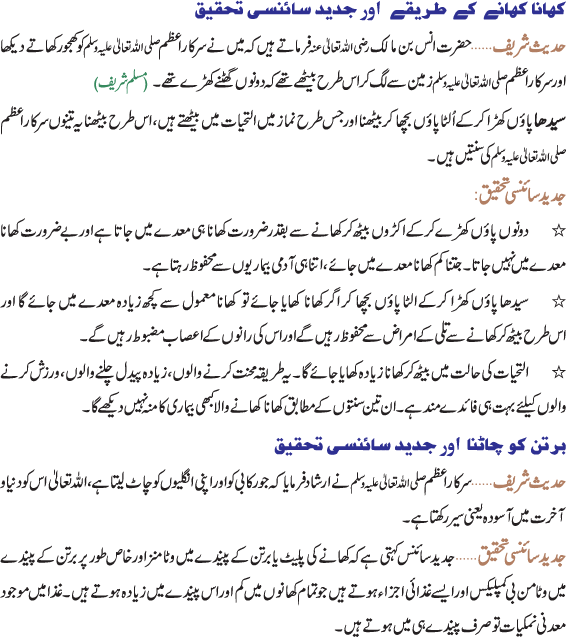
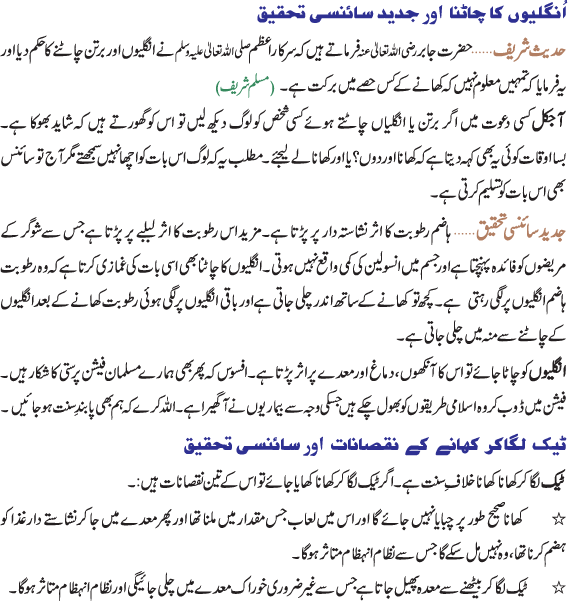
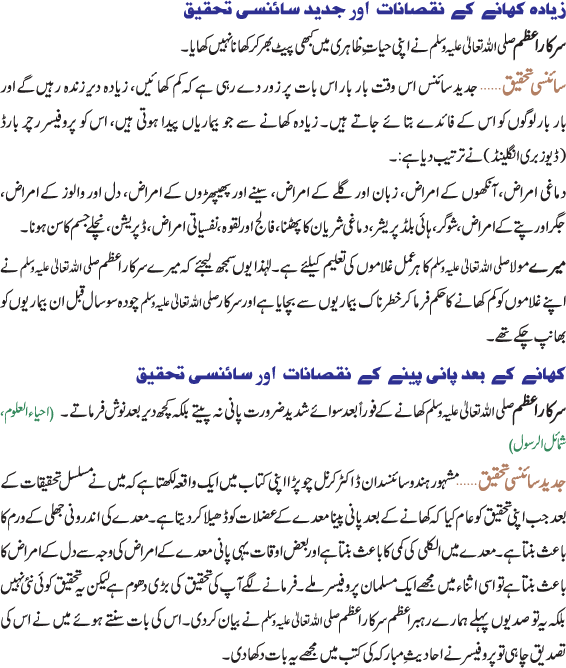
Khana Khane Kay Tarikay Aur Jadeed Science


Khana Khane Kay Tarikay Aur Jadeed Science
Death, An Indispensable Reality
How often do we remember death? Yes death, a harsh and fearful reality that escapes no living person. None can avoid it. The people around a dying person don’t have the ability to prevent it. Death happens every moment and it does not discriminate between the young and the old, the rich and the poor, the strong and the weak. Everyone is equal in front of death, because no one has any means to escape it or use intercession to avoid it or even delay it.
Allah says in the Qur’an:
“Say: Indeed, the death from which you flee will surely meet you, then you will be sent back to Allah, the All-Knower of the unseen and the seen. And He will then tell you what you used to do.” (Qur’an, 62:8)
“Every one is going to taste death. And We shall make a trial of you with evil and with good, and to Us will you be returned.” (Qur’an, 21:35)
Our hearts tremble with fear on the thought of this indispensable reality. A person’s actions are sealed with death and what comes after that is more fearful, because will there be a place where one can flee to in order to escape the afflictions suffered in the grave? What will our reply be when we are questioned in the grave? None of us know where we will end up. Will it be Paradise whose width is like the heavens and the earth or will it be the Fire whose fuel is of men and stones?
Ibrahim Bin Adham (d. 160H) was asked about the verse: “Call upon Me and I will respond to you.” (Qur’an, 40:60) that: “We call upon Allah, but He does nor respond to us.” So Ibrahim replied:
“You know Allah; yet you do not obey Him. You recite the Qur’an; yet you do not act according to it. You know Shaytan; yet you continue agreeing with him. You claim to love Allah’s Messenger (peace be upon him); yet you abandon his Sunnah. You claim to love Paradise, yet you do not work for it. You claim to fear the Fire; yet you do not stop sinning.
You say ‘indeed death is true’; yet you have not prepared for it. You busy yourselves with the faults of others; yet you do not look at your own faults. You eat the sustenance that Allah provides for you; yet you are not grateful to Him. And you bury your dead; yet you have not heeded its lesson.” (Ibn Rajab’s Al-Khushu’-fis-Salah, pg. 62)
This reality must be firmly established in our heart – the reality that life in this world is limited and has an appointed end, and that this end will surely come. Sheikh Ali Hasan Al-Halabi mentions some good reflections in his book Al-Mawt:
“The righteous will die; and the wicked will die. The warriors who fight jihad will die; and those who sit at home will die. Those who busy themselves with correct beliefs will die; and those who treat people as their slaves will die. The brave who reject injustice will die; and the cowards who seek to cling to this vile life will die. The people of lofty goals and ambitions will die; and the wretched who live for cheap enjoyment will die.
“…So keep death in mind, and the passing on to the next life, and the number of sins that one has committed and the small amount of good that one has done. Think of the good that you would earnestly like to do at that time – then bring that forward and do it today. And think of all those things which you would desire to clear yourself of – then clear yourself from them now.”
Arrogance: The Barrier To Paradise
Allah’s Messenger (peace be upon him) said: “Whoever has an atom’s worth of kibr (pride and arrogance) in his heart will not enter Paradise.” So a man said: What about a person who loves (i.e. takes pride in) wearing beautiful clothes and beautiful shoes? So he replied: “Indeed Allah is beautiful and loves beauty. Kibr is to reject the truth and to despise the people.” (Sahih Muslim, 1/65)
So Allah informs us that the Hellfire is the abode of those who have kibr (pride and arrogance). And we learn from the (above) hadith that: “Whoever has one atom’s worth of kibr in his heart will not enter Paradise.” So this is proof that kibr necessitates entry into the Hellfire and prevents entry into Paradise. And this comprehensive explanation that the Prophet (peace be upon him) mentioned has clarified the meaning of kibr in the dearest possible manner. So he divided kibr into two types:
1. Kibr against the truth
This is to reject the truth and not accept it. So anyone who rejects the truth is proud and arrogant – in accordance with what he rejects. So it is obligatory upon everyone to humble themselves to the truth that Allah sent His Messenger with, and (the truth) He sent down in His Book.
Those who, out of pride and arrogance, do not comply with the Messengers (i.e. do not believe in them and their message) are disbelievers and they will eternally dwell in the Hellfire. This is because they rejected the truth that the Messengers brought to them with clear signs and proof. They are prevented from accepting it because of the kibr they harbor in their hearts. Allah said:
“Verily, those who dispute about the Signs of Allah, without any authority having come to them, there is nothing else in their breasts except pride.” (Qur’an, 40:56)
Those who, out of kibr, do not comply with parts of the truth, because it opposes their personal opinions or desires, are not disbelievers. But their action necessitates punishment in accordance with what they have of kibr. This is why scholars have agreed that whenever a sunnah of Allah’s Messenger (peace be upon him) has been explained to someone, it is not lawful for him to turn away from it giving preference to the saying of someone else – whoever the someone else may be.
Therefore, it is obligatory for students of knowledge to give complete and absolute precedence to the saying of Allah and the saying of His Messenger (peace be upon him) over and above the saying of anyone else. He should make that the basis to which he returns, and the foundation upon which he builds. He must try his best to follow the guidance of the Prophet (peace be upon him) inwardly and outwardly and strive hard to understand what is intended from it.
Preparing For The Day Of Judgment
Fear Allah and not do anything that earns His displeasure. Allah protects those who fear Him and makes Paradise their abode.
The sun will come nearer to the earth and nobody will escape its scorching heat. On that Day, there will be no tree to provide shade, no water to give some relief, and no rock beside which to take rest. The land will be flat. The Day of Judgment will be equivalent to 50,000 worldly years.
The level of the people’s sweat will be measured by their deeds. The sweat will cover some up to their anklebones, some to their knees, some to their hips, and others to their mouths.
Amidst this suffering, there are some among the believers whom Allah will provide with shade on the Day when there will no shade except that provided by Him. There are seven categories of people whom Allah will provide with shade. These include a just leader (Imam), a youth who grows up in the worship of Allah, a person whose heart is attached to the mosques, two people who like each other for the sake of Allah, a man who, when called by a beautiful woman of high social standing (for immoral acts), says, “I fear Allah”, one who gives alms and does not disclose it to anyone, and the one who remembered Allah privately and tears flowed from his eyes.
The Prophet (peace be upon him) said that deeds are driven by intention and that what a person gets depends upon his intention (niyyah). Allah commands a Muslim to do good deeds and keep away from committing sins and all that He has forbidden at all times. However, there is an emphasis on doing good deeds when a person becomes old especially when approaching the last days of life. The Prophet (peace be upon him) said, “The deeds are judged by the final deeds.” Therefore, whoever Allah grants success to do good deeds in the final days or hours of his life, then Allah has written a good end for him.
Whoever Allah does not grant success and does an evil deed in his final hour Allah’s wrath will be brought against him. Allah has commanded Muslims to seek a good end.
Whoever succeeds in having a good end, will be happy in the Hereafter, but whoever does an evil deed in the last hours of life, is at a loss in this world and in the Hereafter.
Pious believers are always keen to do good deeds prior to the final hour and they also seek to have a good end. They have good faith in Allah but bad faith in themselves.
Whoever has sincere and good faith in Allah, follows the teachings and Sunnah of the Prophet (peace be upon him) and the guidance of the Prophet’s companions is successful in having a good end because good intentions and sincerity are conditions for deeds to be accepted by Allah.
Means of securing a good end are performing the five obligatory prayers in congregation with the Muslims. Other deeds include belief (Iman), being God-conscious in private and in public, obeying Allah and keeping away from all that He has forbidden, keeping away from major and minor sins, following the teachings of the Prophet (peace be upon him), following the path of the Muhajireen and Ansar, keeping away from being unjust to others, being kind toward others and refraining from innovations in religion (bida’).
Repent Before You Regret
Why should Allah punish you if you have thanked (Him) and have believed in Him? And Allah is Ever All-Appreciative (of good), All-Knowing. (An-Nisaa‚ 4:147)
People are created with many weaknesses and imperfections. Throughout our lives, we forget many things and make countless mistakes. However, through repentance, which Allah grants us as a great favor, it is always possible in this world to correct our mistakes. Indeed, the world is created just for this purpose: We are trained, put to test, and purified of our mistakes in this world. It is likely that we may deeply regret our mistakes or the way we have led our lives. However, it is always possible to make up for this regret. After having lived through this regret, we can ask for repentance and hope for Allah’s forgiveness.
In the Qur’an, Allah gives the glad tidings that He will forgive any sin provided one repents sincerely. Allah knows our inner thoughts and every word we keep to ourselves. He knows whether we are true to Him or not. Allah, in the Qur’an, describes His closeness to His servants:
Your Lord knows best what is in your inner selves. If you are righteous, then, verily, He is Ever Most Forgiving to those who turn unto Him again and again in obedience, and in repentance. (Al-Israa‚ 17:25)
Yet, another important fact surfaces here: After death, it is not possible to make up for the mistakes and sins committed in this world unless Allah wills otherwise. So not a single moment do we have to lose. Minutes pass by in a blink of an eye and with every moment passing, we draw even closer to death. Furthermore, we can never foresee when death will confront us. Its date, hour, and minute can never be known. We all will certainly die one day and will give an account of our deeds in the presence of Allah.
For this reason, man must always bear in mind that he may soon die. If he is not to regret in the Hereafter, he must reconsider his life. If it were the time to meet the angels of death right now, would you be able to give an account of all the years you have spent in this world? What have you done so far to earn the consent of Allah? Have you been meticulous enough in fulfilling Allah‚s commands?
Chalne Ki Sunnatain
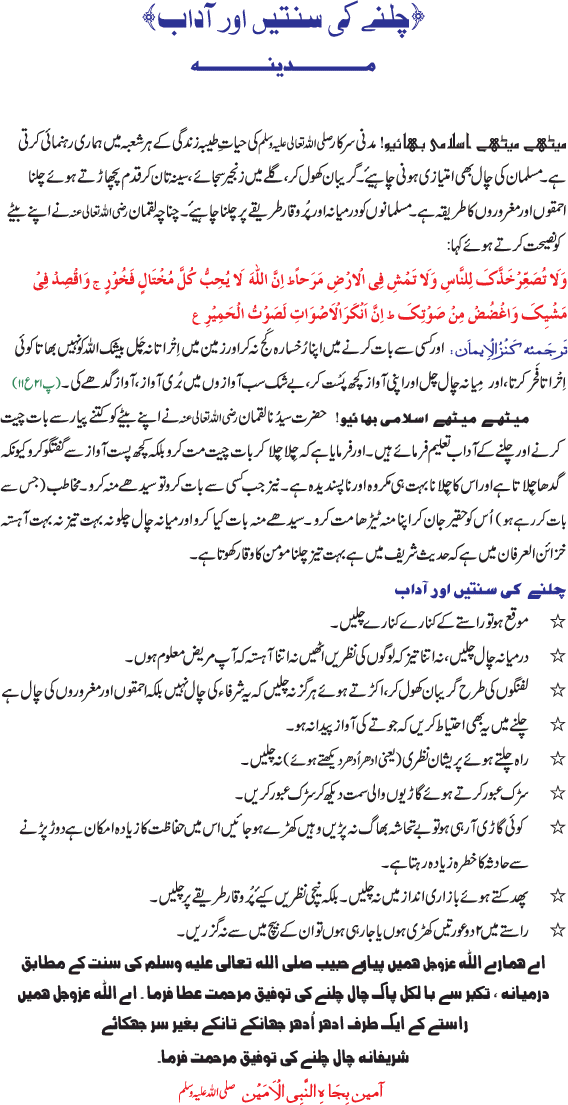
Chalne Ki Sunnatain
Miswak Ki Ahmeat Aur Fazeelat
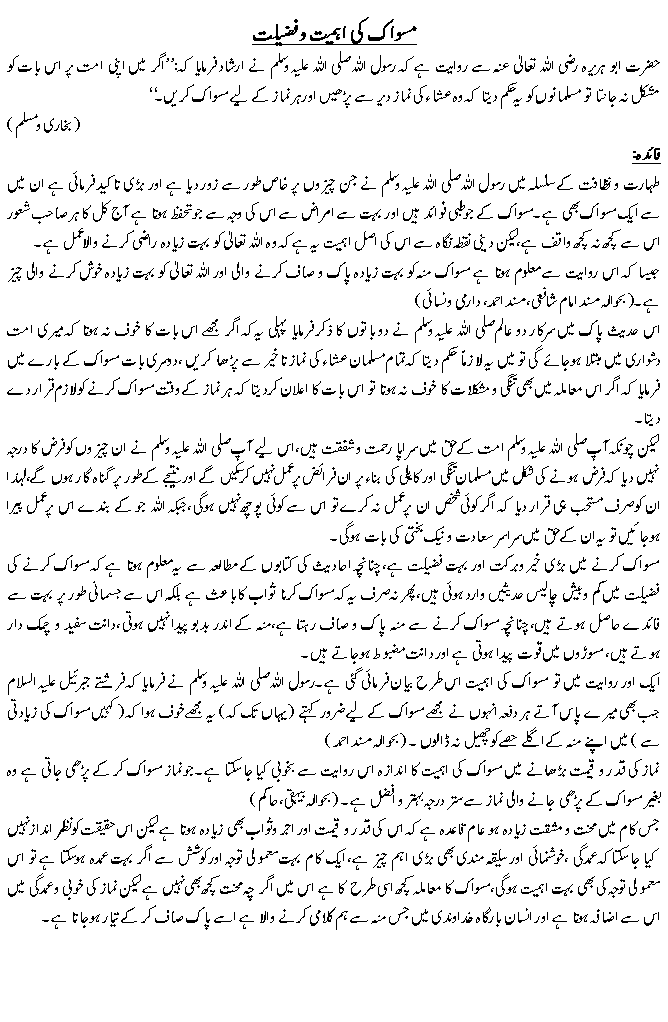
Miswak Ki Ahmeat Aur Fazeelat
Evil Deeds That Lead One To Hell
Sheikh al-Islaam Ibn Taymiyyah, may Allah (SWT) have mercy on him, was asked: “What are the deeds of the people of Hell and what are the deeds of the people of Paradise?” He replied, “The deeds of the people of Hell are:
- associating partners in worship with Allah (SWT)
- disbelieving in His Messenger
- kufr (ingratitude, disbelief)
- hasad (malicious envy)
- lying
- treachery
- oppression and wrongdoing (dhulm)
- promiscuity
- backstabbing
- cutting off the ties of kinship
- cowardice at the time of jihad
- miserliness
- inconsistency between what is in one’s heart and the face one shows to people
- despairing of the mercy of Allah (SWT)
- feeling secure from the plan of Allah (SWT)
- panicking blindly at the time of crisis
- pride and extravagance at the time of plenty
- abandoning one’s duties towards Allah (SWT)
- transgressing His limits
- violating His sanctity
- fearing a created being instead of the Creator
- showing off
- going against the Qur’an and Sunnah in word or deed
- obeying a created being in some act of disobedience to the Creator
- blindly supporting falsehood
- mocking the signs of Allah (SWT)
- rejecting the truth
- withholding knowledge and testimony that should be revealed
- witchcraft and magic
- disobeying one’s parents
- killing any soul forbidden by Allah (SWT) except for reasons of justice
- consuming the wealth of the orphan
- riba (usury)
- desertion from the battlefield
- slandering the reputation of innocent, chaste, believing women” (Yaqadhat uli al-I’tibar, p.222)
The Messenger of Allah (saw) mentioned all the sins that will lead one to Hell. Muslim reports from ‘Iyadh bin Himaar that the Messenger of Allah (saw) said, during a lengthy khutbah:
“..the people of Hell are five: the weak who lack the power to (avoid evil); the (carefree) who pursue (everything irrespective of whether it is good or evil) and who have no concern for their families or their wealth; the dishonest people whose greed cannot be concealed even in the case of minor things; and those who betray you, morning and evening, with regard to your family and your property. He also mentioned misers, liars, and those who are in the habit of abusing people and using obscene, foul language”. (Muslim in Kitaab al-Jannah wa Sifaat Na’imihaa Baab as-Sifaat allaatee yu’raf bihaa fid-dunyaa ahl al-Jannah wa ahl an-Naar, 4/2197 no. 2865)