
TAG: Sunnah
Important Islamic Jurisprudence Terminology
Fard – Obligatory:
An act commanded by Allah in the Holy Qur’an is known as Fard. The following explains a Fard in detail:
a. An act that is obligatory to be executed
b. It has been proven by rigorously authenticated texts
c. The denial of any Fard renders one to come out of the folds of Islam.
d. If one omits to perform any Fard without any valid shari’i reason, then such a person becomes a fasiq (transgressor) and the person is regarded as a major sinner. [Fatawa Ridawiyyah – Vol. 2, Page 194]
Wajib – Necessary:
An act that is almost as compulsory as a Fard. The Messenger of Allah SallAllaho Alaihi wa Aalihi wa Sallam never omitted it. It is a graded second, below a Fard in its necessity.
a. An act that is compulsory to do.
b. It is proven by religious arguments through ijtihad.
c. One who denies a Wajib is misguided.
d. If one omits a Wajib without any valid shari’i reason, then he is a transgressor and liable for the punishment of Hell.
e. To miss a Wajib once (deliberately, without any valid reason) is a minor sin (Gunah-e-Saghira). However, persistently omitting a Wajib shall turn it into a major sin (Gunah-e-Kabira).
Sunnat-e-Mu’akkadah:
“Sunnat” generally means: an act done or liked by the Messenger of Allah SallAllaho Alaihi wa Aalihi wa Sallam in relation to worship. One shall gain a reward for performing a Sunnah, but there is no sin if one omits it. However, to continually omit it is a sin, and if one shows dissatisfaction with a Sunnah, then this is kufr (disbelief).
a. Sunnat-e-Mu’akkada is an act necessary to perform.
b. An act that was always performed by the Messenger of Allah SallAllaho Alaihi wa Aalihi wa Sallam, but occasionally omitted so as to differentiate from something that is Wajib.
c. One gains the displeasure of Allah Most High and His Beloved Prophet SallAllaho Alaihi wa Aalihi wa Sallam if a Sunnat-e-Mu’akkadah is omitted even if it is occasionally. Thus, making it a habit to omit a Sunnat-e-Mu’akkadah is an act of earning even more displeasure of Allah and His Beloved and inevitably, one becomes liable for punishment.
d. The status of a Sunnat-e-Mu’akkadah is near a Wajib.
e. Sunnat-e-Mu’akkadah is sometimes known as Sunnat-e-Huda.
Commander In Chief

Baat Cheet Ki Sunnatain

Sunnahs About Neighbors
SUNNAHS ABOUT NEIGHBOURS

Neend Se Bedar Hone Ki Sunnatain

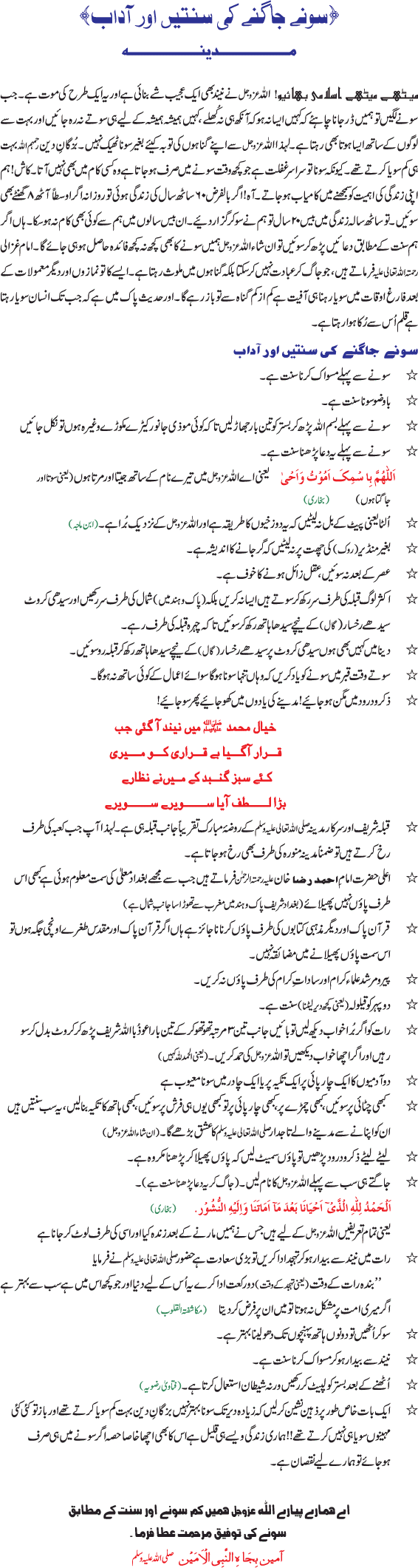
Bed Time Sunnahs
Revive a Sunnah
Say, If you (really) love Allah, then follow me (Sall-Allahu alayhe wasallam), [so] Allah will love you and forgive you your sins. And Allah is Forgiving and Merciful.
(Noble Quran 3:31)
Bed Time Sunnahs
1- Recite the bedtime Du’as from the Masnun Du’as such as Allah-humma bismka amutu wa ahya (Oh Allah, with your name I die and live)
2- Recite the 3 Quls 3 times: One should put his hands together, then, blow into them and recite Surah Ikhlas, Surah Falaq, and Surah Naas then, saying that, wipes as much as he can of his body, starting with his head, his face and the front of his body. He should do this three times. [Narrated by Al-Bukhari]
3- Recite Ayat-ul-Kursi (the verse of the Throne): The fruit (reward) of reciting this ayah is that who recites it, the protection from Allah remains over him, so that no devil can approach him. [narrated by Al-Bukhari]
4- Reciting the last two verses of Surat Al-Baqarah Aamanar-Rasulu: This who recites them at night, they suffice him. [narrated by Al-Bukhari and Muslim]
· Scholars have different views about the meaning of (they suffice him): it has been said: they are sufficient for him, as it is equal to praying Tahajjud of that night. Also, it has been said that they protect him against every evil and adversity. Imam Nawawi said, it may mean both things.
5- Recite Tasbeeh Fatimah: Subhan Allah thirty-three times, Al-Hamdulillah thirty-three times, and Allahu Akbar thirty-four times. [Narrated by Al-Bukhari and Muslim]
6- Reciting Surah Kafirun: as one of its fruits is that it is a protection from polytheism.
7- Make wudhu: One should be pure, for the hadith says if you go to bed, have an ablution.
8- Sleep on the right side then lie on your right side ). [Narrated by Al-Bukhari and Muslim]
9- One should put the right hand under his cheek: when he (Sallallahu alayhi wasallam) lay down, he used to put his right hand under his cheek. [Narrated by Abu-Dawoud]
Signs Of Weak Faith
- Committing Sins And Not Feeling Any Guilt.
- Having A Hard Heart (no sign of mercy and petty when it comes to own benefit/loss).
- Being Materialistic.
- Feeling Too Lazy To Do Good Deeds, e.g. Being Late For Salat
- No Desire To Read The Quran.
- Neglecting The Sunnah.
- Having Mood Swings, For instance, Being Upset about petty things and bothered and irritated most of the time.
- Not feeling anything when hearing verses from the Quran, for example when Allah warns us of punishments and His
- promise of glad tidings.
- Finding difficulty in remembering Allah and making dhikr.
- Not feeling bad when things are done against the Shariah.
- Desiring status and wealth.
- Being mean and miserly, i.e. not wanting to part with wealth.
- Feeling pleased when things are not progressing for others.
- Not concerned with whether something is haram or halal.
- Making fun of people who do simple good deeds, like cleaning the mosque.
- Not feeling concerned about the situation of Muslims.
- Not feeling the responsibility to do something to promote Islam.
- Becoming engrossed and very involved with Dunya, worldly things, i.e. feeling bad only when losing something in terms of material wealth.
- Becoming engrossed and obsessive about ourselves.
Sunnah Way Of Istikhara

A Lost Sunnah, How The Prophet Behaved In His Home
A Lost Sunnah,
How the Prophet Behaved in his Home
Since childhood we men see our mothers and sisters working in the kitchen, doing the daily routine household chores of our home.
After we grow up, we behave in the same way and like the “King who enters his house (and does nothing), we start commanding things and start getting them done by the wife or the servant.
We only remember the ayat from the Quran wherein men are allowed to have 4 wives but easily forget how the Prophet behaved when he was in his home.
So what did Prophet do when he would spend time in his home. ?
Order everyone to clean the house? NO
Lie down on the bed and leave it as it is. NO
Order the nicest dishes to be prepared. NO
Eat and Sleep? NO
So what did Prophet do when he would spend time in his home?
The Apostle of Allah (sallallahu alayhi wa sallam) occupied himself at his home like a common man.
As Aishah relates, he used to clean his clothes, milk the sheep, and do his odd jobs. She also says that he would mend his clothes, repair his shoes and do similar other works.
When asked how the Prophet occupied himself at home, she replied, He used to keep himself busy with household chores and went out when the time for prayer came.
In another report related to her authority, she is reported to have said, The Prophet of Allah (sallallahu alayhi wa sallam) used to repair his shoes, mend his clothes, and occupied himself at home even as any of you occupy yourself.
Aishah relates, Allah’s Messenger (sallallahu alayhi wa sallam) was very softhearted, the kindliest of all. He laughed often and smiled.
Anas says that he had not seen a man who was more clement and nice to his household members than the Apostle of Allah.
It is related to the authority of Aishah that the Prophet (sallallahu alayhi wa sallam) said, The best of you is one who is most nice to his wife and children and I am the nicest among you.