

TAG: Sunnah
Cleanliness: Wudu (Ablution)
It is highly virtuous to remain in Wadu condition at all times. The general rule is one should make fresh ablution before each prayer, however, one’s wadu is valid until unless the following one of the eight (8) conditions take place known as the nullifiers of Ablution (Nawaquid of Wudu), namely:
Things which Nullify Wudhu:
- Discharging urine; feces, or any other matter from these passages.
- Passing stomach gases from the back.
- The flow of blood, or pus from any part of the body.
- Mouthful-vomiting.
- To fall asleep, while lying down, or when leaning against something.
- Fainting due to illness, or for any other reason.
- Going mad; insane.
- Laughing aloud in Prayers (Salat)
If a person requires wadu he or she is in a state of Hadather Asghar. It is makrooh Tahrimi to touch the Holy Quran or even the empty spaces of the pages. but is permissible to recite the Quran without touching. If a verse of the Holy Quran is written on a page that is not a part of the Holy Quran i.e., books, or newspapers, it will be permissible to touch the book or page but not the verse. minor children may touch the Quran without Wudhu, It is not permissible to perform Salaat.
Islamic ablution (Wudu) consists of many actions Some actions are absolutely obligatory’ (Fard). without these actions the ablution is invalid. There are some actions that may be left out, the ‘ablution’ will not be invalidated; though it will be improper (Naquis). Such actions are called ‘Sunnah’. There are certain other actions that bring greater blessings of Allah, known as ‘desirables’ (Mustahab’bat). If these are left out, no harm is done
No doubt clean water plays important role in achieving purity, alternatively in absence of water or health reasons the dry ablution is ordered by Almighty Allah.
Obligatory (Fard) actions in Ablution:
There are four compulsory actions (Fard) in Ablution:
- Washing the face from the hair of the forehead to the lower portion of the chin, and across from one ear to the other;
- Washing both hands and arms up to the elbows.
- Performing the Masa’h (wiping with wet hands, one-fourth of one’s head).
- Washing both the feet up to the ankles.
Sunnah actions in Ablution:
- Saying the Intention (Niyyah).
- Reciting ‘Bismillah’.
- Washing the hands, three times, up to the wrists.
- Brushing teeth with a tooth-stick (Miswak).
- Rinsing the mouth, thrice.
- Sniffing water into the nostrils, thrice.
- Combing (doing Khilal) the beard with the fingers.
- Passing fingers of both hands, against each other, and also passing them through the toes (Khilal of fingers and toes).
- Washing, each limb, three times.
- Performing the Masa’h once over the whole head i.e. wiping head with wet hands.
- Performing the Masa’h of the two ears.
- Performing Ablution (Wudu) in proper order.
- Washing each part, one after the other, without pause, to ensure that no part dries up before the next step.
Desirable (Mustahab) actions in Ablution:
- To begin Ablution (Wudu) from the right side Some scholars regard this among the Masnun (Sunnah) acts. This is quite likely.
- Performing ‘Masa’h’ of the nape.
- Performing Ablution all by himself, without taking others’ help.
- Facing Qiblah.
- Performing Ablution while sitting at a clean and elevated place.
Undesirable (Makrooh) actions in Ablution:
- Performing Ablution in a dirty place.
- Blowing one’s nose with the right hand.
- Talking worldly affairs while performing Ablution.
- Performing Ablution in a manner contrary to Sunnah.
Complete list of actions in Ablution:
- With the intention of saying the prayers (Salat) one should take running clean water (or take water in a clean bucket etc.
- Wash hands up to the wrists.
- Rinse the mouth three times; brush the teeth.
- Sniff water into each nostril, three times; cleanse the nose.
- wash the face, three times.
- hands, up to the elbows.
- Perform ‘Masa’h of the head and ears (moving palms of wet hands overhead, starting from the top of the forehead to the back and passing both hands over the back of the head to the neck.
- Rub wet fingers into the grooves of both ears and holes, and also pass the wet thumbs behind the ears).
Wash the feet, including the ankles.
The Rakaats in Prayer
(A single round of bodily actions within a Prayer, is called a “Rakaat”. )
Dawn (Fajr) Prayer: Total of 4 “Rakaats” – in the following order: 2 Emphasised Sunnah (Muakkadah), 2 Obligatory (Farz).
Afternoon (Zohr) Prayer: Total of 12 “Rakaats” – in the following order: 4 Emphasised Sunnah (Muakkadah), 4 Obligatory (Farz), 2 Emphasised Sunnah (Muakkadah), 2 Voluntary (Nafil).
Evening (Asr) Prayer: Total of 8 “Rakaats” – in the following order: 4 Non-Emphasised Sunnah (Ghair Muakkadah), 4 Obligatory (Farz).
Sunset (Maghrib) Prayer: Total of 7 “Rakaats” – in the following order: 3 Obligatory (Farz), 2 Emphasised Sunnah (Muakkadah), 2 Voluntary (Nafil).
Night (Isha) Prayer: Total of 17 “Rakaats” – in the following order: 4 Non-Emphasised Sunnah (Ghair Muakkadah), 4 Obligatory (Farz), 2 Emphasised Sunnah (Muakkadah), 2 Voluntary (Nafil), 3 Essential (Wajib Witr), 2 Voluntary (Nafil).
Some Sunnah Prayers are Emphasised (Muakkadah) – which Shariah has stressed upon. Leaving it without proper excuse makes one liable for censure, and abandoning it makes one a sinner, disqualified from giving witness and deserving of fire. (These should not be purposely abandoned even during travel.) Some Imaams have said that one who abandons these will be deemed astray, and a sinner although his sin is less than that of leaving an Essential (Wajib). Leaving the Sunnah habitually is close to forbidden (Haraam) and it is feared that (We seek Allah’s refuge) such a person may remain deprived of the Holy Prophet’s (PBUH) intercession. The Holy Prophet (PBUH) has proclaimed: “Whoever abandons the Sunnah will not obtain my intercession.”
Bathing (Ghusl) Rules In Islam
The 3 obligations on bathing (Ghusl)
Gargling: Water must reach right from the lips up to the base of the throat.
Inhaling water up to the nose bone: Water must reach through both nostrils and wet the entire area, up to the nose bone.
Washing the entire body in such a manner that water flows over every part of the body, not leaving dry any spot equal to the breadth of a hair.
If any food particles are stuck in the teeth, these must be removed. Likewise, the nose must be cleaned from any dust stuck inside it, and then the nose washed with water up to the beginning of the nose bone. However, care must be exercised during fasting so as not to overdo it.
Bathing (Ghusl) according to Sunnah
Make an intention (Niyah) for bathing and at first wash both hands up to and including the wrists. Then wash the excretory organs even if there is no impurity. Then cleanse the body area that has any impurity and perform the ablution, without washing the feet. If you have a bath on a stand (high area), you may wash the feet. Next, rub water (like applying oil) on the body to wet it. Then pour water thrice over the right shoulder followed by thrice over the left shoulder. After this, pour water over the head thrice and then thrice properly over the entire body. Rub the hands over the entire body to ensure that no spot equal to the breadth of a hair remains dry. If the feet had not been washed at ablution, wash them after moving away from the bathing spot.
While bathing takes care that you should not be facing the ‘Qiblah’, nor speak nor recite any supplications. Also, bathe in a place where there is no exposure.
Things that make bathing compulsory
- Discharge of semen in a state of sexual excitement.
- Ejaculation while asleep.
- Intercourse with either sex, whether semen is discharged or not.
- Woman completing her menses.
- Stoppage of impurity for a woman after childbirth (or miscarriage etc.).
Basic Beliefs Of Muslims
Islam is based upon five “pillars” that represent the bedrock upon which all else is based. The first pillar, which makes one a Muslim, is called the shahadah, meaning, “testimony” or “witnessing.” It is fulfilled by declaring to two witnesses the foundational creed of Islam: This means, “I witness that there is nothing worthy of worship except God and that Muhammad is God’s messenger.” The first part of the testimony is a belief that God is unique with no partners. Thus, nothing in creation can be associated with God, as creation has no real substantiation without the sustaining power of God. Indeed, creation is not God nor does it have any eternal qualities of the divine that are worthy of worship. Rather, creation is a theater of divine manifestations. Creation is seen as a place where analogies of the divine reveal themselves. The intellect of a person is the vehicle given by God to discern this truth about creation as indicated by several verses in the Qur’an.
The second part of the declaration, Muhammad is the messenger of God, acknowledges the means through which this understanding of God has come. All prophets are special human beings capable of refracting divine light, acting like prisms that allow others to see it. The intensity of direct divine light is something only a prophet can bear. Muslims believe that the revelation given to Prophet Muhammad (peace be upon him) is like a refracted green light, which lies in the middle of the light spectrum. Muslims consider Islam to be the most balanced of the prophetic dispensations, the “middle way.” The Prophet Muhammad’s life is considered to be moderate and exemplary for both men and women. He abhorred extremes saying, “Beware of extremism in your religion.” After the Qur’an, the Prophet’s practice, or sunnah, is the second most important authority in Islam.
The second pillar of Islam is prayer. While people may supplicate anytime they wish to do so, there is a specific prayer every adult Muslim, female and male, is obliged to perform five times a day. The times are determined by the perceived movement of the sun as a way of reminding people of the temporal nature of the world. Thus, each day is considered to be a microcosm of one’s own life: the dawn prayer as one’s coming into the world, the midday prayer as the end of youth, the afternoon prayer as old age, the sunset prayer as death, and the evening prayer as the beginning of the descent into the darkness of the grave and returning to the dawn prayer as the awakening and resurrection of the dead. After the testimony of faith, prayer is considered the most important pillar.
The third pillar of Islam is paying zakah, an obligatory alms given once every lunar year from the standing capital of every responsible adult. It is one-fortieth of a person’s liquid assets. According to the Qur’an, zakah is distributed among eight categories of people, the two most important recipients being the poor and the needy.
The fourth pillar is fasting the entire lunar month of Ramadan, and it begins with the sighting of the new crescent for that month. Fasting entails abstaining from food, drink, and sexual relations from dawn to sunset and is obligatory on adults healthy enough to do so.
The fifth pillar is the Hajj, or pilgrimage to Makkah. Muslims believe Makkah to be the site of the first house of worship built by the Prophet Adam and his wife Eve and then restored millennia later by the Prophet Abraham and his son, the Prophet Ishmael. At the end of his mission, the Prophet Muhammad restored its monotheistic purpose by destroying the 365 idols in it that the Arabs had been worshiping prior to Islam. The rituals performed in the pilgrimage follow the footsteps of Abraham and his second wife Hagar. The Hajj culminates on a vast desert plain where approximately 3 million pilgrims from almost every country on Earth gather every year and prepare for standing before God on the Day of Judgment.
When Was The Last Time You Raced With Your Wife?
You might mockingly or disapprovingly smile, yet the question remains, for it bespeaks an invitation to you to follow the Sunnah of the Prophet, sallallaahu alayhi wa sallam, in his kind attitude toward his wives.
If you claim to follow and love the Noble Messenger of Allah, sallallaahu alayhi wa sallam, Sunnah, in keeping a beard, cleaning your teeth with a Siwaak (tooth stick), and shortening your clothes to reach above the ankle, you are likewise required to emulate him in the way he treated his spouses.
Moreover, the leniency, mercy, and patience of the Prophet, sallallaahu alayhi wa sallam, with his wives is not merely his tradition, but an obligation confirmed by many Quranic verses, among which is the one in which Allah The Almighty Says (what means): {And live with them in kindness.} [Quran 4:20]
He (PBUH) said: “He is the best amongst you who is the kindest towards his wives and I am the kindest amongst you towards my wives.”
Thus, racing was a compassionate gesture of the Prophet, sallallaahu alayhi wa sallam, in order to be friendly and open with his wives.
Aaishah [Allah be pleased with her] narrates that as a young and thin girl, she was once accompanying the Prophet, sallallaahu alayhi wa sallam, on one of his journeys. He, sallallaahu alayhi wa sallam asked his Companions to move ahead of them, which they did. He, sallaallahu alayhi wa sallam, then asked to race with her; she did and won.
Sometime later, after she had forgotten about this, she was with the Prophet, sallallaahu alayhi wa sallam, on another of his journeys and he wanted to race her. She wanted to excuse herself, by telling him she could not, since she had gained some weight, but he, sallallaahu alayhi wa sallam, insisted. They raced and this time he (PBUH) won; so the Prophet, sallallaahu alayhi wa sallam, laughed and said; “This [is] for that.”
Some husbands content that they do not race with their wives because they are too busy and have many responsibilities. Our retort is that by no means can they be busier than the Prophet, sallallaahu alayhi wa sallam, who bore the responsibility of conveying the Message of Islam to the entire world.
He also led the army in combat alongside running errands for his family and doing household chores. Nevertheless, all this did not stop him from twice racing with his wife Aaishah[RA].
Other husbands might argue that the streets are not a suitable place for racing; so, they can surely take their wives away from people, on a picnic.
Moreover, competition is not just in running.
One can compete to win in a permissible electronic game or general knowledge quiz, in which one can ask each other questions and keep score.
The third group of husbands believes that such competitions may cause their wives to become too bold and eventually challenge them.
This is not true, because the Prophet, sallallaahu alayhi wa sallam, raced with his wife, so this is an act to be followed, for copying his behavior with his wives can bring nothing but good.
Also, modern research has established that being kind and easygoing with one’s wife makes it easier for her to be mindful of you.
There are lessons to be learned from the aforementioned incident related by Aaishah concerning the Prophet’s, sallallaahu alayhi wa sallam, kindness toward his wives.
1- The Prophet, sallallaahu alayhi wa sallam, was the one to ask for a race both times.
This teaches husbands that they should take the initiative in such competitions. Wives may be too busy with housework or fear rejection or, as is the generally innate nature of women, be too shy to propose such an idea.
However, on their part, they should try to urge their husbands when they see they are free and in a good mood.
2- A husband should not incessantly brag of superiority over his wife.
We notice that the Prophet, sallallaahu alayhi wa sallam, outran Aaishah after she had already outrun him the first time.
3- Alternately, a husband should neither always deliberately lose for the sake of his wife or the competition would be meaningless.
The factor that decided the winner of Aaishah the first time was her youth and fitness, and when she put on some weight, the Prophet, sallallaahu alayhi wa sallam, outran her.
4- A husband should remember that such competitions are just for amiability and fun.
Neither of the spouses should get worked up or a row could ensue and the activity would lose its desired aim. This can be understood from the reaction of the Prophet, sallallaahu alayhi wa sallam, who only cheerfully referred to his win to counter that of Aaishah’s.
Verily in the noble way of the Prophet, sallallaahu alayhi wa sallam is there a recipe for happiness
Offering Sacrifice In The Name Of Allah
Offering sacrifice is the tradition of our father Ibrahim (peace be upon him) and our Prophet Muhammad (peace be upon him). Allah has promised reward on every part of the animal that you sacrifice, even on its hair. The Prophet (peace be upon him) said, “On the day of sacrifice, no one does a deed more pleasing to Allah than the shedding of blood. The sacrificial animal will come on the Day of Resurrection with its horns, hair, and hooves (and its owner will be rewarded on that basis); and (its) blood finds acceptance with Allah (for its owner) before it falls on the ground, so rejoice over it.” (Tirmidhi)
Slaughtering an animal is better than giving its monetary value in charity. The deed of sacrificing an animal is a recommended or stressed Sunnah (Sunnah Mu’akkadah) for those who can afford it. Slaughter on your behalf and your household, including your wives, children, and parents, so that all of them will gain its reward. This was the practice of the Prophet (peace be upon him). He slaughtered for himself and on behalf of his family. Some people offer sacrifice only on behalf of their parents, depriving themselves and their households of the reward. It is preferable to sacrifice in the name of all (the household). If one is appointed to slaughter then he should fulfill the will accurately.
Many Muslims offer sacrifice on behalf of their deceased relatives during the first year of their death. They call it Dahiyyah Al-Hufrah (the sacrifice of the grave) – this practice has no basis in Shariah. Some people wipe or mark the animal from its face till the back of its neck to specify the owner of the animal. One should only state the owner by mentioning his name while slaughtering, without wiping. This was the conduct of the Prophet (peace be upon him). Moreover if one sacrifices the animal with only the intention and without mentioning the name of its owner, it still will be sufficient.
The sacrifice should be of camels, cows, sheep, or goats. It cannot be valid unless it meets two conditions:
· The animal must have reached the required age
· It must be free of certain defects that invalidate sacrifice.
Age specifications are as follows:
· Camels: Five years old.
· Cows: Two years old.
· Goats: One-year-old.
· Sheep: Six months old.
The defects that invalidate sacrifice have been explained by the Prophet (peace be upon him) in the following Hadith.
“Four (types of animals) should be avoided in sacrifice: A lame animal whose lameness is evident, a one-eyed animal which is clearly one-eyed, an animal which is clearly ill and an emaciated animal with no fat on it.” (Ahmad)
· The clear lameness is identified by the animal’s inability to fight and keep up with healthy animals.
· An animal with a defective eye – either popping out or completely concealed – is identified as one-eyed. If the imperfection is not detectable – even though the animal cannot see with it – the sacrifice will still be valid but disliked.
· The way it trots, the type of appetite it has, and other similar factors determine if the animal is healthy. An ailing animal whose poor health is obvious can be accepted as a legitimate sacrifice. In any case, it is preferable to offer an animal in the sacrifice that is free from all such defects.
· If the sacrificial animal is so thin that its bones contain no marrow, it will not be accepted as a valid sacrifice.
The sounder the sacrificial animal is, the more acceptable it becomes. The male animal, whether castrated or not, is acceptable as the Prophet (peace be upon him) offered both in sacrifice. However, the fleshier the animal, the more satisfactory it is.
Slaughtering a goat or a sheep is better than one-seventh of a camel or a cow, even though both are equivalent. One may share a cow or camel with six other persons, hoping reward for all of them. Sacrificing a pregnant animal is also equally acceptable.
One should slaughter his sacrificial animal himself if he is able to. If he cannot, he can hire someone to do it and should attend the slaughtering. If he is not present, the sacrifice is still valid. If a person slaughtered an animal thinking it was his but found out later that it belonged to someone else, then the sacrifice will be credited to the real owner, he will receive the reward for it and will be entitled to its meat.
For instance, if there is a yard with several sacrificial animals in it and a person takes one of them, assuming that it is his and slaughters it, but later discovers that it did not belong to him, then although the sacrifice is valid, the one who mistakenly slaughtered the animal does not receive the credit or reward for it. His position is like that of someone appointed to slaughter on behalf of the owner.
Libas Kay Ahkam

Khane Ka Bayan
Eating Habits And Diet Of The Prophet
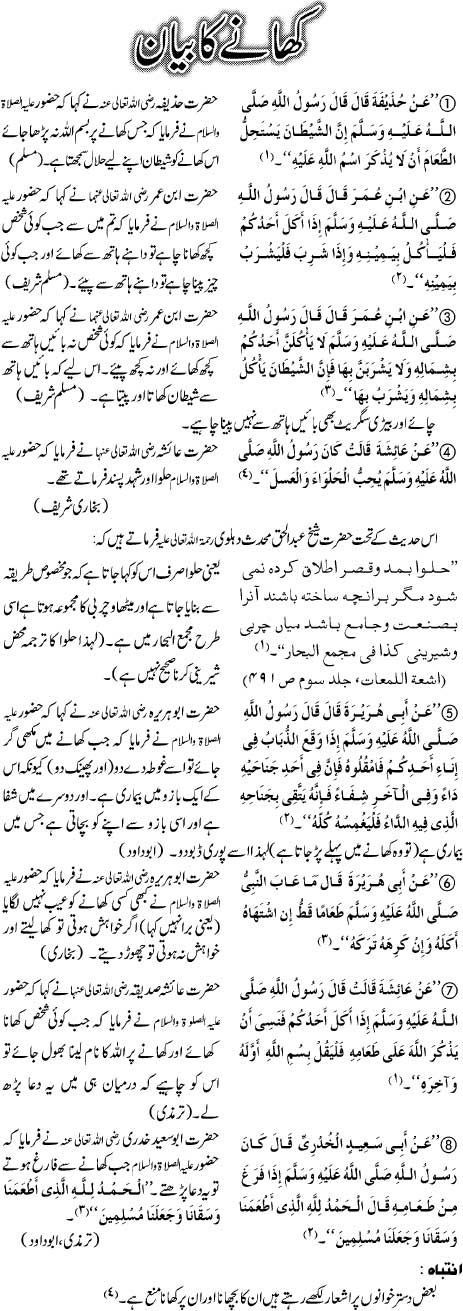
The Prophet’s guidance with regard to food is perfect guidance. It was described by Ibn al-Qayyim as follows: When he put his hand in the food, he would say, “Bismillaah (in the Name of Allah), and he told people to say this when eating.
He said, “When any one of you eats, let him mention the name of Allah. If he forgets to mention the name of Allah at the beginning, let him say Bismillaahi fi awwalihi wa aakhirihi (in the name of Allah at its beginning and at its end).”
Saheeh hadeeth, narrated by al-Tirmidhi (1859) and Abu Dawood (3767).
When he raised the food to his mouth, he would say,
“Al-hamdu Lillaahi hamdan katheeran tayyiban mubaarakan fihi ghayri makfiyyin wa laa muwadda wa laa mustaghni ‘anhu Rabbanaa azza wa jall (Allah be praised with an abundant, beautiful, blessed praise. He is the One Who is Sufficient, Who feeds and is never fed, The One Who is longed for, along with that which is with Him, and the One Who is needed. He is Our Lord, may He be glorified).
Narrated by al-Bukhaari (5142).
He never criticized food at all. If he liked it, he would eat it, and if he did not like it, he would leave it and not say anything.
Narrated by al-Bukhaari (3370) and Muslim (2064).
Or he would say, “I do not feel like eating this.” Narrated by al-Bukhaari (5076) and Muslim (1946).
Sometimes he would praise the food, as when he asked his family for food, and they said, “We have nothing but vinegar.” He asked for it and started to eat it, saying, “What a good food is vinegar.”
Narrated by Muslim (2052)
He used to talk whilst he was eating, as is seen from the report quoted above about vinegar.
And he said to his step-son Umar ibn Abi Salamah when he was eating with him: “Say Bismillaah and eat from that which is in front of you in the dish*.” Narrated by al-Bukhaari (5061) and Muslim (2022).
[* At the time of the Prophet (peace and blessings of Allah be upon him), people used to eat together from one dish, and children would sometimes forget the correct etiquette. – Translator]
He would repeatedly urge his guests to eat, as generous hosts do, and as is seen in the hadeeth of Abu Hurayrah, narrated by al-Bukhaari, about the story of drinking milk, where he repeatedly said to him, “Drink!” and he kept telling him to drink until he (the guest) said, “By the One Who sent you with the truth, I have no more room for it!”
Narrated by al-Bukhaari (6087).
When he ate with others, he would not leave until he had made dua for them.
He made dua in the house of Abd-Allah ibn Bisr, and said: “O Allah, bless for them that which You have provided for them, forgive them and have mercy on them.”
Narrated by Muslim (2042).
He commanded people to eat with their right hands and forbade them to eat with their left hands. He said, “The Shaytaan eats with his left hand and drinks with his left hand.”
Narrated by Muslim (2020).
This implies that eating with the left hand is haraam, and this is the correct view, because the one who eats with his left hand is either a Shaytaan (a devil), or he is imitating the Shaytaan.
It was also reported in a Saheeh hadeeth that he told a man who was eating with his left hand in his presence, “Eat with your right hand!”
The man said, “I cannot.”
He said, “May you never be able to!” – and the man never lifted his right hand to his mouth after that. Narrated by Muslim (2021).
If it was permissible (to eat with the left hand), he would not have prayed against him for doing so. It was the man’s stubborn arrogance that made him refuse to obey the command, and this is the utmost disobedience that deserved this prayer against him.
He commanded those who complained that they never felt full to eat together and not separately, and to mention the name of Allah (say Bismillaah) over the food so that He might bless it for them.”
Narrated by Abu Dawood (3764) and Ibn Maajah (3286). (See Zaad al-Maaad, 2/397-406)
It was also reported that he said, “I do not eat reclining.”
Narrated by al-Bukhaari, 5083.
He used to eat using the first three fingers (of his right hand), which is the best way of eating.
See Zaad al-Maaad, 220-222.
The Prophets guidance regarding diet:
The Prophet (peace and blessings of Allah be upon him) used to know what he was eating. He used to eat what was good for him. He used to eat enough to keep him going, but no so much as to make him fat.
Ibn Umar narrated that the Prophet (peace and blessings of Allah be upon him) said: “The believer eats in one stomach whilst the kaafir eats in seven.” Narrated by al-Bukhaari (5081) and Muslim (2060).
He taught his ummah something to protect them from diseases caused by eating and drinking.
He said: “The son of Adam does not fill any vessel worse than his stomach. It is sufficient for the son of Adam to eat a few mouthfuls, to keep him going. If he must do that (fill his stomach), then let him fill one third with food, one third with drink, and one third with air.”
Narrated by al-Tirmidhi (1381), Ibn Maajah (3349); classed as Saheeh by al-Albaani in al-Silsilah al-Saheehah (2265).
And Allah knows best.