
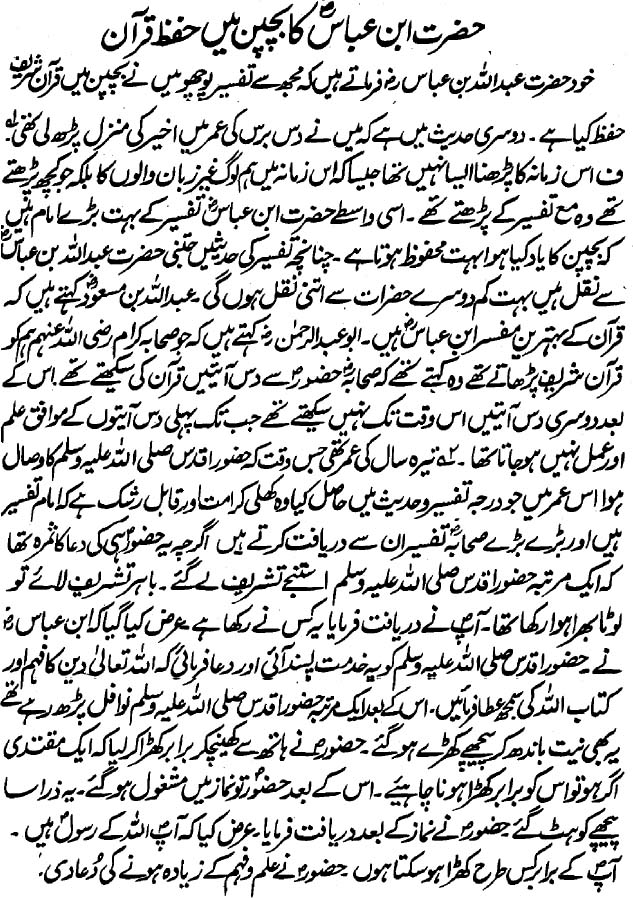
Hazrat Ibn Abbas (radi Allahu anhu) Ka Bachpan Mein Hifz-e-Quran
TAG: Tafseer
The Ultimate Source Of Knowledge
Suhaib (Radi Allahu anhu) reported: Allah’s Messenger (SalAllahu alaihi wasallam) said, “When the inhabitants of Jannah enter Jannah, Allah, the Glorious and Exalted, will say to them: ‘Do you wish me to give you anything more?’ They will reply: ‘Have you not made our faces bright? Have you not brought us into Jannah and delivered us from Hell?’ And Allah will remove the Veil. The (dwellers of Jannah) will feel that they have not been rewarded anything dearer than looking at their Rabb.” [Muslim] As Taken from Riyad-us-Saliheen
Allah, the Exalted , says: Verily, those who believe, and do deeds of righteousness, their Lord will guide them through their Faith; under them will flow rivers in the Gardens of Delight (Paradise).
Their way of request therein will be Subhanaka Allahumma (Glory to You, O Allah!) and Salam (peace, safety from evil) will be their greetings therein (Paradise)! And the close of their request will be: Al-Hamdu Lillahi Rabb-il-‘Alamin [All the praises and thanks be to Allah, the Lord of ‘Alamin (mankind, jinn and all that exists)]. [Holy Qur’an Surat Yunus 10:9,10]
The Ultimate Source of Knowledge
Many new Muslims find that it is through the Quran that they become acquainted with Islam, and the sudden interest in the faith sends them on a life-changing experience.
Tilawat-e-Quran Kay Sharai Adaab Aur Ahkam

Tilawat E Quran Kay Sharai Adaab Aur Ahkam
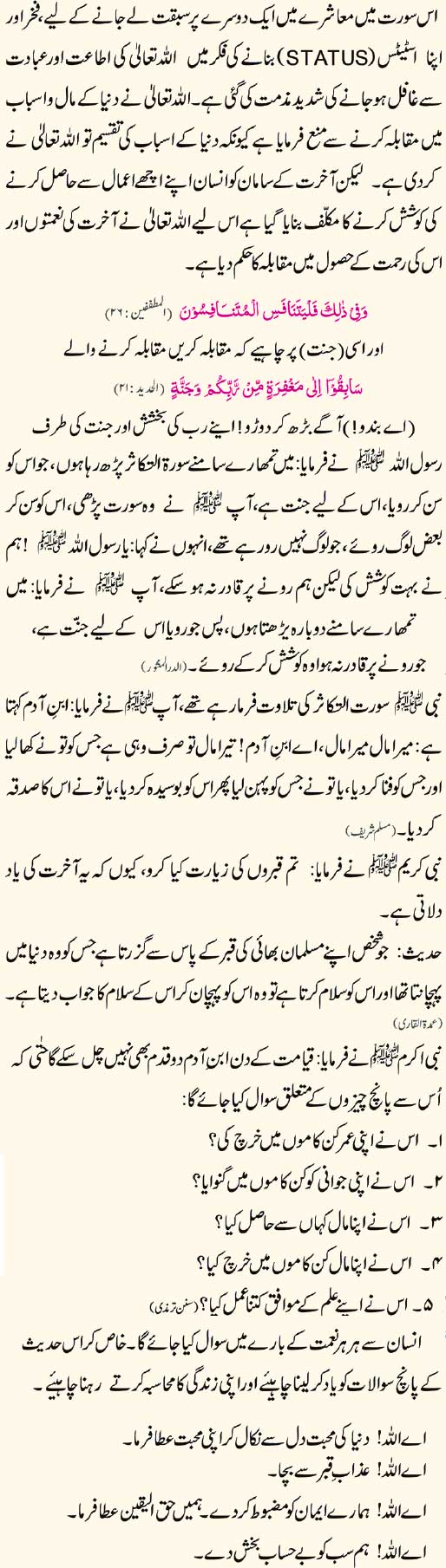
Surah At-Takathur Tafseer
Ibn Abbas: The Interpreter of the Qur’an
ABDULLAH Ibn Abbas (Allah be pleased with him) was born four or five years before the Hijrah. He had a keen intelligence and memory and was an inspired man. Allah s Messenger (peace be upon him) prayed for him, O Allah, make him perceptive and well-versed in the religion and teach him the interpretation of the Quran. In his life, he came to be called The Great Scholar of the Ummah or The Sea, meaning one very profound in knowledge or the interpreter of the Quran.
He was a very handsome, tall man endowed with great fluency of speech. His memory was such that he memorized, at one reading, a poem 80 couplets long by `Amr ibn Rabi`ah. Besides his profound knowledge of Quranic interpretation, tradition, and jurisprudence, he was also well-versed in literature, particularly in the poetry of the pre-Islamic Age of Ignorance. Ibn Jarir At-Tabari relates, in his Tafseer, either a couplet or verse from him in connection with the interpretation of almost every verse of the Quran.
He was greatly loved by the Companions. Despite his youth, `Umar (Allah be pleased with him) included him in his Advisory Council, the other members of which were chosen from the elders among the Companions. When asked why he had included that young man in the council, `Umar (Allah be pleased with him) tested the council about their level of understanding of the Quran. He asked them about the meaning of Surat An-Nasr: (110, 1-3)
When there comes the Help of Allah (to you O Muhammad – peace be upon him – against your enemies, and the Conquest (of Makkah). And you see that the people enter Allah s religion (Islam) in crowds. So glorify the Praises of your Lord, and ask His forgiveness. He is the One Who accepts repentance and Who forgives.
The elders answered It orders the Prophet (peace be upon him) to praise Allah and seek His forgiveness when he sees people entering Islam in throngs after the help of Allah and victory came. `Umar (Allah be pleased with him) did not like this and put the same question to Ibn Abbas: What does this surah mean? Ibn Abbas replied This Surah implies that the death of Allah s Messenger is near. Because, when people enter Islam in throngs, it means that the mission of Messengership has terminated. Umar (Allah be pleased with him) turned to the council and explained, That is why I include him among you.