

TAG: ummul momineen
Khadija Bint Khuwailed: The Ideal Woman
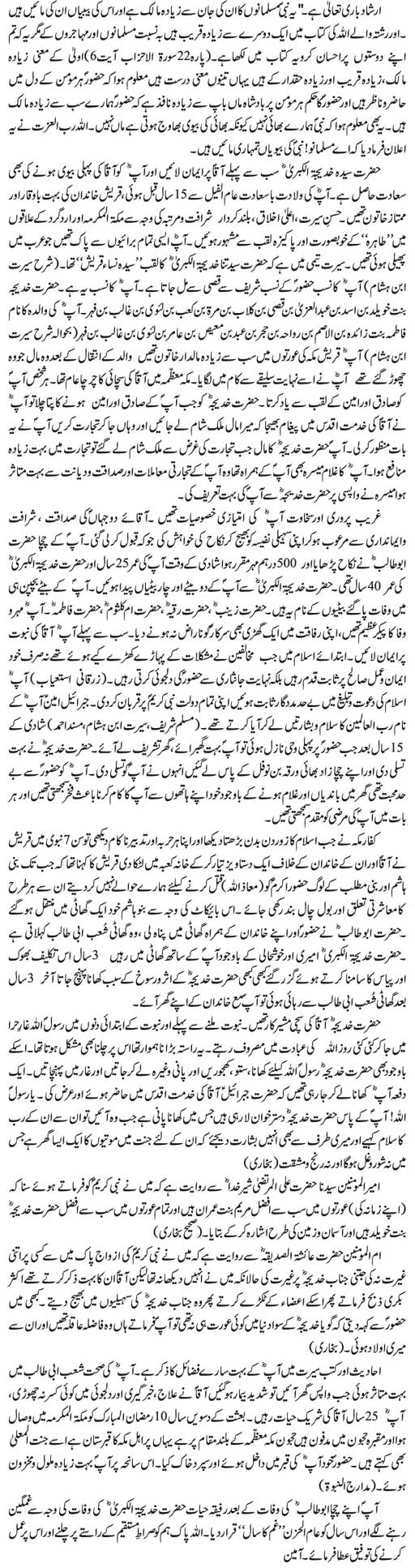
KHADIJA Bint Khuwailed was the Prophet’s (peace be upon him) first wife. Reading the life story of this noble lady reveals that she was an ideal woman in the full sense of the word.
She was married twice before getting married to Prophet Muhammad (peace be upon him). Many of the nobles and rich men of Makkah proposed to her, but she rejected all of them.
She was a wealthy lady in possession of a big fortune and had her own private trade. She heard a lot about Prophet Muhammad’s integrity and honesty and that was why she chose him to conduct her business. Her admiration for the Prophet (peace be upon him) increased after what she had heard from her servant, Maisara, who accompanied the Prophet on his trade journeys. Maisara praised the Prophet’s manners and humane dealings with everybody and narrated some of the miracles that accompanied him (the Prophet) throughout the journey such as the cloud that kept hovering above the Prophet to protect him from the sun.
She sent a go-between to ask the Prophet (peace be upon him) to propose to her. The Prophet (peace be upon him) did not hesitate to propose to this great lady, although she was 15 years older than him. She was his only wife for more than 25 years and the mother of all his children (except for Ibrahim who was the son of Maria the Copt).
She was known for her wisdom, common sense and balanced thinking. She was the Prophet’s wife for 25 years during which she never made him angry even once. She also supported him all through her life financially and emotionally. The year in which she died was called the Year of Sorrow because the Prophet (peace be upon him) was deeply grieved to lose this noble wife who had been the source of tenderness, love and support.
Even after her death the Prophet (peace be upon him) remained loyal to her memory. He used to warmly welcome her relatives and friends and when his other wife ‘Ayesha used to feel jealous because of this. Once she said, “Allah gave you a better wife, (meaning herself),” but he said, “This is not true, nobody is better than she was: for she helped me when other people let me down, and supported me when people abandoned me, and Allah made her the mother of my children.” He really respected her memory and never forgot her favors and love for him. May Allah be pleased with her.
Most Fortunate Stepchildren
“I have the best family line ever: My father is Muhammad (peace be upon him), my mother is Khadeejah, my brother is Al-Qasim and my sister is Fatimah. Who can have a family line to rival mine?” These were the words of Hind ibn Abu Halah, the Prophet’s first stepson. These words are indicative of the sort of relationship the young stepson had with his stepfather, Muhammad, God’s last messenger.
It is well known that the Prophet married Khadeejah, Hind’s mother, 15 years before prophethood. She was married twice before him, having had a daughter by her first marriage. This daughter came to be known as Umm Muhammad bint Ateeq. The very fact that she named her son after her stepfather is indicative of her great love of the Prophet. Hind was Khadeejah’s son by her second marriage to Abu Halah, who was also called Hind, a name most frequently used for girls. It is well known that Khadeejah remained unmarried for a period after her second husband’s death, during which she declined proposals by several distinguished figures in Makkah. Many were those who dearly wished to marry her, knowing that she combined beauty and wealth with maturity and noble descent. She declined as many proposals as she received, preferring to conduct her own business, sending her trade on the two famous trips that became part of the life of the people of Makkah. It was Khadeejah who then chose Muhammad and offered to marry him when she found in him a man of superior honesty and integrity, in addition to the wisdom that belied his years.
Hind ibn Abu Halah was thus brought up from a young age in the Prophet’s home, and the Prophet took good care of him. Hind attained adulthood before the beginning of the Islamic message, benefiting greatly from living in a happy home. When the Prophet preached his message, Hind was one of those who responded positively, adopting Islam in its early days. How could he take any other attitude when he knew how true to his word his stepfather was? He realized that a man who never told a lie to people could never entertain inventing a lie about God. Besides, Hind was a man of literary talent who could easily realize that the Qur’an, which Muhammad started to recite, could have never been composed by a human being. It was exceedingly superior. Hence, he followed his good judgment and adopted Islam. Hind fought alongside the Prophet in several battles and he left us a very detailed description of the Prophet. The description suggests a genuine and deep-seated love of the Prophet.
After Khadeejah’s death, the Prophet married several wives, everyone for a special reason. The only one who had not been married earlier to someone else was c. Some of them had children from their earlier marriages. Sawdah, the first of these was a mature woman when the Prophet married her. Sawdah was among the early Muslims, and she went with her husband, Al-Sakran ibn Amr, on the first immigration to Abyssinia, but they returned sometime later. On their way back, and just before arriving in Makkah, her husband died. She was later the first woman to be suggested to the Prophet as a possible wife when he deeply felt his great loss at Khadeejah’s death. Sawdah had five children of her own. We do not know much about them as they are rarely mentioned in the books that discuss the Prophet’s life. However, we do not have any report that the Prophet ever showed any kind of dissatisfaction with their presence in his home, as often happens between children and their stepfather.
Ramlah was the daughter of Abu Sufyan, the man who led the Quraysh in one campaign after another in opposition to the Prophet, trying to subdue Islam. In one of these campaigns, the declared aim of the allied forces under his leadership was the extermination of Islam and Muslims. Yet she was a Muslim, and she immigrated to Abyssinia with her husband. However, in Abyssinia, her husband, Ubaydellah ibn Jahsh converted to Christianity and then died there. She was left there alone with her daughter, Habeebah. The Prophet felt for her and sent to Negus, the ruler of Abyssinia to arrange his marriage to her on his behalf after receiving her consent. When Ramlah and other Muslims came back and joined the Prophet in Madinah, she lived with him a very happy life. He took care of her daughter and treated her in his most kindly and generous way. Ramlah, or Umm Habbebah, as she is better known, transmitted 65 Hadiths, some of which were also reported by her daughter.
Umm Salamah was another wife who brought the Prophet four more stepchildren. Her eldest, Salamah, was a teenager when she married the Prophet. Her youngest was a suckling daughter named Barrah, but the Prophet changed her name to Zaynab. ‘Barrah’ means a dutiful and devout woman. The Prophet did not like names that were presumptive. Whenever a woman or a girl came under his care bearing that name, he changed it, mostly to Zaynab, which means ‘her father’s jewel’. He said to them: “You do not know who is devout or dutiful and who is not.” Umm Salamah’s children enjoyed good care from the Prophet. He taught them good manners and cared for their upbringing.
In total the Prophet had 12 stepchildren, two by Khadeejah, five by Sawdah, four by Umm Salamah, and one by Ramlah. All of them were fortunate to join the Prophet’s household because they enjoyed the care of the most compassionate and caring stepfather they, or anyone else for that matter, could have ever had. The Prophet was kind even to his enemies. He was most caring for children and young people in general, and he was especially kind to his stepchildren.
- April, 12
- 3631
- Prophet Character
- More
Establishing Her Position- Umm Salamah
Along history in the service of Islam was, Umm Salamah, crowned by her marriage to the best person in human history, Muhammad, God’s last messenger (peace be upon him). The marriage took place in the month of Shawwal in the fourth year of the Islamic calendar, which meant that she lived with the Prophet for six and a half years. In order to have a feeling of the sort of life the Prophet’s new bride was to expect in her new home, we take her report of what she did after she had moved into the home that belonged to Zaynab bint Khuzaymah, a wife of the Prophet who had died a few months after her marriage.
“I looked around and found an earthenware container with some barley. I also found a hand mill and some fruit of desert trees and a saucepan. I found in it some fat. I used the hand mill to ground the barley, then I mixed it thoroughly with the fruit and cooked it using that fat. This was the food God’s messenger ate with his bride on his wedding night.”
Umm Salamah (radi allahu anha) was the fourth wife in the Prophet’s home, but she was a woman who combined beauty with a sound mind and great wisdom. Therefore, she was keen to establish her presence and make her position clear.
Ayesha (radi allahu anha) reports: “When the Prophet married Umm Salamah (radi allahu anha), I was very sad because people spoke much of her beauty. I moved gently to see her, and I saw that she was far prettier than people’s description…” Umm Salamah (radi allahu anha) did not wish her children to be a burden in her new home.
Even though she had a daughter who was still suckling, she arranged for her to be looked after by a wet nurse. However, those children had the best stepfather they could have. He looked after them and helped them as they grew up. He gave his cousin, Umamah, the daughter of his uncle Hamzah, in marriage to Salamah, his stepson.
In their keenness to ensure that the Prophet had a comfortable life, some of his companions tried to interfere. Umar (radi allahu anhu) was told by his wife that his daughter, Hafsah (radi allahu anha), who was married to the Prophet might disagree with him and might sulk. He spoke to her counseling her against doing so. He also went to Umm Salamah (radi allahu anha), who was a relative of his, with a similar intent.
However, when he opened the subject, she stopped him saying that he was interfering between the Prophet and his wives. This was not something he could do. He realized this and left.
Umm Salamah (radi allahu anha) was always aware of her position, unwilling to give in to any pressure.
– By Adil Salahi
Serving The Interests Of The Community
Among all the wives of the Prophet (peace be upon him), Umm Salamah (radiAllahu anha) was perhaps the one who was most sensitive to the interests of the community. She shared the hopes and difficulties of her fellow Muslims at both the individual and the community levels. We saw how she expressed their feelings to the Prophet when the Muslims were told that they could not go to Makkah for their worship rituals and had to return home. Her advice to the Prophet on that day took away all the strain and ensured their compliance with his orders.
After the Tabuk expedition, a few Muslims who did not join the Muslim army tied themselves up in the mosque, as a sign of repentance. They were untied when it was time for prayer, and then they tied themselves up again when the obligatory prayer had finished. They were uncertain about what judgment was to be made in their cases. Their self-imposed restraint was a gesture of their repentance. One of them was Abu Lubabah (Radi Allahu Anhu).
As the Prophet was at Umm Salamah’s home one night, just before the dawn prayer, he received revelations that included the Verse that says: “There are others who have acknowledged their sins, after having mixed righteous deeds with evil ones. It may well be that God will accept their repentance. God is Much-Forgiving, Ever-Merciful.” (9: 102)
The Prophet smiled and Umm Salamah (radiAllahu anha) asked him why he smiled. He said: “God has accepted Abu Lubabah’s repentance.” She asked him: “May I be the one who gives him the good news?”
She opened her door and looked inside the mosque. She said: “Abu Lubabah! Rejoice, for God has accepted your repentance.” Some people rushed to release him, but he refused, saying that he would beg them not to do so, for he wanted the Prophet to release him. We see how she was so pleased for someone who was totally unrelated to her. She shared his joy at the happy news.
Many years later, when the Muslim community went through the very difficult days that saw the assassination of the third Caliph, Uthman (Radi Allahu Anhu), and a serious split in the community, another wife of the Prophet, Ayesha (radiAllahu anha), was about to leave Madinah, marching at the head of an army that sought to gather support for their stand.
Umm Salamah objected to this attitude. She went to Ayesha (radiAllahu anha) and counseled her against going. She said it was wrong for a widow of the Prophet to embark on such a course of action.
As for her own position in those days, she was totally supportive of Ali (Radi Allahu Anhu), the fourth Caliph. She went to him and said: “I would have joined your army, but I know that such an action would be in disobedience of God’s orders and I believe you would not accept it from me. However, this is my son, Omar. He is dearer to me than my own life. He will join you and will fight for your cause.”
Her position then was characteristic of the great insight that enabled her to gauge what best served the interests of the Muslim community.
Umm Salamah (radiAllahu anha) lived long after the Prophet. In fact, she was the last of the Prophet’s wives to die. Her death took place in the year 61, and she was buried at Al-Baqee, the burial place of many of the Prophet’s companions in Madinah.
By: Adil Salahi
Zaynab: The Poor’s Mother
The wives of the Prophet (peace be upon him) are known as the mothers of all believers. This status has been conferred on them by God, as He says in the Qur’an: “The Prophet has more claim on the believers than they have on their selves, and his wives are their mothers.” (33: 6). One of them, however, has an additional title of motherhood. She is Zaynab bint Khuzaymah (radiAllahu anha), known as the mother of the poor. She earned this title because of her compassionate heart and her ready generosity. She was apparently always kind to the poor, and her kindness became greater when she married the Prophet.
The Prophet married Zaynab bint Khuzaymah (radiAllahu anha) in the third year of the Islamic calendar, only a few months after he had married Hafsah bint Umar (radiAllahu anha). The exact date of the marriage cannot be ascertained, as we have different reports none of which can be given greater weight. Moreover, there is some confusion about her earlier marriages. What is certain is that she was married to Ubaydah ibn Al-Harith (radiAllahu anha), who was the first martyr in the Battle of Badr, the first major battle fought by the Muslims under the Prophet’s leadership. Reports suggest that before Ubaydah, Zaynab was married to his brother Al-Tufayl, but other reports say that she was married to Jahm ibn Amr, who was her cousin.
Zaynab (radiAllahu anha) does not feature in any reports of major events that took place during the Prophet’s lifetime. This is mainly due to the fact that she did not stay long in the Prophet’s home. She died soon after her marriage. Some reports suggest that she only stayed with the Prophet for two or three months, while others put the figure at eight months. She then died, aged 30. Her short stay in the Prophet’s home meant that she was not involved in any disagreement or friction of the type that occurs between women living in the same home. Her marriage to the Prophet seems to be a mere short stay before she completes her journey of this life, passing away into the everlasting world.
It is important not to confuse this Zaynab (radiAllahu anha) with another wife of the Prophet with the same name. The other was Zaynab bint Jahsh (radiAllahu anha), also known for her kindness to the poor. That one was the Prophet’s own cousin and her marriage involved the implementation of new legislation clearly outlined in the Qur’an. We will have more to say about this when we look at the Prophet’s marriage to her.
Apart from Khadijah (radiAllahu anha), Zaynab bint Khuzaymah (radiAllahu anha) was the only one of the Prophet’s wives to die during his lifetime. All the others survived him. She was buried at Al-Baqee, the cemetery of Madinah, which was the resting place of many of the Prophet’s companions.
By: Adil Salahi