

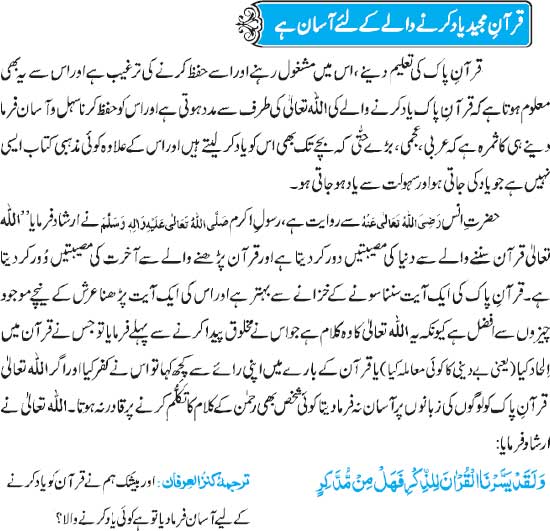
Quran Yaad Karnay Waley Kay Liye Asaan Hai
February 2023
Beauty Of Qur’an In Selecting Precise Words For Parents
A beautiful function of the Arabic language is Uslub Al-Taghlib i.e. when two different things are mentioned together frequently and associated with one another, one of the two mentioned entities takes on its dual form to represent both entities.
One of the words literally takes over the other. A linguistic reason is usually the determining factor in deciding which word will dominate. Some popular examples of this occurrence are:
Qamraan: literally means two moons, but is representative of both the sun and moon.
Umraan: literally means two Umars, but is representative of Abu Bakr and Umar (may Allah be pleased with them)
Hasnaan: literally means two Hasans, but represents both Hasan and Hussain (may Allah be pleased with them)
Now we come to the two instances of this in the Qur’an, Waalidaan, and Abwaan. Both these words mean parents, however, they’re different in their origins. The word Waalidaan comes from the root word Wulida, which means ‘to give birth’. So this is actually representative of the mother. The father is called Waalid figuratively.
Abwaan is a dual form of the word Abb, which means father. So by extension, both mother and father are referred to as Abwaan.
Both of these words have been used in the Qur’an for parents. The real lesson is where and how?
All the verses that speak about good treatment, kindness, and making dua for the parents mention the word Waalidaan, showing a preference for the mother.
As narrated in the famous Hadith, a man came to the Prophet (peace be upon him) and asked, “Who is most deserving of my good companionship?” The Prophet (peace be upon him) replied, “Your mother.”
The man then asked, “Who is next?” The Prophet (peace be upon him) replied, “Your mother.”
The man further inquired, “Who is next?” The Prophet (peace be upon him) once again said, “Your mother.”
The man asked for the fourth time, “Who is next?” The Prophet (peace be upon him) said, “Your father.”
So, when mentioning the good treatment of the parents, the Qur’an uses the word for ‘parents’ which is indicative of the mother over the father.
When mentioning the distribution of inheritance, the word Abwaan, which is indicative of the father, is used, due to the father’s share being greater than the mother’s.
This is a small example of the beauty and precision of the Qur’an. May Allah grant us the ability to study and benefit from the Qur’an. It is also a strong reminder of the rights that our mothers have on us.
Our mothers care so much for us, but we tend to forget everything they have – and continue to – done for us. May Allah bless all mothers and guide us to treat them with the kindness, and respect they deserve.
Mayyat Ko Naik Aamaal Ka Sawab Pahunchta Hai
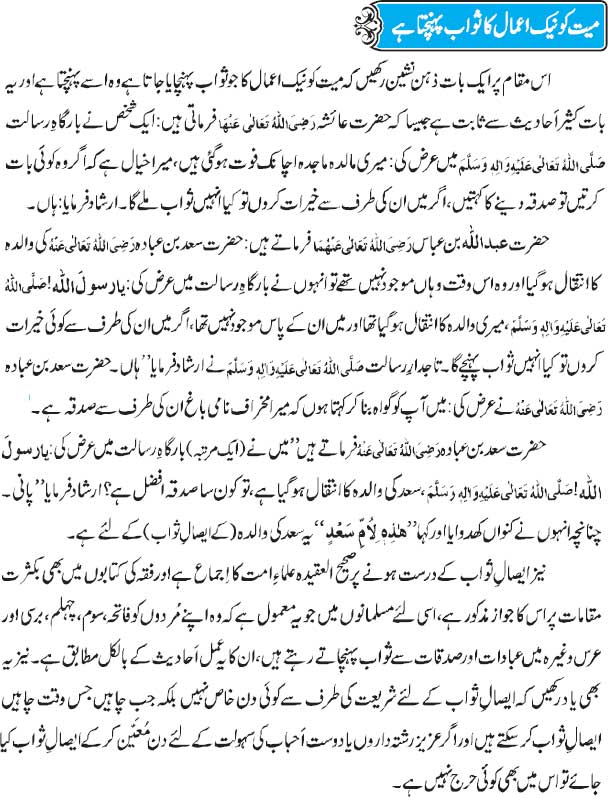
Mayyat Ko Naik Aamaal Ka Sawab Pahunchta Hai
Verily The Religion With Allah Is Islam
The Religion of Islam is the religion which Allah sent Prophet Muhammad[Sallallaahu `Alayhi wa Sallam] with.
Allah the Exalted said: ‘Muhammad is not a father of any of your men, rather he is the Messenger of Allah, and the last of the Prophets.’
[Qur`an Suratul Ahzaab 33: A #40]
Allah the Exalted said: ‘Today I have perfected for you your Religion, and completed for you My favor upon you, and have chosen for you Islaam as a religion.’
[Qur`an’ ~ Suratul Maa’idah 3: A#5]
Allah the Exalted said: ‘Verily the religion with Allah is Isam’.
[‘Qur`an’ ~ Surat Aali ‘Imraan 3: A #19]
‘And whoever takes other than Islam as a religion, it will never be accepted from him, and he will be in the Hereafter from the losers.’
[‘Qur`an’~Surat Aali ‘Imraan 3: A #85]
‘Whoever reads Surat `Al-Kahf ‘ on the day of ‘Jumu`ah’… will have a light that will shine from him from one Friday to the next.’
[Narrated by al-Haakim, 2/399; al-Bayhaqi, 3/249. It was classed as Saheeh by Shaykh al-Albaani in Saheeh al-Jaami’ ~ # 6470)]
Be Rah Ravi Ka Khatma

Be Rah Ravi Ka Khatma by Allama Ibtisam Elahi Zaheer
A Collection Of Quotes On The Rights Of The Parents
Ibn Abbas said: “There is not a single believer who has two parents and wakes up while he is good to them except that Allah opens up for him two gates to Paradise, and if he makes one of them angry, Allah will not be Pleased with him until that parent becomes pleased with him again.” It was asked: “Even if that parent was oppressive and in the wrong?” It was replied: “Yes, even that be so. And he never wakes up while he is bad to them except that Allah opens up for him two gates to Hell.”
As-Samarqandi said: “If Allah – the Exalted – had not mentioned the position and loftiness of the parents in His Book, and did not admonish regarding it, then it would have been realized by simple logic. So, it is obligatory for the one with logic and intelligence to realize their high status and to fulfill their rights. How is it, then, when Allah has mentioned this in all of His Books: the Torah, the Gospels, the Psalms, and the Qur’an, has commanded this in all of His Books, and revealed this to all of His Prophets and advised them regarding the honorable position of the parents and their rights, and has made His Pleasure dependent on their pleasure, and His Anger dependent on their anger?”
Farqad as-Sabakhi said: “I have read in many books that it is not for the son (or daughter) to speak in the presence of the parents except with their permission or to walk in front of them, or to their right or left unless they call him to walk next to them. Rather, he should walk behind them as a slave walks behind his master.”
A group of the Companions said: “To leave off praying for one’s parents results in a tight and constricted life for the son.”
With regard to the duties of parents, Abu Hafs Al-Iskandrani – one of the scholars of Uzbekistan – said that a man came to him and said: “My son hit me and hurt me!” The scholar said: “Glory be to Allah! A son hitting his father? Have you taught him manners and knowledge?” The man said: “No.” “Have you taught him the Qur’an?” The man replied: “No.” “So, what does he know how to do?” The man replied: “Farming.” “Do you know why he hit you?” The man replied: “No.” The scholar then said: “It might have been that when he woke up in the morning, he went to the fields, was riding on a donkey, had a stick between his hands, had a dog behind him, and did not have any knowledge of the Qur’an (because you failed to teach him any of it). So, he started singing, and you came out to him at that moment, and he thought you were a cow and hit you with the stick. So, thank Allah that your skull was not fractured.”
One of the early righteous people would not order his son. If he needed something, he would ask someone else for it. When he was asked about this, he said: “I fear that if I were to command my son with something that he wouldn’t be able to bear, he would not carry it out and would therefore be disobedient to me and would deserve Hell as a result, and I do not want to be the cause of my son burning in Hell.”
– As-Samarqandi, ‘Tambih Al-Ghafilin’, (p. 84-91)
Iqamat Kay Ahkam
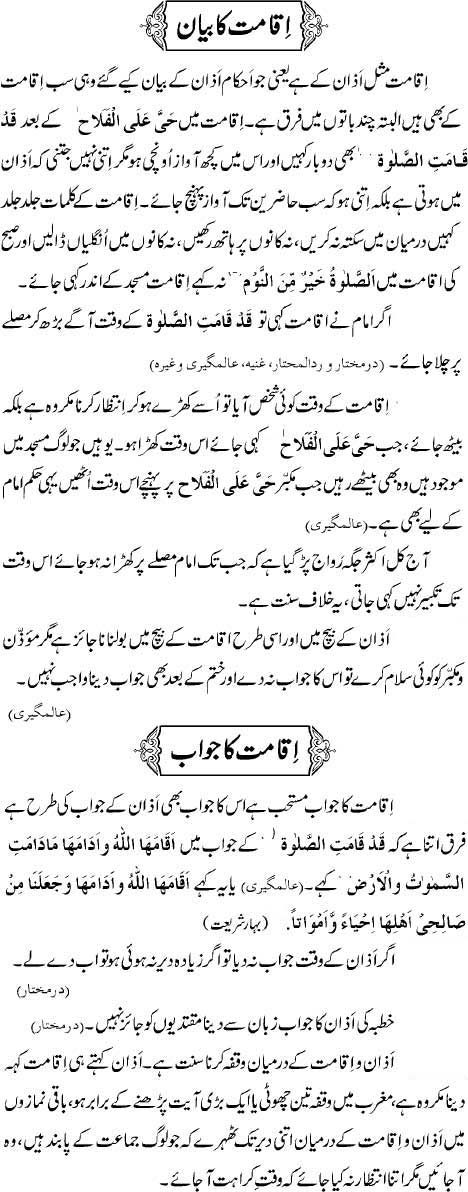
Iqamat Kay Ahkam
Kin Auqat Mein Nafil Parhna Mana Hai
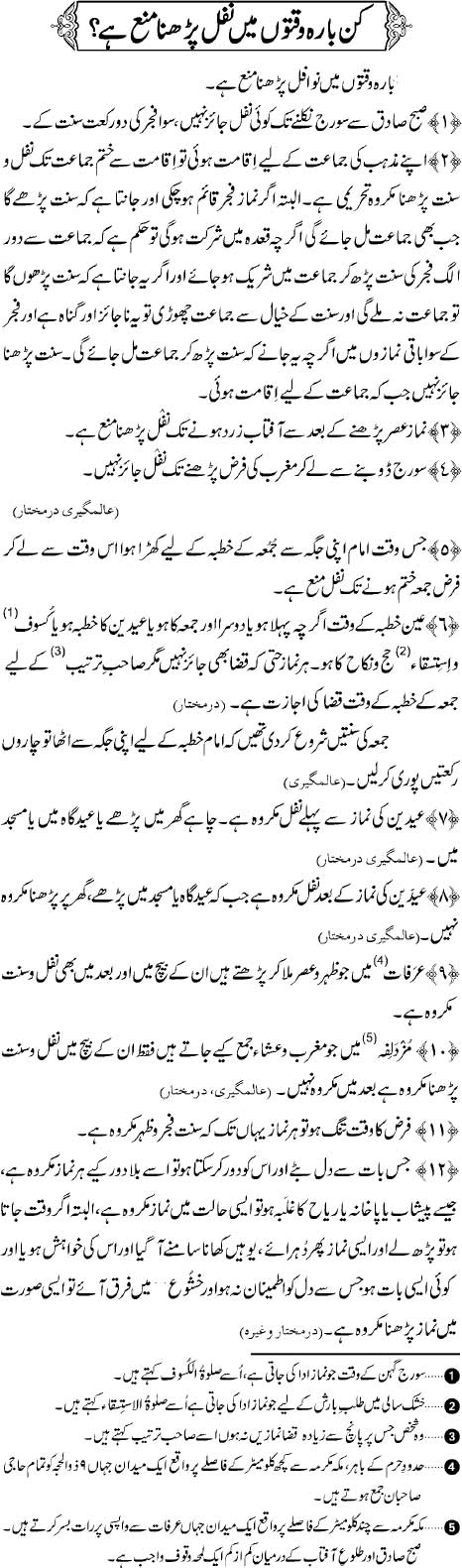
Kin Auqat Mein Nafil Parhna Mana Hai
Marriage After A Hard Battle
When the Prophet (peace be upon him) settled in Madinah, he put relations among the different communities living in the city on a proper basis. There were the Muslims who were composed of two main groups: The Muhajirin who had migrated from Makkah, and the Ansar, or the Arabs who lived there but responded to the Prophet’s call and adopted Islam. Their numbers were always on the increase as more and more of their tribesmen and women adopted Islam every day. There were also the Arabs who retained their idolatrous beliefs and did not accept Islam. Their numbers might have been considerable to start with, but dwindled into insignificance as time passed. There was also the Jewish community which consisted of several tribes. The Prophet ordered a charter to be written down, organizing relations between all these groups. This became the first written constitution in the history of mankind. It established a pluralist society where different communities could live in peace and with mutual respect.
However, relations with the Jews did not run very smoothly, with one tribe after another violating this constitution or coming into open alliance with the enemies of the Muslim state. The result was the evacuation from Madinah of the three major Jewish tribes, one after another. By the end of the fifth year of the Prophet’s settlement there, Madinah became a largely Muslim city, with a small number of hypocrites pretending to be Muslim when they were truly unbelievers and a handful of others who remained idolaters. Now the Jews concentrated in the city of Khaybar, to the north of Madinah, from where they engaged in trying to forge a new alliance of forces. The Prophet moved quickly to forestall these efforts. He laid siege to Khaybar and its forts fell to him, one after another. He then made a peace agreement with the Jews, allowing them to stay and farm the land in return for half its produce.
When the battle was over, Safiyyah was brought to the Prophet. She, like many others of her people, was taken captive and faced a life of slavery. She was a young woman. Some reports suggest that she was only 17, but, most probably, this is inaccurate. She had been married twice before, with the second marriage taking place only a few months earlier. Her second husband, Kinanah ibn Al-Rabie, was killed during the battle. He was one of the main Jewish chiefs, exceedingly hostile to Islam and the Prophet. He had worked hard to stem the tide of Islam.
Thus, both Safiyyah’s father and husband were killed by the Muslims. Now she was being brought to face the Prophet because in her position the Muslims felt that he should be the one to decide her fate. As it happened, it was Bilal who led her, and another Jewish woman, through a yard where there were many bodies of people who were killed in the battle. The other woman wailed loudly, but Safiyyah adopted a dignified attitude. When the Prophet realized what had happened, he remonstrated with Bilal, saying: “Has mercy departed from your heart? How can you lead two women across a place where they would pass by the bodies of their killed people?”
What fate awaited Safiyyah? The Prophet looked at her and then offered her two alternatives: Either he would send her back to her people, or she would be set free and marry her. She chose the latter. He, therefore, assigned her to Umm Sulaym, to look after her and prepare her for the impending marriage. She needed to complete her waiting period first.
– By Adil Salahi
Hadith: Taqdeer Kay Munkir
Hadith: Taqdeer Kay Munkir