
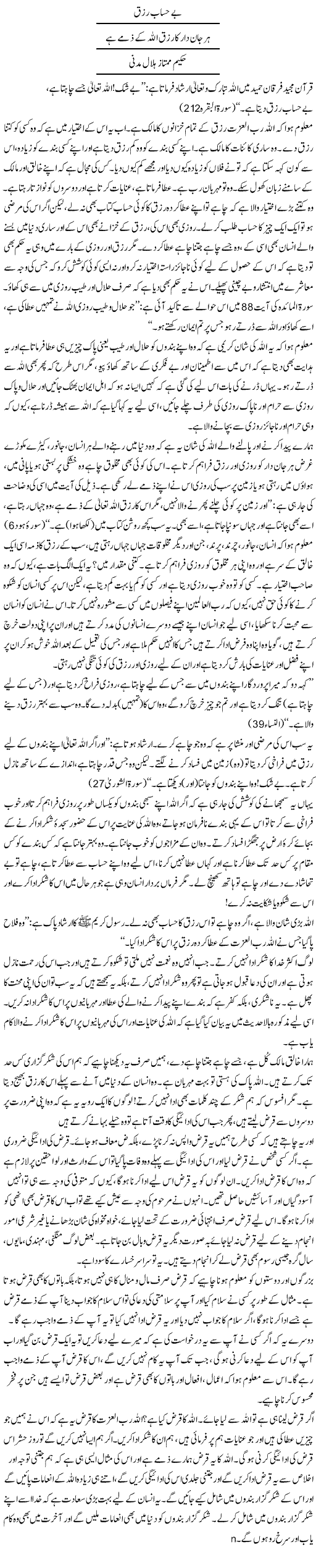
Be Hisab Rizq
December 2025
Allah The Almighty Who Is The Disposer Of All Things
Hadith Qudsi:
On the authority of Zayd ibn Khalid al-Juhaniyy (may Allah be pleased with him), who said:
The Messenger of Allah (may the blessings and peace of Allah be upon him) led the morning prayer for us at al-Hudaybiyah following rainfall during the night. When the Prophet (may the blessings and peace of Allah be upon him) finished, he faced the people and said to them: Do you know what your Lord has said? They said: Allah and His Messenger know best. He said: This morning, one of my servants became a believer in Me and one a disbeliever. As for him who said: We have been given rain by virtue of Allah and His mercy, that one is a believer in Me, a disbeliever in the stars (2); and as for him who said: We have been given rain by such-and-such a star, that one is a disbeliever in Me, a believer in the stars.
(2) The pre-Islamic Arabs believed that rain was brought about by the movement of stars. This Hadith draws attention to the fact that, whatever be the direct cause of such natural phenomena as rain, it is Allah the Almighty who is the Disposer of all things.
It is related by al-Bukhari (also by Malik and an-Nasa’i).
Hadith Qudsi :
On the authority of Abu Hurayrah (may Allah be pleased with him), who said that the Messenger of Allah (may the blessings and peace of Allah be upon him) said: Allah said:
Sons of Adam inveigh against [the vicissitudes of] Time, and I am Time, in My hand is the night and the day (1).
(1) As the Almighty is the Ordainer of all things, to inveigh against misfortunes that are part of Time is tantamount to inveighing against Him.
It was related by al-Bukhari (also by Muslim).
Hazrat Abu Bakr (radi Allahu anhu) Ka Hijrat Kay Waqt Maal Lay Jana
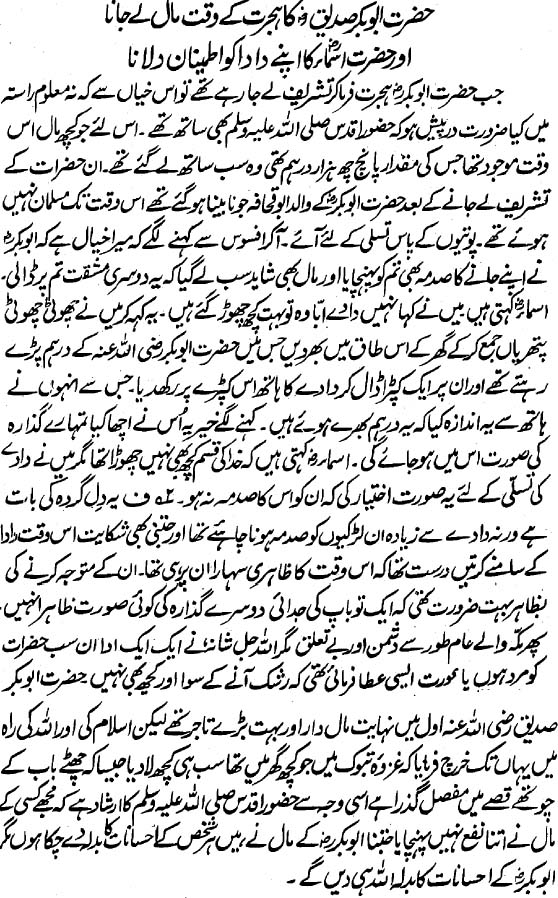
Hazrat Abu Bakr (radi Allahu anhu) Ka Hijrat Kay Waqt Maal Lay Jana Aur Hazrst Asma (radi Allahu anha) Ka Apnay Dada Ko Itmenan Dilana
25 Ways To Remove Stress And Anxiety From Your Life
1. Ask Him. He Listens: Dua
Turn each anxiety, each fear, and each concern into a Dua (supplication). Look at it as another reason to submit to God and be in Sajdah (prostration), during which you are closest to Allah. God listens and already knows what is in your heart, but He wants you to ask Him for what you want. The Prophet said, “Allah is angry with those who do not ask Him for anything” (Tirmidhi).
The Prophet once said that in prayer, he would find rest and relief (Nasai). He would also regularly ask for God’s forgiveness and remain in prostration during prayer, praising God (Tasbeeh) and asking for His forgiveness (Bukhari).
Allah wants you to be specific. The Prophet advised us to ask Allah for exactly what we want instead of making vague Duas. Dua is the essence of worship (the Prophet as quoted in Tirmidhi).
“Call on your Lord with humility and in private: for Allah loveth not those who trespass beyond bounds. Do not make mischief on the earth, after it hath been set in order, but call on Him with fear. And longing (in your hearts): for the mercy of Allah is (always) near to those who do good” (Quran 7:55-56).
2. Tie your Camel: Do your Part
One day, Prophet Muhammad , peace and blessings be upon him, noticed a Bedouin leaving his camel without tying it. He asked the Bedouin, “Why don’t you tie down your camel?” The Bedouin answered, “I put my trust in Allah.” The Prophet then said, “Tie your camel first, then put your trust in Allah” (Tirmidhi).
Ummat e Muhammadi (Sallallahu alaihi wasallam) Kay Gunnahgaro Ka Dozakh Say Nikala Jana
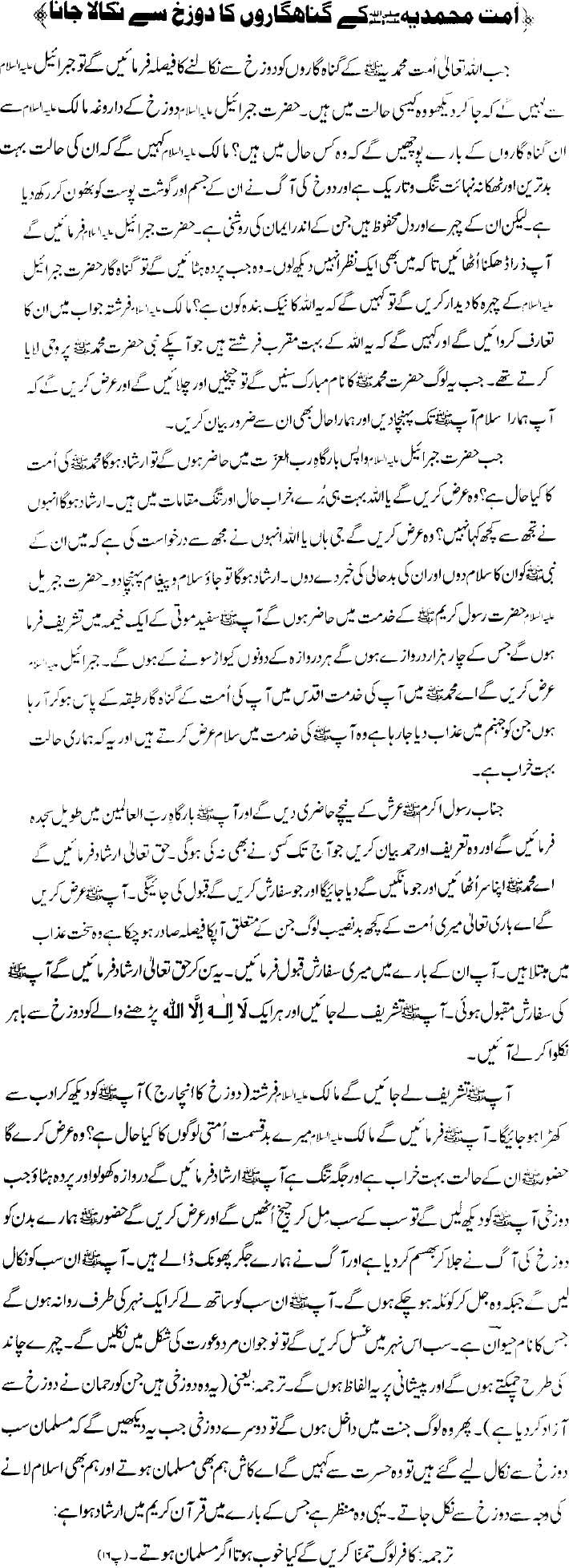
Ummat e Muhammadi (Sallallahu alaihi wasallam) Kay Gunnahgaro Ka Dozakh Say Nikala Jana
What Makes Us Different From Iblis, Shaitan
Iblis. Shaytan. The Devil. Whatever name you call him, everyone knows him. He is the accursed one. The rejected outcast, who was thrown out of Jannah. The one damned to the Fire of Hell forever and doomed until eternity.
Ever wonder how he got there? I mean, really wondered…?
What did he do, or perhaps not do, that condemned him to be the most despicable and humiliated creature in the heavens and the earth?
Yes, sure, we all know the story. We’ve known it since we were babies. We’ve read it in the Qur’an a million times. But, have we ever read the story with the eyes of our hearts? Have we really thought about what happened? Have we ever pondered it? What did Iblis do that was so wrong? Let us look at some of Iblis’ actions.
1. Did Iblis not believe in Allah? Indeed, he did!
Iblis, the accursed, believed in Alah. He knew Allah is the Master, Owner, Sustainer, the Giver of life and death, the Lord of all things. In fact, he calls Him my Rabb, my Lord.
He (Iblis) said, ‘My Lord, reprieve me till the Day they are raised.’ (Surah al-Hijr:36)
Why, Iblis even swore by Allah’s Might, knowing fully well that it is Allah Subhaanahu wa Ta’ala, Who is Almighty and that all Power belongs to Him Alone. Iblis swears: He (Iblis) said, ‘I swear by Your Might, that I will surely mislead them all. (Surah Saad:82)
2. Did he believe that someone else created him? NO, he knew Allah is his Creator!
Shaytan knew very well that Allah is the Creator of the heavens and the earth and whatever is in them, including himself, all jinn and mankind. He admitted it himself.
(Iblis) said: ‘I am better than he (Adam). You created me of fire, and You created him of clay.’ (Surah al-Aaraaf:12)
Agar Niyyat Naik Ho Tu
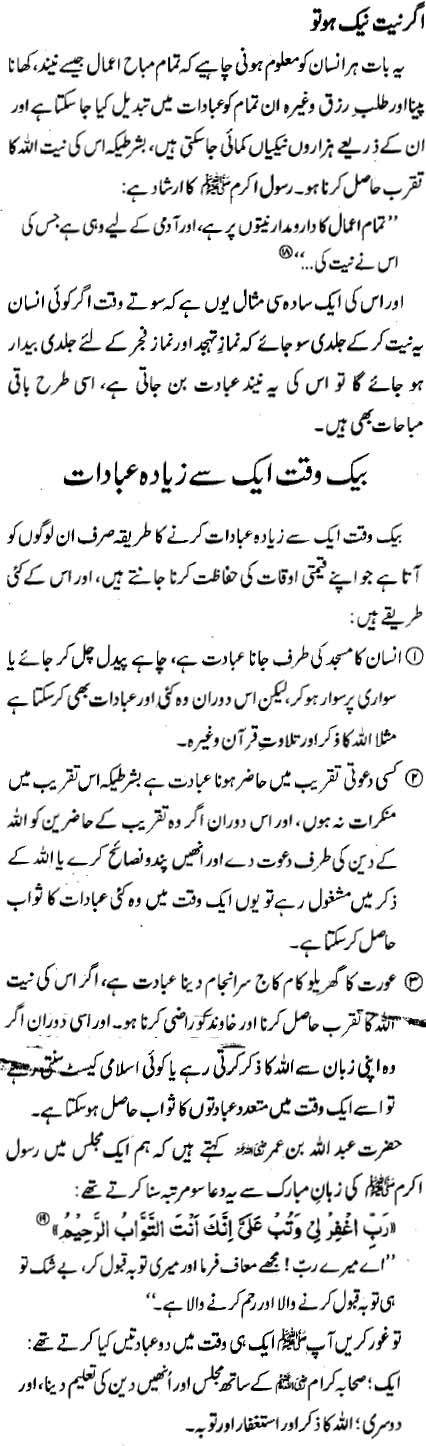
Agar Niyyat Naik Ho Tu
Akhlaq: The Importance Of Islamic Morals
The definition of morals (Akhlaq) in the Arabic language: It is a term derived from the word “Khuluq” meaning the character and the nature; therefore, a man’s character would be his qualities and his morals. The definition of morals in Shari’ah terminology: Morals are the characteristics that Allah (SWT) has ordered Muslims to abide by when performing their actions. They are the commands and prohibitions related to the qualities which the Muslim should demonstrate when performing his actions, be it acts of worship, transactions and others
Since the Shari’ah, or rather restrict the Muslim, his actions are restricted, for Allah (SWT) says: “It is not fitting for a believer, man or woman, when a matter has been decided by Allah and His Messenger, to have any option about their decision. If anyone disobeys Allah and His Messenger, he is indeed on a clearly wrong path” [TMQ 33:36]
And for He (SWT) says: “But no by the Lord, they shall not be believers, until they make you judge in all disputes between them, and find in their souls no resistance against your decisions, but accept them with the fullest conviction.” [TMQ 4:65]
Tib-e-Nabvi: Kalonji
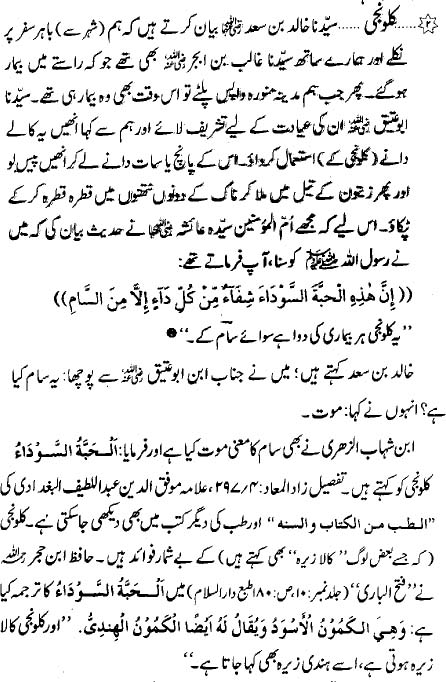
Tib-e-Nabvi: Kalonji
The Negative C’s Of Islamic Parenting
One of the greatest challenges a Muslim will ever face is being a parent. This is one challenge, however, many of us are least prepared for. Allah tells us in the Quran that our children are our trial, and as such, we should take the task of parenting seriously and start learning from each other.
There are many negative C’s, which should also be identified so that we can avoid them or at least be aware of them.
Competition: In an authentic Hadith, the Prophet Muhammad said: “Look up to one who is greater in piety so you strive to be like him and look upon one who is below you in material status so that you may be thankful to Allah’s Grace”. As a Muslim community, we are experiencing the opposite. We are literally killing ourselves to gain bigger and better material goods than others and passing this same competitive spirit to our children. If Br. X’s son is going to Yale, my son must go to Harvard; otherwise, he is a failure, no matter how good a Mumin (believer) he is in comparison to Br. X’s son. We are inadvertently putting so much pressure on our children to compete in Dunya (this world) that we are actually hurting their self-esteem and pushing them away. Remember, if children don’t find acceptance of who they are and what they are capable of at home, they will find it elsewhere.