


Majlis Say Uth Kar Jane Ki Sunnat
December 2025
Receiving Naseeha – Work On Ourselves First
Usually, you’ll find in articles on “The Manners of Naseeha” or “Fiqh of Naseeha” going over how to give Naseeha before mentioning how to accept it. I want to change things up and speak about receiving it first because of the problems many Muslims face with it.
Firstly, you have to humble yourself and break down your walls of arrogance. This lays the foundation for Naseeha to operate on. If every Muslim were to work for this, it would make identifying our mistakes for correction much more streamlined, whether the identification comes from yourself or from your fellow Muslim brother or sister.
Secondly, discard any self-perceived “rank” or “status” in your mind. It doesn’t matter if the person is a different age, or a different nationality, a different Manhaj, a different gender, or different at all. Whether it’s your parent, child, relative, Shaykh, friend, student, a pious person, a sinner, whoever, every Muslim has the right to advise you when you do wrong. Imam Malik (rahimuhullah) once came into a masjid after Asr and was commanded by a boy to pray two rak’ah of Tahayyatul Masjid even though it was clearly contradictory to his Fiqh position. His students saw this and later asked him why he prayed the two rak’ah. Imam Malik replied:
Bura Anjam: Aik Munafiq Ka Ibrat-nak Anjam
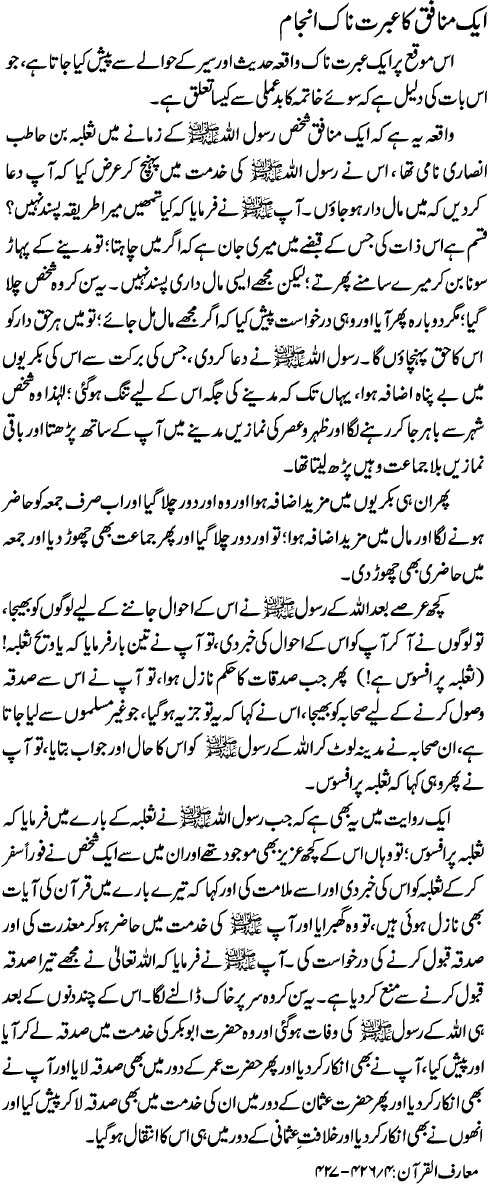
Bura Anjam: Aik Munafiq Ka Ibrat-nak Anjam
Ten Principles Of Success In the Light Of The Seerah
It is a well-known fact that the Prophet of Islam (PBUH) was the supremely successful man in the entire human history. But he was not just a hero, as Thomas Carlyle has called him. According to the Qur’an, he was a good example for all mankind. He has shown us the way to achieve supreme success in this world.
By studying the life of the Prophet, we can derive those important principles that the Prophet followed. In short, the Prophet of Islam was a profoundly positive thinker in every sense of the word. All his activities were result-oriented. He completely refrained from all such steps as may prove counter-productive.
First Principle: To begin from the possible
This principle is well explained in a saying of Aisha RA. She said: “Whenever the Prophet had to choose between two options, he always opted for the easier choice.” (Al-Bukhari) To choose the easiest option means to begin from the possible, and one who begins from the possible will surely reach his goal.
Second Principle: To see advantage in disadvantage
In the early days of Mecca, there were many problems and difficulties. At that time, a guiding verse in the Qur’an was revealed. It said: “With every hardship there is ease, with every hardship there is ease.” (94:5-6). This means that if there are some problems, there are also opportunities at the same time. And the way to success is to ignore the problems and avail the opportunities.
Aamaal Ka Wazan
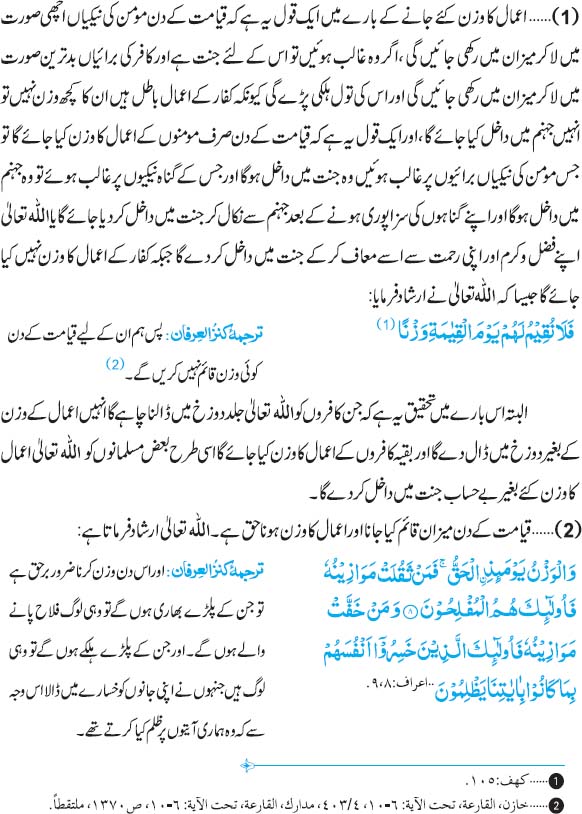
Aamaal Ka Wazan
The Life Of This World Is, But Goods And Chattels Of Deception
“Fair in the eyes of men is the love of things they covet: Women and sons; Heaped-up hoards of gold and silver; horses branded (for blood and excellence); and (wealth of) cattle and well-tilled land. Such are the possessions of this world’s life; but in nearness to Allah is the best of the goals (To return to).” (Surah-3 Ale-Imran Ayah-14)
“Those who desire the life of the present and its glitter,- to them, we shall pay (the price of) their deeds therein,- without diminution.”
“They are those for whom there is nothing in the Hereafter but the Fire: vain are the designs they frame therein, and of no effect and the deeds that they do!” (Surah-11 Hud Ayah-15-16)
“Wealth and sons are allurements of the life of this world: But the things that endure, good deeds, are best in the sight of thy Lord, as rewards, and best as (the foundation for) hopes.” (Surah-18 Al-Kahf Ayah-46)
“What is the life of this world but amusement and play? But verily the Home in the Hereafter,- that is life indeed, if they but knew.” (Surah-29 *Al-Ankaboot* Ayah-64)
“If any do wish for the transitory things (of this life), We readily grant them – such things as We will, to such person as We will: in the end have We provided Hell for them: they will burn therein, disgraced and rejected.”
“Those who do wish for the (things of) the Hereafter, and strive therefor with all due striving, and have Faith, – they are the ones whose striving is acceptable (to Allah)” (Surah-17 Al-Isra Ayah-18-19)
“Day (behold), ye prefer the life of this world;”
“But the Hereafter is better and more enduring.” (Surah-87 Al-Alaa Ayah-16-17)
“Know ye (all), that the life of this world is but play and amusement, pomp and mutual boasting and multiplying, (in rivalry) among yourselves, riches and children. Here is a similitude: How rain and the growth which it brings forth, delight (the hearts of) the tillers; soon it withers; thou wilt see it grow yellow; then it becomes dry and crumbles away. But in the Hereafter is a Penalty severe (for the devotees of wrong). And Forgiveness from Allah and (His) Good Pleasure (for the devotees of Allah.. And what is the life of this world, but goods and chattels of deception? ”
(Surah-57 Al-Hadid Ayah-20)
Qabar Ki Tayari Kar Lo
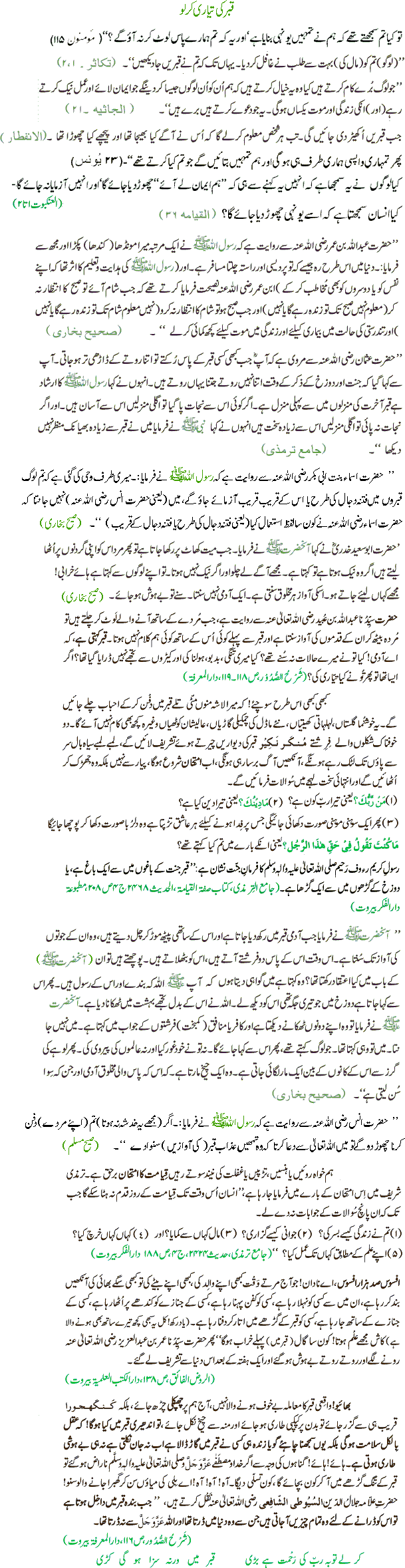
Qabar Ki Tayari Kar Lo
Prophet Jonah (PBUH)
In the name of Allah, the Most Merciful, the All-Compassionate
“May the Peace and Blessings of Allah be Upon You”
Praise be to Allah, we seek His help and His forgiveness. We seek refuge with Allah from the evil of our own souls and from our bad deeds. Whomsoever Allah guides will never be led astray, and whomsoever Allah leaves astray, no one can guide. I bear witness that there is no god but Allah, and I bear witness that Muhammad is His slave and Messenger.
Bismillah Walhamdulillah Was Salaatu Was Salaam ‘ala Rasulillah
As-Salaam Alaikum Wa-Rahmatullahi Wa-Barakatuhu
Prophet Yunus (Jonah)
Prophet Jonah (Yunus) (PBUH), also known as Dhan-Nun. About his people, Almighty Allah said: “Was there any town community that believed after seeing the punishment, and its Faith at that moment, saved it from the punishment? (the answer is none)–except the people of Jonah; when they believed, We removed from them the torment of disgrace in the life of the present world, and permitted them to enjoy for a while.” (Ch 10:98 Quran)
The inhabitants of the town of Nineveh were idolaters who lived a shameless life. Prophet Jonah (PBUH) was sent to teach them the worship of Allah. The people disliked his interference in their way of worship, so they argued. “We and our forefathers have worshiped these gods for many years, and no harm has come to us.”
Jonah Leaves His People
Try as he might to convince them of the foolishness of idolatry and of the goodness of Allah’s laws, they ignored him. He warned them that if they kept on with their foolishness, Allah’s punishment would soon follow. Instead of fearing Allah, they told Jonah that they were not afraid of his threats. “Let it happen,” they told him. Jonah was disheartened. “In that case, I will leave you to your misery!” So saying, he left Nineveh, fearing that Allah’s anger would soon follow.
“Remember Dhan Nun (Jonah), when he went off in anger, and imagined that We shall not punish him (the calamities which had befallen him)! (ch 21:87)
The People are Forgiven
Hardly had he left the city when the skies began to change color and looked as if they were on fire. The people were filled with fear at the sight of this. They recalled the destruction of the people of Ad, Thamud, and Noah. Was theirs to be a similar fate? Slowly, faith penetrated their hearts. They all gathered on the mountain and started to beseech Allah for His mercy and forgiveness. The mountains echoed with their cries. It was a momentous hour, filled with sincere repentance.
Jannat Aur Iss Ki Naimatien
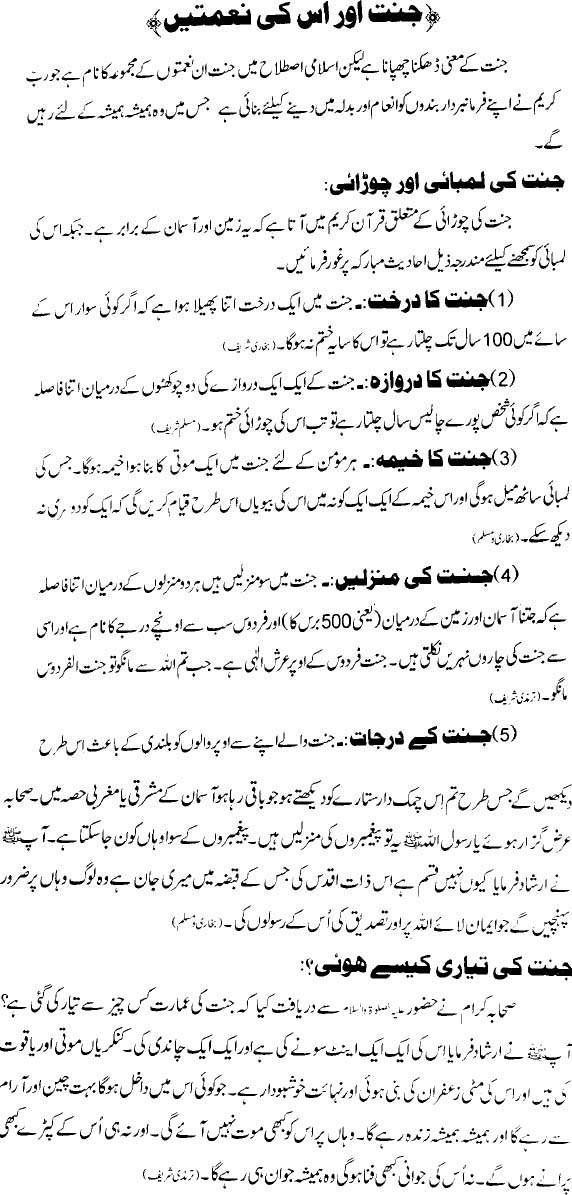
Jannat Aur Iss Ki Naimatien
Want A Palace(In Jannah)?..Give Up Malice!
Narrated Hudhaifa (Radi Allahu anhu): The Prophet (SallAllahu alaihi wasallam) said,” Before your time, the angels took the soul of a man and asked him, ‘Did you do any good deeds (in your life)?’ He replied, ‘I used to order my employees to grant time to rich person to pay his debts at his convenience and excuse the one in hard circumstances.’ So Allah said to the angels, ‘Excuse him,'” Sahih Al-Bukhari 3:291
Want a Palace(In Jannah)?..Give up, Malice!
Every person’s honor is sacred. We are duty-bound to respect and honor our fellow brothers and sisters and never…yes, NEVER to hold an iota of malice or ill will in our hearts towards them. The Noble Messenger of Allah (peace be upon him) tried to eliminate hatred, malice, jealousy, and rivalry by inducing brotherhood, sincere love and friendship. (Please note that while in most cases the ahaadeeth mention the masculine gender, the same rewards etc. refer to the females as well)
Our society is ideally built upon the foundation of brotherhood, as the Noble Messenger of Allah (peace be upon him) advised: “Believers are like a structure, parts of which support one another. The believers, in their mutual friendship, mercy, and affection, are like one body; if any part of it complains, the rest of the body will also stay awake in fever.” (Hadith-Al-Bukhaari and Muslim).
The Noble Messenger of Allah (peace be upon him) also said, “Do not break off ties with one another, do not turn away from one another, do not hate one another, and do not envy one another. Be O slaves of Allah brothers.” (Al-Bukhaari)