

Archives
The Gate Of Iman- Hazrat Abu Bakr Siddique radiallahu taala anhu
Sahih Bukhari Volume 1, Book 8, Number 455
Narrated by Abu Said Al-Khudri
The Prophet delivered a sermon and said, “Allah gave a choice to one of (His) slaves either to choose this world or what is with Him in the Hereafter. He chose the latter.” Abu Bakr wept. I said lo myself, “Why is this Sheikh weeping, if Allah gave choice to one (of His) slaves either to choose this world or what is with Him in the Here after and he chose the latter?” And that slave was Allah’s Apostle himself. Abu Bakr knew more than us. The Prophet said, “O Abu Bakr! Don’t weep. The Prophet added: Abu- Bakr has favored me much with his property and company. If I were to take a Khalil from mankind I would certainly have taken Abu Bakr but the Islamic brotherhood and friendship is sufficient. Close all the gates in the mosque except that of Abu Bakr.
The way of Love , Ishq E Rasool is the gate of the way to Allah , All who achieved communion with Allah , came through the way of love , this is way of Abu Bakr Siddique radi allahu taala anhu and the way of Success ,
He was among the first person to endorse and accept the Apostleship of the Holy Prophet Muhammed Salalaahu Alaihi wasallam.
His deep love and reverence for the Holy Prophet Muhamed Salalaahu Alaihi wasallam earned him some of the highest honors
He Always led the prayer in the absence of The Holy Prophet Muhammed Salalaahu Alaihis wasallam
Sahih Bukhari Volume 1, Book 11, Number 633 :
Narrated by Al-Aswad
“We were with ‘Aisha discussing the regularity of offering the prayer and dignifying it. She said, ‘When Allah’s Apostle fell sick with the fatal illness and when the time of prayer became due and Adhan was pronounced, he said, ‘Tell Abu Bakr to lead the people in prayer.’ He was told that Abu Bakr was a soft-hearted man and would not be able to lead the prayer in his place. The Prophet gave the same order again but he was given the same reply. He gave the order for the third time and said, ‘You (women) are the companions of Joseph. Tell Abu Bakr to lead the prayer.’ So Abu Bakr came out to lead the prayer. In the meantime the condition of the Prophet improved a bit and he came out with the help of two men one on each side. As if I was observing his legs dragging on the ground owing to the disease. Abu Bakr wanted to retreat but the Prophet beckoned him to remain at his place and the Prophet was brought till he sat beside Abu Bakr.” Al-A’mash was asked, “Was the Prophet praying and Abu Bakr following him, and were the people following Abu Bakr in that prayer?” Al-A’mash replied in the affirmative with a nod of his head. Abu Muawiya said, “The Prophet was sitting on the left side of Abu Bakr who was praying while standing.”
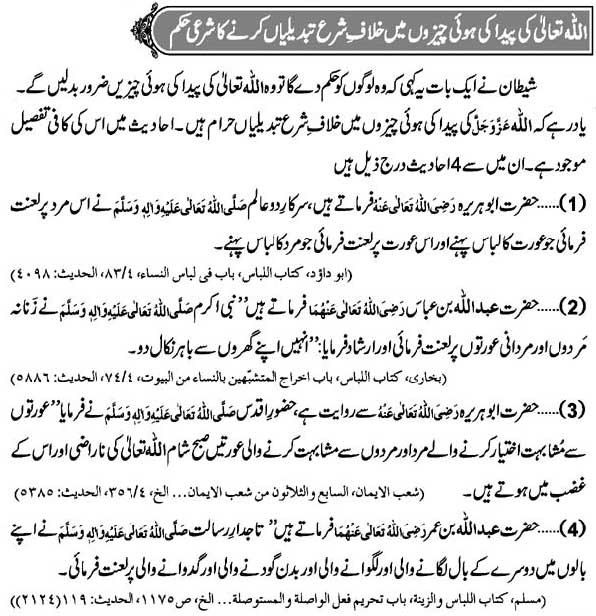
Khilaf-e-Shara Tabdeelian Kernay Ka Sharai Hukam
Thanking And Being Grateful To Allah For The Wealth Bestowed Upon Us
Being Grateful To Allah and Thanking him for the favours and wealth conferred upon us
Sahih Muslim Book 42, Number 7070:
Abu Huraira reported Allah’s Messenger (may peace be upon him) as saying: Look at those who stand at a lower level than you but don’t look at those who stand at a higher level than you, for this would make the favors (conferred upon you by Allah) insignificant(in your eyes). Abu Mu’awiya said: Upon you.
Avoiding Envy and jealousy over wealth
Sahih Muslim Book 42, Number 7068:Abu Huraira reported that Allah’s Messenger (may peace be upon him) said: When one of you looks at one who stands at a higher level than you in regard to wealth and physical structure he should also see one who stands at a lower level than you in regard to these things (in which he stands) at a higher level (as compared to him).
The world is a prison-house for a believer and Paradise for a non-believer.
Sahih Muslim Book 42, Number 7058:Abu Huraira reported Allah’s Messenger (may peace be upon him) as saying: The world is a prison-house for a believer and Paradise for a non-believer.
The world is like a dead lamb in the eyes of Allah
Sahih Muslim Book 42, Number 7059: Jabir b. Abdullah reported that Allah’s Apostle (may peace be upon him) happened to walk through the bazar coming from the side of ‘Aliya and the people were on both his sides.There he found a dead lamb with very short ears. He took hold of his ear and said: Who amongst you would like to have this for a dirham? They said: We do not like to have it even for less than that as it is of no use to us. He said: Do you wish to have it (free of any cost)? They said: By Allah, even if it were alive (we would not have liked to possess that), for there is detect in it as its ear is very short; now it is dead also.Thereupon Allah’s Messenger (may peace be upon him) said: By Allah, this world is more insignificant in the eye of Allah as it (this dead lamb) is in your eye.
Wealth Spent on oneself , one’s family and on others(the poor and needy) is money saved for the Hereafter , Wealth spent is wealth saved
Sahih Muslim Book 42, Number 7061:Mutarrif reported on the authority of his father: I came to Allah’s Apostle (may peace be upon him) as he was reciting: “Abundance diverts you” .He said: The son of Adam claims: My wealth, my wealth. And he (the Holy Prophet) said: O son of Adam. is there anything as your belonging except that which you consumed, which you utilized, or which you wore and then it was worn out or you gave as charity and sent it forward?
Sahih Muslim Book 42, Number 7063:Abu Huraira reported Allah’s Messenger (may peace be upon him) as saying: A servant says, My wealth. my wealth, but out of his wealth three things are only his: whatever he eats and makes use of or by means of which he dresses himself and it wears out or he gives as charity, and this is what he stored for himself (as a reward for the Hereafter), and what is beyond this (it is of no use to you) because you are to depart and leave it for other people.This hadith has been narrated on the authority of al-‘Ala’ b. ‘Abd al-Rahman with the same chain of transmitters.
Spend and Allah will spend on you
Sahih Muslim Book 5, Number 2178:Abu Huraira reported Allah’s Messenger (may peace be upon him) as saying that Allah, the Most Blessed and High, said: O son of Adam, spend. I will spend on you. The right hand of Allah is full and overflowing and in nothing would diminish it, by overspending day and night.
Excellence of Spending on ones family and saving them from want
Sahih Muslim Book 5, Number 2180: Thauban reported Allah’s Messenger (may peace be upon him) as saying: The most excellent dinar is one that a person spends on his family, and the dinar which he spends on his animal in Allah’s path, and the dinar he spends on his companions in Allah’s path. Abu Qilaba (one of the narrators) said: He (the narrator) started with family, and then Abu Qilaba said: Who is the person with greater reward than a person who spends on young members of his family (and thus) preserves (saves them from want) (and by virtue of which) Allah brings profit for them and makes them rich.
Importance of being modest and having Humility and doing Justice to others inspite of being wealthy
Sahih Muslim Book 42, Number 7067:’Abdullah b. ‘Amr b. al-As reported that Allah’s Messenger (may peace be upon him) said: How would you be, O people. when Persia and Rome would be conquered for you?’ Abd at-Rahman b Auf said: We would say as Allah has commanded us and we would express our gratitude to Allah Thereupon Allah’s Messenger (may peace be upon him) said: Nothing else besides it? You would (in fact) vie with one another, then you would feel jealous. then your relations would be estranged and then you will bear enmity against one another. or something to the same effect.Then you would go to the poor emigrants and would make some the masters of the others.
Allah Hafiz.
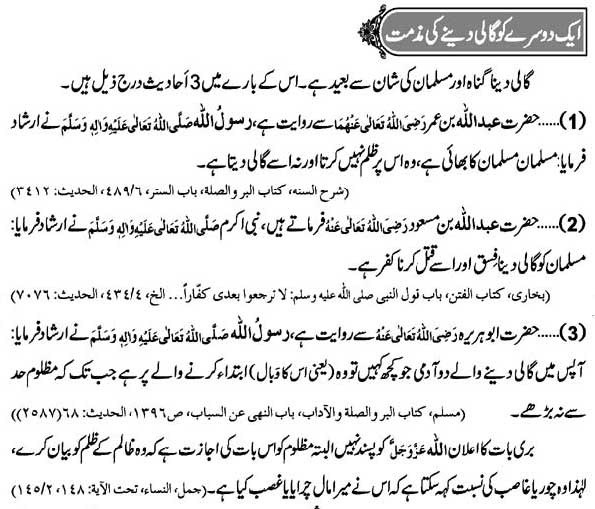
Gali Denay Ki Muzammat
Sayings Of The Prophet Muhammad (PBUH)
Narrated by Imran ibn Husayn(Radhiallaho anho): Allah’s Messenger (sallAllaahu `alaihi wasallam) said : If anyone swears a false oath in confinement, he should make his seat in Hell
on account of his (act).
Sunan of Abu-Dawood 3236
Narrated by AbuSa’id al-Khudri(Radhiallaho anho): Allah’s Messenger (sallAllaahu `alaihi wasallam) said :A man giving a dirham as sadaqah (charity) during his life is better than giving one hundred dirhams as sadaqah (charity) at the moment of his death.
Sunan of Abu-Dawood 2860
Narrated by Ibn Abbas (Radhiallaho anho): Allah’s Messenger (sallallaahu ‘alaihi wasallam)said, “There are two blessings which many people lose: (They are) health and free time for doing good.”
Sahih Al-Bukhari Vol. 8 : No. 421
Narrated by Abu Huraira (Radhiallaho anho): Allah’s Messenger (sallallaahu ‘alaihi wasallam) said, ” “Whoever believes in Allah and His Apostle, offers prayer perfectly and fasts the month of Ramadan, will rightfully be granted Paradise by Allah, no matter whether he fights in Allah’s cause or remains in the land where he is born.” The people said, “O Allah’s Apostle! Shall we acquaint the people with this good news?” He said, “Paradise has one-hundred grades which Allah has reserved for the mujahidin who fight in His cause, and the distance between each of two grades is like the distance between the Heaven and the earth. So, when you ask Allah (for something), ask for Al-Firdaus which is the best and highest part of Paradise.” (i.e., The sub-narrator added, “I think the Prophet also said, ‘Above it (i.e. Al-Firdaus) is the Throne of Beneficent (i.e. Allah), and from it originate the rivers of Paradise.”)
Sahih Al-Bukhari Vol. 4 : No. 48 Hadith
Narrated by Abu Huraira (Radhiallaho anho): Allah’s Messenger (sallallaahu ‘alaihi wasallam) said, “Angels come to you in succession by night and day and all of them get together at the time of the Fajr and ‘Asr prayers. Those who have passed the night with you (or stayed with you) ascend (to the Heaven) and Allah asks them, though He knows everything about you, well, “In what state did you leave my slaves?” The angels reply: “When we left them they were praying and when we reached them, they were praying.”
Sahih Al-Bukhari Vol. 1 : No. 530
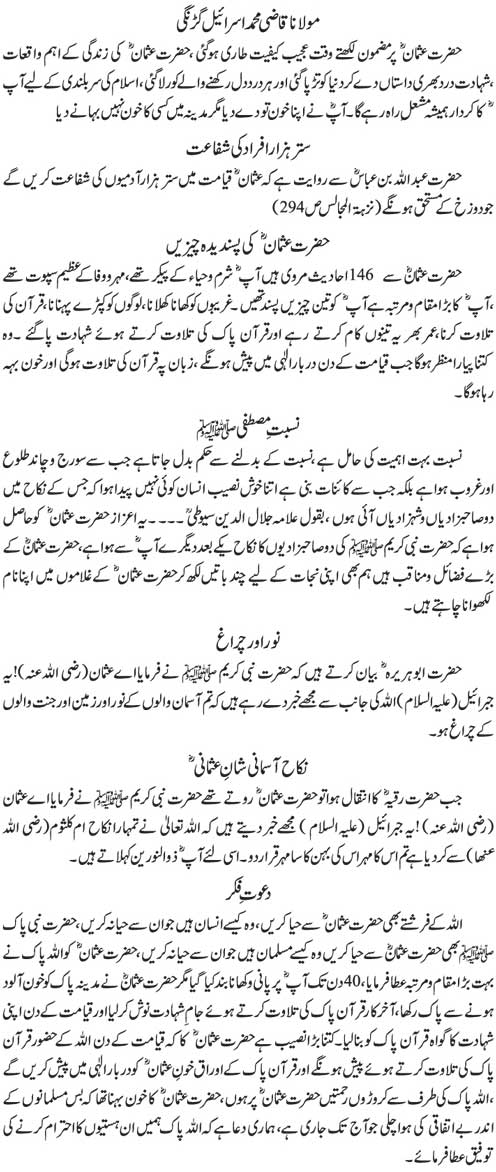
Hazrat Usman Ghani (R.A)
Paradise And Hell Have Already Been Created
At-Tahhaawi said, in his book on al-‘Aqeedah al-Salafiyyah (correct belief in accordance with that of the early generations of Islam) that is known as al-‘Aqeedah al-Tahhaawiyyah.
“Paradise and Hell have already been created. They will never come to an end or cease to exist. Allah (swt) created Paradise and Hell before the rest of creation, and He (swt) created inhabitants for each of them. Whoever He (swt) wishes (will enter) Paradise by His grace and mercy, and whoever He (swt) wishes (will enter Hell) as a result of His (swt) justice. Every person will behave according to that for which he was created, and his destiny will be that for which he was created; good deeds and evil deeds are foreordained for all men”.
Muhammad ibn Muhammad ibn Abul-‘Izz al-Hanafi remarked, in his commentary on
this text:
“With regard to his saying that Paradise and Hell have already been created, Ahl as-Sunnah agree that Paradise and Hell have been created and are in existence at the present moment. Ahlus-Sunnah continued to hold this view, until some odd ideas of the Mu’tazilah and Qaadariyyah came along, which denied that. These groups said: “Allah will create them (ie Paradise and Hell) on the Day of Resurrection.” They said this because of their false arguments by means of which they seek to improve regulations on what Allah (swt) should do; (they say) it befits Allah (swt) to do this, or it does not befit Allah (swt) to do that. They compare Him to His creation and their actions. This is a kind of anthropomorphism with regard to deeds; they have allowed the ideas of Jahmiyyah (a sect of Mu’tazilah named after the deviant, Jahm ibn Safwan) to creep into their thinking, and have become mu’attalah (those who deny that Allah can see). They said, “It does not make sense for Paradise to be created before the time of reward, because it will not be used or inhabited for a very long time. They rejected the aayaat and reports that contradict these false notions they seek to project onto Allah (swt). They misinterpreted the texts and accused those who disagreed with them of going astray and concocting bid’ah”.
Proofs from the Qur’an and Hadeeth in support of this are, for example:
“Race with one another in hastening towards forgiveness from your Lord, and Paradise the width whereof is as the width of the heaven and the earth, prepared for those who believe in Allah and His Messengers. That is the Grace of Allah, which He bestows on whom He is pleased with. And Allah is the Owner of Great Bounty”. (57:21)
“…for Paradise as wide as are the heavens and the earth, prepared for al-Muttaqun” (3:133)
“And fear the fire, which is prepared for the disbelievers” (3:131)
“And indeed he (Muhammad) saw him (Jibreel) at a second descent (ie another time), near Sidrat al-Muntahaa (lote tree of the utmost boundary (beyond which none can pass), near it is the Paradise of Abode” (53:13-15)
The Prophet (saw) saw Sidrat al-Muntahaa, a tree in Heaven, and near it, Paradise, as is mention in al-Bukhaari, and Muslim in the hadith of Anas (ra). At the end of this narrative of al-Israa, the Prophet (saw) said, “Then Jibreel brought me to Sidrat al-Muntahaa which was veiled in colours indescribable. Then I entered Paradise, and its lights were of pearls and its soil was musk”.
Muslim, Abu Dawud and Imaam Ahmad report from Abu Hurayrah (ra) that the Messenger (saw) said, “When Allah (swt) created Paradise and Hell, He sent Jibreel to Paradise, saying “Go and look at it and at what I have prepared therein for its inhabitants”. So he went and looked at it and at what Allah had prepared therein for its inhabitants…. then He sent him to Hellfire saying, “Go and look at it and what I have prepared therein for its inhabitants” So he looked at it and saw that it was in layers, one above the other….”
Muslim reports from Aishah (ra) that there was a solar eclipse in the time of the Messenger (saw) and he said, “Whilst I was standing here I saw everything that you have been promised, I even saw myself picking some of the fruits of Paradise, when you saw me stepping forward. And I saw Hellfire, parts of it consuming other parts, when you saw me stepping backward”.
al-Bukhaari and Muslim report from Ibn ‘Abbas the same incident, “I saw Paradise and I tried to take a bunch of its fruit. If I had managed to do so, you would have eaten from it until the end of time. And I saw the Fire of Hell, and I have never seen anything so horrific or terrifying. I saw that the majority of its inhabitants are women.”
Muslim also reports from Anas that the Prophet (Saw) said, “By the One in Whose Hand is my soul, if you had seen what I saw, you would laugh little and cry much.” They said, “What did you see, O Messenger of Allah?”, He said, “I saw Paradise and Hell”.
The Prophet (saw) also ascended into jannah on the night of Mi’raj in his ‘Isra (night journey): for example
* “…I saw four rivers flowing out from beneath Sidrat al-Muntahaa, two visible and two hidden.” (Muslim, Kitaab al-Imaan, Baab al-‘Israa, 1/150, no.164) * “Whilst I was walking in Paradise I saw a river whose banks were domes of hollow pearls and I asked, “What is this, O Jibreel?” He said, “This is al-Kawthar which your Rabb has given to you”. (from Anas ibn Maalik, Sahih al-Bukhaari, Kitaab ar-Riqaaq, Baab fil-Hawd, Fath al-Baari, 11/464)
* al-Bukhaari and Muslim report from Jaabir that the Messenger of Allah said, “I entered Paradise where I saw ar-Rumaysa, the wife of Abu Talhah. And I heard footsteps and asked, “Who is that?” He (Jibreel) said, “That is Bilaal”. And I saw a palace with women in its courtyard. I asked, “Whose is this?” They said, It is for ‘Umar ibn al-Khattab” (Mishkaat al-Masaabih, 3/226)
Imaam Ahmed, Ibn Hibbaan and al-Haakim report from Abu Hurayrah that the Prophet (saw) said, “The children of the believers are in Paradise, being cared for by Ibraahim (as) [and in the narration of Abu Nu’aym, ad-Dawylami, and Ibn Asakir it adds- “and Sarah, until they give them back to their parents on the day of Resurrection”]
al-Bukhaari and Muslim also report from ‘Abdullaah ibn ‘Umar (ra) that the Messenger of Allah (saw) said, “When anyone of you dies, he will be shown his position morning and evening. If he is one of the people of Paradise then he will be one of the people of Paradise, and if he is one of the people of Hell, then he will be one of the people of Hell, and he will be told, “This is your position, until Allah (swt) resurrects you on the Day of Resurrection”.
According to al-Muwatta of Imaam Maalik and as-Sunaan, Abu Dawood, “Ka’b ibn Maalik said the Messenger of Allah (saw) said, “Verily the soul of the believer is a bird hanging on to the trees of Paradise, until Allah Swt returns it to its body on the day of Resurrection”
This makes it clear that souls will enter Paradise before the Day of Resurrection.
As for the specious arguments of those who say that Hell has not been created yet, they say: If it was already created now, then it would of necessity have to come to an end of the Day of Resurrection and everyone in it would have to perish because Allah says: “Everything will perish save His Face” (28:88) and “Everyone shall taste death..” (3:185) The response to this is: If you mean that Paradise does not exist until the Trumpet is blown and people are resurrected from their graves, then this is incorrect and is refuted by the evidence quoted above and other proofs which we have not mentioned here. If you mean that Allah (swt) has not yet completed the creation of everything that He will prepare for the inhabitants of Paradise and that He is still creating more and more things in it, and that when the believers enter Paradise, Allah (swt) will create even more things in it, then this is true and cannot be refuted, and the evidence that you give can only mean this, but when you use the aayah – “Everything will perish save His Face” – as evidence, your problem is that you misinterpret this aayah. Using it to prove that Paradise and Hell do not yet exist is like your colleagues using it to prove that they will both be destroyed and their inhabitants will all perish! You and your scholars did not understand the aayah properly; only the leaders (great scholars) of Islaam have understood it properly. They say that “everything” for which Allah (swt) has decreed destruction and oblivion “will perish” but Paradise and Hell have been created to last forever and never pass away, as has the Throne, which forms the roof of Paradise.
“It was suggested that it meant that everything would perish except His dominion, or whatever was done for His sake. Another suggestion was that when Allah (swt) revealed the word: “Whatever is on it will perish” – the angels said, “The people of earth are doomed”, and hoped that they would remain. Allah said that the people of heaven and earth would perish and said, “And invoke not any other ilaah along with Allah, Laa ilaaha illaa Huwaa. Everything will perish save His Face” (28:88) because He is the Living and does not die. The angels realise that they too were destined to die. Their words should be taken in the light of and reconciled with other clear and unambiguous reports that prove that both Paradise and Hell are eternal”.
(Sharh at-Tahaawiyyah, p.479, see also Siddeeq Hasan Khan, Yaqadhah ula al-‘i’tibaar, p. 37 and ‘Aqeedah as-Safarini 2/230)
Hazrat Umar (R.A) Ki Fauji Aur Taleemi Islahat
Teaching Children Good Manners
Just as a child should be taught ritual acts of worship, he should also be taught good habits and etiquettes until they become second nature to him.
The Prophet, sallallaahu alayhi wa sallam, said: “The believers who have the most perfect faith are those who have the best manners.” [Abu Daawood]
Good manners are an acquired trait that must be adopted from a young age. Of such manners are the following:
Being respectful and dutiful to parents:
The first person from whom a child learns good manners is the father. If a child is raised in a good Islamic home, then it would be natural for him to treat his parents respectfully.
Allah Says (what means): “And your Lord has decreed that you worship none but Him. And that you be dutiful to your parents. If one of them or both of them reach old age in your life, never say ‘uff’ (an expression of displeasure), nor shout at them but address them in terms of honour. And humble yourself to them out of mercy and say, ‘My Lord! Bestow on them Your Mercy as they did bring me up when I was small.'” [Quran, 17:23,24]
Maintaining good relations with relatives:
Sound cultivation also stipulates teaching children to maintain good relations with their relatives.
Allah Says (what means): ”Worship Allah and associate none with Him in worship, and do good to parents, kinsfolk, orphans, the needy, the neighbor who is near of kin, the neighbor who is a stranger, the companion by your side, the wayfarer (you meet), and those (slaves) whom your right hands possess. Verily, Allah does not like such as are proud and boastful. ” [Quran, 4:36]
The fulfillment of this Divine command can be accomplished only by sound cultivation which makes them grow attached to their relatives out of obedience to Allah.
Since relatives are an extension of the family, then strengthening ties with them strengthens the whole family and it is like strengthening the whole community and this reflects an Islamic community that enjoys a cohesive structure. The Prophet, sallallaahu alayhi wa sallam, said: “The example of the believers in their reciprocal love and mercy is like a human body, when one of its organs suffers, the rest of the body remains awake and suffers fever.” [Muslim]
Inculcating brotherly love:
Brotherly love and believers’ solidarity must be embedded in children’s minds and that the believers are brothers-in-faith. For example to follow the pious predecessors, the Muhajireen and the Ansaar, may Allah be pleased with them, whose brotherly love and altruism Allah commands in His Book.
Giving a friendly gesture or a happy greeting to Muslim brothers generates friendliness in their hearts and, strengthens the love among the believers. This indeed is a fine trait, which is instructed by Allah, the Exalted. He describes the believers by saying (what means): “Muhammad is the Messenger of Allah, and those who are with him are severe against disbelievers, and merciful among themselves…” [Quran, 48:29]
Allah also addressed His Messenger, sallallaahu alayhi wa sallam, saying (what means): “Had you been severe and harsh-hearted, they would have broken away from about you…” [Quran, 3:159]
Guarding the tongue:
Giving a good word is a type of remembrance of Allah, telling the truth, guarding one’s own tongue against slandering other Muslims are good deeds. The best Muslim, according to the Prophet, sallallaahu alayhi wa sallam, is the one from whose tongue the Muslims feel safe.
Parents should make their children aware of the gravity of abusing others with their tongue and of the fact that the tongue is a double-sided and dangerous weapon. Therefore, they should be warned in particular against abusing it.
Warning children against backbiting and slandering:
Children should be taught that backbiting is speaking slanderously about an absent person. The Prophet, sallallaahu alayhi wa sallam, said: “Do you know what back biting is?” They (companions) said: “Allah and His Messenger know best.” He, sallallaahu alayhi wa sallam, said: “It is to attribute to your brother what he dislikes.” He, sallallaahu alayhi wa sallam, was asked: “What do you think if what I say about my brother is true?” He, sallallaahu alayhi wa sallam, said: “If what you attribute to him is true, then you have backbitten him, and if it is not true, then you have lied about him.” [Muslim]
While talebearing is to circulate slanderous rumors between two persons to damage or sever the ties between them. The Prophet, sallallaahu alayhi wa sallam, said: “Talebearer will not be admitted to Paradise.” [Muslim]
Deriding people in their presence by making negative facial expressions or by hand gestures while they are unaware is also forbidden in Islam.
Warning children against lying:
Children must be taught to tell the truth and to keep away from lying, which is the most horrible habit. The Prophet, sallallaahu alayhi wa sallam, said: “There are four traits whoever possesses them is a sheer hypocrite, and he who possesses one of them, possesses a trait of hypocrisy unless he quits it. They are: when he speaks, he lies; and when he enters into an agreement, he acts unfaithfully; when he promises, he breaches his promise; and when he litigates, he behaves treacherously. While the liar receives the anger of Allah on the Day of Resurrection.” [Al-Bukhaari]
Parents should not take this evil habit lightly, or consider it funny when their children tell lies because later on, it becomes easy for them to lie without any compunction.
Abusing others:
Among the worst of manners is reviling people and swearing at them. If this bad habit is not redressed while the child is growing up, it becomes hard for him to avoid it later on.
Islam enjoins guarding the tongues. The Prophet, sallallaahu alayhi wa sallam, said: “He who guarantees, what is in between his jaws (tongue), and what is in between his thighs (private parts), I guarantee Paradise for him.” [Al-Bukhaari]
This means guarding one’s own tongue against uttering anything that displeases Allah, and guarding one’s own private parts against committing illicit acts or fornication.