Archives
The Trees And Fruits Of Paradise
(i) Its trees and fruits are of many kinds and everlasting
The trees of Paradise are abundant and good and of many kinds. Allah has told us that there are grapevines, datepalms and pomegranate trees in Paradise, as well as lotus trees and acacia trees:
“Verily, for the muttaqoon, there will be a success [Paradise], gardens and grape yards” [78:31-32]
“in them [both will be fruits, date palms and pomegranates” [55:68]
“And those on the Right Hand – who will be those on the Right Hand? [They will be] among thornless lote-trees, Among Talh trees with fruits piled one above another, In shade long-extended, By water flowing constantly, And fruit in plenty” [56:27-32]
The lotus tree [ad-Sidr] is a thorny plant, but in Paradise it will be thornless. at-Talh [acacia tree] is a tree of Hijaaz, a kind of ‘idah [a fair sized thorny shrub], but in Paradise its fruits will be ready to eat, with no effort required.
What Allah (swt) has told us about the trees of Paradise is only a small part of what Paradise contains. Hence Allah told us
“In them [both] will be every kind of fruit in pairs” [55:52]
Because of its abundance, people will be able to leave what they want and take what they want:
“…and therein they will call for fruits in abundance and drinks”. [38:51]
“With fruits, any that they may select” [56:20]
“Verily the Muttaqoon shall be amidst shades and springs, And fruits – such as they desire” [77:41-42]
In short, Paradise contains all kinds of fruits and other joys that one’s heart could desire:
“Trays of gold and cups will be passed round them, [there will be] therein all that one’s soul could desire, all that the eyes could delight in, and you will abide therein forever” [43:71]
Ibn Katheer spoke very cleverly about the greatness of the fruits of Paradise, and concluded that by means of understatement, Allah (swt) conveyed the abundance and greatness of those fruits. He said, “The lotus tree [as-Sidr] does not bear any fruit other than some insignificant, inferior fruits, and it is thorny. The acacia tree [at-Talh] is only used for shade in this world [not for fruit] but in Paradise there will be many of them, growing beautifully, and bearing such abundant fruit that a single fruit will have seventy kinds of taste and colour that resemble one another.
So how do you think the trees that are grown for their fruit on earth will be in Paradise, like apple trees, date palms, grape vines and so on? How do you think the flowers will be? In short, there will be what no eye has seen, no ear has heard and no human heart can comprehend and we ask Allah (swt) to grant us some of this, by His Grace” [an-Nihaayah, 2/262]
The trees of Paradise bear fruit constantly, unlike the trees of this world, which bear fruit only at certain times or seasons. The trees of Paradise always bear fruit and offer shade:
“The description of the Paradise which the Muttaqoon have been promised! -Underneath it rivers flow, its provision is eternal and so is its shade” [13:55]
“And fruit in plenty, whose season is not limited, and their supply will not be cut off” [56:32-33]
The supply is continuous and the people of Paradise are never denied. one of the delights that the people of Paradise will enjoy is finding that its fruits are similar in appearance, but different in taste:
“Everytime they will be provided with a fruit therefrom, they will say, “This is what we were provided with before”, and they will be given things in resemblance [ i.e. in the same form but different in taste]” [2:25]
The trees of Paradise are of rich and lush foliage – “With spreading branches” [55:48], and they are intensely green – “dark and green [in colour]” [55:64]. The intensity of the colour is because of the density of the trees in Paradise.
The fruits of the trees will be low-hanging, in easy reach of the people of Paradise:
“Reclining upon the couches lined with silk brocade, and the fruits of the two Gardens will be near at hand” [55:54]
The shade of these trees will be as Allah (swt) says:
“..and We shall admit them to shades wide and ever deepening”. [4:57]
“In shade long-extended” [56:30]
(ii) Some of the trees of Paradise
The Messenger of Allah (saw) told us wondrous things about some of the trees of paradise which indicates that they are so amazingly huge that trying to imagine them makes one’s head spin. We shall quote some examples here:
(a) A tree whose shadow it takes one hundred years to cross.
This is a huge tree, whose true size is known only to its Creator. The Prophet (saw) conveyed an impression of its size when he said that “In Paradise there is a tree which the rider of a swift horse would need one hundred years to pass beneath” [al-Bukhaari, Kitaab ar-Riqaaq, Baab Sifaat al-Jannah, Fath al-Baari, 11/416; Muslim, Kitaab al-Jannah, Baab inna fil-Jannah Shajarah, 2/2176, no. 2828, from Abu Sa’eed al-Khudri; see also al-Bukhaari, Kitaab Bid’ al-Khalq, Baab ma jaa’a fi Sifaat al-Jannah, Fath al-Baari, 6/319]
And in the narration of Muslim from Abu Hurayrah and Sahl ibn Sa’d it is said that “In Paradise there is a tree under whose shade a traveller could travel for one hundred years and not reach the edge of it” [Muslim, Kitaab al-Jannah, Baab in fil-Jannah Shajarah Yaseer al-Raakib fi dhiliha mi’ah ‘aam, hadith no 2826, 2827]
(b) Sidrat al-Muntaha
There is a tree in paradise which Allah has mentioned in a clear and unambiguous revelation. Allah (swt) told us that our Prophet Muhammad (saw) saw Jibreel in the form in which Allah created him at that tree. He also told us that it was veiled with something known only to Allah (swt) when the Prophet (saw) saw it:
“And indeed he [Muhammad] saw him [Jibreel] at a second descent [i.e. a second time] near Sidrat al-Muntaha [the Lote-tree of the utmost boundary beyond which none may pass] near it is the Paradise of Abode. When that covered the lote-tree which covered it! The sight of [Muhammad] turned not aside [right or left], nor did it transgress beyond [the] limit [ordained for it]” [53:13-18]
The Prophet (saw) told us about what he saw of this tree:
“Then I was taken up until I reached Sidrat al-Muntaha and I saw its Nabq [fruits] which looked like the clay jugs of Hajar, its leaves were like the ears of elephants, and one of these leaves could cover the whole of this ummah. It was veiled in colours indescribable. Then I entered Paradise, and its lights were pearls and its soil was musk”. [Saheeh al-Jaami’ as-Sagheer, 4/82, no. 4075, al-Bukhaari and Muslim; see also al-Bukhaari, Ahmad, at-Tirmidhi and Muslim, Saheeh al-Jaami’, 3/18, no. 2861]
(c) Tooba.
This is a huge tree which produces the fabric for the clothing of the people of Paradise. Ahmad Ibn Jareer and Ibn Hibbaan report from Abu Sa’eed
al-Khudri that the Messenger of Allah (saw) said, “Tooba is a tree in Paradise, as big as a hundred year’s journey; the clothes of the people of Paradise comes from its calyces [the outer parts of its flowers]” [Silsilat al-Hadith as-Saheehah, 4/639, no. 1985, the isnaad is hasan]
Narrated by Ahmad from ‘Abdullaah ibn ‘Amr, who said, “A man came to the Prophet (saw) and asked, “O Messenger of Allah, tell us about the clothes of the people of Paradise; are they created or are they woven?” Some of the people laughed. The Messenger of Allah (saw) said, “Why are you laughing? Because someone who does not know has asked someone who does know?” Then he turned and asked, “Where is the one who asked the question?” The man said, “Here I am, O Messenger of Allah”. He said, “No, they are produced by the fruits of Paradise” three times” [Silsilat al-Hadith as-Saheehah, 4/640]
(iii) The best aromatic plants in Paradise
Allah told us that in Paradise there are aromatic plants:
“[there is for him] rest and provision [Rayhaan – literally – sweet smelling plants, here used as symbolical of complete satisfaction and delight]” [56:89]
In Mu’jam at-Tabaraanee al-Kabeer, a report from ‘Abdullaah ibn ‘Amr whose isnaad is saheeh according to the conditions of al-Bukhaari and Muslim states that the Prophet (saw) said, “The best of the aromatic plants of Paradise is henna.” [SilSilah as-Saheehah, 3/407, no. 1420]
(iv) The trunks of the trees of Paradise are of Gold
One of the wondrous things that the Messenger of Allah (saw) told us is that the trunks of the trees are gold:
“There is no tree in Paradise that does not have a trunk made of gold” [Ibn Hibbaan, at-Tirmidhi, al-Bayhaqee, from Abu Hurayrah, Saheeh al-Jaami’ as-Sagheer 5/150 saheeh]
(v) How can the Believer increase his share of the trees of Paradise?
al-Khaleel ar-Rahmaan and the Father of the Prophets, Ibraaheem (as) asked our Prophet Muhammad (saw) on the night of the Israa’ to convey his greetings to this ummah and to tell them the way in which they could increase their share of the trees of Paradise. at-Tirmidhi reported with a hasan isnaad from Ibn Mas’oud that the Messenger of Allah (saw) said:
“I met Ibraaheem…and he said, “O Muhammad, tell your ummah that Paradise is a land whose soil is good and its water is sweet. It is an empty plain, which will be planted with SubhaanAllah, al-Hamdulillaah, and Allahu Akbar” [Saheeh al-Jaami’ as-Sagheer, 5/34, no. 5028]
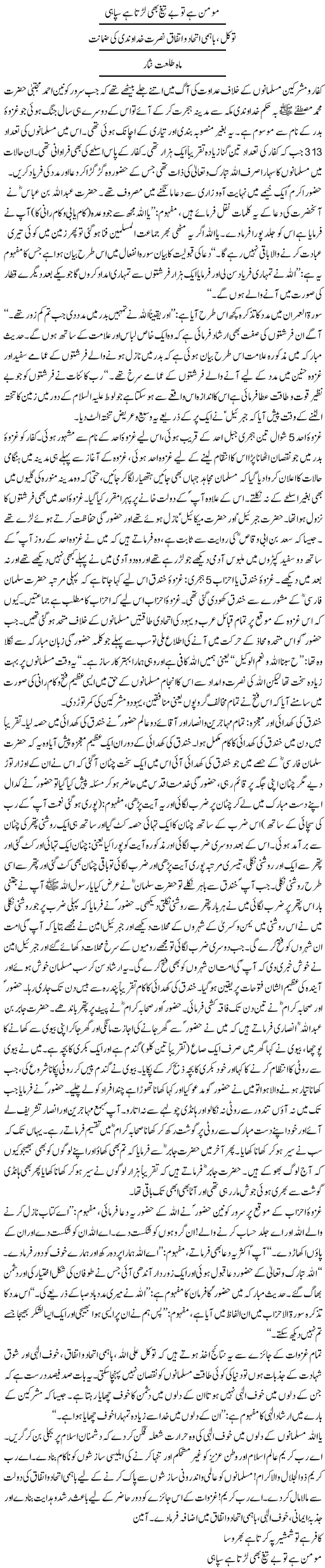
Momin Hai To Be Taigh Bhi Larta Hai Sipahi
He Who Kneels Before Allah Can Stand Before Anyone
Bismillaahi wa’Alaa barakatillahi (“[I am eating] In the name of Allah (swt) and with the blessings of Allah (swt)”). These words are spoken before taking a meal to express our gratitude for the food on our table.
Food is life, a gift from Allah (swt) given to humans for sustenance. The Qur’an states “O believers, eat the clean things we have provided you, be grateful to Allah if you sincerely want to obey Him” (7:158).
The resources that Allah (swt) has provided to us are His gifts, and by respecting them, we are in turn being grateful to Allah (swt). No human can produce his own sustenance; we are, in essence, living off of the fruits of the earth, which are gifts from Allah. The food which we garner from the earth is our only means of sustenance. Without that food, we cannot survive. Hence, we owe our everyday existence to Allah, for Allah is our Provider and our Sustainer, ar-Razzaq being one of His many names.
According to the Qur’an and Sunnah, Muslims must follow certain etiquette, before, during and after eating, not only to be satiated with what is given to us, but also to be grateful and appreciative of the gifts of food and life that Allah (swt) has blessed us with. During a meal, Muslims have to abide by certain protocol to show their gratitude towards Allah (swt) and respect for His gifts. Prophet Mohammad (saw) said “mention the Name of Allah and eat with your right hand, and eat of the dish which is nearer to you (Bukhari VII; 65:288). In the Qur’an, Allah (swt) says, “Eat and drink but do not waste by excess, for Allah does not love the wasters” (VII: 31). Islamic law emphasizes the importance of remembering and thanking Allah (swt) while eating and only consuming enough food to survive. “A Muslim eats in one intestine (i.e. he is satisfied with a little food) while a Kafir (unbeliever) eats in seven intestines (eats much)” (Bukhari VII, 65:308).
Gluttony is considered wasteful. When one has greater access and availability of food and resources, one should take only what is necessary to sustain oneself without over-consumption. If there is an excess of food, then one must distribute it to the needy instead of hoarding or throwing it away.
Many of us are guilty of leaving food on our plates and trashing leftovers from the refrigerator. The amount of food wasted by well-off people could easily feed the famished stomachs of young children all around the world. Homelessness and starvation could lessen if charity were practiced locally. Major epidemics, famine and hunger could also be reduced if the right steps were taken to distribute food evenly round the world instead of having the wealthy few cache a majority of the resources. If charity were practiced more frequently, and an understanding that food and resources of this world are a blessing and gift from Allah (swt) were more widespread, then may be food shortage and hunger wouldn’t be so widespread today.
As the centuries have passed, people who can afford to, eat more, while those who can’t are left famished and dying. It is important to understand that Allah (swt) is the Sustainer of life and provides many of us with resources so we can preserve our lives. How we use the gifts of Allah (swt) is important. If we throw away these gifts instead of carefully cherishing them and sharing them with the needy, then we are disrespecting Allah’s gifts and being ungracious.
Because food is the key to life, Allah (swt) has outlined rules for us to respect food and treat it as a valuable and important part of our lives. Remembering Allah (swt) for His gift is integral to understanding the value of food. When Muslims are done with their meals, they must say, “Al-hamdu lill’hilladhi at-amana’ wasaq’n’ waja-alana minal muslimin.” (“All praise is due to Allah (swt) who gave us food and drink and made us Muslims”) (Tirmidhi). It is our duty to show our gratitude for our food by sharing it with others, thus showing our thankfulness to Allah for our gift of life.
By Mahruq Siddiqui
SIDDIQUI is a UC Irvine Alumna with a B.S. in Information and Computer Science.
Museebat Par Sabar Aur Naimat Milne Ka Shukar
مصیبت آنے پر صبر اور نعمت ملنے پر شکر کرنا

Museebat Par Sabar Aur Naimat Milne Ka Shukar
Some Hadith On Supplication
1496. Usamah bin Zaid (May Allah be pleased with them) reported: The Messenger of Allah (PBUH) said, “He who is favored by another and says to his benefactor: `Jazak-Allah khairan (may Allah reward you well)’ indeed praised (the benefactor) satisfactorily.”
[At-Tirmidhi].
Commentary: If one is unable to return someone’s kindness with kindness, he should say, “Jazak-Allahu khairan (may Allah reward you well).” This means: “I am unable to reciprocate your kindness. May Allah grant you the best reward for it.” Obviously there is no match for the reward that one gets from Allah. For this reason the Prophet (PBUH) said that it was the best of the praise for a benefactor.
1497. Jabir (May Allah be pleased with him) reported: The Messenger of Allah (PBUH) said, “Do not invoke curses on yourself or on your children or on your possessions lest you should happen to do it at a moment when the supplications are accepted, and your prayer might be granted.”
[Muslim].
Commentary: Almighty Allah always listens to everyone’s prayer but He has fixed certain times when He grants more prayers addressed to Him. Therefore, one should never curse oneself or one’s own children or one’s own business, etc., lest this is done at the time when prayers are accepted by Allah and then one has to regret it all his life.
1498. Abu Hurairah (May Allah be pleased with him) reported: The Messenger of Allah (PBUH) said, “A slave becomes nearest to his Rubb when he is in prostration. So increase supplications in prostrations.”
[Muslim].
Commentary: This Hadith points out the excellence of supplicating while prostrating in Salat, as one gets closer to Allah in this position.
1499. Abu Hurairah (May Allah be pleased with him) reported: The Messenger of Allah (PBUH), “The supplication of every one of you will be granted if he does not get impatient and say (for example): `I supplicated my Rubb but my prayer has not been granted’.”
[Al-Bukhari and Muslim].
The narration of Muslim is: “The supplication of a slave continues to be granted as long as he does not supplicate for a sinful thing or for something that would cut off the ties of kinship and he does not grow impatient.” It was said: “O Messenger of Allah! What does growing impatient mean?” He (PBUH) said, “It is one’s saying: `I supplicated again and again but I do not think that my prayer will be answered.’ Then he becomes frustrated (in such circumstances) and gives up supplication altogether.”
Commentary: We learn from this Hadith that one should continue beseeching Allah without ever thinking that in spite of praying for a long time, his prayer has not been granted. One should never allow frustration to overcome in his mind. If a person’s supplication is not granted for a long time, there would be certainly some good for him in that delay the reason of which is known to Allah Alone. It is, therefore, essential that he should never cease to pray whether his prayer is granted or not. Persistence in prayer is certainly beneficial to him.
1500. Abu Umamah (May Allah be pleased with him) reported: The Messenger of Allah (PBUH) was asked: “At what time does the supplication find the greatest response?” He (PBUH) replied, “A supplication made during the middle of the last part of the night and after the conclusion of the obligatory prayers.”
[At-Tirmidhi].
Commentary: “Al-‘Akhir” is the characteristic of “Jauf” and in the present context it means the late hours of night. “Jauf” can also mean here “middle”, that is in the later-half of the night.
In other words, if the night is divided between two equal parts then it (Jauf) would be the middle of the second part. In either case it is the time of the night which in other Ahadith has been termed as the third part of the night. It is the time when Almighty Allah comes to descend on the sky of this world.
Prayers are also granted by Allah after the obligatory Salat.
1501. `Ubadah bin As-Samit (May Allah be pleased with him) said: The Messenger of Allah (PBUH) said, “Whenever a Muslim supplicates Allah, He accepts his supplication or averts any similar kind of trouble from him until he prays for something sinful or something that may break the ties of kinship.” Upon this someone of the Companions said: “Then we shall supplicate plenty.” The Messenger of Allah (PBUH) said, “Allah is more plentiful (in responding).”
[At-Tirmidhi].
Commentary: We learn from this Hadith that prayer (supplication) is beneficial to us in any case, because Almighty Allah either grants the prayer we make, or if the supplication is not being accepted, He removes some future trouble that was destined for us, or He grants us in full in the Hereafter.
A Muslim should never feel shy of praying to Allah. In fact, he should persistently pray because there is no end to His Treasures.
1502. Ibn `Abbas (May Allah be pleased with them) said: The Messenger of Allah (PBUH) used to say when he was in distress: “La ilaha illallahul-Azimul-Halim. La ilaha illallahu Rabbul-`Arshil-`Azim. La ilaha illallahu Rabbus-samawati, wa Rabbul-ardi, wa Rabbul-`Arshil-Karim. (None has the right to be worshiped but Allah the Incomparably Great, the Compassionate. None has the right to be worshiped but Allah the Rubb of the Mighty Throne. None has the right to be worshipped but Allah the Rubb of the heavens, the Rubb of the earth, and the Rubb of the Honourable Throne).”
[Al-Bukhari and Muslim].
Commentary: The only medicine in a time of distress is the remembrance of Allah Whose Help alone should be sought. This Du`a contains words which glorify Allah and exalt Him far above all else. It is desirable to recite these words when one is in distress as this is exactly what the Prophet (PBUH) used to recite in such situations.
The Prophet Of Mercy Muhammad (saw)
Quba, the first mosque of Islam, was originally built by the Holy Prophet Muhammad (saw) and his fellow emigrants from Makkah on their arrival in Madinah in 622. That year marks the beginning of both the Muslim era and the Muslim calendar.
For thirteen years in his birthplace of Makkah, the Holy Prophet Muhammad (saw) called people to the worship of the One True God, to do good and renounce all that was false. But the powers with interests to protect remained implacably hostile and made life intolerable for those who had submitted to the truth.
In constant search for fertile soil to plant the message of truth, the noble Prophet Muhammad (saw) eventually migrated – not fled – northwards to Yathrib. The green oasis became known as the Madinah or the City of the Prophet and was to become the territorial base from which he won the hearts of multitudes and consolidated Islam’s place in the landscape of the peninsula.
The leaders of Makkah and a large part of its citizenry remained stubbornly hostile and sought – through wars, siege and alliances – to destabilise the fledgling community. The Holy Prophet (saw), who desired security and peace for people, negotiated a truce with the pagan Makkans on terms that many of his followers were deeply unhappy about. This was in the fifth year after the hijrah or migration to Madinah.
The truce turned out to be beneficial to the whole peninsula but the Makkans eventually broke it by mounting a bloody aggression against an ally of the state of Medinah. The Holy Prophet (saw) could not overlook this breach and in the eighth year after the hijrah, he mobilised an impressive force and moved on Makkah. Ten thousand converged on the city, reaching there in the month of Ramadan, the month of fasting. The Quraysh realized that there was no hope of resisting, let alone of defeating, the Muslim forces. What was to be their fate – they who had harried and persecuted the believers, tortured and boycotted them, driven them out of their hearths and homes, stirred up others against them, made war on them, and killed many?
They were now completely at the mercy of the Holy Prophet Muhammad (saw).
Revenge was easy. He could have laid waste the city and wiped out its inhabitants. But revenge was not his object. He did not lead his confident army into Makkah like any tyrant, full of arrogance, forgetting the Almighty, the Cause of all causes, and intoxicated with self-conceit.
Far from it. In the words of an early biographer, he entered with great humility and gratitude, prostrating himself repeatedly on the back of the camel he was riding, before the One God, thankful to Him for all He had provided, declaring an all-embracing amnesty and peace, in place of any thought of avenging past material or mental afflictions, and in fact demonstrating what God wills of Godly men:
“… enter the gate prostrating and say ‘Amnesty’.” (Holy Qur’an, Ch. 2: Vs. 58; Ch. 7: Vs.160)
He ordered Bilal, the Ethiopian, to go on the rooftop of the Ka’bah to call the adhan. The noble Prophet Muhammad (saw) led the congregational prayer and then addressed the assembled citizens in the compound around the Ka’bah. He reminded them of what they had done to him and the Muslims, and said, “The arrogance and racial pride of the heathen days has been wiped out by God today. All human beings are descended from Adam, and Adam was made of clay.”
He recited the following verse of the Quran:
“O human beings! We have indeed created you of a male and a female and made you into nations and tribes so that you may know one another. Surely the most honorable of you with God is the one among you who is most deeply conscious of Him. Surely, God is Knowing, Aware.” (Holy Qur’an, Ch. 49: Vs. 13)
If the Holy Prophet (saw) abused anybody, he used to give him compensation and show him kindness. He never cursed any woman or slave. Once when he was in the battle field, he was asked: Oh Messenger of Allah, it would have been better if you had cursed them.
He (saw) said: Allah sent me as a Mercy and not as a great curser. When he was asked once to curse a particular person or an unbeliever, he did not curse him but on the contrary prayed for his welfare. He never beat anybody with his own hand except in the way of Allah. He did not take any revenge for personal wrongs but he used to take it for preservation of the honor of Allah.
He used to select the easier of two things and keep away if there was any sin therein or anything to cut off relationship. He used to fulfill the needs of anyone who required his help, whether a slave or a free man. Hazrat Anas (ra) said: By One who has sent him as a Prophet, he never said to me: “Why have you done this or why have you not done this?” His wives also did not rebuke me. If there was any bed of the Holy Prophet (saw), he used to sleep on it or else he used to sleep on the ground.
Another trait of his character is that he used to salute first one whom he met with. He used to wait at a place where he was to meet a man. He used not to withdraw his hand from anybody ’till he first withdrew his hand. When he met with any of his companions, he used to handshake with them, hold his hand, enter his fingers into his fingers and hold them firmly. He did not stand up or sit without remembering Allah. When anybody sat by him at the time of his prayer, he used to make it short and say to him: Have you got any need? When he fulfilled his need, he returned to his prayer.
His assembly was not different from that of his companions, as he sat where he went. He was not found sitting among his companions spreading out his legs. He used to sit mostly facing the Ka’ba and honor one who came to him. Even he used to spread his own sheet of cloth for one whom he had no relationship.
He used to give his pillow to one who came to him and everyone thought that the Nabi honored him more. Whoever came to him could see his face.
He used to call his companions by their Kunyas with honor and he used to give one kunya to one who had no kunya. He used to call the women by the names of their issues and call others by their surnames. He used to call the boys by their kunyas for which their hearts were inclined to him. He used to get angry last of all and was very affectionate and kind in dealing with the people. Nobody could speak loudly in his assembly. He used to recite: “O Allah, Thou are Pure, all praise is for Thee. I bear witness that there is no deity but Thee. I seek forgiveness from Thee and turn to Thee.”
Narrated ‘Aisha: The commencement of the Divine Inspiration to Allah’s Apostle was in the form of good righteous (true) dreams in his sleep. He never had a dream but that it came true like bright daylight. He used to go in seclusion to (the cave of) Hira where he used to worship (Allah Alone) continuously for many (days) nights. He used to take with him the journey food for that (stay) and then come back to (his wife) Khadija to take his food like-wise again for another period to stay, till suddenly the Truth descended upon him while he was in the cave of Hira. The angel came to him in it and asked him to read. The Prophet (saw) replied, “I do not know how to read.” (The Prophet added), “The angel caught me (forcefully) and pressed me so hard that I could not bear it anymore. He then released me and again asked me to read, and I replied, “I do not know how to read,” whereupon he caught me again and pressed me a second time till I could not bear it anymore. He then released me and asked me again to read, but again I replied, “I do not know how to read (or, what shall I read?).” Thereupon he caught me for the third time and pressed me and then released me and said, “Read: In the Name of your Lord, Who has created (all that exists). Has created man from a clot. Read and Your Lord is Most Generous…up to….. ..that which he knew not.” (Qur’an 96.15)
Then Allah’s Apostle returned with the Inspiration, his neck muscles twitching with terror till he entered upon Khadija and said, “Cover me! Cover me!” They covered him till his fear was over and then he said, “O Khadija, what is wrong with me?” Then he told her everything that had happened and said, ‘I fear that something may happen to me.” Khadija said, ‘Never! But have the glad tidings, for by Allah, Allah will never disgrace you as you keep good reactions with your Kith and kin, speak the truth, help the poor and the destitute, serve your guest generously and assist the deserving, calamity-afflicted ones.” Khadija then accompanied him to (her cousin) Waraqa bin Naufal bin Asad bin ‘Abdul ‘Uzza bin Qusai. Waraqa was the son of her paternal uncle, i.e., her father’s brother, who during the Pre-Islamic Period became a Christian and used to write the Arabic writing and used to write of the Gospels in Arabic as much as Allah wished him to write. He was an old man and had lost his eyesight. Khadija said to him, “O my cousin! Listen to the story of your nephew.” Waraqa asked, “O my nephew! What have you seen?” The Prophet (saw) described whatever he had seen.
Waraqa said, “This is the same Namus (i.e., Gabriel, the Angel who keeps the secrets) whom Allah had sent to Moses. I wish I were young and could live up to the time when your people would turn you out.” Allah’s Apostle asked, “Will they turn me out?” Waraqa replied in the affirmative and said: “Never did a man come with something similar to what you have brought but was treated with hostility. If I should remain alive till the day when you will be turned out then I would support you strongly.” But after a few days Waraqa died.
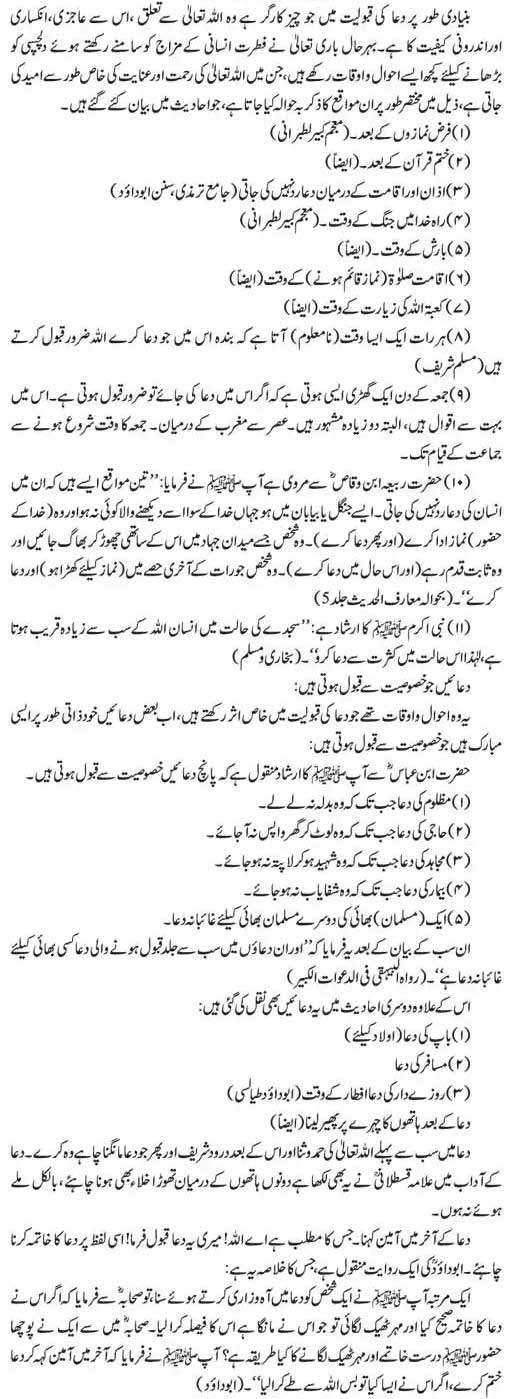
Dua Ki Qabooliyat K Auaqt
Hidden Sadaqah Extinguishes Allah’s Wrath
Sadaqah (optional charity) refers to helping others in any way, by giving them in charity, by spending some time with them, listening to them attentively, directing them to the right path, feeling for them, smiling to them, removing whatever may harm them in streets, etc. All these are instances of sadaqah in its comprehensive sense.
Hidden sadaqah is what one gives in secret with no one but Almighty Allah knowing about it. When one gives charity to a needy person in secret, one spares the needy person the feelings of inferiority he may experience if given charity in front of other people.
Hidden sadaqah will help the needy meet their needs and will also help them get rid of the negative feelings of envy and grudge they might have harbored towards the rich people.
Feelings of love and respect would grow then between the needy and rich people, and this, in turn, would positively reflect on the unity of society and bind its members with the bonds of love and cooperation.
When the poor’s needs are met in an atmosphere that preserves them their dignity, the tension they would live in because of need will decrease and their energy for work will increase. This will reflect positively on their social relations with others.
There are many poor people who are in dire need, yet they restrain from asking for charity. Hidden sadaqah will help them a lot and spare them exposure to humiliation.
Allah Almighty says about that kind of people: [(Alms are) for the poor who are straitened for the cause of Allah, who cannot travel in the land (for trade). The unthinking man accounteth them wealthy because of their restraint. Thou shalt know them by their mark: They do not beg of men with importunity.] (Al-Baqarah: 273)
As for he who gives hidden sadaqah, the process of giving itself provides him with great happiness and purifies his soul. It helps him get rid of selfishness and develop feelings of cooperation with others. It is also a means of protecting his wealth, [for when he gives others, he wins their love, and thus spares himself the influence of their envy.] In essence, giving sadaqah reflects on the giver and benefits him [as much as it benefits the recipients].
Allah Almighty says: [….. And whatever you spend in good, it is for yourselves, when you spend not except seeking Allah’s Face. And whatever you spend in good, it will be repaid to you in full, and you shall not be wronged.)…] (Al-Baqarah: 272)
Furthermore, hidden sadaqah helps its givers get rid of feelings of depression that they may experience. When one gives the poor, one feels deep happiness, especially when one hears them praying for one and expressing gratitude for one.
Contemplate the image Allah Almighty gives in the following verse that describes the example of the one who gives generously in charity: [And the example of those who spend their wealth seeking means to the approval of Allah and assuring [reward for] themselves is like a garden on high ground which is hit by a downpour – so it yields its fruits in double. And [even] if it is not hit by a downpour, then a drizzle [is sufficient]. And Allah, of what you do, is Seeing..] (Al-Baqarah: 265)
Based on the above lines, the psychological analysis of the influence of hidden sadaqah on both the giver and the recipient shows that it extinguishes the humiliation of the recipient and the embarrassment of the giver. It creates between them such an atmosphere of peaceful coexistence that Almighty Allah is pleased with. Moreover, it extinguishes the wrath that Allah Most High may have towards the giver, for there is a divine hadith to the effect that ?the hidden sadaqah extinguishes Allah’s wrath.