
Archives
You Don’t Get Any U-turns On The Way Up To Allah
When we pack our bags to go visit our friends, we remember to pack our clothes, shoes, and other little things.
Since we could know right from wrong, we have started packing our bags and will finish when our souls leave us.
Have you packed your prayer in your bag of provisions everyday? Have you packed your fasting? Have you packed your reading and memorizing the Qur’an?
Our bags are called life. We have to pack everyday because we don’t know when Allah will call us back, so we have to be ready for the journey.
And on the way up to Allah, you don’t get any U-turns so that you could go back and get the things you forgot to pack. So start packing if you already haven’t, and don’t forget, there’s no such thing as too many bags when we’re packing for our trip to Allah.
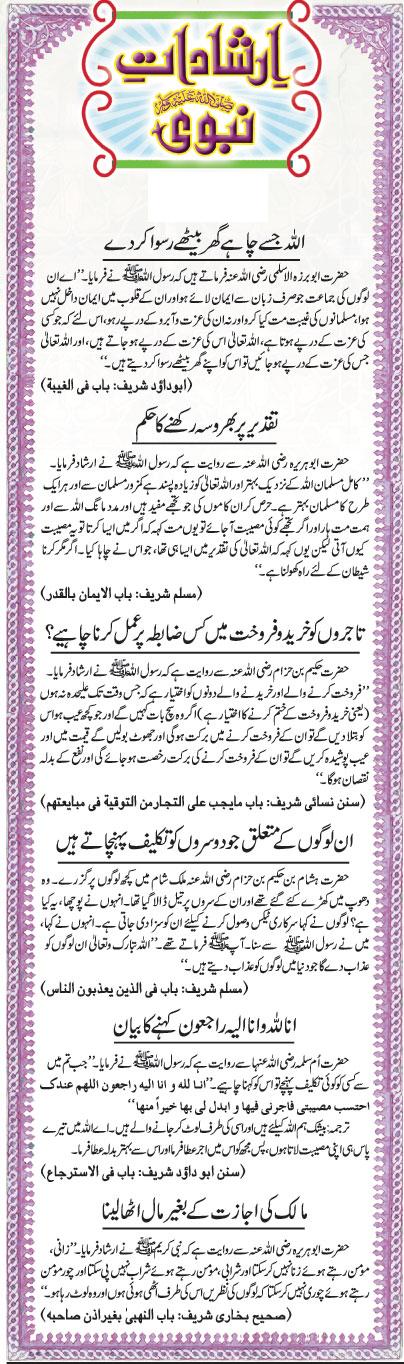
Naik Aamaal Ki Targheeb
Children’s Duties Toward Parents
ISLAM has laid great stress on the rights of parents and the duties of children. To be obedient to parents and to show kindness to them has been enjoined in the Holy Qur’an in such a manner that it appears that among human deeds, to obey parents and treat them with respect and kindness is next only to Divine worship.
The Holy Qur’an says: “And your Lord has decreed that you worship none but Him, and that you be dutiful to your parents.” (17;23)
According to a Hadith (saying of Prophet Muhammad – peace be upon him), the parents of a person constitute his Heaven or Hell. This implies that if a person obeys his parents and attends to their needs and comforts and keeps them happy, he will enter into Paradise. On the other hand, if he is rude and disobedient to them and offends them by ignoring their feelings or by causing them grief in any other way, his place shall be in Hell.
Anyone who seeks to please Allah should earn the good pleasure of his parents. To keep the parents well-pleased is essential since their anger and displeasure will lead to Allah’s anger and displeasure.
The Prophet (peace be upon him) has said: “In the good pleasure of the father lies the good pleasure of the Creator and in his displeasure lies the displeasure of the Creator.”
Here the mother has not been mentioned but, according to many other Ahadith, the rights of the mother with regard to service and kind treatment is even higher than that of the father. Therefore, her pleasure or displeasure will carry an equal significance.
The time that the parents need to be looked after most carefully is in their old age, and to serve them devotedly in that state is most pleasing to Allah and it is an easy way to attain Paradise.
Abu Hurairah relates that the Prophet (peace be upon him) said: “May he be disgraced, may he be disgraced, may he be disgraced.” “Who?” the Companions asked. “The person whose parents, or anyone of them, attain old age during his life-time and he does not enter Paradise (by being kind-hearted and dutiful to them)!”
Therefore, anyone who gets an opportunity to serve his parents in their old age and does not avail himself of this reward (to attain Paradise), undoubtedly, he is a most wretched person.
Abu Hurairah narrates that a person asked the Noble Prophet (peace be upon him): “Who has the greatest claim on me with regard to service and kind treatment?” The Prophet (peace be upon him) replied, “Your mother, and again your mother, and once again your mother. After her, is the claim of your father, then that of your near relations, and then of the relations next to them.”
This shows that where care and kind treatment are concerned, the claim of the mother is greater than that of the father.
It appears to be the same in the Holy Qur’an too. In many instances, the pain and the suffering which the mother has to bear during pregnancy, at childbirth, and in the bringing up of the children, has been mentioned along with the importance of showing kindness to parents.
In one Hadith the Prophet (peace be upon him) has clearly stated that a person’s Paradise lies at his mother’s feet. By serving her well and being obedient to her, one can attain Paradise.
In some other Ahadeeth, the Prophet (peace be upon him) explained that serving the mother, maternal aunt and maternal grandmother are among the acts by virtue of whose merit even the repentance of a great sinner and evil-doer is accepted and he is forgiven.
If one’s parents are polytheists and they want one to follow their faith, one should refuse to do so but should continue to be kind and respectful to them.
The Prophet (peace be upon him) is reported to have said: “Obey your parents and treat them with kindness, your children will be kind and obedient to you.”
Asma Bint Abu Bakr relates that her mother had come to Madinah, from Makkah, to meet her. Her mother followed the Pagan customs and beliefs, so Asma enquired of the Prophet (peace be upon him) as to how she was to treat her – whether she should have nothing to do with her, as she was a Pagan, or treat her like a daughter should, and show kindness to her. Prophet Muhammad (peace be upon him) told her to be kind and considerate and to deal with her as was a mother’s due from a daughter.
The rights of parents do not come to an end with their death. In fact, some of their rights take effect even after their death, and it is a religious obligation of the children to fulfill them.
Obeying one’s parents and treating them with respect and affection is great virtue and it expiates one’s sins. Similarly, to pray Allah to have mercy on them after their death is an act which brings comfort to them in their graves and serves to atone for one’s sins.
After the death of one’s parents one’s duties among others should be to pray for their forgiveness and treat their relatives and friends with due respect.
In the Holy Qur’an, Muslims have been urged to pray for the salvation of their parents as shown in the verse “And say, ‘My Lord. Have mercy on both of them, as they cared for me when I was little’.”
The real reward for serving the parents, with great care, is Paradise and the pleasure of Allah. But the Almighty bestows a special favor, in this world too, on the believer who discharges obligations towards one’s parents’ with devotion. Jabir reports that the Prophet (peace be upon him) said: “Allah prolongs the life of a person who obeys his parents and serves them devotedly.”
Just as the Prophet (peace be upon him) declared that serving one’s parents well is an act of great virtue, he condemned showing of disobedience to them, or harming them, as a most serious and detestable sin.
When asked about the major sins, the Prophet (peace be upon him) replied, “To associate anyone with Allah, to disobey parents, to kill unlawfully and to give false evidence.”
The Prophet (peace be upon him) has said, “To abuse one’s parents is also a major sin.” He was asked: “Can anyone abuse his parents?” “Yes,” the Prophet (peace be upon him) replied, “If a person abused someone else’s parents and that person, in retaliation, abused his parents, then it is as though he himself had abused his parents.”
One can conclude from this what an important place respect for parents occupies in the moral and social teachings of Islam, and how careful one should be about it.
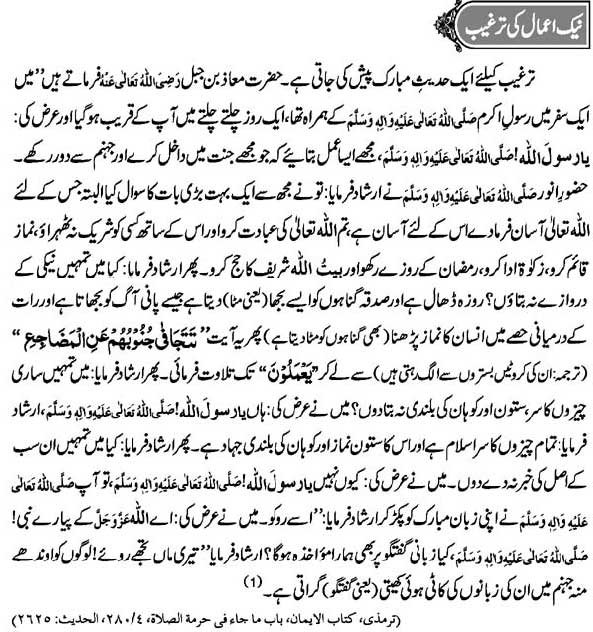
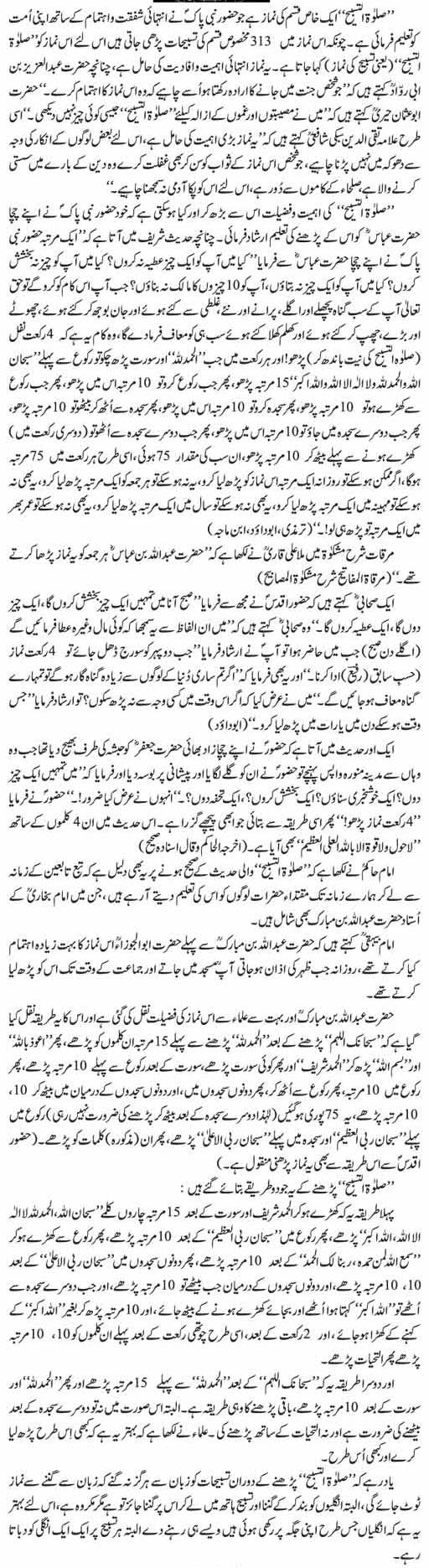
Salatul Tasbeeh Ki Fazeelat
Supplication And Its Manners, Times, Conditions and Mistakes
Proofs Of Supplication From Qur’an
All mighty Allah (SWT) said :
“And when My slaves ask you (O Mohammed) concerning Me then (answer them), I am indeed near (to them by my knowledge) I respond to the invocations of the supplicant when he calls on me (without any mediator or intercessor) So let them obey Me and believe in Me, so that they may be led to the right path.” (Qur’an 2:186)
The Prophet (SAW) was asked by some of his companions: “Is Allah near so we invoke him or is he far so we call him? so Allah revealed this verse, – Allah (SWT) is near He can hear the supplicant anytime anywhere and respond to him if the supplicant invokes Allah (SWT) with a sincere heart and avoid interdictions of supplication.
Allah (SWT) also said:
“Invoke your Rabb (Cherisher and Sustainer) with humility and in secret, He likes not the aggressors.” (Qur’an 7:55)
Supplication is of two kinds. One is worship and the other is a request. So He commands to be invoked with humility which is insisting in request and continuously in worship and “secretly” not loud to avoid “Ryea” (showing off)
Allah (SWT) also said:
“And your Rabb (Cherisher and Sustainer) said: “Invoke Me (i.e. believe in My Oneness) (and ask Me for anything) I will respond to your (invocation) Verily! Those who scorn My worship ( i.e. do not invoke Me, and do not believe in My Oneness ) they will surely enter hell in humiliation!” (Qur’an 40:60)
Allah (SWT) said:
“Invoke Me, I will respond to you” , so from His mercy for His slaves He has promised to respond to their invocations but for those who do not invoke Him, He has promised punishment because invocation of Allah (SWT) is an act of worship and refusing to invoke Him ( disbelieving in Him or having doubt in His ability to answer the invocation) is refusal to worship Him.
Proofs Of Supplication From Sunnah
Narrated An-Numan bin Bashir (Ra) (Radhiallahu anhu, meaning: may Allah be pleased with him): The Prophet (SAW) said: “Verily, Supplication is worship.” (AI-Arbaa (The four) and AI-Tirmdhi, graded it Sahih (sound))
Narrated Anas (Ra): The Prophet (SAW) said: “Supplication is the Pith (essence) of worship.” (At-Tirmidhi with a full chain of narrators)
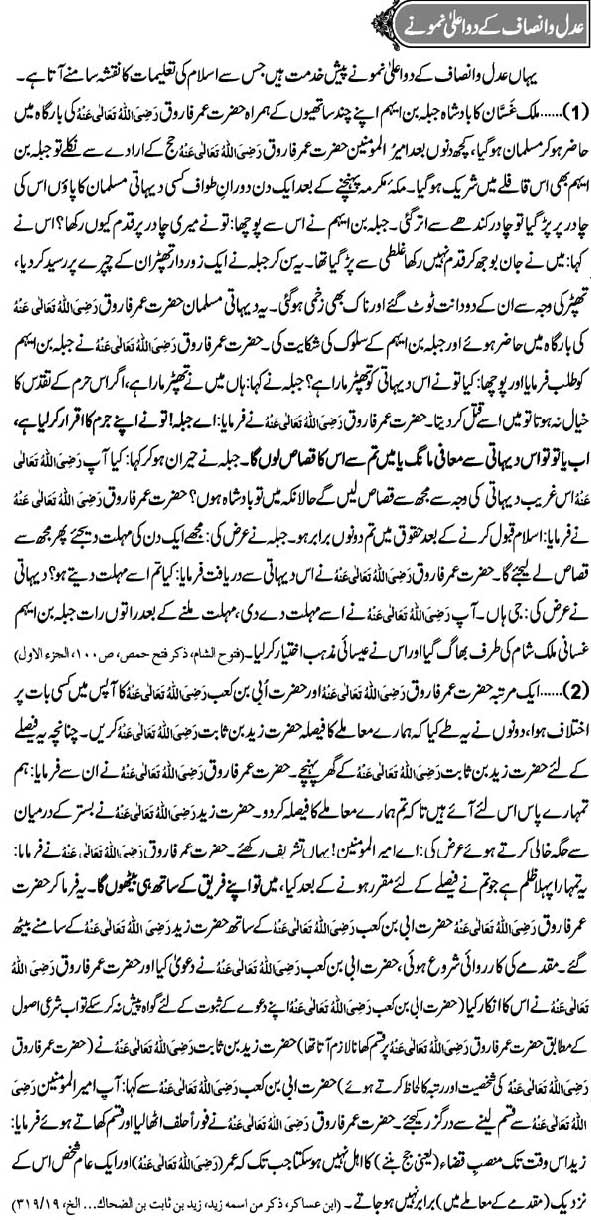
Adal O Insaaf Kay Doo Aala Namoonay
Golden Naseehah To The Seekers of Knowledge
Be aware of the Obstacles
My dear beloved brothers and sisters, knowledge is very noble and the People of Knowledge and their students are the best of people in the Muslim community. We should know as well, that whenever one of you wants to climb high in seeking knowledge, the things that may take you away from knowledge will also become greater. This is because nothing becomes precious and expensive except that the things which will take you away from attaining it – the obstacles and the hardships, they become greater in numbers as well; so you have to pay attention to this.
Follow the Path of the Rightly Guided Predecessors
When seeking knowledge you must be upon the path of the rightly guided predecessors; the Companions of the Prophet Muhammad and whoever followed their path. You should know that the first thing that will face you, the first problem and difficulty that will face you along this long path of seeking knowledge is that you have to face the people of desires and opinions and fitan (trials), so therefore be extremely aware of them and their evil.
Avoid Hasad (Envy)
The Muslim in general and the one who is seeking knowledge should be aware of hasad (envy) i.e. having envy of his brothers and sisters. For example; if you see one of your brothers or sisters to whom Allah has given a great memory so he memorizes a lot, or understands the issues easily, you should praise Allah and ask Him for His bounty, and for Him to make you like that individual. Do not envy them and do not be jealous because of that which Allah has given them.
Do not be Arrogant
Also from the things that one should be aware of while on the path of seeking knowledge is to avoid being arrogant to your brothers and sisters because of that which Allah has given you. Do not be from those people who think that they are better than others, and do not be proud and look up at yourself. Rather, be modest regarding that which Allah has given you, and be modest around your brothers and sisters.
Do not be Hasty
Likewise do not be hasty, do not be from those people who are hasty. Rather, seek knowledge little by little, step by step, as one of the statements says: “Whoever was hasty and wants to learn everything at one time will be punished by not learning anything at all.” Rather, the Student of Knowledge has to choose from the easiest of the mutoon (texts) – whether in Fiqh or the like of this. Start with those which are easy, then go to those at the second level and choose from the text in Hadeeth, Fiqh, ‘Aqeedah and all the other fields of the Legislation; and don’t be hasty. Rather, what you have to be mindful of is that you understand what you read and what you are studying. Your main concern should not be that you finish the book in the shortest time.
by Shaykh Fahad Al Fuhayd
Surah Al-Maidah Kay Fazail

Glossary Of Islamic Terms
There are a number of different collections of Islamic terms and common expressions. Here is a collection that I have found to be most useful to explain common expressions and terminology used by Muslims.
ALAYHIS SALAM-
‘Peace be upon him’, a formula used after the name of a prophet
ALLAHU AKBAR-
The Arabic expression meaning ‘Allah is greater.’ Also called the takbir
ALLAHU ALAM-
An Arabic expression meaning ‘Allah knows best’
AMMA BAAD-
An expression used for separating an introductory from the main topics in a speech; the introductory being usually concerned with Allah’s praises and glorification. Literally it means ‘whatever comes after’
ASTAGFURALLAH-
The Arabic expression meaning ‘I ask forgiveness of Allah’
AUDHU BILLAHI MIN ASH SHAYTAN AR RAJIM-
The Arabic expression meaning ‘I seek protection in Allah from the accursed satan.’
AZZA WA JAL-
A formula used after the mentioning the name of Allah meaning ‘Mighty and Majestic is He’
BARAKALLAH FIK-
An expression which means ‘May the blessings of Allah be upon you.’ When a Muslims wants to thank another person, he uses different statements to express his thanks, appreciation and gratitude. One of them is BarakAllah
BISMILLAH AR RAHMAN AR RAHIM-
‘In the name of Allah, the all Merciful the all Compassionate.’
FI AMANALLAH-
Valedictory phrase meaning ‘In Allah’s protection’
FI SABILILLAH-
The Arabic expression meaning ‘In the way of Allah’, ‘For the cause of Allah’ [also used to mean ‘for the love of Allah’]
AL HAMDU LILAH WA SHUKRU LILLAH-
The Arabic expression meaning which means ‘Praise belongs to Allah and all thanks to Allah’
HASBALA-
The Arabic expression, ‘Hasbunallah wa nimalwakil’ meaning ‘Allah is enough for us and an excellent guardian’
HAWQALA-
The Arabic expression, ‘la hawla wa la quwwata illa billah’ which means ‘There is no power nor strength save (expect) by Allah’
INNA LILLAHI WA INNA ILAYHI RAJIUN-
This is something which a Muslim expresses when he is afflicted by a misfortune, the meaning of which is ‘We are from Allah and to Him are we returning.’ It is taken from an ayat (verse) from the Quran (ch 2 vs 156).
[this is usually said upon hearing of the death of an individual]
INSHALLAH-
The Arabic expression meaning ‘If Allah wills’
[this is usually said when referring to a situation in the future e.g. inshAllah I will go to the grocery shop tomorrow etc]
ISTIGHFAR-
To ask the forgiveness of Allah, especially by saying, Astagfuralah, ‘I seek the forgiveness of Allah’
ISTITHNA-
Exception, saying ‘InshAllah’, ‘If Allah wills’
JALLA JALALUH-
The formula said after the name of Allah meaning ‘Great is His Majesty’
JAZAKALLAHU KHAIRAN-
This is a statement of thanks and appreciation to be said to a person who does a favor. Instead of saying ‘shukran’ (thanks), this phrase is used. It means ‘May Allah reward you with good.
KARAM ALLAHU WAJHAHU-
‘May Allah honor him’, a formula used when Ali ibn Abi Talib (RadiAllahu Ta’ala anhu) is mentioned
LABBAYK-
‘At your service’, the talbiya or call of the pilgrim to his Lord in the hajj.
[the full talbiya is ‘LabbaykAllah huma Labbayk, LabbaykAllah sharee kalala Labbayk, innal hamda, wa naimata lakawulmulk la shareekala’ which means “Here I am O Lord, here I am, Oh Allah, here I am. Here I am. You have no partner. Here I am. Surely all praise, grace and dominion is yours, and you have no partner.”]
LA HAWLA WALA QUWWATA ILLA BILLAH-
The meaning of this expression is ‘There is no power nor strength save in Allah’. This is said by a Muslim when he is struck with calamity, or is taken over by a situation beyond his control.
LI WAJHILLAH-
Literally, ‘For the face of Allah’, meaning in order to obtain the pleasure of Allah, purely for Allah himself.
MA SALAMA-
‘With peace’, a formula for ending letters
MASHALLAH-
A phrase literally meaning ‘What Allah wishes’, and it indicates a good omen
[example of usage, I get an A in a test, my mother would say MashAllah]
MALWANA
‘Our master’, a term of respect
[usually used in the context of referring to the Prophet SAW, also however used in the context of referring to a learned individual e.g. scholar or imam, a concept I am not too keen on supporting and Allah knows best]
RABBANA WA LAKAL_HAMD-
‘Our Lord, Praise if yours’, said after rising from ruku after saying ‘sami Allahuliman hamidah’
[which means ‘Allah listens to the one who praises him’]
RADIYALLAHU ANHA-
The formula ‘May Allah be pleased with her’ used after a female companion
[usually abbreviated as RA or RAA]
RADIYALLAHU ANHU-
This is an expression to be used by Muslims whenever a name of a companion of the Prophet Muhammad is mentioned or used in writing. IT means ‘May Allah be pleased with him’
[usually abbreviated as RA or RAA]
RADIYALLAHU ANHUM-
The formula, ‘May Allah be pleased with them’, used after a group of companions
[usually abbreviated as RA or RAA]
RAHIMAHULLAH-
The formula, ‘May Allah have mercy on him’
ASSALAMU ALAYKUM
‘Peace be upon you’ the greeting of the Muslim
[the reply is ‘wa alaikumus salam’ which means ‘and peace be upon you. The fuller version reads, ‘assalam u alaikum wa rahmatulahi wa baakatuhu’ which means ‘peace be upon you and the blessings and mercy of Alllah’ the reply is ‘wa alaikumus salam wa rahmatulahi wa baakatuhu’]
SALLAHU ALAYHI WA SALLAM-
‘May Allah bless him and grant him peace’, the formula spoken after the mentioning of the Prophet Muhammad
[usually the following two sets of abbreviations are used for this phrase (pbuh) which means ‘peace be upon him’ and is the technical reply for all Prophets or (saws) the correct suffix when referring to the Prophet Muhammad ]
SAMI ALLAHU LIMAN HAMIDAH-
‘Allah heard him who send praise to Him’, said by someone praying when he rises from ruku (unless he is following an imam in prayer)
[if he is following an imam in prayer he says ‘Rabana wala kalhamd’ only]
SAYYIDUNA-
‘Our Master’, a term of respect
[usually used to refer to the Prophet Muhammad SAW , however many people use it to refer to learned man / scholar]
SUBHANALLAH-
‘Glorified is Allah.’ To honor Allah and make Him free from all (unsuitable evil things) that are ascribed to Him, (or ‘Glorified be Allah’)
SUBHANAHU WA TA’ALA-
‘Glorified is He and exalted,’ an expression that Muslims use when the name of Allah is pronounced or written
[this us usually abbreviated as (swt)]
TA’ALA-
‘Exalted is He’, an expression used after the name of Allah is mentioned
[i.e. Allah Ta’ala meaning, Allah, exalted be He]
TAAWWUDH-
Saying, ‘I seek refuge in Allah…’ (audhu billahi minash shaitan nirajeem)
TABARAKALLAH-
The formula ‘Blessed is Allah’
TAHMID-
Saying the expression ‘alhamdulillah’, which means ‘Praise belongs to Allah’
TAKBIR-
Saying ‘Allahu akbar’, which means ‘Allah is Great’
TALBIYA-
Saying ‘Labbayk’, which means ‘At your service’ during the hajj
TAMJID-
Glorifying Allah
TARDIYA-
Saying one of the expressions which begin with ‘radiyallahu….’
TASBIH-
Glorification, saying ‘SubhanAllah’, which means ‘Glory be to Allah’
TASHMIT –
Uttering a prayer for the sneezer which thes the form, ‘yarhamuk Allah’ which means ‘may Allah have mercy on you’
[when a person sneezes he says, Ahamdulillah (Praise be to Allah), a person who hears the sneeze says ‘yarhamuk Allah’ and the sneezer replies ‘Yahdikumul-lah wa Yuslih balakum’ which means ‘May Allah give you guidance and improve your condition.’]
WAJHULLAH –
‘The face of Allah’, meaning for the sake of Allah, irrespective of any reward in this life, purely for Allah’
also however used in the context of referring to a learned individual e.g. scholar or imam
By Aisha Bewley