
Archives
Avoiding Nightmares And Sleep Disturbances
Most nightmares have their basis in our waking lives. They can stem from something we have seen or from what had been preoccupying our minds during the day. They can be the consequence of stressful or frightening experiences.
Nightmares are most common among small children. Their frequency generally decreases with age up to the time of puberty.
Someone who has a nightmare should not become worried. A major cause of nightmares is eating late at night right before going to sleep.
Apart from that, it is recommended for a Muslim to sleep in a state of ritual purity. This mean it is best to perform wudu (ablution) before going to bed.
It is also recommended to lie on the right side when going to sleep. The Prophet (peace be upon him) used to sleep on his right side and instructed his followers to do so.
He said (Sahih al-Bukhari (247) and Sahih Muslim (2710)):
If you come to your sleeping place, perform your ablutions as you would for prayer, then lay down on your right side, then say:
“O Allah, I have submitted myself to You and have entrusted to You my affairs, and I have taken refuge in You, in both hope and fear of You. There is no refuge or sanctuary from You except with You. O Allah! I believe in Your Book that You have revealed and Your Prophet whom You have sent.”
If you die in on this night of yours, then you will be on the natural faith. Make these words the last thing that you utter.
Not Everyone Suits To Be Your Friend
Friends have a large influence on our lives. Islam has emphasized on choosing companions who are upright and noble. The Prophet (peace be upon him said), “Man is on his friend’s religion. Therefore, man should see with whom he is making friends.” (Abu Dawood, no.4815).
Friendship that leads one to Allah’s disobedience is not worth it. Ibn Qudamah Al-Maqdisi mentions in his book Mukhtasar Minhaj Al-Qasidin (pg. 126-132) some valuable points on this topic:
Know that not everyone is suitable to be your friend. You must verify that this potential friend has the necessary characteristics that make friendship with him something to be desired. The one you seek to befriend must have five characteristics:
• He must be intelligent, as there is no good in befriending an idiot, as he will only harm you when he wants to benefit you. By intelligent, we mean one who understands things as they are, either on his own, or if they are explained to him;
• He must have good manners, and this is a must. One who is simply intelligent might be overcome by anger or desire, and obey his desire. Thus, there would be no benefit in befriending him;
• He must not be a fasiq, as such a person would not fear Allah, and whoever does not fear Allah cannot be trusted;
• He must not be an innovator, as his over-indulgence innovation is feared from befriending him;
• He should not be eager in seeking the dunya.”
The Islamic Concept Of Life
In Islam, man’s entire individual and social life is an exercise in developing and strengthening his relationship with Allah. The starting point of our religion consists of the acceptance of this relationship by man ‘s intellect and will. Islam means submission to the will of Allah in all aspects of life. The Islamic code of conduct is known as the Shariah. Its sources are the Qur’an and the Sunnah of the Prophet (pbuh).
The final Book of Allah and His final Messenger stand today as the repositories of this truth. Everyone who agrees that the concept of Reality expounded by the Prophet, and the Holy Book is true, should step forward and surrender himself to the Will of Allah. It is this submission which is called Islam, the result of Iman in actual life. And those who of their own freewill accept Allah as their Sovereign, surrender to His Divine will and undertake to regulate their lives in accordance with His commandments, are called Muslims.
All those persons who thus surrender themselves are welded into a community and that is how the ‘Muslim Society’ comes into being. It is an ideological society, radically different from those which are founded on the basis of race, color or territory. It is the result of a deliberate choice, the outcome of a ‘contract ‘ which takes place between human beings and their Creator. Those who enter into this contract undertake to recognize Allah as their Sovereign, His guidance as supreme and His injunctions as absolute Law. They also undertake to accept, without question, His word as to what is good or evil, right or wrong, permissible or prohibited. In short, freedoms in the Islamic society are limited by the commandments of the Omniscient Allah. In other words, it is Allah and not man whose will is the primary source of Law in a Muslim society. When such a society comes into existence, the Book and the Messenger prescribe for it a code of life called the Shariah and this society is bound to conform to it by virtue of the contract it has entered into. It is, therefore, inconceivable that a real Muslim society can deliberately adopt any other system of life than that based on the Shariah. If it does so, its contract is ipso facto broken and it becomes ‘un-Islamic. ‘
But we must clearly distinguish between the everyday sins of the individual and a deliberate revolt against the Shariah. The former may not mean a breaking of the contract, while the latter most certainly would. The point that should be clearly understood is that if an Islamic society consciously resolves not to accept the Shariah, and decides to enact its own constitution and laws or borrows them from any other source in disregard of the Shariah, such a society breaks its contract with Allah and forfeits its right to be called ‘Islamic. ‘
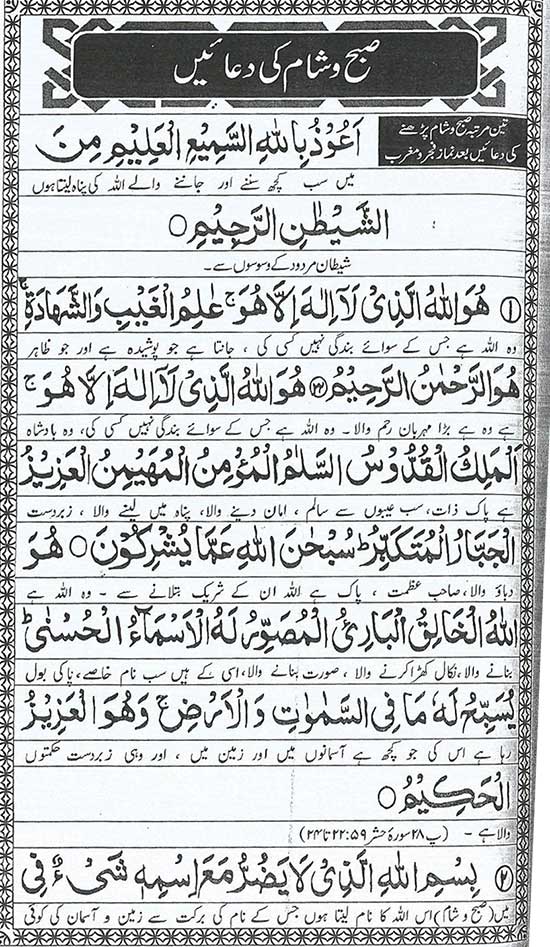
Subha Aur Shaam Ki Duaaien
Refuge In Allah Alone
SEEKING refuge with Allah against things a person fears or is cautious about is one of the aspects of worship.
Allah mentions in the Qur’an:
Say: “I seek refuge with (Allah), the Lord of the daybreak. (Qur’an, 113:1)… until the end of the Surah.
Also, (Allah said about Musa in the Qur’an):
Musa (Moses) said: “Verily, I seek refuge in my Lord and your Lord from every arrogant who believes not in the Day of Reckoning!” (Qur’an, 40:27)
Also, in the Hadith of the Prophet (peace be upon him): “Whoever comes to rest at a place says this supplication – ‘I seek protection in Allah’s complete words from the evil that He has created’ – nothing shall harm him until he moves from that place where he is.”
Allah also informed us that the Mushrikeen (polytheists) who the Prophet (peace be upon him) fought against, used to seek refuge in deities other than Allah. Whoever seeks refuge in the Jinn, the dwellers of the graves, the dead, or an angel so that they may avert some harm from him or bring some benefit, then seeking refuge in the created being in this way is something which is not permissible because Isti’adhah (seeking refuge) is an act of worship and should be directed to Allah alone.
Allah said:
“And verily, there were men among mankind who took shelter with the males among the jinn, but they (jinn) increased them (mankind) in sin and transgression.” (Qur’an, 72:6)
The Springs of Paradise
In Paradise there are many springs that provide drinks of different tastes:
“Truly al-Muttaqoon [the pious and righteous] will be amidst Gardens and Water-springs” [15:45]
“Verily al-Muttaqoon shall be amidst shades and springs.” [77:41]
Concerning the two Gardens which Allah (swt) has prepared for those who fear their Rabb, Allah (swt) said, “In them [both] will be two springs flowing [free].” [55:50]
And concerning the two Gardens beneath them, He said, “In them [both] will be two springs gushing forth water.” [55:66]
In Paradise there are two springs from which al-Muqarraboon will drink pure and undiluted, whilst the Abraar will drink their water mixed with something else. The first is the spring of Kafoor, as Allah (swt) says:
“Verily the Abraar [the pious, those who fear Allah and avoid evil], shall drink a cup [of wine] mixed with water from a spring in Paradise called Kafoor, A spring where from the slaves of Allah will drink, causing it to gush forth abundantly.” [76:5-6]
He tells us that the pious will drink from it mixed with something else, whilst those close to Allah will drink it pure and undiluted.
The second spring is of Tasneem, as Allah (swt) says:
“Verily al-Abraar will be in delight [Paradise], On thrones, looking [at all things]. You will recognize in their faces the brightness of delight. They will b given to drink pure sealed wine, the last thereof [that wine] will be the smell of musk, and for this let [all] those who strive who want to strive [ i.e. hasten earnestly to the obedience of Allah]. It [that wine] will be mixed with Tasneem, a spring whereof drink those nearest to Allah.” [83:22-27]
Another of the springs of Paradise is called al-Salsabeel as Allah (swt) says:
“And they will be given to drink there a cup [of wine] mixed with zanjabeel [ginger], a spring there, called Salsabeel”. [76:17-18]
This is probably the same spring as that mentioned above, i.e. Kafoor.
The First People To Enter Paradise
The first of mankind to enter Paradise will be our Prophet Muhammad (saw) and the first nation to enter Paradise will be his ummah. The first member of this ummah to enter will be Abu Bakr as-Siddiq (ra).
Ibn Katheer quotes a number of Hadith [an-Nihayah, 2/213] that state this such as the report of Muslim from Anas (ra) according to which the Messenger of Allah (saw) said, “I will be the first one to knock at the gates of Paradise”.
Muslim also reported from Anas that the Messenger of Allah (saw) said: “I will come to the gates of paradise and ask for it to be opened. The gatekeeper will ask, “Who are you?” I will say, “Muhammad”. The gatekeeper will say, “I was ordered not to open the gate for anyone else before you””.
al-Bukhaari, Muslim and an-Nasaa’ee report from Abu Hurayrah (ra) that the Prophet (saw) said: “We are the last, but we will be the first on the Day of Resurrection. We will be the first of mankind to enter Paradise”.
Abu Dawood reports from Abu Hurayrah (ra) that the Prophet (saw) said, “Jibreel came to me, and showed me the gate of Paradise through which my ummah will enter”. Abu Bakr said, “O Messenger of Allah (saw), would that I had been with you to see it!”. The Messenger of Allah (saw) “But you, O Abu Bakr, will be the first of my ummah to enter Paradise”.
Peghambar-e-Islam Ka Turka
Don’t You Know How To Cook?
BURSTING over food not cooked to our taste is a sin that few escape. Extreme fury and anger, mostly with spouses, is expressed with rejecting food and refusing to eat, undermining this great blessing many are deprived of.
Yes, mistakes happen. The wife may have forgotten to add salt.
In such situations, we ought to be patient, as the Prophet (peace be upon him) was when his wives cooked food he didn’t like. He sat, and said nothing at all, nor did he eat from it.
Abu Hurairah reported: The Messenger of Allah (peace be upon him) never found fault with food. If he had inclination to eating it, he would eat; and if he disliked it, he would leave it. (Al-Bukhari and Muslim)
Commentary from Riyad-us-Saliheen: “This Hadith throws light on the Prophet’s excellent manners which ought to be followed by all Muslims.
It is a deplorable state of affairs that when we find a dish a bit unsavory, we lose our temper and create quite a scene in the house.”
Another important aspect is not hurting someone’s feeling. He or she might have exerted so much effort in cooking that for us. Positive and encouraging statements are more helpful in correcting people than hurting their feelings.