
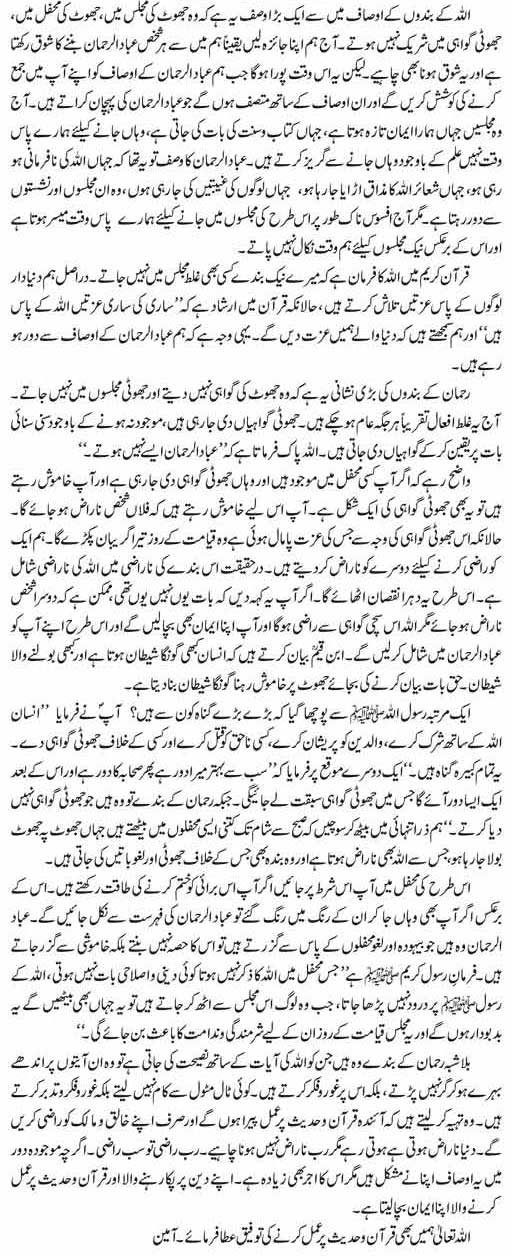
Jhooti Gawahi
And Celebrate The Praises Of Your Lord
And from among you there should be a party who invite to good and enjoin what is right and forbid the wrong, and these it is that shall be successful.
[Sahih Al-Bukhari: Volume 1, Book 10, Number 547] Narrated Jarir bin ‘Abdullah: We were with the Prophet on a full moon night. He looked at the moon and said, “You will certainly see your Lord as you see this moon, and there will be no trouble in seeing Him. So if you can avoid missing (through sleep, business, etc.) a prayer before the rising of the sun (Fajr) and before its setting (‘Asr) you must do so. He (the Prophet ) then recited the following verse: “And celebrate the praises Of Your Lord before The rising of the sun And before (its) setting.” (50.39)
[20. Surah Tauha: Ayah 130]” And glorify your Lord by the praising of Him before the rising of the sun and before its setting, and during hours of the night do also glorify (Him) and during parts of the day, that you may be well pleased.”
[20. Surah Tauha: Ayah 131] Do not let your eyes crave what We have allowed some of the disbelievers to enjoy; the ˹fleeting˺ splendor of this worldly life, which We test them with. But your Lord’s provision ˹in the Hereafter˺ is far better and more lasting.
[20. Surah Tauha: Ayah 132] Bid your people to pray, and be diligent in ˹observing˺ it. We do not ask you to provide. It is We Who provide for you. And the ultimate outcome is ˹only˺ for ˹the people of˺ righteousness.
My Lord! grant me that I should be grateful for Thy favor which Thou hast bestowed on me and on my parents and that I should do good such as Thou art pleased with, and make me enter, by Thy mercy, into Thy servants, the good ones.
Hadith Qudsi: Sila Rehmi


Hadith Qudsi: Sila Rehmi
Ahad Ahad: Bilal Radhiyallaho `Anhu
Bilal (Radhiyallaho Anhu) is one of the Best known of the galaxy of ‘Sahabah’ as ‘Moazzin’ of the Prophet (Sallallaho `alaihe wasallam) ‘Masjid’. He was an Abyssinian slave of a disbeliever in Mecca. His conversion to Islam was, naturally, not liked by his master and he was, therefore, persecuted mercilessly.
Ummayah bin Khalaf, who was the worst enemy of Islam, would make him lie down on the burning sand at midday and would place a heavy stone on his breast so that he could not even move a limb…! he would then say to him…
‘Renounce Islam or swelter and die.’
Even under these afflictions, Bilal (Radhiyallaho Anhu) would exclaim…
‘Ahad’ The One Allah! ‘Ahad’ The One Allah!
He was whipped at night and with the cuts thus received, made to lie on the burning ground during the day to make him either forsake Islam or die a lingering death from wounds. The torturers would get tired and take turns… Abu Jahl, Umayyah, and others would vie with one another in afflicting more and more painful punishments …but Bilal (Radhiyallaho Anhu) would not yield. Subhan Allah!
At last Abu Bakr (Radhiyallaho Anhu) bought Bilal’s (R.A.) freedom, and he became a free Muslim…! As Islam taught implicitly the oneness of the Almighty Creator, while the idolaters of Mecca believed in many gods and goddesses with minor godlings, therefore Bilal (Radhiyallaho Anhu) repeated…
‘Ahad (The One), Ahad (The One).’
This shows his love and devotion to Allah. Allah was so dear to him that no amount of persecution could distract him from reciting His Holy name. It is said that the urchins of Mecca would drag him in the streets, with his words ‘Ahad’ ‘Ahad ‘ ringing in their wake.
Look how Allah rewarded his steadfastness…! He was to have the honor of becoming the Prophet (Peace be upon him) Moazzin. He was always to remain with him at home and abroad to call out the Azaan for his ‘Salaat’.
After the Prophet’s (peace be upon him) death it became very hard for him to continue his stay in Madinah where he would miss him at every step and in every corner…He, therefore, left Madinah and decided to pass the rest of his life striving in the path of Allah. Once he beheld the Prophet (Sallallaho `Alaihe Wasallam) in his dream saying to him…
‘O, Bilal! How is it that you never visit me?’
No sooner did he get up than he set out for ‘Madinah’. upon reaching there, Hasan and Husain (Radhiyallaho anhuma) The Prophet’s (Sallallaho `Alaihe Wasallam) grandsons requested him to call out the ‘Azaan’.
he could not refuse them, for they were very dear to him. But as soon as the ‘Azaan’ was called, the people of Madinah cried openly out of their anguish at the memory of the happy old days of the Prophet (Sallallaho `alaihe wasallam) time. Even the women came out of their houses weeping. Bilal (Radhiyallaho Anhu) left Madinah again after a few days and died in Damascus in 20 A..H.
Notes:
The great devotee and Muazzin of PROPHET( SALLALLAHO `Alaihe Wa Sallam) the courageous and beloved Abyssinian by the name of Bilal Habshi (Radhiyallaho Anhu) passed away in the middle of reading ‘Azaan’ in Damascus, Syria between the years 638 and 642 (AD). This was the second time after the death of PROPHET( SALLALLAHO `ALAIHE WASALLAM) that BILAL( Radhiyallaho Anhu) recited the Azaan.
Durood-o-Salam Kay Fazail-o-Barkat

Durood-o-Salam Kay Fazail-o-Barkat
Tasbeeh And Takbeer Are Among The Delights Of The People Of Paradise
Paradise is the abode of reward and delight, not of trials and testing. A problem might arise concerning the hadith reported by al-Bukhaari and others from Abu Hurayrah, according to which the Prophet (saw) described the first group to enter Paradise and said, “They will glorify Allah (SWT) morning and evening.” [Saheeh al-Bukhaari, Kitaab Bid’ al-Khalq, Baab maa jaa’a fi Sifaat al-Jannah, Fath al-Baari, 6/318]
But there is nothing problematic in this report, insha’Allah, because, as al-Qurtubee said “This Tasbeeh is not the matter of obligation or imposition.” As was reported by Muslims, Jaabir explained it as follows, “They will be inspired with Tasbeeh and Takbeer as they are inspired with breathing.” The analogy of breathing was used because it is something man does with no conscious effort. Their breathing will become Tasbeeh, and the reason for this is that their hearts will be illuminated with the knowledge of their Rabb, may He be glorified, and filled with love for Him, and whoever loves a thing remembers it frequently.” [Fath al-Baari, 6/326]
Shaykh al-Islaam Ibn Taymiyyah stated that this Tasbeeh and Takbeer will be one of the pleasures enjoyed by the people of Paradise. He said, “This is not the kind of obligatory work that is done for the sake of a specific reward. It is the same as the kind of deeds that people do for pleasure and enjoyment.” [Majmu’ Fataawa, 4/330]
Allah Taala Kay Liye Jama Ka Segha Istamal Kerna Kesa Hai?
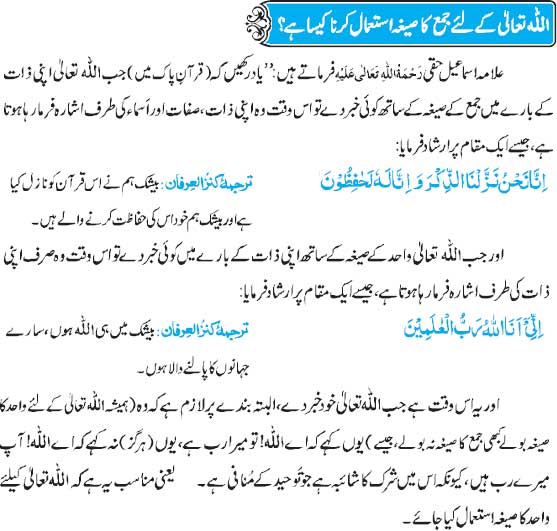
Allah Taala Kay Liye Jama Ka Sigha Istamal Kerna Kesa Hai?
Have You Entered Into Islam Whole Heartedly Or Just Pick And Choose?
When you visit a mall you pick up those goods that offer you a lucrative offer. BUY THREE AND TAKE ONE FREE ‘ or 50% Discount …. Something similar has been happening to Muslims too. We have started considering Islam as a supermarket, thinking of plenty of options even in obligatory things.
Ask a HAJI, “ How many Hajj have you performed?”
“ Five “ because there is a Hadith which says that if my Hajj is accepted all my past sins are forgiven” “And Umrah?
‘Oh every Ramadan, because whoever performs an Umrah in Ramadhan has performed Hajj with the Prophet (PBUH).
Mashallah ! then you must be praying all your Fardh Salaah in the congregation right?
Yes of course! If I pray in the congregation I get the reward of praying 27 times!
Excuse me err… Have you given your sister her rightful share of your father’s wealth?
No! Oh because maybe there is no such discount offer or other gift scheme associated with it…
Ask a sister “ Do you wear a hijab? “
“Yes, Alhamdolillah! I wear it everywhere, in college and weddings, in family gatherings…”
“But do you observe hijab with your male cousins?”
“No…I do whatever I find easy!”
This is Pick and Choose. We conveniently cling to those deeds which offer supermarket type of discounts and free gifts.
This is what the Bani Israel did with their shariah. Pick and Choose. That’s what Allah reminds us of with their example. They were not allowed to kill amongst themselves, nor were they allowed to drive each other from their homes. But they did it regularly. On the contrary, they picked and choose another easy option. They freed the captives knowing that it had a great reward.
So Allah puts up a question to such people: Do you believe in only a part of the book and reject the rest?
Then He answers it with an interrogative question: Then what is the reward for those among you who behave like this but disgrace in this life …..( Surah al Baqarah verse 85)
The Arabic word here is KHIZYOON. It means a public humiliation. And that is what we Muslims are undergoing these days. Public humiliation. If a Muslim has boarded a flight in the US the pilot fears that he may repeat the 9/11 episode. Our sisters are being deprived of wearing niqabs. Our oil and other natural resources are plundered legally. Our cities are being destroyed and our women and children and old are killed. Our youth are killed by our handicapped.
Our populations and number of countries are more yet we are humiliated at the airports, in workplaces, and also UN. For this, we cannot blame the anti-Islamic forces only. We have to take a share of the consequences….. So the Qur’an declares… ENTER INTO ISLAM WHOLEHEARTEDLY……
Author : Nisaar Nadiadwala
Hadith Qudsi: Istaanat
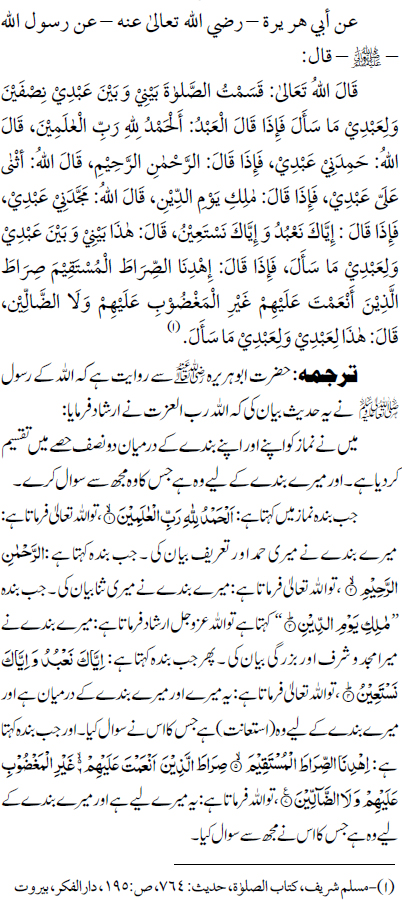
Hadith Qudsi: Istaanat
Immigrating To A Non-Muslim Country For Work
Muslims can live in any place and in any country. However, there are some basic Islamic rules about migration, which differ according to the circumstances in one s country and in the prospective country.
Muslim Shariah scholars have divided hijrah, or migration, into four categories: fard (obligatory), haram (forbidden), makruh (disliked), and mubah (permissible).
Immigration is fard when you are forced to change your religion and cannot freely establish your faith in your location, in such case you have to move to another area where you can worship Allah without restraint.
It is haram to immigrate for an evil purpose, to corrupt your faith, or to cause mischief in the land.
It becomes makruh if you feel your religion will come under great risk (in the new land). It is not recommended for Muslims to migrate to the lands where their and their descendant’s religion might be at risk.
And it is mubah if you make sure your faith will remain strong and you will benefit from the new location you want to move to.
Therefore, before you immigrate to any country, you have to make sure your faith will be solid and that you will be able to keep the religious identity of your children safe in face of temptations and evil surroundings. If you are able to do this, then you can move to any place you want.