


Zikr-e-Elahi Say Ilaj by Ibtisam Elahi Zaheer
A Home Based On Love
A foremost characteristic of life in the home of the Prophet (peace be upon him) was love. Love is the quality most necessary to ensure happiness. When love is present, happiness is assured. Prophet preferred a life of poverty, which was sometimes close to if not below, the subsistence level. Yet this did not detract from the fact that he was a very happy home, with love spreading from its rooms to those who were associated in any way with the Prophet’s family.
Should love be removed from the life of any family, happiness becomes lacking for everyone, no matter how affluent the family may be. Wealth can buy comfort and luxury, but it cannot buy love and happiness. Muhammad (peace be upon him) experienced first a life of poverty when he was brought up by his uncle Abu Talib, who had a large family and small means. He had to work and earn his living when he was still in his early teens. Then he experienced a life of comfort and plenty when he lived with his first wife, Khadeejah, who was rich and he looked after her business. Then in Madinah, he lived a life of poverty, even though he could have had whatever he wanted. He was the head of state and all its resources were at his disposal. Yet he preferred to live on the borderline of poverty. When he had more than enough for his family’s needs for the day, he gave away all that was extra. Once he received a gift of cooked birds. He gave his servant a bird to eat and ate one himself. One bird was left, so Anas, his servant brought it for the Prophet’s dinner the following day. The Prophet was upset and said: “Have I not told you never to leave anything for the following day?”
His life with Khadeejah was the symbol of happiness. She cherished his company and looked after him in the most exemplary way. She realized that he combined characteristics of the noblest type that made him unique among men. On her part, Khadeejah combined beauty, good sense, mature judgment, and a loving and generous heart. They were the happiest of couples. They lived together for 15 years or longer before he began to receive his message. Theirs was a happy life of a loving couple. When he received his message, she realized that her task was greater, and she fulfilled it with exemplary devotion. He might spend a whole day speaking to people and telling them about Islam, stressing that they needed to believe in God as the only deity in the universe, and receiving nothing but one hostile reaction after another. Yet he was assured that once he steps home, a comforting heart will be there to receive him and dispel all that troubled his caring soul. He was pained by the fact that people could not realize that the guidance he gave them was for their own good and happiness in both this life and the life to come. She reassured him that such stubborn rejection was the result of ignorance or selfishness and that it was bound to be temporary. Once people saw the truth inherent in it, they were bound to accept it.
Khadeejah was his only wife for 25 years or longer. When she died, she left a huge vacuum in his life that no woman could easily fill. Later, the Prophet needed to marry several other women. There were social, political, or legislative reasons leading to each of his marriages. God allowed him any number of wives, exempting him from the condition that allows man no more than four wives at the same time. Despite the fact that some of these marriages were in quick succession, love spread its wings on the Prophet’s home, with all inhabitants benefiting from it. No man’s life was documented in such detail as the Prophet’s life, yet we do not have a single incident when any of his wives felt anything other than love toward him. Never was any of them hurt by an angry word or an insult. He never raised his hand in earnest or in jest to express an angry feeling.
Ayesha was the one he loved most, but this did not mean that he did not love the others or that he showed them any disfavor. He felt for them and prayed that God would not hold him accountable for his feelings, which were beyond his control. Yet his treatment of all his wives was an exemplary exercise in complete fairness. However, Ayesha knew how to impart her feelings to him without putting this in words. The Prophet once told her: “I know when you are pleased or angry with me.” As she was keen not to let her anger surface, she was surprised. She asked him: “How do you know that?” He said: “When you are pleased with me and you want to emphasize something, you say: ‘By God, the Lord of Muhammad!’ But when you are angry with me, you say: ‘By God, the Lord of Abraham!’ She said: ‘By God, I forsake only your name.'”
It was the love he emanated in his family life that made all his wives happy with their situation, despite the fact that there were several others sharing the same position with them. None would exchange her position as the Prophet’s wife for being the wife of any man on earth. When they all joined together in demanding a better standard of living, he was angry with them and left them all for a whole month. After this, he gave them the choice that he would either divorce them and give them plentiful gifts or they would remain with him accepting the sort of life he gave them, which was one of hard poverty. Every one of them said unhesitatingly that she would stay with him and never make a similar demand.
We should remember that divorce in their society was accepted as normal, and a divorcee or a widow could easily be married again. Yet none of them would contemplate for a moment living with any man after having been the Prophet’s wife. It was such exemplary love that pulled them toward such a happy life. Hence, God admonishes them to be grateful for their lot and to remember the supreme wisdom that is recited in their homes, as it is revealed from on high to their husband, Muhammad (peace be upon him). God also elevated their rank, making them mothers of all believers, in all generations. Each one of them is Umm Al-Mumineen, i.e. Mother of Believers. This was a real status, and all their contemporaries treated them as such. Later generations of Muslims venerated them in the same way. As mothers of all Muslims, they could not marry anyone after the Prophet had died. Thus, they kept this status for all times.
By: Adil Salahi
Gunahon Par Asrar Ka Anjam
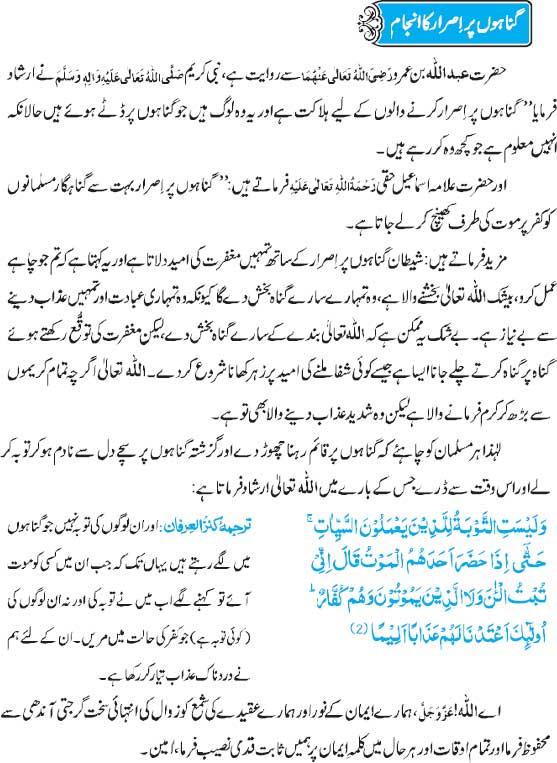
Gunahon Par Asrar Ka Anjam
The Honorable Wife Of Prophet PBUH: Umm Habeebah R.A
She is Ramlah Bin Abu Sufyan Bin Sakhr Bin Harb Bin Umayyah Bin Abd Shams Bin Qusai. Her lineage is connected with that of the prophet S.A.W through their common ancestor Qusai. She was born seventeen years before the start of the prophetic mission and she was married to Ubaidullah Bin Jahsh Al-Asadi.
Blessed Marriage
The marriage contract was made the Nugus informed the people that the Messenger of Allah had written to him asking Hin to give Umm Habeebah in marriage to him and that he had given her in marriage to him and given her dowry of four hundred deenar on his behalf, then he made the proposal of marriage to Khalid bin Saeed R.A – whom Umm Habeebah R.A had appointed to represent her – and he said I have responded to the request of the messenger of Allah and married him to request of the messenger of Allah and him to Umm Habeebah R.A, then he took the deenar and the Negus organized a wedding party in celebration of this occasion and the people ate and celebrate the happy event. so Umm Habeebah R.A became one of the mother of the believers and after a contract had been made, she loved the messenger of Allah.
Umm Habeebah R.A was a sincere believer and that sincere faith manifested itself in her love of Allah, the highest and his messenger. She feared not the rebuke of any person regarding Allah and she did not hold any person in the same high regard in which she held the messenger of Allah no matter how close he was to her, her father entered the house of his daughter Umm Habeebah R.A and after he greeted her, he went to sit on the mattress of the Messenger of Allah, but she folded it up in order to prevent him from doing so this wounded him deeply and caused him great pain and said to her, O my daughter! it is because the mattress is too good for me or because I am too good for the mattress? she said: it belongs to the prophet and you are an unclean polytheist, so I do not like that you should sit on the mattress of the Messenger of Allah, he replied angrily by Allah you have been afflicted by evil after leaving me.
After a life filled with good deeds which she undertook in order to get close to Allah the highest and to earn the pleasure of the Messenger of Allah the mother of the believer she died, may Allah have mercy on her in al-Madinah in the year 44 A.H
Hadith Qudsi: Husn-e-Zan
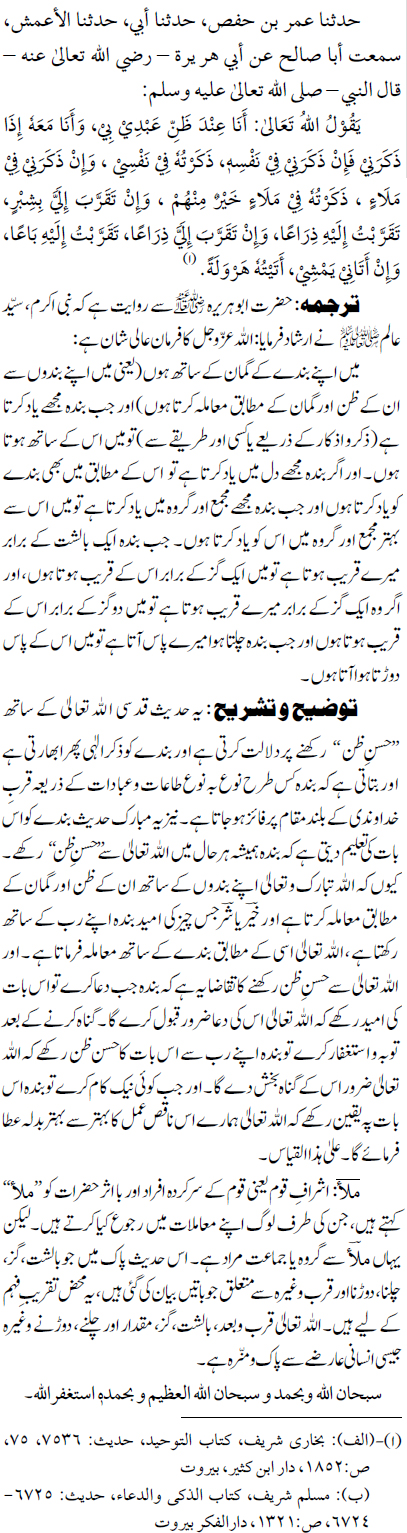
Hadith Qudsi: Husn-e-Zan
What The Qur’an Teaches: An Appeal By A Compassionate Believer
In the name of God, the Lord of Grace, the Ever Merciful
Anyone who does a bad deed will be requited with no more than its like, whereas anyone, be it man or woman, who does righteous deeds and is a believer will enter paradise where they will receive blessings beyond reckoning. My people! How is it that I call you to salvation, while you call me to the fire? You call upon me to deny God and to associate with Him others of whom I have no knowledge, the while I call you to the Almighty, the All-Forgiving. There is no doubt that what you call me to is not fit to be invoked either in this world or in the life to come. To God is our return, when the transgressors shall find themselves in the fire.
‘You shall then remember what I am telling you now. As for me, I commit myself to God: God is well aware of all His servants. God delivered him from the evils of their scheming, whereas grievous suffering was to encompass Pharaoh’s folk: before the fire they are brought, morning and evening, and then on the Day when the Last Hour comes, it will be said: “Cast Pharaoh’s people into the worst suffering.”
(The Forgiving; Ghafir: 40: 40-46)
We have been discussing the argument of the believer who lived in Pharaoh’s household when he defended Moses’ case. He states for his people the rule that governs reward and punishment in the life to come: “Anyone who does a bad deed will be requited with no more than its like, whereas anyone, be it man or woman, who does righteous deeds and is a believer will enter paradise where they will receive blessings beyond reckoning.” It is out of God’s grace that good deeds will be rewarded in multiples, while bad ones are requited with no more than what they actually are. God is fully aware of people’s weaknesses, the temptations to which they are exposed, and the impediments they have to face when they try to adhere to His guidance. Therefore, He multiplies their good deeds and makes them a means to erase their bad ones. If, after the reckoning, they attain admittance into heaven, God grants them blessings beyond all ken.
The believer expresses his amazement that he should call them to what saves them from punishment, while they call him to what will lead him to the fire: “My people! How is it that I call you to salvation, while you call me to the fire?” Needless to say, they did not call on him to throw himself into a fire, but they called on him to associate partners with God. The two are synonymous. Therefore, he states the other call in the next verse: “You call upon me to deny God and to associate with Him others of whom I have no knowledge, the while I call you to the Almighty, the All-Forgiving.”
The difference between his and their calls cannot be wider. His call is clear, and straight, requiring them to believe in God, the Almighty, the All-Forgiving. He calls them to believe in the One God, whose work in the universe testifies to His oneness, limitless ability, and infinite power. They should believe in Him so that He will forgive them, as He is the One who forgives all. How does this contrast with what they call him to do? They call him to disbelieve in God, to associate with Him beings of whom he has no knowledge: idols, myths, legends, and paradoxes.
The believer then states in all clarity that those alleged partners have no say on any matter in this present world or in the life to come. All shall return to God Almighty when those who transgress the bounds will be the dwellers of fire: “There is no doubt that what you call me to is not fit to be invoked either in this world or in the life to come. To God is our return, when the transgressors shall find themselves in the fire.”
Thus the basic facts of true faith are laid down, clear, and free of all ambiguity. This believer unhesitatingly states them in front of Pharaoh and his noblemen, although until then he had kept secret the fact that he believed in God. Now he declares his faith openly. What is left for him, then? Nothing other than to surrender himself to God. He has stated the truth as he knew it in the depths of his heart. He warns them that they are certain to remember his words when remembrance will avail them nothing. All matters are referred to God: “You shall then remember what I am telling you now. As for me, I commit myself to God: God is well aware of all His servants.”
The argument is now over, for the believer from among Pharaoh’s household has declared the word of truth, which remains clear and valid for the rest of time.
The surah does not dwell on what happened between Moses, Pharaoh, and the Children of Israel after this, up to the point of Pharaoh’s drowning while Moses and his people were saved. Instead, it affords some glimpses of what happened thereafter, indeed, after life itself: “God delivered him from the evils of their scheming, whereas grievous suffering was to encompass Pharaoh’s folk.”
This present world is over, and we see the first event that succeeds it. We see the believer who stated the truth being saved from Pharaoh and his aides’ scheming. They could not cause him any harm in this world, or after it. By contrast, Pharaoh’s folk were engulfed by suffering: “Before the fire, they are brought, morning and evening, and then on the Day when the Last Hour comes, it will be said: Cast Pharaoh’s people into the worst suffering.”
Maqam-e-Ibrahim
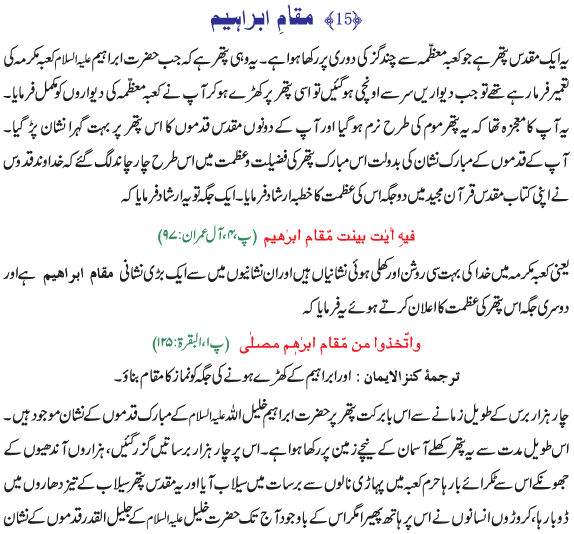
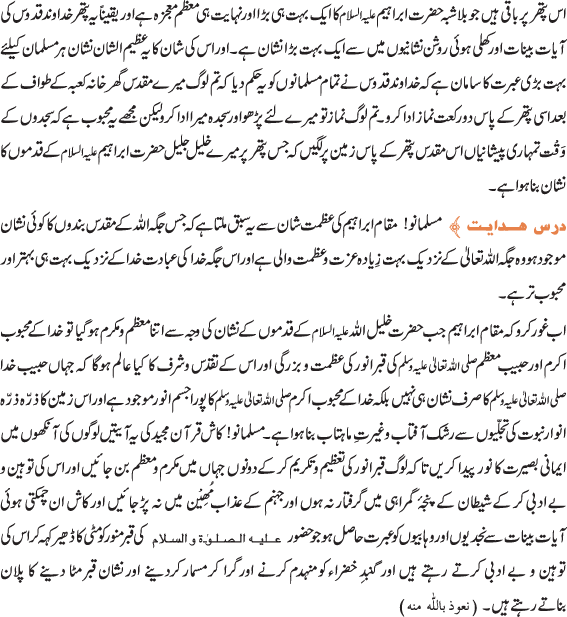
Maqam-e-Ibrahim
Signs Of Kibr (Pride/Arrogance)
The Prophet (PBUH) said: “No one who has an atom’s-weight of Pride in his heart will enter Paradise.” A man said, “O Messenger of Allah, what if a man likes his clothes and his shoes to look good?” He (PBUH) said, “Allah is Beautiful and loves beauty, Pride means rejecting the truth and looking down on people”(Sahih Muslim).
Commentary:
The word or the name for arrogance/pride in Arabic is ‘Kibr’. This is the inner quality of pride. The name of the outward quality is ‘Takabbur’ which means arrogance.
Arrogance is a blameworthy characteristic that is the feature of Iblees and his followers in this world, those on whose hearts Allah Ta’ala has placed a seal.
11 Signs of a Person Having Pride/Arrogance:
- He doesn’t like others to have what he has
- He cannot avoid anger
- He cannot avoid being jealous of others
- He doesn’t accept advice from others
- He doesn’t want to listen or accept advice from a learned person or even attend lessons
- When advising people he always puts them down
- When speaking he will say good remarks about himself
- When he speaks he speaks with pride to let people know he has knowledge
- He deals with people in a bad way
- He walks in a bad way
- He looks down on people because he is wealthier, or has a better appearance.
The cure for arrogance involves Knowledge and Action which involves the following remedies:
Firstly, you should know and recognize your Lord and know and recognize your own self as you should be recognized, and that you are not worthy of greatness and that true greatness and pride are only for Allah Ta’ala
Secondly, you should think of yourself as being just like other people and realize that they are like you; they were born from a mother and a father just as you were, and that Taqwa (piety, fear of Allah) is the true criterion of superiority.
Allah Ta’ala says (interpretation of the meaning): “Verily, the most honorable of you with Allah is that (believer) who has At-Taqwa [i.e. he is one of the Muttaqoon (the pious)” (Al-Hujuraat, 49:13)…
And finally, know and realize that on the Day of Resurrection the person with pride will be gathered in a small form like an ant which will be trampled underfoot as The Prophet (PBUH) said: “On the Day of Resurrection, the arrogant will be gathered like ants in the form of men. Humiliation will overwhelm them from all sides. They will be driven to a prison in Hell called Bawlas, with the hottest fire rising over them, and they will be given to drink of the juice of the inhabitants of Hell, which is teenat al-khabaal” (Narrated by al-Tirmidhi).
Arrogant people are hated by other people just as they are hated by Allah Ta’ala; people love humble, tolerant, and gentle people, and they hate those who are harsh and cruel to people.
And Allah knows best!
Katib-e-Wahi, Nashir-o-Hafiz Quran Syedna Usman-e-Ghani Zulnoorain
Katib-e-Wahi, Nashir-o-Hafiz Quran Syedna Usman-e-Ghani Zulnoorain