
Kaaba Ki Chat Par Azan
by Hafiz Muhammad Idrees

Kaaba Ki Chat Par Azan
by Hafiz Muhammad Idrees
[6. Surah Al-An’am: Ayah 120] And abandon open and secret sin; surely they who earn sin shall be recompensed with what they earned.
[Sahih Muslim: Book 1 Kitab Al-Iman, Number 144] It is narrated on the authority of Abu Huraira (Radi Allah Anhu) that when the son of Adam recites the Ayat of Sajdah (prostration) and then falls down in prostration, the Satan goes into seclusion and weeps and says: Alas, and in the narration of Abu Kuraib the words are: Woe unto me, the son of Adam was commanded to prostrate, and he prostrated and Paradise was entitled to him and I was commanded to prostrate, but I refused and am doomed to Hell.
[Sahih Muslim: Book 1 Kitab Al-Iman, Number 146] It is narrated on the authority of Jabir (Radi Allah Anhu) that he heard the Apostle (may peace and blessings be upon him) saying. “Verily between man and between polytheism and unbelief is the negligence of prayer.”
[Sahih Muslim : Book 1 Kitab Al-Iman, Number 147]
It is narrated on the authority of Abu Zubair (Radi Allah Anhu) that he heard Jabir b. ‘Abdullah (Radi Allah Anhu) saying. I heard the Messenger of Allah (sal-allahu-alleihi-wasallam) observing this: “Between man and polytheism and unbelief is the abandonment of salat.”
[Sahih Muslim: Book 1 Kitab Al-Iman, Number 151] It is narrated on the authority of ‘Abdullah b. Mas’ud (Radi Allah Anhu) that he observed. I asked the Messenger of Allah (sal-allahu-alleihi-wasallam) which deed was the best. He (the Holy Prophet) replied: Prayer at its appointed hour. I (again) said: Then what? He (the Holy Prophet) replied: Kindness to the parents. I (again) said: Then what? He replied: Earnest endeavor (Jihad) in the cause of Allah. And I would have not ceased asking more questions but out of regard (for his feelings).
[Sahih Muslim: Book 1 Kitab Al-Iman, Number 155] It is reported on the authority of ‘Abdullah (Radi Allah Anhu) that the Apostle of Allah (sal-allahu-alleihi-wasallam) observed: The best of’ the deeds or deed is the (observance of) prayer at its proper time and kindness to the parents.
My Lord! grant me that I should be grateful for Thy favor which Thou hast bestowed on me and on my parents and that I should do good such as Thou art pleased with, and make me enter, by Thy mercy, into Thy servants, the good ones.

Hifz-e-Quran Kay Ahkam Aur Fazail
Allahumma Salli Ala Sayyidina Muhammadin Wa-Ala Ali Muhammadin Wa-Sabibi Wa-Sallim
YA GHAWTHU’L-A’ZAMU AGHITH-NI FI KULLI AHWALI WA’NSUR-NI FI KULLI AMALI WA TAQALLAB-NI FI TARIQI-KA BI-HURMATI JADDI-KA MUHAMMDINWA BI-SHIFA’ATI-HI WA RUHI-HI WA SIRRI-H.
Hazrat Anas Ibn Malik has said, our Nabi has said: “The dua is never refused between the azan and the iqamah, so call unto Allah.”
Hazarath Anas Ibn Malik has said, our Nabi has said: “When the call for Salah is made, the heavens doors open, and the duas are accepted.”
Hazarath Abu Hurairah has said: “I came to the mountain of Thoor and I met a Rabbi. I spoke to him about Nabi and he spoke to me about the Torah. We did not disagree on anything right until we completed our conversation, and I said to him: “The Messenger of Allah has said: On the day of Jum-ah, there is a time that if a believer gets it, there is nothing good he asks Allah for, except that it will be granted to him! The Rabbi asked, “In every year?” I said: but in every Jum-ah, that is what the Messenger of Allah said!”
So he went away for a little while, then he returned to me, and he said: ” You have spoken the truth, By Allah, It is like the Messenger of Allah said, it is every Jum-ah and indeed (Jum-ah) is the greatest of days, and the dearest of days to Allah, in it Adam was created, and in it, he was placed in Paradise, and in it, he was expelled from paradise and in it will the day of Ressurection, and there is no animal except that it is…, and it waits for the day of Jum-ah, except Man and Jin.”
Amar Ibn Auf Muzni narrated from his father who narrates from his grandfather, that Rasulullah has said: ” Indeed on the day of Jum-ah there is time, no servants ask for anything, except he will be granted what he asks.” It was said to him “Which time is it O’ Messenger of Allah?” He replied: “The salah time until the people return from it”
Hazrath Jabir Ibn Abdullah says that our Nabi said: ” The Messenger of Allah supplicated in the musjid at the battle of the Trench on Monday, Tuesday, Wednesday, and his call was answered on Wednesday between the two salaahs, face (at that time. Hazrath Jabir Ibn Abdullah says from himself: “So nothing of importance had ever come upon me, except that I waited that particular time of that day, except that I asked, and I knew of the answer to my supplication.”
Hazrath Abu Hurairah has stated that the Messenger of Allah said: “When you hear the crow of a rooster, then ask Allah for his favors, for verily the rooster had seen an angel of Allah, and whenever you hear the bray of an ass, then seek protection in Allah from the Shaitaan, for verily the ass had seen the shaitaan.” (Hazrath Imam Mawawi explains the reason for this supplication. The angels ask forgiveness for the son of Adam and they say Ameen for his Duas!)

It should be the desire of every Muslim to draw nearer and closer to Almighty Allah the most compassionate and the most merciful. By drawing closer and near to Allah we gain his help in every aspect of our lives in this world and to be merciful to us so that we may gain mercy in the hereafter in order to enter Jannah in the next world.
When we call upon him he would answer our calls and when we ask of him for anything he would give it to us when we draw nearer to him then our sincerity and intentions will enable us to become closer to him.
So we should strive to draw nearer to Allah, the Glorified the Exalted, who is the majesty of honor and generosity and the giver of peace, the highest and the most honored.
So what can we do to draw closer to him? The following are 10 steps for us to draw closer to our Almighty Allah:
The Prophet (May Allah bless him and grant him peace) has guided us. And Allah, the Glorified and the Exalted has guided us on how to draw near to Him. As He said According to Hadith Qudsi: “Whoever draws near to Me among those drawn near by fulfilling what I have made obligatory on them….
You do not draw near to Allah except by fulfilling the obligatory duties which Allah has made obligatory on you; (that is) the obligatory duties from the obligatory duties (Faraid) such as Prayers, Zakat (obligatory charity), and Hajj, and Fasting and being good to Parents and all these obligatory duties on you draw you near to Allah, the Glorified and the Exalted.
Allah says in Hadith Qudsi: ….and My slave keeps on coming closer to Me through performing Nawafil(voluntary deeds) until I love him, so I become his sense of hearing with which he hears, and his sense of sight with which he sees, and his hand with which he grips, and his leg with which he walks; and if he asks Me, I will give him, and if he asks My Protection, I will protect him…” [Bukhari]
A Source of Elevation for you
The Prophet (sallAllahu alayhi wasallam) said: “Ask (anything).” Rabi’ah said: “I ask of you to be your companion in paradise.” The Prophet said: “Anything else?” Rabi’ah said: “That is it.” The Prophet (sallAllahu alayhi wasallam) said to him: “Then help me by making many prostrations (i.e., supererogatory prayers).” [Muslim]
“…Verily, in the remembrance of Allah do hearts find rest.” (13:28)
Remembrance of Allah is the foundation of all good deeds. Whoever succeeds in it is blessed with the close friendship of Allah.
The Prophet, peace be upon him, used to make remembrance of Allah at all times and also encouraged all of us to do the same. When a man complained, “The laws of Islam are too heavy for me, so tell me something that I can easily follow,” the Prophet told him, “Let your tongue be always busy with the remembrance of Allah.” [Ahmad].
In order to build a close relationship with Allah we should always call upon him in all situations and circumstances whether we are happy or sad and we should ask him for all of our needs as well as help and guidance in all aspects of our lives.
Allah the most compassionate says in the Holy Quran, “Call on Me. I will answer your prayer, but those who are too arrogant to serve me will surely find themselves humiliated in Hell” (40:60).
So let us build a close relationship with Allah by making much dua to him. He loves it when his slave calls upon him and it angers him if his slave does not call upon him.
Let us have full hope that our dua’s will be accepted and if you think they won’t they know Allah is keeping the rewards for you in the hereafter and those rewards are so great that one would wish that none of their duas were excepted in this world just so that one can gain all the rewards for their duas in the next world.
Recite the Holy Qur’an as much as we can for It will come as an intercessor for its reciter’ on the Day of Judgement [Muslim]
Learn the Qur’an and recite it, because the example of one who learns the Qur’an, reads it, and recites it in Tahajjud is like an open bag full of musk whose fragrance permeates the entire place. And the person who has learned the Qur’an but sleeps while the Qur’an is in the heart is like a bag full of musk but with its mouth closed.
Virtues of reciting the Qur’an
“Whoever reads a letter from the Book of Allah will receive a hasanah (good deed) from it (i.e. his recitation), and the hasanah is multiplied by ten. I do not say that Alif-Laam-Meem is (considered as) a letter, rather Alif is a letter, Laam is a letter, and Meem is a letter.” [At-Tirmidhi, Ad-Darimi]
One of the most important things we must do, which sadly many people neglect, is we should avoid bad company. People, we should avoid taking as friends those who speak too freely, who miss Salah, who do not dress modestly, who backbite, slander, etc.
The company of such people is poison; just even sitting and talking with them will lead one to commit sins. Just as a person who sits for a long time with a perfume seller begins to smell nice, and a person who sits by a gutter cleaner begins to smell awful, similarly a person who spends time in the company of the wicked eventually gets affected badly by them.
Rather, we should seek out pious friends who fear Allah Taala and who have the qualities of humility, charity, compassion, modesty, and knowledge. If we sit with them we will always benefit and they will be a means for us to get closer to Allah Taala!
Indeed, no one despairs relief from Allah except the disbelieving people..(Surah Yusuf 12:87)
One must be hopeful of Allah’s mercy and forgiveness and fearful of His punishment. It is this fear that should lead one to seek Allah’s forgiveness with hope. Allah says: Know that Allah is severe in punishment and that Allah is Forgiving and Merciful. (Surat al-Maaidah 5:98)
In the above verse, Allah gives us reason to fear because His punishment is justly severe, as well as a good reason to have hope, since He is the Most Forgiving and Merciful. There should be a balance between fear and hope and not too much or too less of one or the other.
Fasting in general and voluntary fasting, in particular, is a great worship. Fasting is not restricted to Ramadhan, but it is an act of worship that can be [and should be in some cases] performed at any time and at any place except when not recommended. Indeed, it is worship that draws the believer closer to Allah and closer to perfection.
Fasting Mondays and Thursdays:
`Aa’ishah said: The Messenger of Allah, salla Allahu alaihi wa salam, used to fast Mondays and Thursdays”. [An-Nasaa’i; Sahih]
Abu Hurairah reported that the most the Prophet, salla Allahu alaihi wa salam, would fast be Monday and Thursday. He was asked about that and he said: “The deeds of people are presented to Allah every Monday and Thursday. Allah forgives every Muslim except for those who are deserting each other. He says: “leave them for later.” [Ahmad; Hasan]
Allah says: O son of Adam, if your sins were to reach the clouds of the sky and you would then seek My forgiveness, I would forgive you.
When a person sins and then sincerely turns to Allah for forgiveness, one will find Allah ready to accept his repentance and forgive him, as this verse indicates:
And whoever does a wrong or wrongs himself, but then seeks forgiveness from Allah, he will find Allah forgiving and merciful. (Surat an-Nisaa 4:110)
Everyone commits sin and does wrong, but Allah is always willing to forgive and He always gives them a chance to repent and seek His forgiveness. A believer should never forget the fact that Allah is so forgiving. If Allah had willed, He could have held everyone accountable for his or her sins, but He has decreed that He shall allow His servants to seek His forgiveness and that He shall in fact forgive who and what He wills. In fact, Allah commands that His servants seek His forgiveness:
Many of us think that “a perfect Muslim” is simply one who is correct in the observance of the salah (ritual Prayer), the fasting, the zakah (payment of a certain portion of one’s wealth to the poor), and the Hajj (pilgrimage to Makkah). This indeed is not the case.
If the ritual observances do not help the person to be humble, virtuous, and truly God-fearing, then he or she is not a real Muslim. A Muslim should be good and just in dealing with others, no matter their religion, and take special care to keep away from all the shameful and sinful things Allah has forbidden.
One can never get close to Allah by being arrogant, full of pride, and having bad character and manners. Those who have humility and are humble and have good character and manners are the closest to Allah and Allah raises their ranks in the hereafter. The best person is the one who is best toward others.
By: Ahmad Afnan
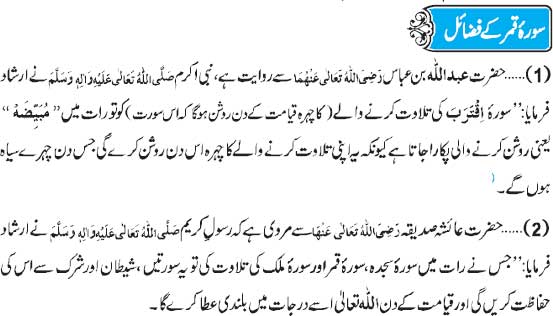
Surah Al-Qamar Kay Fazail
Allah created every animal from water. Some of them go on their bellies, some of them on two legs, and some on four. Allah creates whatever He wills … Allah has power over all things. (Surat an-Nur, 24:45)
Bees accomplish their tasks perfectly. Worker bees construct the hive, ventilate it, and maintain a constant temperature in it. They also bring in the nutrients they collect from flowers. The queen bee, on the other hand, remains in the hive and ensures the community’s continuity. The gnat larva changes its skin four times before it fully completes its development. Toward the end of the pupa period, the pupa cocoon, which is covered with a special viscous liquid that protects the gnat’s head from contact with water, is torn at the top and the adult gnat climbs onto the water with only its feet touching it.
Bees and gnats are the only two types of living beings on this planet. Yet, as is the case with all other living beings, Allah determines when they will be born, live, and die. From the time they are born, they live as Allah considers proper for them and commands them to live. Never do they transgress the boundaries of their assigned duties. This holds true for lizards that survive in deserts where the temperature reaches 50° Celsius (122° Fahrenheit), as well as for penguins living in polar regions where the temperature can drop far below -50° Celsius (-58° Fahrenheit) or sponges whose habitat is thousands of meters below the ocean’s surface. The earlier ones also lived in the same way and the latter ones will continue to do so, for Allah determines a way of life for each living being. Therefore, no living being can determine how it will live, for this determination lies only with Allah, to Whom they all submit.
Humanity is a tiny part of life, a being Allah created from a drop of water and granted a way of life. Thus, only He can determine when a person will be born or die, control the aging process, or will one to be immune or susceptible to any weakness or disease. The unprecedented nature of His power and His control over everything is related in the Qur’an, as follows:
He is the Originator of the heavens and Earth… How could He have a son when He has no wife? He created all things and has knowledge of all things. (Surat al-An‘am, 6:101)
Say: “Who is the Lord of the heavens and Earth?” Say: “Allah.” Say: “So why have you taken protectors apart from Him who possess no power to help or harm themselves?” Say: “Are the blind and the seeing equal? Or are darkness and light the same? Or have they assigned partners to Allah, Who creates as He creates, so that all creating seems the same to them?” Say: “Allah is the Creator of everything. He is the One, the All-Conquering.” (Surat ar-Ra‘d, 13:16)
They will ask their skins: “Why did you testify against us?” and they will reply: “Allah gave us speech, as He has given speech to everything. He created you in the first place, and you will be returned to Him.” (Surah Fussilat, 41:21)

Nabi (PBUH) Ki Fasahat o Balaghat
Comprehensive notes covering the most important qualities of the Prophet (Sallallaahu ’Alayhi wa Sallam) in regard to food and diet.
‘It is sufficient for the son of Aadam to eat a few mouthfuls, to keep him going. If he must do that (fill his stomach), then let him fill one-third with food, one-third with drink, and one-third with air. FOOD… [1]: When he put his hand in the food, he would say, “Bismillaah (with the Name of Allah),’’ and he told people to say this when eating. he said, “When any one of you eats, let him mention the name of Allah. If he forgets to mention the name of Allah at the beginning, let him say…
‘Bismillaahi fee Awwalihi wa Aakhirihi,’ (with the name of Allah, at its beginning and at its end).” [2] The correct view is that it is obligatory to mention the name of Allah (say ‘Bismillaah’) when eating. {The ahaadeeth that state this are Saheeh (authentic) and are clear, with no contradictions in them.} [2]: When he raised the food to his mouth, he would say…
“Al-hamdu lillaahi hamdan katheeran tayyiban mubaarakan feehi, ghayra [makfiyyin wa laa] muwadda’in, wa laa mustaghnan ’anhu Rabbanaa ’azza wa jall. Translation: [All praise is to Allaah, praise in abundance, good and blessed. It cannot [be compensated for, nor can it] be left, nor can it be done without, our Lord. [3] [3]: he never criticized food at all. If he liked it, he would eat it, and if he did not like it, he would leave it and not say anything. [4] or he would say..“I do not feel like eating this.” [5] [4]: Sometimes he would praise the food, as when he asked his family for food, and they said, “We have nothing but vinegar.” he asked for it and started to eat it, saying.
“ What good food is Vinegar.” [6] [5]: he used to talk whilst he was eating, as is seen from the report quoted above about vinegar. And he said to his stepson ..’ Umar Ibn Abee Salamah (radiyallaahu ’anhu) when he was eating with him.. “Say Bismillaah and eat from that which is
in front of you in the dish.’’ [7] [6]: He would repeatedly urge his guests to eat, as generous hosts do, and as is seen in the hadeeth of .. [Aboo Hurayrah (radiyallaahu ’anhu), related by al-Bukhaaree..]
About the story of drinking milk, where he repeatedly said to him… “Drink,” and he kept telling him to drink until he (the guest) said..“By the One Who sent you with the truth, I have no more room for it ”! [8] [7] When he ate with others, he would not leave until he had made Du’aa (supplication) for them. he made Du’aa in the house of ’Abdullaah Ibn Bishr,(Allah be pleased with him) and said…
“ O Allah, bless for them that which You have provided for them, forgive them, and have mercy on them.” [9] [8]: he commanded people to eat with their right hands and forbade them to eat with their left hands. he said… “ The Shaytaan eats with his left hand and drinks with his left hand.” [10]
Note: This implies that eating with the left hand is ‘Haram’ (unlawful), and this is the correct view, because the one who eats with his left hand is either a Shaytaan (Devil), or he is imitating the Shaytaan.
It was also reported in an authentic ‘Hadeeth’ that he told a man who was eating with his left hand in his presence…
“ Eat with your right hand! ”
The man said, “I cannot.” he said…
“ May you never be able to,” and the man never lifted his right hand to his mouth after that. [9]: he commanded those who complained that they never felt full to eat together and not separately and to mention the name of Allah (say ‘Bismillah’) over the food so that He might bless it for them. [12] [10]: It was also reported that he said…
“ I do not eat reclining.” [13] [11]: he used to eat using the first three (3)
fingers (of his right hand), which is the best way of eating ..!
The Prophet’s(Sallallaahu ’Alayhi wa Sallam) Guidance Regarding Eating
[1]: The Prophet (sallallaahu ’alayhi wa sallam) used to know what he was eating.
[2]: he used to eat whatever was good for him.
[3]: he used to eat enough to keep him going, but not so much as to make him fat.
Ibn ’Umar [Allah be pleased with him] related that…
Prophet (sallallaahu ’alayhi wa sallam) said..
“The believer eats in one stomach whilst the disbeliever eats in seven !” [14] [4]: He taught his ‘Ummah’ something to protect them from diseases caused by eating and drinking.
Prophet(Sallallaahu ’Alayhi wa Sallam) said..
“The son of Aadam does not fill any vessel worse than his stomach. It is sufficient for the son of Aadam to eat a few mouthfuls, to keep him going. If he must do that (fill his stomach), then let him fill one-third with food, one-third with drink, and one-third with air.” [15]
Footnotes: [1] Zaadul-Ma’aad (p. 2/397-406)
[2] Saheeh: Related by at-Tirmidhee (no. 1859) and Aboo Daawood (no. 3767).
[3] Related by al-Bukhaaree (no. 5142)
[4] Related by al-Bukhaaree (no. 3370) and Muslim (no. 2064).
[5] Related by al-Bukhaaree (no. 5076) and Muslim (no. 1946).
[6] Related by Muslim (no. 5052)
[7] Related by al-Bukhaaree (no. 5061) and Muslim (no. 2022).
[8] Related by al-Bukhaaree (no. 6087)
[9] Related by Muslim (no. 2042)
[10] Related by Muslim (no. 2020)
[11] Related by Muslim (no. 2021)
[12] Saheeh: Narrated by Abu Dawood (3764) and Ibn Maajah (3286).
[13] Related by al-Bukhaaree (no. 5083)
[14] Related by al-Bukhaaree (no. 5081) and Muslim (no. 2060).
[15]: Saheeh: Related by at-Tirmidhee (no. 1381)and Ibn Maajah (no. 3349). It was authenticated by Shaykh Muhammad Naasirud-Deen al-Albaanee in Silsilatul-Ahaadeethus-Saheehah (no. 2265).
Imam Ibnul-Qayyim al-Jawziyyah{Rahimhullah}