
Musafiha Kay Ahkam
Showcasing The Shyness Of A Shepherdess
Allah mentions good people in the Qur’an and highlights their good points when He is pleased with them so that we indirectly identify the stamp of approval He has given in order to incorporate that behavior in our own actions.
In the following incident from the life of Prophet Musa, Allah describes a shy young woman’s praiseworthy demeanor. The verses quoted are from Surah Al-Qasas (28: 23-28) and the explanation is from Ibn Kathir’s Tafsir.
“And when he arrived at the water (a well) of Madyan,” which means when he reached Madyan and went to drink from its water, “for it had a well where shepherds used to water their flocks,” meaning he found there a group of men watering, “and besides them, he found two women who were keeping back,” which means, they were stopping their sheep from drinking with the sheep of those shepherds, lest some harm comes to them. When Musa saw them, he felt sorry for them and took pity on them.
“He said: “What is the matter with you?” meaning, ‘why do you not water your flocks with these people?’
“They both said: “We cannot water until the shepherds take…” meaning, `we cannot water our flocks until they finish.’
“And our father is a very old man,” which means, “this is what has driven us to what you see.”
“So he watered (their flocks) for them, then he turned back to shade, and said: ‘My Lord! Truly, I am in need of whatever good that You bestow on me!”’
“Towards the shade,” Ibn Abbas, Ibn Mas`ud, and As-Suddi said: “He sat beneath a tree.”
Ata’ Bin As-Sa’ib said: “When Musa said: ‘My Lord! Truly, I am in need of whatever good that You bestow on me!’ the women heard him.”
When the two women came back quickly with the sheep, their father was surprised that they returned so soon. He asked them what had happened, and they told him what Musa had done. So he sent one of them to call him to meet her father. Allah says:
“Then there came to him one of them, walking shyly” – meaning, she was walking like a free woman, as it was narrated from Umar Bin Al-Khattab: “She was covering herself from him with the folds of her garment.”
Umar said: “She came walking shyly, putting her garment over her face. She was not one of those audacious women who come and go as they please.” This chain of narrators is Sahih.
“She said: ‘Verily, my father calls you that he may reward you for having watered (our flocks) for us.’”
This is an example of good manners: She did not invite him directly lest he has some suspicious thoughts about her. Rather she said: “My father is inviting you so that he may reward you for watering our sheep,” i.e., give you some payment for that.
Imam Sa’di says in his Tafsir, “This (description) points to her proper upbringing and her good character, for indeed Haya is from the most honorable of manners, and is a special trait in women. It also shows that Musa did not assist them to receive payment; but rather, it was because of the honorable and strong nature of his soul and his upright manners.”
“So when he came to him (the father) and narrated the story,” means, he told (the father) about his story and why he had to leave his country.
“He said: ‘Fear you not. You have escaped from the people who are wrongdoers.’”
“And said one of them: ‘O my father! Hire him! Verily, the best of men for you to hire is the strong, the trustworthy.’” One of the two daughters of the man said this, and it was said that she was the one who had walked behind Musa.
Umar, Ibn Abbas, Shurayh Al-Qadi, Abu Malik, Qatadah, Muhammad Bin Ishaq, and others narrated that her father asked her, “What do you know about that?” She replied, “He lifted a rock which could only be lifted by 10 men, and when I came back with him, I walked ahead of him, but he said to me, walk behind me, and if I get confused about the route, throw a pebble so that I will know which way to go.”
Bhook Aur Shikam Seri
Ahadith Qudsi – Superiority Of Monotheism
1: Narrated Abu Dhar (R.A) Allah’s Messenger Sallallahu ‘alayihi wasallam said that Allah Assawajall said: He who comes with a good deed, its reward will be ten like that or even more. And he who comes with vice, his reward will be only one like that, or I can forgive him. He who draws close to Me a hand’s span, I will draw close to him an arm’s length. And whoever draws near Me an arm’s length, I will draw near him a fathom’s length. And whoever comes to Me walking, I will go to him running. And whoever faces Me with sins nearly as great as the earth, I will meet him with forgiveness nearly as great as that, provided he does not worship something with me.
This Hadith is sound and reported by Muslim, Ibn Majah and Ahmad in his Musnad
Another prophetic tradition says: (He who met Allah associating anything with Him, will enter Hell) (Muslim)
2. Narrated Abu Sa’id Al-Khudri (r.a.): Allah’s Messenger (s.a.w.s.) said: None of you will have argued for his right in the world more vehemently than the believers who will do with their Lord about their brethren who were admitted into Hell. The Prophet (s.a.w.s.) added: they will say: O Lord! Our brethren used to offer prayers with us observe fast with us and perform pilgrimage (Hajj) with us. But You cast them into the fire. The Prophet (s.a.w.s) further said: Allah will say: Go and bring out whoever you know from among them. The Prophet (s.a.w.s.) said: The believers will come to them and recognize them by face. Some of them will be those the fire would have seized up to half of their shanks and some of them up to their ankles. They will bring them and say: O Lord! We have taken out those for whom you gave us order. Then the Prophet (s.a.w.s.) said: Allah will say: Bring out whoever has in his heart any belief weighing a Dinar (a coin). Then He will say: Take out whoever has in his heart the belief weighing half a Dinar until He will say: Take out whoever has in his heart the belief that equals the weight of an atom. (This Hadith is sound and reported by Nasa’i and Ibn Majah). After narrating this Hadith, Abu Sa’id Al-Khudri (r.a.): He who does not accept it as true should read this verse:
“Verily, Allah forgives not that partners should be set up with Him in worship, but He forgives except that (anything else) to whom He please, and whoever sets up partners with Allah in worship, he has indeed invented a tremendous sin”. (4:48)
Chugli Aur Gheebat
Allah With The Patient
[ALLAH’S Quran – 2:153] “O you who believe! seek assistance through patience and prayer; surely Allah
is with the patient.”
The Prophet (Peace Be Upon Him) has said :
[Bukhari, Book #70, Hadith #547] “Narrated Abu Huraira: Allah’s Apostle said, “The example of a believer is that of a fresh tender plant; from whatever direction the wind comes, it bends it, but when the wind becomes quiet, it becomes straight again. Similarly, a believer is afflicted with calamities (but he remains patient till Allah removes his difficulties.) And an impious wicked person is like a pine tree which keeps hard and straight till Allah cuts (breaks) it down when He wishes.”
Aulad Kay Haqooq
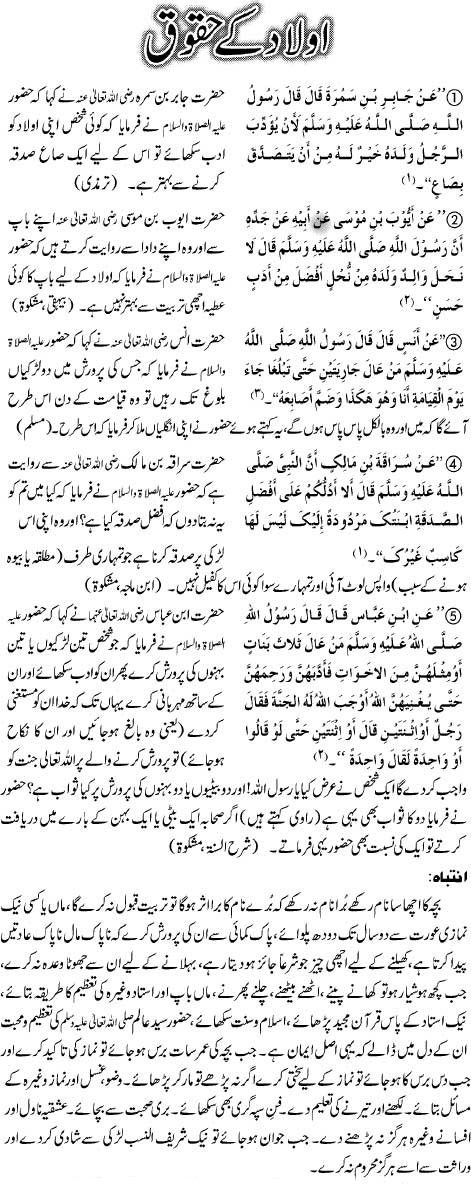
A Beautiful Piece Of Advice
A beautiful piece of advice:
It is narrated that Imam Hussain (as), grandson of the Holy Prophet (saw), said to a man who was backbiting another before him,
‘O you, stop backbiting, for it is the daily meal of the dogs of Hell.’
A person asked Allah’s Messenger (may peace and blessings be upon him) who among Muslims were better. Upon this (the Holy Prophet) remarked: One from whose hand and tongue, Muslims are safe.
Commentary
Are others safe from your words (back-biting, comments, sarcasm, hurtful jokes, fitnah, etc) and your deeds (retaliation, plotting, etc)?
Angels stand by your side, recording your words. It is better to be silent than to comment. “Speak good, or else be silent,” says Rasulullah (saw). Busy yourself with finding your own faults, and you shall have little time to comment on others.
Angels stand by your side, recording your deeds. It is better to forgive than to retaliate. Busy yourself with seeking forgiveness for your own soul, and you shall have little time to plot revenge or to ponder about the deeds of others.
When others are safe from your words and deeds, it means that YOU are now safe from words and deeds that will destroy YOURSELF on Judgement Day. On that Day, Man will regret what evil he has said and done. He will be filled with relief, for all the evil which was NOT said and done. So restrain yourself, for your own good.
Will you not then take heed?
Ponder and practice.
Rasulullah S.A.W said, “An intelligent person is one who is constantly thinking about and preparing for death.”
Think about it. How does one prepare for death?
1) By seeking knowledge of Islam. So study about Allah, his Prophet, of good deeds and evil deeds. But knowledge itself is useless without…
2) Practising it. Perform good deeds, small or big, and avoid all evil deeds. But all performance is useless unless you are…..
3) Sincere (Ikhlas). To do lillahi ta’ala. But you will never achieve sincerity, as long as you do not have…
4) True Faith (Iman). You must
truly believe in Allah,
truly be in awe of Allah,
truly depend and ask only from Allah,
truly hope from Allah,
truly fear Allah,
truly put your trust in Allah.
But such faith does not come from reading books or talking about Islam or listening to fiery speeches about Islam; it comes from…
5) Striving hard in Allah’s path (Jihad). This does not mean going around trying to convert the world to Islam; it does not mean waving a sword at disbelievers showing them the ‘terror’ that Islam can inflict. It means fighting hard to cleanse the evil in yourselves –
the jealousy,
the greed,
the stinginess,
the arrogance,
the pride,
the laziness,
the hatred,
the lack of faith,
the stupidity,
the blindness of the heart,
the backbiting and
all the terrible sins that we do day after day, year after year until death comes a calling.
That is jihad. As you can see, this is a full-time job, that will take all your life to complete. But you will never start to strive for all this until you begin to…
6) Realize …
Realize that you will die soon.
Realize that you will be shown all your deeds (good and bad) on Judgement Day.
Realize that Allah watches you all your life and that no deed escapes His repayment.
Realize that money, and fame, and property cannot buy your way out of Hell.
Realize that only iman and good deeds can.
Realize that you live only once.
Realize that you are responsible for yourself.
Realize that in the end, you are the one who will gain or lose.
So many people have realized, and have studied Islam, and yet have gone astray – becoming terrorists, extremists, and fundamentalists. Why?
They have forgotten the most important thing in Islam. Which is that…….
7) Islam is about YOURSELF. Correcting YOURSELF. Cleansing YOURSELF. Not about fighting with people or proving other people wrong.
In the grave, you will be asked about YOURSELF.
What YOU did.
What YOU said.
What was YOUR intention?
Then Allah will tell YOU, what is YOUR final destination is.
“And do not be as those who forget Allah, then Allah makes them forget about themselves….”Al-Qur’an.
Have you thought of yourself lately? For every man who forgets about himself lands in Hell.
Ponder…and practice.
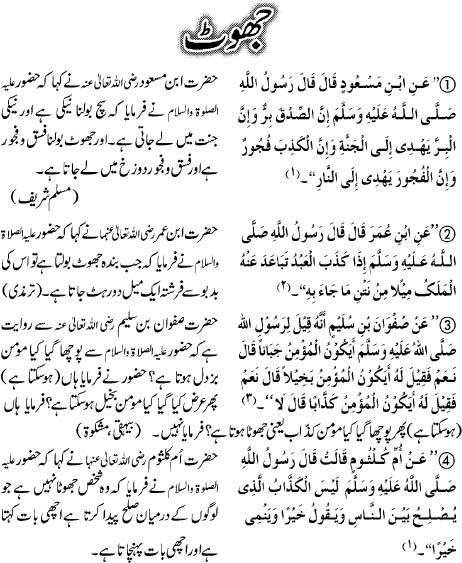
Jhoot: Gunah-e-Kabira
Man And Pollution
Evil (sins and disobedience to Allah) has appeared on land and sea because of what the hands of men have earned (by oppression and evil deeds), that He (Allah) may make them taste a part of that which they have done, in order that they may return (by repenting to Allah and begging His Pardon). (Ar-Rum; 30 – 41)
Man has been paying the cost of the damage he has inflicted on his surroundings and nature for centuries. Passion for more money, sloth, and irresponsibility have made the man blind to the fact that he is part of his natural environment and that the damage he causes will inevitably affect him. The development of environmental consciousness in man, as a result of damage of his own doing, is a recent phenomenon, after 1970.
The reference made in the Qur’an to the corruption caused by man in land and sea, which was revealed at a time when environmental awareness cannot be said to have existed, offers a lesson.
We translate the Arabic word “bahr” as “sea” (However, it may also designate a large lake, reservoir, inland sea, waterway, etc.). We are advised not to dispose of nature’s bounties as we like, otherwise, we shall have to pay for it. We are also informed that the damage caused by man to his environment will also affect the land and sea beyond his reach.
Therefore, nobody is allowed to say, “I am on my own. No one can meddle with what I do.” Nature is our common heritage and it is everybody’s duty to contribute to checking its transgression.
The industrial revolution in the 19th century greatly contributed to the growth of pollution. It is, however, incorrect to say that this was the beginning of environmental pollution, which has been going on since ancient times. What is new, however, is the development of ecology and ecological consciousness. To begin with, the burning down of forests has been going on for ages. The forest fire was the principal cause of such diseases as anthracosis that man often suffered. These pyromaniacs had certainly no inkling of what they were perpetrating with their own hands.
During the Middle Ages, environmental pollution seems to have been an important problem. In the England of 1345, people who tossed feces out of their windows were fined two shillings. In the 12th century, Philippe Auguste of France was the first king to ordain the collection of abominable waste littering the streets of the city. The public who disposed of their waste by channeling it into waterways polluted the springs they drank from. The first law on pollution that we know about was passed in 1388 by the British parliament; this law prohibited the throwing of waste into the streets and waterways. Transgressors were to be reported by the people residing in the precincts to the private secretary to the king. Only after it reached extraordinary proportions was the pollution made the subject of the law.
The situation became even graver during the industrialization period in the 19th century. Metallurgy and iron and steel works polluted the land, water, and air. This is reflected in the novels of Charles Dickens and the writings of Friedrich Engels that describe the pollution in London. In 1930, 63 people died of pollution in the Mosa Valley in Belgium. The situation in London, in 1952, was even more serious. Four thousand died of upper respiratory tract diseases because of man’s ravages of nature.
The situation at present is hardly any rosier. There may not be such mass mortality, but according to the World Health Organization, more than one billion people are under threat from pollution. It is impossible to evaluate the degree of damage the public has suffered from throwing garbage and waste into the sea. This habit is still going on. Sea pollution that threatens marine fauna and flora, and the settlement in their tissues of noxious substances, is thought to be the cause of many illnesses, including cancer. Carbon dioxide emissions from cars and factories also contribute to the so-called “greenhouse” effect, and it is feared that drastic changes in global climate are causing catastrophic disasters.
Environmental pollution is one of the greatest dangers for humankind. This reference to pollution in the Qur’an at a time when there was no environmental awareness is remarkably interesting. The Qur’an was not penned like books that are products of the human mind under the influence of social and sociological realities in due consideration of the current issues. It was sent by God, Lord of all times and beings. Knowledge unavailable at the time of its revelation, problems of the past and of the future, are all present in the Qur’an.
Man is the author of his own destruction. The verse serves as a warning to redress his wrongdoings. The more we expand efforts to counteract our past shortcomings, the better we can protect ourselves against catastrophes. Ecology must be our common concern.