

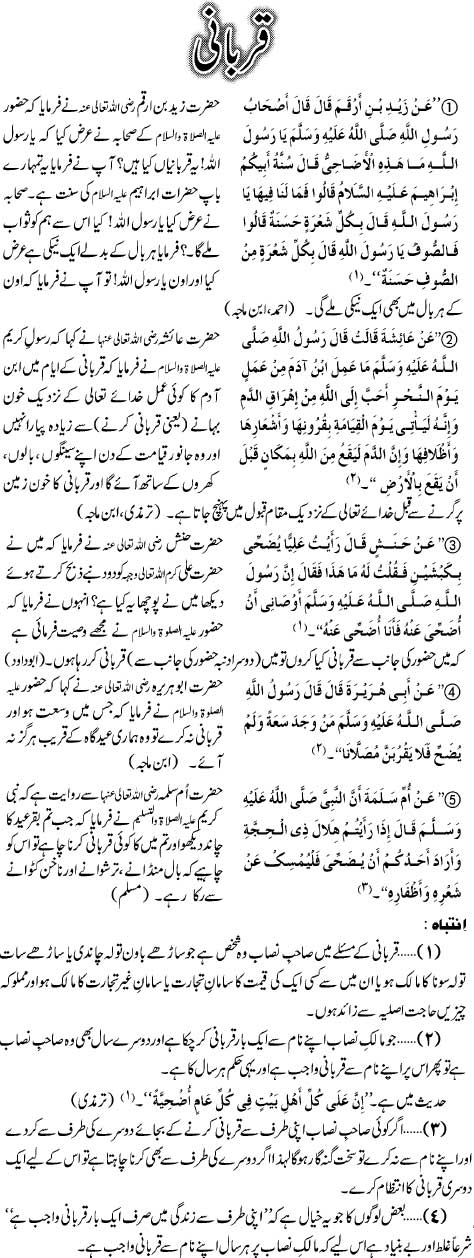
Offering Sacrifice In The Name Of Allah
Offering sacrifice is the tradition of our father Ibrahim (peace be upon him) and our Prophet Muhammad (peace be upon him). Allah has promised reward on every part of the animal that you sacrifice, even on its hair. The Prophet (peace be upon him) said, “On the day of sacrifice, no one does a deed more pleasing to Allah than the shedding of blood. The sacrificial animal will come on the Day of Resurrection with its horns, hair, and hooves (and its owner will be rewarded on that basis); and (its) blood finds acceptance with Allah (for its owner) before it falls on the ground, so rejoice over it.” (Tirmidhi)
Slaughtering an animal is better than giving its monetary value in charity. The deed of sacrificing an animal is a recommended or stressed Sunnah (Sunnah Mu’akkadah) for those who can afford it. Slaughter on your behalf and your household, including your wives, children, and parents, so that all of them will gain its reward. This was the practice of the Prophet (peace be upon him). He slaughtered for himself and on behalf of his family. Some people offer sacrifice only on behalf of their parents, depriving themselves and their households of the reward. It is preferable to sacrifice in the name of all (the household). If one is appointed to slaughter then he should fulfill the will accurately.
Many Muslims offer sacrifice on behalf of their deceased relatives during the first year of their death. They call it Dahiyyah Al-Hufrah (the sacrifice of the grave) – this practice has no basis in Shariah. Some people wipe or mark the animal from its face till the back of its neck to specify the owner of the animal. One should only state the owner by mentioning his name while slaughtering, without wiping. This was the conduct of the Prophet (peace be upon him). Moreover if one sacrifices the animal with only the intention and without mentioning the name of its owner, it still will be sufficient.
The sacrifice should be of camels, cows, sheep, or goats. It cannot be valid unless it meets two conditions:
· The animal must have reached the required age
· It must be free of certain defects that invalidate sacrifice.
Age specifications are as follows:
· Camels: Five years old.
· Cows: Two years old.
· Goats: One-year-old.
· Sheep: Six months old.
The defects that invalidate sacrifice have been explained by the Prophet (peace be upon him) in the following Hadith.
“Four (types of animals) should be avoided in sacrifice: A lame animal whose lameness is evident, a one-eyed animal which is clearly one-eyed, an animal which is clearly ill and an emaciated animal with no fat on it.” (Ahmad)
· The clear lameness is identified by the animal’s inability to fight and keep up with healthy animals.
· An animal with a defective eye – either popping out or completely concealed – is identified as one-eyed. If the imperfection is not detectable – even though the animal cannot see with it – the sacrifice will still be valid but disliked.
· The way it trots, the type of appetite it has, and other similar factors determine if the animal is healthy. An ailing animal whose poor health is obvious can be accepted as a legitimate sacrifice. In any case, it is preferable to offer an animal in the sacrifice that is free from all such defects.
· If the sacrificial animal is so thin that its bones contain no marrow, it will not be accepted as a valid sacrifice.
The sounder the sacrificial animal is, the more acceptable it becomes. The male animal, whether castrated or not, is acceptable as the Prophet (peace be upon him) offered both in sacrifice. However, the fleshier the animal, the more satisfactory it is.
Slaughtering a goat or a sheep is better than one-seventh of a camel or a cow, even though both are equivalent. One may share a cow or camel with six other persons, hoping reward for all of them. Sacrificing a pregnant animal is also equally acceptable.
One should slaughter his sacrificial animal himself if he is able to. If he cannot, he can hire someone to do it and should attend the slaughtering. If he is not present, the sacrifice is still valid. If a person slaughtered an animal thinking it was his but found out later that it belonged to someone else, then the sacrifice will be credited to the real owner, he will receive the reward for it and will be entitled to its meat.
For instance, if there is a yard with several sacrificial animals in it and a person takes one of them, assuming that it is his and slaughters it, but later discovers that it did not belong to him, then although the sacrifice is valid, the one who mistakenly slaughtered the animal does not receive the credit or reward for it. His position is like that of someone appointed to slaughter on behalf of the owner.
Halal Aur Haram Janwar

Four Principles Of Worship
The verse: “You alone do we worship.” (Qur’an, 1:5) is built on four principles:
1. Saying of the heart
It is i’tiqad (belief) in what Allah informed about His Self; concerning His Names, His Attributes, His Actions, His Angels, and all that He revealed upon His Messenger (peace be upon him).
2. Saying of the tongue
It is to inform and convey (what Allah has revealed), to call to it, defend it, to explain the false innovations which oppose it, to establish its remembrance, and to convey what it orders.
3. Action of the heart
Love for (Allah), reliance upon Him, repenting to Him, having fear and hope in Him, making the religion purely and sincerely for Him, having patience in what He orders and prohibits, having patience with what He decrees, and being pleased with it are some examples. These are connected with the action of limbs. In fact actions of limbs without the heart are of little benefit, if any benefit at all.
4. Action of the limbs
Such as salah and jihad, attending the Jumu’ah (Friday prayers), aiding those who are (needy), and displaying kindness to the creation.
So Al-’Ubudiyyah (servitude to Allah) is a comprehensive term for all these four stages. The one who actualizes them has indeed actualized: “You alone do we worship.”
Madarij-us-Salikin (1/100-101)
Hajjaj karam Kay Liay Zad-e-Rah

What Is Hajj?
The pilgrimage (Hajj) is
1) One of the most important pillars of Islam.
2) A principal means of obtaining proximity to the Almighty.
3) One of the most difficult physical forms of worship.
4) So, vital that one who does not perform Hajj will be barred from Heaven.
The main aim of human creation is to recognize God and attain a stage of acquaintance and love for Him and this depends on the purity and loftiness of the human soul. i.e. The purer the soul becomes the more love will it have for the Almighty.
This stage of love can be attained by abstaining from desires and refraining from worldly pleasures and distractions, and by exerting oneself in the rigorous self-training activities for the sake of God, and, remembering him continuously. For this purpose, the Almighty has legislated certain forms of worship (Ibadat).
a) Those involving the expenditure of wealth for His sake e.g. Zakat and Khums which serve to sever the deep attachments to worldly possessions.
b) Those involving abstinence from desires and pleasures e.g. fasting.
c) Those related to His remembrance and diverting total attention towards Him e.g. Salat/Namaaz.
But Hajj involves all these and more, such as
i) Leaving one’s hometown.
ii) Physical exertion.
iii) Expenditure of wealth.
iv) Renewal of the covenant with God.
v) Circumambulation (Tawaaf).
vi) Supplication (Dua).
vii) Prayers (Salat/Namaaz).
And others like throwing pebbles, running between Safaa and Marwah, etc.
Those who wonder at these actions do not realize that when we do not know the hidden meanings and reason of certain commands, we manifest more complete obedience and total submission to the Absolute Master in carrying out those orders. Those actions whose secrets we have been successful in understanding, our soul, besides obeying the Master’s commands, is also inclined and pleased in performing them. Thus, it is only for Hajj that the Holy Prophet (S.A.W.) is reported to have said, “O Almighty, I have responded to your call for Hajj with complete submission and humility.”
Furthermore, the Hajj constitutes the congregation of people from all parts of the world, in the place where revelation was repeatedly sent down to the Holy Prophet (S.A.W.), where the beloved (Khaleel) of God resided, where angles used to descend every now and then. In fact, it is the holy place, which has been the abode of the majority of the Prophets.
Here the leader of the Holy Prophet (S.A.W.) was born, his holy feet walked, and the Almighty has chosen it for His house so that people should pray towards it. He has sanctified its surroundings and has kept Arafah at the beginning of the Holy Land. He has prohibited hurting animals and uprooting vegetation therein as a mark of respect to the holiness of the land. He has designed it to be like the throne of Kings so that visitors from far-off lands, disheveled and dusty, should remain there in humility to the Absolute Monarch realizing the fact that He is above all needs of time and space. While such a congregation leads to new acquaintances, meeting with virtuous personalities, and stimulates a quicker response to supplications (Dua), it invariably reminds of the Holy Prophet (S.A.W.) and his efforts at spreading the Word of God. In this way, one attains the purity of the soul.
The intention for Hajj
1. The intention (Niyyah) must be pure and sincere for the sake of God only, but not for any other worldly motives, such as,
1) Showing off (Riyaa).
2) Avoiding rebukes for not performing Hajj.
3) Fear of poverty for it is known that one who does not perform Hajj is afflicted with poverty.
4) Business prospects, etc.
All these other motives destroy the sincerity (Ikhlaas) of the deeds and deprive one of the promised rewards. It is foolish to undertake all this rigor and expense only to end up in Damnation because the motive was adulterated.
2. One should sincerely repent of past sins and clear all the dues, (Huquq-un-Naas), and cleanse himself of all distractions so that the mind is easily turned towards God. One should write his will and prepare for the journey to the Hereafter as he leaves his house, relatives, friends, and possessions behind.
3. One should remember the majesty of the House and the Absolute Owner, and that one has chosen to leave family, friends, and possessions for the lofty and noble purpose of visiting a House, which the Almighty has designed as a sanctuary for all people. Hence this journey differs from all other worldly journeys. The pilgrim is one of those who have responded willingly to the invitation made by the Almighty’s messenger.
4. The pilgrim should free himself of all matters, which tend to worry him so his total attention is towards the Almighty.
5. Any financial loss or physical affliction in this journey should be greeted happily, for, it is a sign of acceptance of Hajj.
6. The Pilgrim should ensure his earnings are acquired through lawful means and he should be liberal in expenditure, not extravagant (Israaf) though. But spending for the needy and deserving is not extravagance as it has been reported that there is no goodness in extravagance and no extravagance in goodness!
7. He should behave courteously towards his fellow travelers, smiling and talking gently with them, avoiding harsh words, abuses, or vain talk. He should be humble to the other guests of the Almighty. Magnanimity does not only mean not to hurt others but also to endure when others hurt.
8. He should be disheveled and dusty, avoid cosmetics or any cause of pride and beauty, and if possible, travel on foot, especially from Makkah to Mina, Masher, and Arafah, not as a means to avoid extra expenses (in which case, transport is better!) rather for exerting oneself for the sake of God, except if it affects other worship (Ibadat) or supplication (Dua).
Hajj: Majmua Ibadat

Abraham (PBUH): The Focus Of Hajj
ABRAHAM (peace be upon him) is the main pivot around whom the religion of Islam revolves. He was put to such severe tests that no other Prophet ever faced. It was all because the coming generations of the Muslims should know that the Father of this Ummah did never hesitate to offer the sacrifice of his dearest things.
He stood firmly while calling the people to leave idol worship and believe in Allah Alone. He smashed the idols and stood in the face of Nimrod the Barbarian who cast him in a massive blazing fire but Allah ordered the fire: “O fire! Be you coolness and safety for Abraham.”
Abraham was a great devotee of Allah who surrendered to his Sustainer’s Will and Plan. In return, Allah too accepted his sacrifices and made his memory everlasting for the Muslim generations in the form of Haj till the Last Day.
Allah blessed him with a son at the age of 86 but he was directed to leave his breastfed son Ismael and his mother Hagar in a barren and stony desert having no animate beings in the treeless valley of Hijaz.
They were the very first inhabitants on the land which was destined to later become the cradle of Islam. Hagar’s breast dried up, her throat choked with extreme thirst, the cries of her infant baby made her run in search of water between the two hills now known As-Safa and Al-Marwah. Every time she was desperate in her great agony to find some animate being or some trace of water but she could find nothing.
On her seventh run to Al-Marwah, she heard a sound coming from the direction of her son. She saw someone standing by the side of her son. She ran back to find an angel that had struck the land with a big wing making the water spring in a fountain. She said ‘Zamzam.’ This Zamzam became the food and drink for the mother and her son for years to come.
Allah loved the mother’s running to save the life of her son and later preserved it as Sa’ee an ingredient of Haj and Umrah.
A caravan from Yemen happened to pass from there. They, on finding water, took permission from Ismael’s mother to live there. Ismael lived with them and learned their language Arabic. On some occasions, Abraham would come from Jerusalem to see his son. Now there comes the severest test for Abraham when this time he came to his son and said, “O my son! I have seen in a dream that I am slaughtering you (offering you in sacrifice to Allah). So look what you think.” The dutiful son did not resist but submitting to the will of Allah said, “O my father do what you are commanded, if Allah wills, you will find me the patient.”
The submission of both the father and his son is the greatest example of surrendering to the will of Allah. Then when they had submitted themselves (to the Will of Allah) and he had laid him prostrate on his forehead for slaughtering. It is said that Abraham had covered his eyes with a cloth and he put the knife on the neck of his son and was about to cut through it, to find that Allah has replaced Ismael with a male sheep.
Allah said, “We called out to him: ‘O Abraham! You have fulfilled the dream. Verily thus We do reward the good-doers. Verily, that was a manifest trial. And We ransomed him with a great sacrifice (i.e. a ram).” (Qur’an, 37:102-107)
Allah loved this sacrifice so much that he made it an eternal remembrance for the Muslims who come for Haj and offer this sacrifice.
After a lapse of good time Abraham came again and told his son to lend a helping hand in building the House of Allah, i.e. the Ka’ba.
“And (remember) when Abraham and (his son) Ismael were raising the foundations of the House (the Ka’ba at Makkah) saying: Our Lord accept this service from us.” (Qur’an, 2:127)
After the building of Ka’ba Allah sent Arch Angel Gabriel who came following the prayer of Abraham, “Our Lord, make us submissive unto You and of our offspring a nation submissive unto You and show us our Manasik (rituals of Haj and Umrah).” (Qur’an, 2:128)
So Gabriel taught Abraham the Tawaf, Sa’ee, both done in seven circuits, then Gabriel took him to Mina, where Satan tried to interfere with the Haj rituals. So Gabriel gave Abraham seven pebbles to throw at Satan saying ‘Allah Akbar’. Satan tried three times and so we have three places now known as Jamarat. Gabriel showed all other rituals of Haj including going to and staying Muzdalifa and Arafat. He also showed Abraham the allround boundaries of the Haram.
Lastly, Allah ordered Abraham: And proclaim to mankind the Haj. They will come to you on foot and on every lean camel, they will come from every deep and distant (wide) mountain highway (to perform Haj).
Is it not amazing that this proclamation was made 6,000 years ago and now we see the millions of believers coming for Haj and Umrah from every corner of the world.
Thus we see that our obligatory Haj is the outcome of the severest tests put to Abraham (peace be upon him). Our Prophet comes from his progeny and he re-instituted all the rituals of Haj as he said‚ “Take from me your rituals of Haj.” (Agreed upon)
Hajj Kay Ahkam
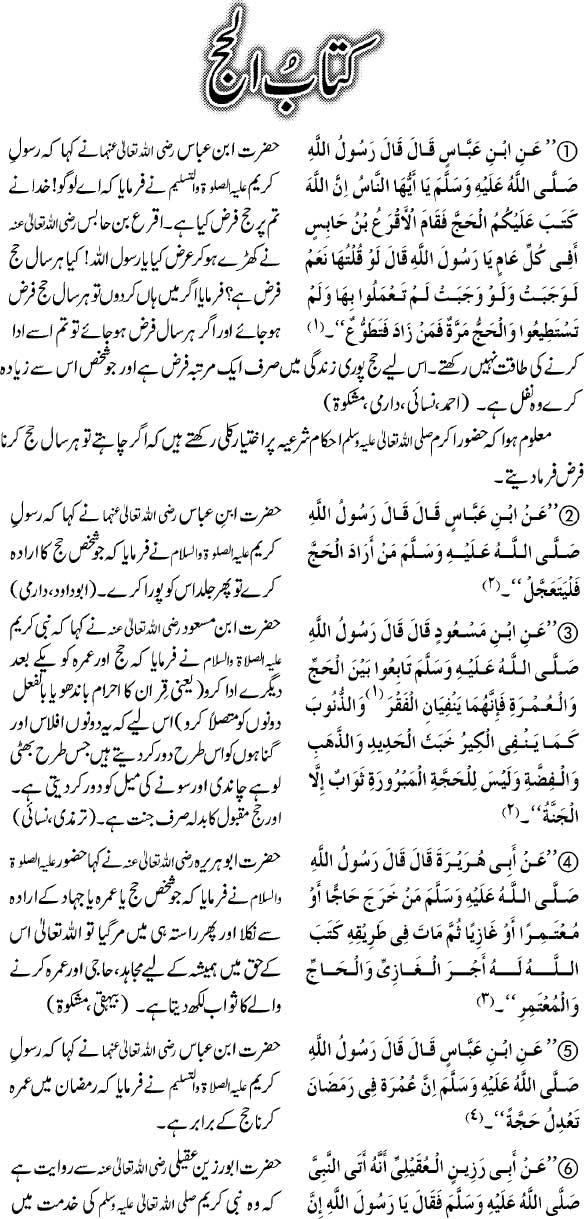

Performing Haj With Gifted Money
HAJ is not obligatory except for those who are able to perform it. This includes the physical and financial ability. But if a person is given a donation through a lawful channel, then it becomes his own property and he can use it for Hajj. This consequently means that a person can give some money as a gift to another so that he can use it to perform Hajj.
It is generally allowed for a Muslim to offer his brother a gift. It is moreover a commendable act. The Prophet (peace be upon him) said: “Exchange presents so that you would exchange love.”
The only condition in this case, when someone pays for the Haj of another as a gift, is that it should be from lawful money. Actually, a sum taken as a gift is acquired through a lawful channel of earning, and thus there is nothing wrong with it, especially if the person who offered it is known for his honesty and trustworthiness. Therefore, a sister can give her brother the costs of Haj as a gift, in the same way, she can perform Haj on his behalf if he is physically unable to do it himself.
When Allah made Haj obligatory, He made the ability to afford it an essential condition for that obligation. Hence, Hajj is not an obligation except on those who can afford it. The exact ability to perform Hajj and to prepare oneself for it is not precisely dictated in the Shariah. What is really important is that such ability is acquired through lawful channels. So, as long as the financial ability is attained through lawful means, there is nothing in Shariah to prevent one from performing Haj from the donated money or the gifts that one receives. This applies whether the financial ability is obtained through work, donation, gift, or else. So, there is nothing wrong with performing Hajj with donated money.
Also, it is permissible to perform Haj, (obligatory or supererogatory) out of the money received as a prize, even if it is intended as some kind of support so that he can perform Haj with it. Hence, a prize or a donated sum transfers to the ownership of the recipient as soon as he or she is in possession of it, so he or she can use it as per his or her wishes.
The evidence of this is the incident of Barirah; she was given some meat in charity. Then she gave it as a gift to Aishah, the Mother of the Believers (may Allah be pleased with her). Aishah cooked the meat but did not present it to the Prophet (peace be upon him), thinking that the Prophet (PBUH) would not partake of it, as it was given in charity. But the Prophet (PBUH) said: “It is a charity on her part, but a present for us.” Then he ate from it.”