


Kindness In Islam
Nasiruddin was the slave of a king, and very fond of hunting. One day he came across a very pretty baby deer and picked it up and rode away. The mother deer saw Nasiruddin take her baby and followed him anxiously. Nasiruddin,
pleased with the baby dear, was thinking about presenting it to his children to play with.
After a time, he chanced to look back and saw the mother deer following him, her expression full of grief. He noticed too that she did not seem to care about her own safety. Moved to pity, Nasiruddin set the baby deer free. The mother deer nuzzled and licked her baby fondly and the two deer leaped happily away into the forest. But many times the mother deer looked back at Nasiruddin as if to express her thanks.
That night Nasiruddin dreamt that the revered Prophet (s.a.w.s.) was addressing him: ” Nasiruddin, your name has been entered in the list of Allah, and you will one day have a kingdom. But remember that when you are king you will also have many responsibilities. Just as you have shown mercy to the deer today, you should be merciful to all Allah’s creatures. You should not forget your people by falling into a life of luxury.” This dream came true and Nasiruddin did become king, Amir Nasiruddin Subaktagin, father of Sultan Muhammad.
The Moral Of The Story …. is that if we wish Allah to be merciful to us, we must be eager to show mercy to all the living creatures of the earth.
When a flower blooms,
its color and scent first touch the garden near it and then spread.
In the same way,
a Muslim’s acts of human kindness should first touch those nearest to him,
his family and his neighbors.
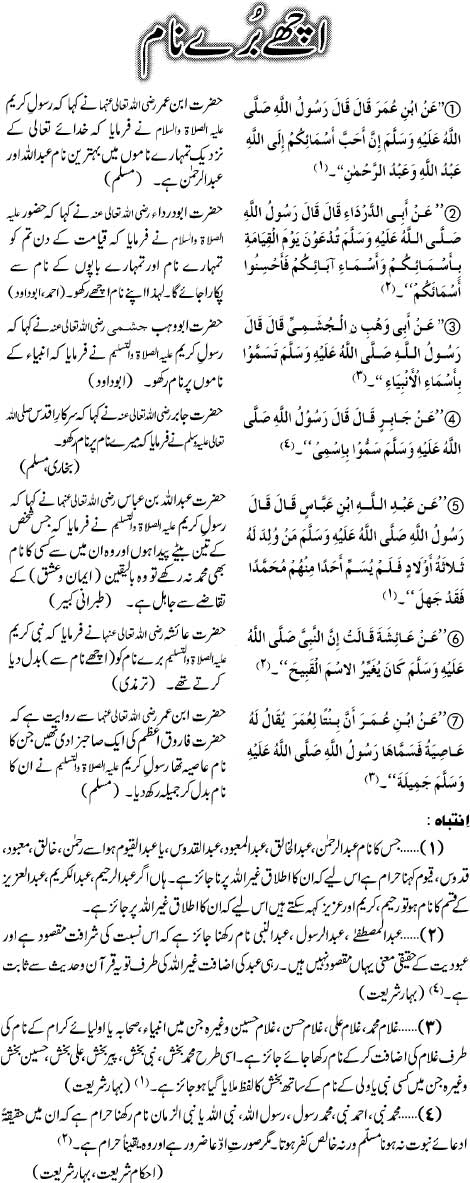
Achay Aur Buray Naam
Companions Of The Prophet Muhammad: Who Were They And Why Are They So Important?
MENTION is often made of the Companions of the Prophet Muhammad (peace be upon him). Just who were they and why are they so important?
A Companion is anyone, man or woman, who met the Prophet (PBUH) – whether for a short or long period – and who died while still Muslim. Many of the Companions were relatives, wives, servants, or close friends of the Prophet. The details of the Prophet’s life – including his words, deeds, and reactions to events – have been handed down to us through the Companions. These accounts form the collection of Hadiths from which we derive the Sunnah, which is the second basis of Islamic law after the Qur’an.
The Companions, men, and women are exemplars of faith. The earliest Muslims suffered terrible torments at the hands of the Quraish, the ruling tribe of Makkah. Those who emigrated from Makkah left behind their homes and families, even all their worldly possessions, to follow the call of Islam.
Many of them were fearless. One of them (‘Ali Bin Abi Talib) was willing to take the place of the Prophet (PBUH) in his bed when the Quraish were planning to assassinate Muhammad (PBUH) in his sleep. Another, a woman (Nusaybah Bint Ka’b), protected the Prophet in the Battle of Uhud. Many others fought fearlessly in the battles to defend their faith.
The Companions memorized the verses of the Qur’an as they were revealed, and those who were lettered wrote the verses down. So many of them devoted themselves to memorizing the entire Qur’an that when Zayd Bin Thabit was tasked with compiling one standard copy, he was able to assure there were no errors in writing by comparing his copy to the memorization of the Companions. Allah promised to protect His Qur’an, and it was through the efforts of the great Companions (and their later followers) that He did so.
Reading through the biographies of the Companions, one is struck by their devotion. Several of them were noted for their ascetic way of life. Others were noted for their extreme generosity. Still, others were noted for their piety and fear of Allah’s wrath – even for sins, they had committed before they embraced Islam, although embracing Islam effaced their sins. Because some of the Companions were in such close contact with the Prophet (PBUH) and familiar with his sayings and doings, their opinions on jurisprudence were often sought and remain recorded in books. Many of the Companions, including his wife A’ishah, survived the Prophet by several decades and were able to pass on their knowledge to two or three generations.
Thus we owe a great deal to the Companions of the Prophet, and we honor and respect them all.
Talaq Kay Masail

Muslims Are Followed And Are Not A Follower
It is obligatory upon Muslims to have pride and honor in their religion. They should also limit themselves to what Allah and His Messenger (peace be upon him) have restricted this upright religion to. This is the religion that Allah is pleased to have His servants follow. There can be no addition or subtraction from this religion.
Furthermore, a Muslim should not be so weak that he follows (every Tom, Dick and Harry). Instead, his personality should be defined by the Law of Allah, such that he is followed and is not a follower, such that he becomes an example and not a disciple. This should be the case because the law of Allah, praise be to Allah, is complete and perfect in all aspects. Allah says in the Qur’an:
“This day, I have perfected your religion for you, completed My favor upon you and have chosen for you Islam as your religion.” (Qur’an, 5:3)
Shajar Kari: Deeni Aur Mili Fareeza

What Sort Of Married Life
When we try to discern the sort of life the Prophet (peace be upon him) had before the start of his message, we have few reports to hand. Interest in his personal life did not develop until later. Before prophethood, he was an ordinary man living in his community. While he did not take part in idol worship and did not attend festivals organized in the name of any idol, he did not stand out as different from other people. He was well known for his honesty and integrity. In fact, people in his community nicknamed him Al-Ameen, which meant the Trustworthy. People trusted him in every way, realizing that he was a man of his word, and he never tried to cheat in any situation. This earned him immense respect in his community. People continued to deposit their valuables with him for safekeeping, even when they were determinedly opposed to his message.
From the few reports that we have of his life after his marriage, up until he received the Angel Gabriel who told him of his assignment as God’s last messenger to mankind, we realize that he led a very happy life, with a caring and loving wife, Khadijah. She recognized his exceptional qualities and provided him with a comfortable home. Many years later, when he had established the first Muslim community and first Muslim state in Madinah, he mentioned that he had a business partner in Makkah called Al-Saib and he praised his partner for his integrity. This suggests that the Prophet continued to run his wife’s business, as he had no money of his own while she was a wealthy lady who employed people to travel on her business. This was how she met Muhammad and recognized his personal qualities. He must have been successful in this, ensuring a comfortable standard of living. When Makkah went through a rough period and people found it difficult to cope, Muhammad (peace be upon him) said to his uncle Al-Abbas: “Your brother, Abu Talib, has a large family and things are hard for everyone. Let us both help him: you take one of his children and I take one to reduce his burden.” This is how Ali came to live with the Prophet in his home, giving him a good upbringing.
Khadijah was a model wife: loving, caring, supporting, and providing everything a man needs. We have good reports about her support when the Prophet was met with open hostility and determined opposition as he called on people to believe in God and abandon idolatry. Yet this was not new in their relationship. A few years before he began to receive his message, the Prophet used to spend time alone in a cave, in contemplation. She made sure that he lacked nothing. When once his absence was a little longer than usual, she sent a few of her servants looking for him.
Her exceptional care stands out when he received the Angel for the first time. This was not an easy encounter. How could it be when there is nothing in human experience to prepare him for it? He was in fear as he looked at the Angel standing above him, with his head high in the sky, and he told him: “You are the Prophet of this community.” It was Khadijah who reassured him, feeling that a man of his upright nature could not be deceived on such a momentous matter. She enlisted the learned support of her cousin, Waraqah ibn Nawfal, who had studied the Bible and gained exceptional experience in religious matters. The two comforted him and helped him recognize the way that he was to lead as God’s messenger. Khadijah’s support was the best he could have received in his hour of great need.
– By Adil Salahi
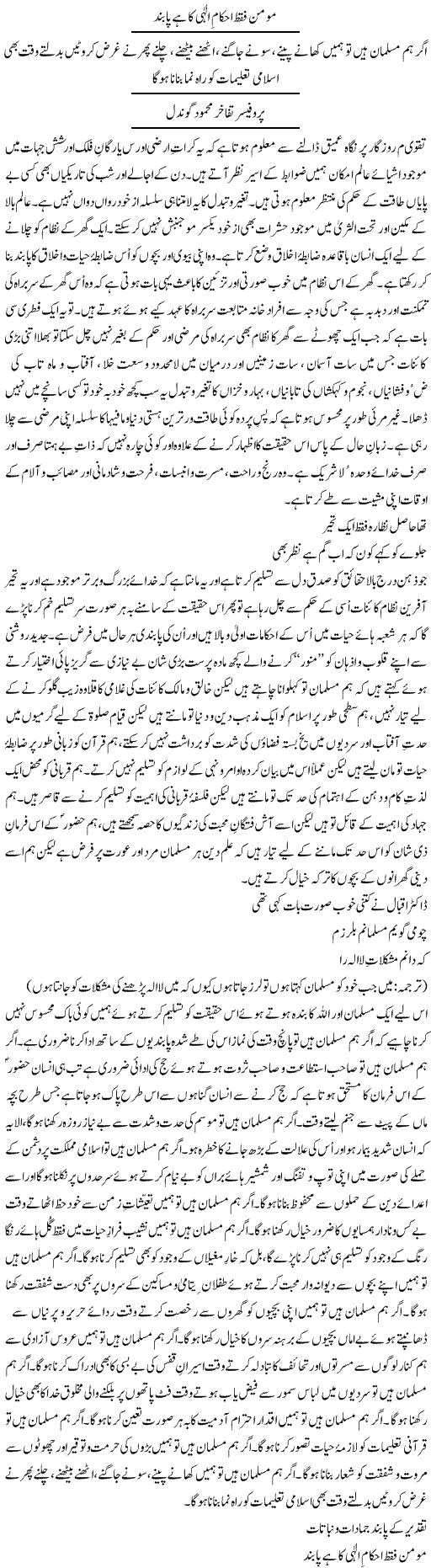
Momin Ahkam-e-Ilaahi Ka Paband Hai
A Chance That Must Not Be Missed
Allah forgives all sins. Therefore, people should make haste and repent of their sins so that they could earn His forgiveness. It calls on them to heed its call: come on all of you, then! Come on “before the suffering comes upon you, for then you cannot be helped.”
Should the chance be missed, there can be no help. The chance is open now, but its duration cannot be guaranteed. In fact, it can terminate at any moment of the night and day. Therefore, come on and “Follow the best that has been revealed to you by your Lord,” which is this Qur’an that you now have at your fingertips, “before the suffering comes upon you of a sudden, without your being aware of it.”
Come on now before it is too late. Otherwise, you will regret missing the chance and ridiculing God’s promise: “lest anyone should say: Woe is me for having neglected what is due to God, and for having been one of those who scoffed (at the truth).”
Alternatively, someone may say that God condemned him to be in error: had He decreed that he would follow divine guidance, he would have been a God-fearing person: “or lest he should say: ‘If God had but guided me, I would surely have been among the God-fearing.”
This is a baseless excuse: the chance is offered to everyone, the means are available to all, and the gates are wide open. Yet people deliberately miss out: “Or lest he should say when faced by the suffering (that awaits him): If only I could have a second chance in life, I will be among those who do good.” This is something that will never be given. Once this life is over, no return is allowed. All people are now at the stage when they can do what they want. If they miss this chance, all is lost. They will be held to account, and they will be rebuked: “Yes, indeed! My revelations did come to you, but you rejected them. You were filled with false pride and had no faith at all.”
At this point, when the surah has brought our feelings and hearts to the Day of Judgment, it shows us the two contrasting images of the unbelievers and the God-fearing on that momentous day: “On the Day of Resurrection you will see those who invented lies about God with their faces darkened. Is not there in hell a proper abode for the arrogant?
But God will deliver those who are God-fearing to their place of safety: no harm shall afflict them, nor shall they grieve.”
This is the final end: one group has faces darkened by humiliation, sorrow, and the scorches of hell. These are arrogant who, during their lives in this world, were called to turn to God and believe in Him, and the chance was kept open for them even after they went far into sin, but they refused to pay heed.
Now, on the Day of Judgment, they are left in utter humiliation that shows in their faces. The other group is the winner who will not be touched by grief or affliction. These are the God-fearing who, during their lives on earth, paid heed to God’s warnings and hoped for His mercy. They are the ones who will be safe: “No harm shall afflict them, nor shall they grieve.”
With all issues made abundantly clear, let everyone choose what they want. They can either respond to the call and enjoy God’s grace they are certain to find just behind the open gate of repentance, or they can persist in disobedience until the suffering takes them unawares.
God’s oneness, from the angle of the oneness of the Creator who created and controls everything. This serves to show how singular the unbelievers’ offer to the Prophet was that he should join them in worshipping their idols in return for them joining him in worshipping God.
Since God is the Creator and Controller of all, how could anyone be worshipped alongside Him? “No true understanding of God have they,” when they associate partners with Him when He has sway over all and everything, subjecting them all to His will: “on the Day of Resurrection, the whole earth will be a mere handful to Him, and the heavens will be rolled up in His right hand.”
As this image of the Day of Judgment is shown here, the surah presents a unique scene of that day, culminating with the angels surrounding God’s throne, extolling their Lord’s glory and praise. The entire universe joins them in their praises: “All praise is due to God, the Lord of all the worlds.” This is, then, the decisive word on the issue of God’s oneness.
by Adil Salahi
Permission is granted to circulate among private individuals and groups, to post on Internet sites and to publish in full text and subject title in not-for-profit publications.
Reply
Reply to this message…
See