
Don’t Do’s For Eid
- Men “beautifying” themselves by shaving the beard. This is a thing that most Muslims do, even though shaving the beard is Haraam in the Religion of Allah, the Perfect and Free from all imperfections. This (ruling) is shown in authentic narrations that contain a command to leave the beard. The beard is also from the Fitra, and it is not permissible to change the Fitra. Textual proof regarding the forbiddance of shaving the beard is found in the books of the four schools of thought.
- Shaking hands of strange women – those that are not Mahram for a man. This is one of the widespread problems that we suffer from and none is saved from it except he whom Allah has favored. This act is prohibited (Haraam) because the Prophet (peace be upon him) said: “To pierce a metal comb into a man’s head is better for him than for him to touch a woman, for whom he is not a Mahram. ” (Silsilatul Ahadeeth As-Saheehah, no. 227) This ruling is also found in the books of the four schools of thoughts.
- Imitating the non-believers and Westerners in their clothing, in listening to music and other reprehensible acts. Indeed the Prophet (peace be upon him) said: “Whosoever imitates a people then he is from them. ” (Ahmad) Also, because of the saying of the Prophet (peace be upon him): “There will be a group of people from my Ummah who will seek to make fornication, the wearing of silk, intoxicants and musical instruments permissible (Halaal). Indeed a people will stay at the side of a mountain peak and when he – i.e. a needy person comes to them in the evening asking them for aid, they will say to him, ‘Come back tomorrow.’ Allah will destroy them and cause the mountain to fall upon them and change others into apes and swine and they will remain like that until the Day of Judgement.” (Abu Dawood and Al-Baihaqee)
- Tabarruj (open display of beauty) by women. This is prohibited in the Laws of Allah. The Prophet (peace be upon him): “I have not seen two types of people from the people of the Fire: … women that are clothed but at the same time naked and are (deviated away from the obedience of Allah). Their heads are like tilted camels’ humps. These women will not enter paradise and neither will they smell its aroma; even though its aroma can be smelt from a distance of so and so.” (Saheeh Muslim)
- Being extravagant in spending. The Prophet (peace be upon him) said: “The son of Adam will not cease to be in front of his Lord on the Day of Judgement until he is asked about his…. wealth and where he gained it from and how he spent it.” (Tirmidhi)
- Abandoning prayer in the mosque by many people, without a valid excuse. Some people do not pray at all except the Eid prayers. By Allah, this is a great sin.
- Not having any compassion for the poor and the needy. The rich display their joy and happiness, eat appetizing food in front of the poor and their children, without having any sympathy to help. Allah’s Messenger (peace be upon him) said: “None of you truly believes until he wishes for his brother that which he wishes for himself ” (Al-Bukhari)
Ajnabi Aurat Kay Sath Tanhai
Exposing Modern Muslim Misleaders
Strangely, there is a class of so-called “Muslims” supported by Western neo-con think tanks who are full-time “da’ees” inviting people to the path of Shaitan, in the name of Islam.
These “Muslims” go to great lengths to explain how we should not practice our faith. In short, keep the title only, but discard the religion.
They are the new modernists created and funded by people who are working non-stop in their war against Islam. Nothing is obligatory for them. No rules at all. Here are some general issues with these people:
1. They attack the sources
They do not want to understand the Qur’an in the way it should be understood, even though the verses are very clear. They belittle the second most important source of Islam – the Hadith. They either play on the ignorance of Muslims or invent blatant lies about the Hadith.
Let there be no doubt left that the way Hadith has been preserved is superior to any standard of authentication ever known to human history and that will ever be known till the Day of Judgment. Such are the sciences of Hadith. Such is the manner in which the Hadith were preserved. The Ahadith are 500% more verifiable, more authentic, and hence have more reasons to be believed in, than the front-page report of any newspaper. Such was the strict conditions applied for the acceptance of Hadith. Usool Al-Hadith (sciences of Hadith) will testify to that.
2. Changing Islam
These “Muslims” really believe in secularism, not in the pure Shariah. So they try to fit Islam according to the world’s ever-changing standards of ethics. They have a problem with accepting some of the laws of Islam or few things that may have been permitted or prohibited in Islam. Allah says:
“Do you believe in some parts of the Book and disbelieve in other parts? Whosoever does that would be subjected to humiliation in this life and a severe punishment on the day of resurrection.” (Qur’an. 2:85)
Realize O Muslim! Whose Messenger was Muhammad? Allah’s! His actions, his sayings, and his commands are based on the revelation from Allah. It is sufficient for non-Muslims and the skeptics to verify if Muhammad (peace be upon him) was truly a messenger or not and if the Qur’an is truly divine or not. And there are overwhelming evidence that would leave no room for doubt about the truthfulness of Islam. So if you have verified this to be true, then you cannot question the commandments of your Creator.
We are Muslims – we submit to Allah and His Messenger. When Allah and His Messenger have said something, we humbly accept it. Muslims submit to the truth immediately.
“It is not fitting for any believer, man or woman, when Allah and His Messenger have decreed a matter, to have a choice in their affair. And whosoever disobeys Allah and His Messenger, he has gone astray into manifest error.” (Qur’an, 33:36)
“But no, by your Lord (Rabb), they can have no faith until they make you the judge in all disputes between them, and find in their souls no resistance against your decisions, but accept (them) fully with submission.” (Qur’an, 4:65)
What Allah and His Messenger say is right, is right, and what they say is wrong, is wrong. End of discussion. Yet, Islam is a natural religion. It is a religion of Fitrah – the natural state in which man is born. It is based on our Creator’s Guidance. So it doesn’t order or command anything that is against the general interest of man.
One such “Muslim” writer of a recent article that was supposedly defending the Prophet (peace be upon him) called for the separation of the state and the religion in Muslim lands, called for the Hadith to be limited to “common history” and to detach away from “man-made laws” of “medieval word” and step into “21st century”. What fallacy!
Just tell me how this isn’t different from secular propaganda? So, typical secular propaganda has come in the form of an “Islamic article” that “defends” the Prophet (peace be upon him). Yet this “defense” in effect calls to reject the commandments of the Prophet (peace be upon him) in our daily life, in our economic life, and in our political life! What love and what defense?!
Let’s break down these general phrases of the writer into something practical to understand its implications, shall we? The following is the direction of the “secular states” we see in our world today:
• Man is the superior being. No place for God.
• Riba (Interest) is perfectly “OK” for the 21st century.
• Premarital sex: It’s people’s choice! Marriage: Debasement and abuse.
• Homosexuality: Must be permitted. We’re in the 21st century. Freedom!
The writer says if we Muslims don’t “step into 21st century” and accept these “universal human rights”, which I have summarized above, “then we better be prepared to be mocked as stragglers in the caravan who are slowing down the progress of all humanity.”
Mr. Writer, Muslims need not leave their religion to escape the mockery of a people who don’t believe in Allah!
Just tell me how and why should man’s stances change on these immoral issues I’ve listed above? These evils don’t change into good because of advancement. What is advancement? What is enlightenment? What we see in today’s world is only scientific advancement. Socially, we are falling and regressing to new lows.
Nay, Muslims need not change their fundamentals to be accepted by the world. The world is stumbling down towards its destruction by adopting hedonism in the name of freedom. Muslims need not follow that path. Islam dictates every aspect of our life, and we should be proud of that! Our Creator did not leave us to wander without guidance and fall into the pits that we see the world falling into. We are the ones who believed in His Message.
Yes, the divine laws came down 1400 years ago. But they were with imbued such wisdom that they could be applied in the 21st century and in the centuries to come. While Shariah has specific laws for things that don’t change, it largely has general outlines and principles that can be applied to any issue that may come up with the advancement of time.
There have been in the past and will always be in the future people who call people towards the path of Shaitan and who work tenuously to misguide Muslims. But Allah has promised to protect Islam. So Islam has not changed through the ages and it will continue to be protected till the Day of Judgment.
We as Muslims must be careful about the sources where we take our Islam from. We should learn Islam from the roots – the Qur’an and the Sunnah.
We should learn Islam from scholars who stick to the Qur’an and Sunnah and the interpretation of the early generations of Muslims. Because the understanding of the early generations is what is authentic and has been approved of by Allah and His Messenger.
Eid ul-Fitr Aur Eid Al-Adha
The Greatest Statement Ever
MILLIONS of Muslims around the world pronounce this statement on a regular basis. It is heard in the call to prayer, in our daily lives, in sermons, read in books, fought and died for, and the basis of our religion. It differentiates believers from non-believers and is the key to enter into paradise. All the Messengers and Prophets came to propagate and teach it in order to take people from darkness to light. Above all, it is the reason Allah created us for. Allah says in the Qur’an:
“And I (Allâh) created not the jinns and humans except they should worship Me (Alone)…” (Qur’an, 51:56)
The testimony of faith, the Kalimtul-Haqq, the Kalimatul-Ikhlas – Laa ilaaha illa Allah – comprises the greatest statement ever. It means ‘None has the right to be worshipped except Allah’. However, as we all utter these beautiful words on a daily basis we should ask a few questions:
Do we understand it and fulfill its obligations?
Are we aware of its conditions?
Just utterance alone without understanding its meaning is something that may not stop us from associating partners with Allah; something that is the essence of this great statement. Allah says in the Qur’an,
“Worship Allâh and join none with Him in worship…” (Qur’an, 4:36)
Allah, our Creator, and Sustainer has commanded us to worship Him alone, without any partners.
We may think we are, but without knowledge of this statement can we really knowingly stop ourselves from the gravest of sins?
“Verily, Allâh forgives not that partners should be set up with him in worship, but He forgives except that (anything else) to whom He pleases, and whoever sets up partners with Allâh in worship, he has indeed invented a tremendous sin.” (Qur’an, 4: 48)
The statement has two pillars:
1-NEGATION
None has the right to be worshipped
To negate anything and everything that is worshipped besides Allah
2-AFFIRMATION
Except Allah
To affirm that Allah and only Allah has the right to be worshipped
Conditions of Worship:
Must be sincerely for the sake of Allah alone
Must be in accordance with the Sunnah of the Prophet (peace be upon him)
Types of worship in the Qur’an and Sunnah:
Supplication (Du’a), Fear (Khawf), Hope (Rajaa), Reliance (Tawakkul), Longing (Raghbah) and Dreading (Rahbah), Submissiveness (Khushoo’), Awe (Khashyah), Repentance (Inaabah), Seeking Assitance (Isti’aanah), Seeking Refuge (Iti’aadhah), Asking for Help (Istighaathah), Offering Sacrifices (Dhabah), Making Oaths (Nadhar) and all other types of worship that Allah commanded – all of these belong to Allah alone.If any act of worship is directed to other than Allah, then Shirk has occurred.
Conditions of the Laa ilaha illAllah are seven:
Conditions Results
- Knowledge expels ignorance
- Certainty expels doubt
- Sincerity expels shirk
- Truthfulness expels hypocrisy
- Love expels hate
- Submissive compliance expels deviation
- Acceptance expels rejection
References: Aqeedah of Tawheed, by Sheikh Saleh Al-Fawzaan and The Three Fundamental Principles, by Sheikh Muhammad Ibn Abdul Wahhab Virtues of Laa ilaaha illAllah
Haafidh Ibn Rajab mentions many virtues of this statement in his essay entitled Kalimatul-Ikhlaas ( p. 54 -66)
- It is the price to pay for the Gardens of Paradise
- His whose last words are none has the right to be worshipped except Allah will enter Paradise
- It is a salvation from the Hellfire
- It necessitates being forgiven
- It is the best of all good actions
- It wipes away sins
- It renews the faith in the heart
- It outweighs the record of sins on the scales
- It is the best of what the Prophets have said
- It is the best form of remembrance, the best of actions, and the one that is multiplied the most in reward
- It is a protection against the devil
- All eight gates of Paradise will be opened to its testifier and he may enter from any gate he chooses
With all this in mind, it is imperative that we all learn its pillars and conditions so that we can say it with full meaning and understanding preventing us from falling into associating partners with Allah.
Indeed Allah has forbidden for Hell the person who says ‘There is nothing that has the right to be worshipped but Allah’, seeking thereby the Face of Allah.
(Bukhari and Muslim)
Tawakul Ki Targheeb

Woman – the Concealed Jewel
It is to you, the founder of generations, and producer of great men. I will point out in it some of what Islam requires of the individual and the society concerning the rights of women.
1) Have you seen the jewel? Why is it that the people love it while it is simply a piece of art? It is because it is not so easy to see it, nor can you touch it. Similar is the case of the woman – it is forbidden for a man to see her or touch her, in order that he does not dishonor her. She is like an untouched (pure) jewel, which is affected by the least touch.
2) Have you seen how a rose wilts, withers, and loses its luster and beauty if it is touched too much.
Likewise, the woman is not allowed to be touched except by one in a lawful relationship of marriage. And whoever attempts to touch her – unlawfully – will earn a severe punishment or death.
3) Do you know the punishment for one who violates the marriage trust and betrays his wife? The penalty is death since he has fallen short in regards to the jewel which is with him, in addition to transgressing the rights of others.
4) Have you seen a jewel searching for a person (to possess it)? The same is the case of the woman, like a precious jewel, she is the one who is sought out, not the seeker.
It is incumbent upon the man to seek her hand. And if she agrees to marry him, then he will present to her a marriage dowry and something from his wealth.
5) Allah has created the male strong of the body in order that he may go out and earn his livelihood, even in difficult circumstances. This is so that he may serve the women and children of his family.
As for the woman, she has been created gentle, soft and sensitive, so that she may cultivate the future generations. The man goes out and works with the natural elements, while the woman deals with the human beings (raising the children).
6) The woman is allowed to work in any occupation, which she is capable of, as long as it is in consonance with the nature of her delicate physique.
7) The woman – like man – is addressed in the divine revelation with responsibilities for which she – like a man – is equally rewarded.
8) The woman is excused from certain religious observances and obligations during her post-childbirth and menstrual periods since these conditions are a cause of weakness and hence, she is in need of rest and relaxation.
9) The person who is killed while defending his mother, wife, daughter, or sister will be rewarded with the highest station in Paradise.
10) It is permissible for a woman to seek a separation from her husband if he fails to fulfill her marital rights.
11) It is permissible for the woman to remarry – whomever she desires – if he is divorced from her husband or widowed.
12) If a woman possesses wealth, she is free to use it in any lawful way, without permission of anyone (father, husband, or others.)
13) The woman has the right to the inheritance of her relatives – at the time of his death – even if he does not desire that she receive it.
14) It is obligatory upon the man to spend his wealth for the maintenance – housing, food, etc. – of those under his care including his mother, wife, or daughter, even if he doesn’t desire to do so.
15) The mother has been given preference over the father – three times over – concerning their right to kindness and benevolence from their children.
16) Whoever has daughters and treats them well – they will be a cause of him being screened from the Hellfire.
17) The Messenger of Allah (peace be upon him) advised concerning the woman: Treat the women well. He also said: The best of you are those who are the best in the treatment of their wives.
He also said: No one honors the woman except an honorable man. And no one humiliates her or holds her in contempt except one who is evil, vile, wicked, and depraved.
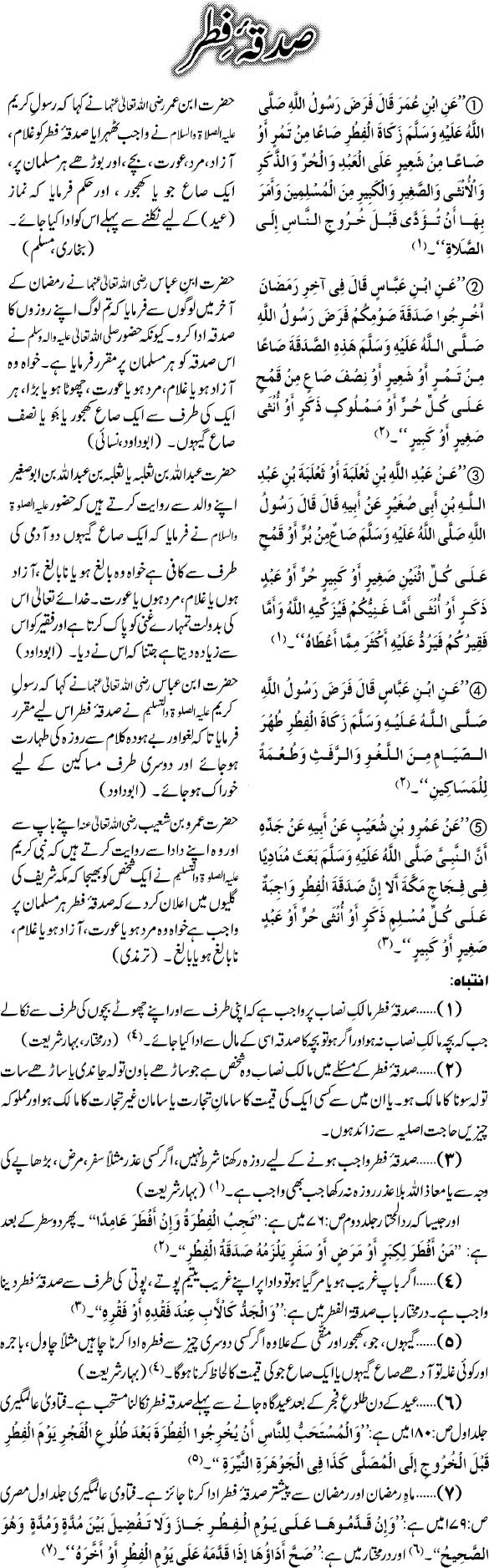
Ramadan: Sadqa-e-Fitr
Dua To Keep Our Hearts Steadfast
While many of us remember to supplicate to Allah for guidance, knowledge, and Paradise, there is one important thing that we forget to include in our prayers. In a narration that many of us are familiar with, the Prophet (peace be upon him) said: “Unquestionably, in the body, there is a lump of flesh; if it is sound, the whole body is sound, and if it is corrupt, the whole body is corrupt, and behold, it is the heart.” (Al-Bukhari and Muslim)
Countless scholars of Islam have dedicated books upon books to reformation and purification of the heart because it is the key to success or destruction. Just as doctors today tell us that having a healthy heart is the key to having a healthy body, the Prophet (peace be upon him) conveys to us that having a good heart is the key to righteousness.
Anas narrated that asking for a firm and obedient heart was one of the constant supplications of the Prophet (peace be upon him); and one narration from Umm Salamah states that the Du’a he made the most was: “Allahumma ya Muqallib Al-Quloob thabbit qalbi ‘alaa Deenik,” which means, “O Turner of the hearts, make my heart firm upon Your Religion.”
There is, however, another authentic Du’a narrated in Sahih Muslim that isn’t as well-known: “Allahumma Musarrif Al-Quloobi Sarrif Quloobana ‘Ala Ta’atika,” which means, “O Allah, Turner of the hearts, direct our hearts to Your obedience.”
Selected words analysis
Musarrif/Sarrif: Both these words come from the same root, which has many meanings such as, to turn, to divert, to turn from another direction, to avert, and to change. The meaning of this word in this Du’a is to turn or direct. How is this word different from “Muqallib Al-Quloob?” There are a few linguistic differences, but the essence of both supplications is the same. Qallaba, just like Sarrafa, means to change and turn the direction of something.
The linguistic difference is that Qallaba points more to constant moving and turning about, while Sarrafa points to changing of the direction. When we make this Du’a, we are asking Allah to Sarrif (turn and direct) our hearts to His Obedience, while in the other Du’a, we are asking Allah to Thabbit, i.e. make our hearts firm on Islam, and not Qallib because the heart is constantly changing about and turning directions.
Quloob: Quloob is plural of Qalb which means the heart. Qalb is the general word for heart. It comes from the root which means something that turns around and about and upside down, as mentioned above. It is the nature of hearts that they are constantly changing.
Ta’atika: Ta’ah means to obey and to submit. The beauty of this word is that it not only means to submit one’s self, it specifically means to submit willingly, voluntarily, and on one’s own free will. We are asking Allah to direct our hearts to willingly submit and obey Him.
Points of benefit
Supplications regarding the heart are found both in the Qur’an and Sunnah. In the Qur’an, the believers supplicate, “Our Lord, let not our hearts deviate after You have guided us.” (Qur’an, 3:8) Also in Surah Hashr, “And (there is a share for) those who came after them, saying, “Our Lord, forgive us and our brothers who preceded us in faith and put not in our hearts (any) resentment toward those who have believed.” (Qur’an, 59:10) Both of these Du’as are seeking refuge in Allah from corrupted hearts. The first Du’a seeks refuge from deviation after guidance, and the second from evil and ill-feelings towards fellow Muslims.
• The Prophet (peace be upon him) constantly made Du’a for a righteous and good heart. We learn from this the status of the heart and that we too should supplicate as much as we can for an obedient and a heart standing firm upon Islam.
• The nature of the heart is to constantly change, and asking Allah to direct our hearts to His Obedience shows that we are constantly falling short in our obedience to Him. By this Du’a, we ask Allah to keep turning our hearts back to His Obedience as we are prone to falter.
• Scholars like Imam Ibn Qayyim and Ibn Uthaymeen state that the intelligence and the understanding of a human lie in the heart, and not necessarily the brain. Their evidence for this statement is the verse, “So have they not traveled through the earth and have hearts by which to reason and ears by which to hear? For indeed, it is not eyes that are blinded, but blinded are the hearts which are within the chests.” (Qur’an, 22:46) Sheikh Ibn Uthaymeen says the brain is like a secretary who processes information, but it is the heart that decides to do good or evil based on that information.
• The heart is the foundation. We must purify our hearts from associating partners with Allah, from Bid’ah, from ill feelings against our fellow Muslims, and other evil deeds in our character and our theology. The Muslim should focus on the reformation of his heart as well as the accumulation of good deeds. The heart is the source of good deeds. It will be tested on the Day of Judgment. Allah says, “Knows he not that when the contents of the graves are brought out and poured forth (all mankind is resurrected). And that which is in the breasts (of men) shall be made known. Verily, that Day (i.e. the Day of Resurrection) their Lord will be Well-Acquainted with them (as to their deeds), (and will reward them for their deeds). (Qur’an, 100:9-11).”
• In another Hadith, the Prophet (peace be upon him) pointed to his heart and said three times, “Taqwa (consciousness and fear of Allah) is here.” (Musnad Ahmad) This Hadith shows us that when the heart fears Allah, then the limbs will follow, just as the first Hadith narrated that, “If it is sound (the heart), the whole body is sound.”
• This Du’a is a constant reminder for us that we are not in control of our guidance. It is crucial for us to make Du’a for our hearts on a regular basis because we do not know what the condition of our hearts will be tomorrow. The hearts of the children of Adam are between the two fingers of Allah, He turns them to any (direction) He likes. So, who else can we turn to than Musarrif Al-Quloob to keep our hearts towards the direction of His obedience?