

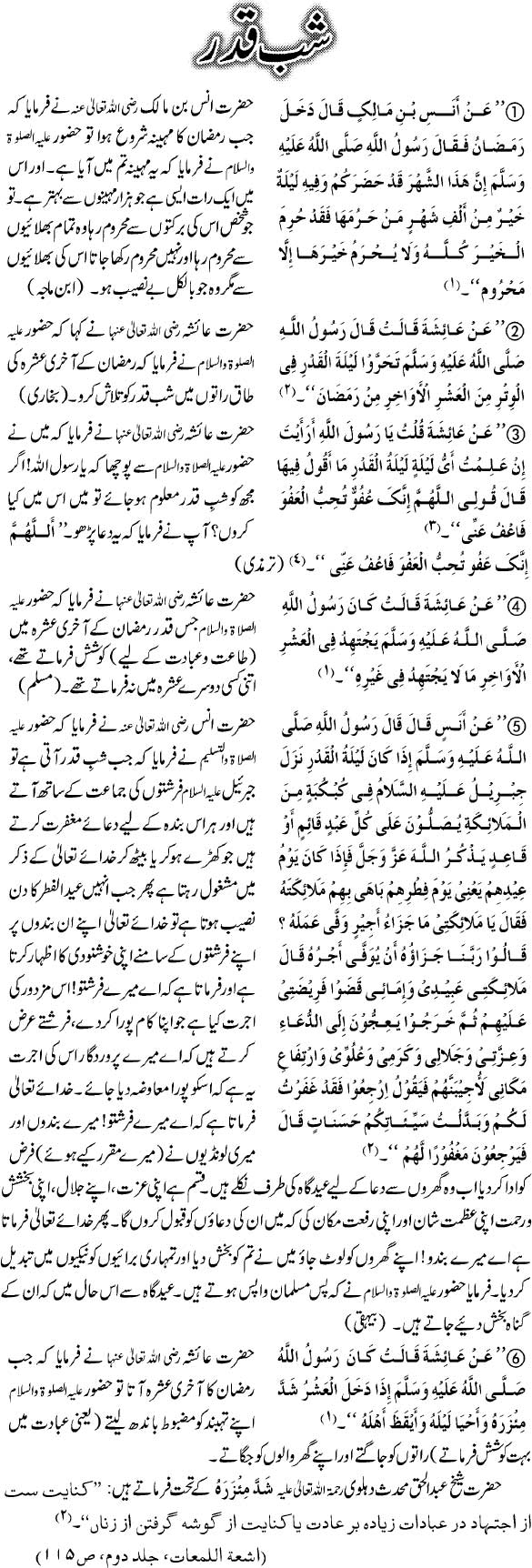
Prophet’s Special Deeds In Ramadan
When the holy month of Ramadan arrives, everyone in the Muslim Ummah feels a delightful uplift in faith. They feel less inclined towards sins and wasteful pursuits and more towards keen, soulful worship and contemplation of the Qur’an.
They change their routines according to the new schedule of eating, sleeping, and standing in prayer and look forward to great rewards in the Hereafter for their month-long ritual of abstinence and piety.
It is interesting to note the diversity that prevails in our Ummah regarding worship during Ramadan, which arises from everyone’s unique circumstances. The office-going executive might not be able to pray long, soulful Qiyam Al-Layl every night before Suhoor because of having to get enough sleep for his strenuous weekday work hours, but can zealously attend Taraweeh with the Imam after Isha to get the same reward.
School and college-going youngsters might find it difficult to tear themselves away from studies, but they might read some Qur’an every day before Iftar. The elderly grandmother might spend long morning hours reading the Qur’an and revising her memorization, whilst the young housewife who is inundated with housework for the rest of the day might attend a ladies’ morning Halaqah at a neighborhood home to study one Juz of the Qur’an daily.
This lovely diversity lends extra beauty to the flexibility of our Deen, Islam, which caters to each individual according to what he or she is capable of. Let us take a quick look at three of the main Ramadan activities that authentic Ahadith attribute to our beloved Prophet Muhammad (peace be upon him):
More generous than the fast wind
Narrated Ibn Abbas: “The Prophet was the most generous amongst the people, and he used to be more so in the month of Ramadan when Jibreel visited him, and Jibreel used to meet him on every night of Ramadan till the end of the month. The Prophet used to recite the Qur’an to Jibreel, and when Jibreel met him, he used to be more generous than a fast wind (which causes rain and welfare).” (Al-Bukhari, 3/31, no. 126)
The Messenger of Allah (peace be upon him) used to be so generous in Ramadan that this action of his was particularly notable to onlookers. Imagine for a minute what fast winds achieve: they feel good, firstly, in addition to filling our hearts with excitement about imminent rain.
They assist in pollination that brings forth vegetation in the land (fruit, grains, cereals, and vegetables) that we eat. Now use this simile to imagine what the Prophet must have been like during Ramadan – a generous man spreading the wealth, goodwill, hope, and happiness everywhere with his big-hearted spending for the sake of Allah!
Reviewing the Qur’an with Jibreel
Archangel Jibreel would visit the Prophet (peace be upon him) every night in Ramadan to listen to the Qur’an. The Prophet (peace be upon him) would recite the Qur’an to him, i.e. the entire Qur’an that had been revealed to him till then. In a way, he used to “revise” or “review” the Qur’an with the Archangel.
Ten-day secluded worship
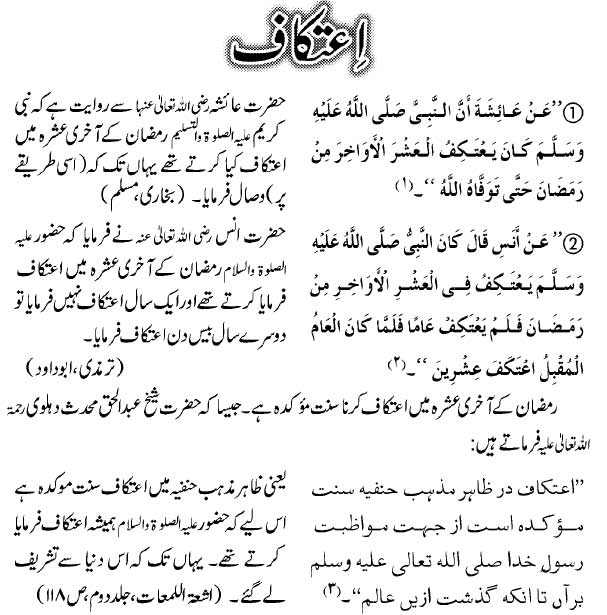
“The Messenger of Allah (peace be upon him) would go into seclusion for (the last) 10 days during the month of Ramadan, but the year in which he passed away he went into seclusion for 20 days.” (Al-Bukhari)
For a man who was always busy leading the Ummah in all its affairs and attending to his family and companions, it is indeed poignant to note that he withdrew in seclusion every year to be close to His Lord. So much so that he did not communicate, or spend time, with his family except for meeting their basic needs.
Narrated Ayesha: “Allah’s Messenger used to practice I’tikaf in the last 10 nights of Ramadan and used to say, ‘Look for the Night of Qadr in the last 10 nights of the month of Ramadan’.” (Al-Bukhari)
Lessons for us
By keeping in mind these three specific Sunnah of our dear Prophet Muhammad (peace be upon him), we can devise an action plan for our worship during the holy month that incorporates, if not in entirety, their spirit, and essence in our schedule.
We can try to give charity every day, even if it is little. We should review the Qur’an for our angels, the Kiraman Katibeen (Honorable Scribes), to record in our book of deeds on a daily basis, and in the last 10 days seclude ourselves socially from our family and friends for devoted worship and prayer to Allah. By this, we will earn a reward of following the Sunnah and emulating our Prophet’s actions during Ramadan, Insha Allah.
Khatam e Nabuwat: Hazrat Muhammad (P.B.U.H)

Qur’an: Witness The Miracle
Night after night in Ramadan, the believers witness a unique spectacle at mosques around the world. They stand in special Taraweeh prayers in which the prayer leader will recite the entire Quran from memory. Those who have accomplished this extraordinary feat of memorizing all of the 6246 verses are not a handful of devotees but there are hundreds of thousands of them. Most, just like most Muslims in the world today, do not speak Arabic. Yet they have painstakingly learnt to pronounce each and every word of the Quran correctly. The phenomenon is not a result of some religious resurgence that would pass. From the very first day that the Quran was revealed, it was memorized. And the number of those who have memorized it has been increasing ever since. Memorization of the Quran has been going on all through the centuries, all over the globe wherever Muslims are.
There are other religions that claim to possess the Word of God. There are none that can show a book that has commanded anything remotely comparable to this level of devotion. Quran is the most read and the only completely memorized book in the whole world. It is also the most studied book in the world. It has stimulated the development of entire disciplines of knowledge dealing with its reading, writing, and interpretation.
Miraculous as it is, this is not the only unique aspect of the Quran.
Quran was the first book in the Arabic language. Yet fourteen centuries later, its language is as alive as it was when it was revealed. And there is no other example of when the very first book in a language became any masterpiece let alone the eternal masterpiece that the Quran is.
This Book is meant to command and guide humanity until the end of time. That the passage of fourteen centuries has not made the slightest dent in its language or literary beauty is only one evidence of that unique role; its contents have also been unassailable by the passage of time. It makes statements of scientific facts that science would discover centuries later but none that science could ever refute. It tells about ancient histories, like the civilization of the ‘Aad people in the Empty Quarter of the Arabian desert that no other historical sources, then or since, contain any information about. Yet, its veracity has only recently been verified by scientific discoveries. Above all, it provides a system of beliefs and a code of conduct for life that is as relevant, illuminating, and true today as it was fourteen centuries earlier and during all the centuries in between.
The believers know that this Book had to be above space and time because this is the Word of the Creator of space and time. And He has promised that it will always be above space and time. But those who are looking from the outside and are just curious may consider these additional facts:
Prophet Muhammad, Sall-Allahu alayhi wa sallam, did not go to any school, study from any teacher, or even learn how to read and write. He even had no interest in poetry, which was one of the most prized disciplines of his time. Yet suddenly at age forty, he began to recite this marvelous revelation.
The style of the Quran is very distinct from the words of the Prophet, Sall-Allahu alayhi wa sallam, himself, which also have been preserved in Hadith collections. His own sayings are embodiments of eloquence, but they have a different style. Moreover, they clearly are the words of a human being. Although never deviating from the truth, they do show human emotions and the effects of the circumstances in which they were said. Quran, on the other hand, never shows the slightest trace of these effects. It always speaks from above.
It was revealed over a twenty-three-year period and covers a very wide range of subjects yet it shows neither a gradual development of style nor any self-contradictions in the voluminous text.
The twenty-three years of Prophetic life was not a period spent in isolation. He did not retire to a cave to produce this miraculous work. The Prophet, Sall-Allahu alayhi wa sallam, did spend long periods of time in quiet meditation in Cave Hira before becoming a Prophet. But after Prophethood was conferred upon him, his life was one of constant struggle with the pagans, and later the Jews, of Arabia who spared no effort to stop and persecute him. It was during this period of persecution, wars, campaigns, and solving problems associated with the bringing about of the greatest civilizational revolution of all times — an extremely busy and challenging period — that Quranic Revelation was also received and compiled.
The Prophet, Sall-Allahu alayhi wa sallam, himself was most deeply moved by the Book. He used to stand for hours in solitary midnight prayers reciting from the Book until his feet used to get swollen. How preposterous that one should attempt to attribute the Book to him. Has there ever been another example of somebody getting so moved by his own words?
This is not meant to be an exhaustive list of all the evidence that proves the Quran to be the Word of God. Scholars have written books expounding the miracle of miracles that the Quran is. But even this small sampler may propel an inquiring mind to go and read the Book himself.
To read this book with an open mind is to believe in it. Those who sincerely seek guidance will find their questions answered, their confusions removed, their problems solved in its pages. From the beginning until the end, every word in the Quran tells the reader that it is the Word of Allah. And those who ignore it do so at their own peril.
“And if you are in doubt as to what We have revealed to Our servant, then produce a Sura like thereunto; and call your witnesses or helpers (if there are any) besides Allah, if your (doubts) are true. But if you cannot – and of a surety, you cannot – then fear the Fire whose fuel is men and stones which is prepared for those who reject Faith.” [Al-Baqarah 2:23-24]
By Khalid Baig
Ramadan: Itikaf
Martyrdom Of Imam Ali Ibn Abu Talib
`Ali Ibn Abu Talib was the Prophet’s nephew; his father was Abu Talib Ibn Abdul Muttalib, and his mother was Fatimah bint Asad. He embraced Islam when he was just seven. He married Fatimah, the Prophet’s daughter and apple of his eye and the mistress of believing women in Paradise. Fatimah bore him Al-Hasan, Al-Husain, Zainab and Umm Kulthum.
On the Day of Khaibar, the Prophet, peace be upon him, said: “Tomorrow, I will give the banner to a man whom Allah will make victorious. That man loves Allah and His Messenger, and Allah and His Messenger love him.” On the next day, the Prophet, peace be upon him, summoned Ali and gave him the banner. Also, on the day of Tabuk, Ali was sad that the Prophet, peace be upon him, would leave him at home to take care of the household. Hence the Prophet said to him: “Aren’t you happy that you are for me exactly as Harun (Aaron) was for Musa (Moses), save that there is no Prophet after me?”
`Ali was one of the greatest heroes of Islam; he never refrained from fighting nor feared death in the cause of Allah. On the Battle of Badr, he fought along with Hamzah and `Ubaidah Ibn El-Harith against three of the enemies and the Muslim group won. On the Battle of Al-Khandaq, he fought `Amr Ibn Wudd, one of the strongest men in Quraish, and killed him. `Ali was assassinated by `Abdur-Rahman Ibn Muljam, may Allah curse him, on 17th Ramadam, 40 A.H. at the age of 58.
His Quotable Remarks:
Once he said: “The true scholar is the one who does not make the people despair of Allah’s Mercy, or make them heedless of His punishment, or gives them permission to disobey Him; or (he himself) discards the Qur’an for the sake of anything else, and there is no good in worship that is void of knowledge, and knowledge that is void of understanding and reading that is void of contemplation.”
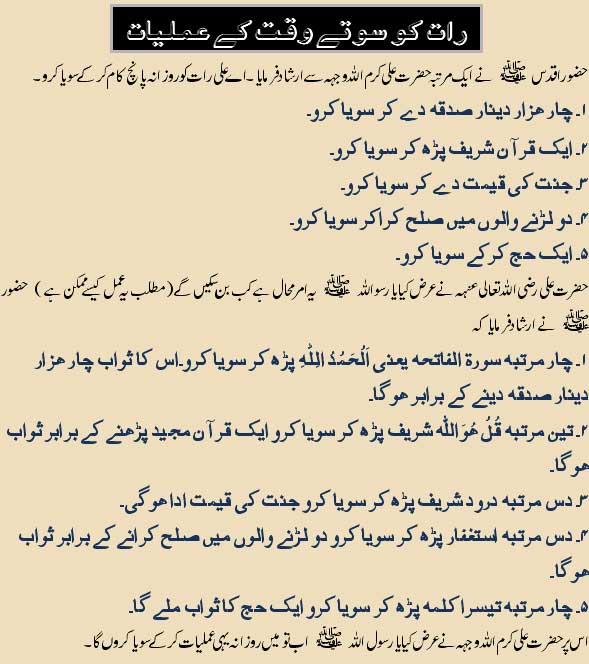
Raat Ko Sotey Waqt Kay Amliyat
Why Is Secularism Incompatible With Islam?
Secularism can never enjoy a general acceptance in an Islamic society. For Muslim societies, the acceptance of secularism means something totally different. As Islam is a comprehensive system of worship (Ibadah) and legislation (Shari’ah), the acceptance of secularism means abandonment of Shari’ah, a denial of the divine guidance, and a rejection of Allah’s injunctions. It is indeed a false claim that Shari’ah is not proper to the requirements of the present age. The acceptance of a legislation formulated by humans means a preference of the humans’ limited knowledge and experiences to the divine guidance: “Say! Do you know better than Allah?” (Qur’an, 2:140)
For this reason, the call for secularism among Muslims is atheism and a rejection of Islam. Its acceptance as a basis for rule in place of Shari’ah is downright apostasy. The silence of the masses in the Muslim world about this deviation has been a major transgression and a clear-cut instance of disobedience which have produced a sense of guilt, remorse, and inward resentment, all of which have generated discontent, insecurity, and hatred among committed Muslims because such deviation lacks legality.
Secularism is (only) compatible with the Western concept of God which maintains that after God had created the world, He left it to look after itself. In this sense, God’s relationship with the world is like that of a watchmaker with a watch: he makes it then leaves it to function without any need for him. This (baseless) concept is inherited from Greek philosophy, especially that of Aristotle who argued that God neither controls nor knows anything about this world.
This concept is totally different from that of Muslims. We Muslims believe that Allah is the sole Creator and Sustainer of the Worlds. One Who “…takes account of every single thing.” (Qur’an, 72:28); that He is All-Powerful and All-Knowing; that His Mercy and Bounties encompass everyone and suffice for all. In that capacity, Allah revealed His divine guidance to humanity, made certain things permissible and others prohibited, commanded people to observe His injunctions and to judge according to them. If they do not do so, then they commit Kufr, aggression, and transgression.
-By By Yusuf Al-Qaradawi
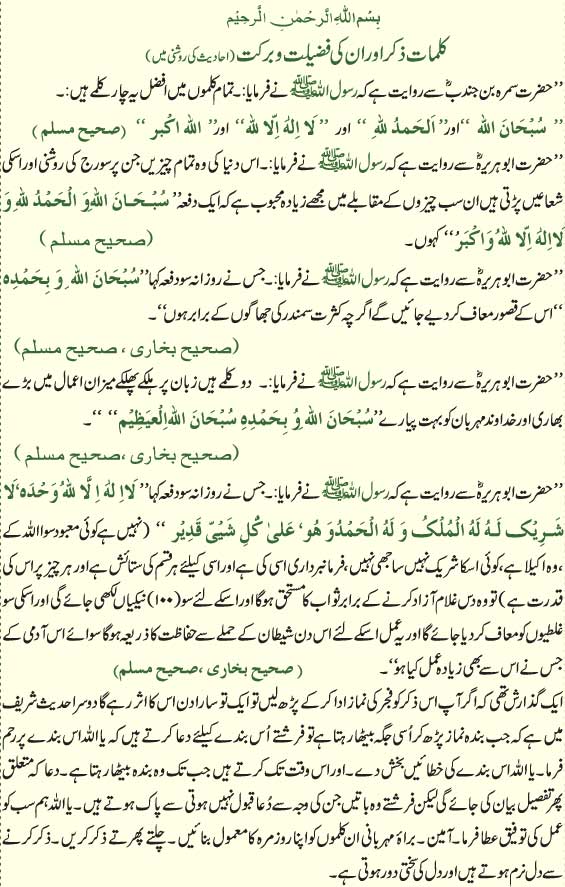
Kalmat E Zikr: Fazeelat Aur Barkat
Knowing The Bounds Of Our Mannerisms
Mannerisms have limits: When these limits are crossed, they become transgression. When they fall short, they become deficiency and disgrace.
Anger has a limit: It is to be bold while being above having negative and deficient traits, and this is the perfect form of anger. If this limit is exceeded, you become a transgressor. If you fall short of it, you will be a coward and will not be able to raise yourself above negative traits.
Covetousness has a limit: It is to take all you need from this world and what it has to offer you. When you fall short of this limit, it becomes disgrace and lack of resolve. When you exceed this limit, you end up wanting what you shouldn’t want.
Envy has a limit: It is to compete in becoming perfect and to excel such that your rival is unable to excel you. When this limit is exceeded, you transgress and oppress in which you wish that the good things are taken away from the one you envy and are keen to harm him. When you fall short of this limit, you become low, weak in aspiration, and you belittle yourself. The Prophet (peace be upon him) said: “There should be no envy except in regards to two things: a man who is granted wealth by Allah and he is able to spend it for the sake of the truth, and a man who is granted wisdom by Allah and he takes it and teaches it to the people.” So, this is an envy of competition, where the envious one pushes himself to be like the one he envies without wishing that he is deprived of the good things that he has.
Sexual desire has a limit: It is to relax the heart and mind from the exhaustion of worship, to maintain moral excellence, and to use the fulfillment of these desires to help you in this. When you exceed this limit, you fall into being overly lustful, and you come to resemble animals. When you fall short of this limit and don’t use this time to obtain excellence and virtue, this becomes weakness, inability, and disgrace.
Relaxation has a limit: It is to collect yourself and your strength to prepare for worship and perfection of the self and to save this so that you don’t become weak or tired. When you exceed this limit, this becomes laziness and waste, and you end up missing out on so many things that could benefit you. When you fall short of this limit, you end up hurting and weakening your energy, and it might even be cut off from you like a farmer who has no land to plow or crops to pick.
Generosity has a limit: Whenever this limit is exceeded, this becomes wastefulness and extravagance. When you fall short of this limit, you become cheap and miserly.
Bravery has a limit: When you cross this limit, you become reckless. When you fall short of this limit, you become a coward. This limit is that you put yourself forth when the time is right to do so and that you hold yourself back when the time is right to do so, just like Mu’awiyah said to Amr Bin Al-’Aas: “I don’t know whether you’re brave or cowardly! You go forth to the point that I say you’re the bravest person, and then you stay back to the point that I say you’re the most cowardly person!” So, he replied: “I am brave if I am guaranteed the chance, If I don’t have the chance, I am a coward.”
Protective jealousy has a limit: If you exceed this limit, you fall into accusation and suspicion of the innocent. If you fall short of this limit, you fall into heedlessness and lack of manhood.
Humility has a limit: If it is crossed, this becomes humiliation and disgrace. If you fall short of it, you deviate from arrogance and false pride.
Honor has a limit: If you exceed it, you fall into arrogance and blameworthy traits. If you fall short of it, you deviate to humiliation and disgrace.
The basic principle in all this is to choose the path of moderation between excess and negligence. This is what all of the benefits of this world and the next are built upon. In fact, you can benefit your body in no other way, because when some of your activities are done with a lack of moderation and either exceed or fall short of it, your body’s health and energy begin to decline accordingly.
Likewise, natural activities such as sleeping, staying awake, eating, drinking, having intercourse, playing sports, spending time alone, spending time with others, etc. – if these are all done moderately between the two blameworthy extremes, this is justice. If you deviate to either extreme, this is a sign of deficiency and will lead to even more deficiency. This knowledge of proper limits is from the best types of knowledge, especially the limits of what is commanded and prohibited. The most knowledgeable people are those who know the most about these limits.
– By Ibn Qayyim Al-Jawziyyah, Al-Fawa’id, pg. 196-199