

5 Things About Ramadan Traditions
It’s celebration time when Muslims around the world anxiously wait for the first moon of the ninth Lunar month to appear in the sky. Traditionally, families used to gather in their backyards, or get on the nearest hillock or climb on the top of their homes and wait for the pencil-thin moon to appear on the horizon. These days, however, most of us find out whether the moon has been sighted or not from the Internet or TV channels. Here are some Ramadan traditions that are still going strong:
1. The Ramadan Cannon is something that a lot of countries still have. It was historically implemented as a tool to announce the official daily sunset for the people too far away to hear the Adhaan Al Maghreb announce the breaking of the fast. The tradition of using artillery to announce sunset has its roots in Egypt when it was governed by the Ottoman Khosh Qadam, more than two centuries ago. The story goes that Qadam had been given a cannon as a gift, which he was testing during the Iftar of the first day of Ramadan. When he fired it, the whole of Cairo reverberated with its sound and inhabitants thought that this was a new method of announcing sunset.
2. We live in the age of digital alarm clocks. However, this was not always so and the time was when this role was performed by a man going around from house to house in a particular community or area well before Suhoor time in the morning so that people could prepare themselves for the fast and the Fajr prayer. This man, known as the Musaharati, used to dutifully wake people every night in the month of Ramadan so that they could have their Suhoor and still exists in cities like Sidon (in Lebanon), Jerusalem and Cairo.
3. Incense burners are many sought-after items in Ramadan as the burning of incense within homes is considered a form of celebration in Ramadan. The scent, mixed with other concentrated Arabic perfumes, results in a fresh yet intimate smell that can only be associated with festivities and moments of joy. For the month of Ramadan and the three-day Eid that follows, burning incense is an aromatic way to celebrate the purity of the month.
4. On the culinary side, Ramadan is a feast! Ramadan cuisine is a type in itself and Iftar, in particular, has traditionally become a community event, involving family, friends, and neighbors. A variety of dishes are prepared according to the culinary traditions of each country though dates and a dessert made of vermicelli, milk, honey, and nuts is fast becoming a universal delicacy. Also popular across the world are fried goodies, fruit salads, dairy products, and popular local desserts.
5. In many Muslim and non-Muslim countries with large Muslim populations, markets close down in the evening to enable people to perform prayers and consume Iftar. These markets then re-open and stay open for a good part of the night. Muslims can be seen shopping, eating, spending time with their friends and family during the evening hours.
Reality And Obligation In Ramadan
During this Ramadhan do not let the sweetness of our deeds vanish into the night, leaving only emptiness. When one contemplates the texts on fasting, its wisdom, and goals in Shariah, and looks at the reality of the Muslim communities, one realizes a wide gap between reality and our obligations.
Remember that Ramadhan is a bounty that Allah blessed His servants with, to strengthen their faith, and increase their piety (Taqwa). Allah said: “O you who believe! Fasting is prescribed for you as it was prescribed for those before you, that you may become pious.” (Al-Baqarah 2:183).
This article is an attempt to present the essential causes of this gap and to some remedies. the primary reason for the gap is ignorance about the goals of fasting and the wisdom behind it. Many Muslims ignore the purpose and wisdom of fasting. Fasting is done merely to conform to the social environment without contemplation. If one is not aware of the divine wisdom of Shariah and its fruits in this world and in the hereafter, one will not apply it in the right way.
Goals of Fasting
Achieving Taqwa: is one of the most important wisdom of fasting. Fasting brings on Taqwa as it lessens the desire of the stomach and mutes the sexual appetite. Whoever fasts frequently would overcome these two desires more easily. This deters against committing abominations and sins and assist in controlling life leading to Taqwa.
Strengthening willpower and acquiring patience: The Prophet sallallahu alayhe wa sallam called Ramadhan
the month of patience as it increases one’s will power to control his desire and the selfishness of his soul. This training allows him to be strong in following Allah’s commands. The most important being to carry the Message and propel it forward. The person trains himself to be patient in obeying Allah by stopping at the limits set by Allah both by way of action and abstention. Allah said: “These are the limits set by Allah, so approach them not.” (Al-Baqarah 2:187)
Fasting is pure worship: The fact that he is abstaining from food and drink both in public and in secret shows his honest faith and strong love of Allah, and his knowledge and feeling that Allah is all-knowing of everything. For this reason, Allah has made the reward for fasting greater than for any other type of worship.
Allah said in the hadith Qudsi: “Every deed of the son of Adam will be multiplied [in rewards], the good deed by ten of its like, up to seven hundred, up to whatever Allah wills, except fasting, it is for Me and I will reward it. He abandons his desire and his food for My sake..”
(Related by Muslim)
ibn al-Qayyim said: “…And people may see that a person is not eating in front of them, but the fact that he is really abandoning his food and his desire for the sake of God is a thing that nobody can find out about, and that is the essence of fasting.” (Zaad al-Ma’ad 2/29).
Relieving Muslims from life’s distractions: Eating, drinking and socializing all distract a person and weaken ties with Allah. It is by the Mercy of Allah that Muslims are ordered to fast so as not to be bothered by the intrusion of these activities. Nor by the thought about them nor the anticipation for them when devoting themselves to all types of worship Either reading the Qur’an, offering additional prayer, or making I’tikaf. For this reason, the Prophet Sallallahu Alayhi Wa Sallam said: “Fasting is a shield and a secure fortress against Hellfire”
(Related by Ahmad).
Discovering Allah’s Blessings: A person experiences the hardship of the poor. He should then be thankful to Allah Who has blessed him with His bounty while others are deprived. This should make him more sympathetic and willing to share this bounty. The poor rediscovers that fasting helps a person be more devoted to worship. More able to concentrate and meditate. He should then be able of this devotion all year long, a blessing he should thank Allah for.
Acquiring strength and endurance: It has been discovered that depriving the body of food for a period of time helps its defense and endurance mechanism. This in turn this protects the body from certain diseases.
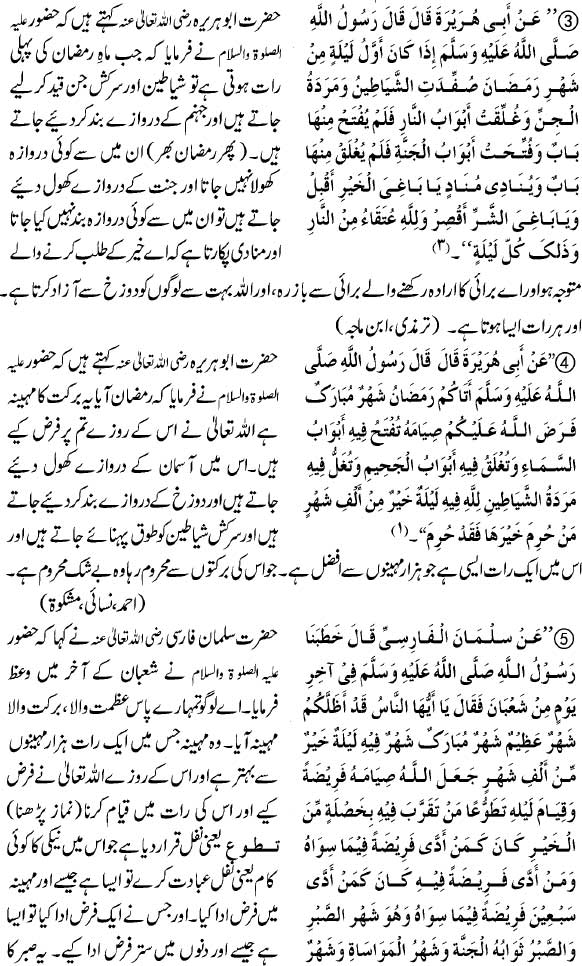
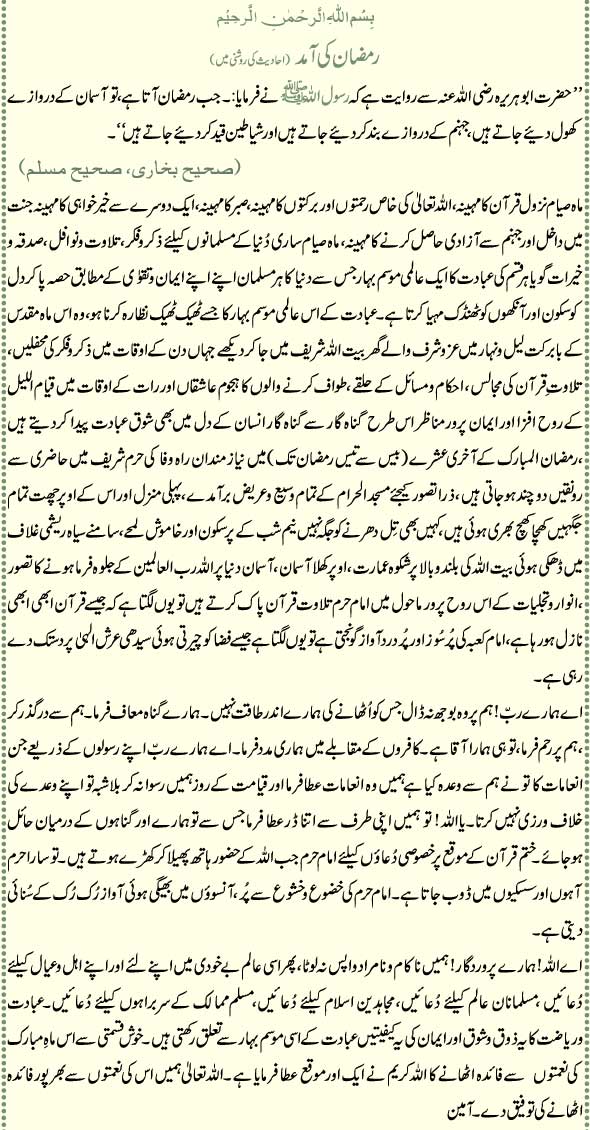
Ramzan Ki Aamad Marhaba
Backbiting (Gheebat)
Allah (SWT) says: ‘O you who believe! Avoid much suspicion; indeed some suspicions are sins. And spy not, neither backbite one another. Would one of you like to eat the flesh of his brother? You would hate it (so hate backbiting). And fear Allah, Verily Allah is the One who forgives and accepts repentance, Most Merciful (Surah 49,v12)
The above Quran ayat has stated that the despicable act of backbiting fellow Muslims is similar to eating their dead flesh. Would any human being find this act pleasing? Remember that the act of backbiting is even worse than doing this!
In accordance with the Shari’ah, backbiting is to speak of another individual’s bad points (if they are true) when they are not present, be it by speech, pen, or any other means, and, if he was to hear this he would dislike it. However, if such a vice is mentioned which is not present in a particular individual, then this will be a false accusation but is still a form of backbiting.
Our Nabi (Sallallahu Alayhi wassalaam) mentioned once, ‘Backbiting is that one mentions the vices of another brother which are present in him (a reality)…the Sahaba mentioned: ‘Ya Rasulullah (saw) we thought that backbiting was mentioning something which is not present in another brother..’ Nabi (saw) mentioned: You thought wrong, that is falsely accusing a brother.’ (Duri Manthoor)
The Messenger of Allah (saw) stated, ‘The person who controls his tongue as much as possible, he has attained salvation.’ (Darmi)
Ibn Abbas (radiallahu‘anhu) relates, ‘In the same way that Allah (SWT) has made the flesh of carrion (dead animals) haraam, the same way He (SWT) has prohibited the act of backbiting.’ (Ibn Jarri, Duri Manthoor)
In the same way that backbiting of a living individual is haraam, the same is applicable to the dead also.
Rasulullah (saw) mentioned, ‘When anyone of you dies, then let him be… and do not backbite about him.’ (Abu Daawood)
Abu Darda (RA) was asked by Sayyidina Ali (RA): ‘Why do you frequently visit the graves? He answered, ‘The dwellers of the graves remind one of death, this is how we benefit from this, they don’t complain about us and if we get up and leave them, they don’t backbite about us…This is why I spend more time in their company (meaning in the graveyard).’ (Ahyal Uloom)
Rasulullah (saw) stated: ‘Backbiting as a sin is greater than the act of fornication (Zina).’ (Ibn Abi Dunya)
Just as fornication is considered as a great sin, backbiting should be considered in the same manner, or an even greater sin as proven by this Hadith).
The Reason Backbiting is a GREATER Sin than Fornication (Zina)
• In the act of fornication, the sinner (Zani) committing the act of fornication is only punishable for the reason that he/she has disobeyed Allah’s (SWT) order and instead chosen the path of Shaytaan.
• The act of Backbiting involves two sins, (1) disobedience to the law of Allah (SWT), and (2) Disrespecting the honor of a fellow Muslim. The disobedience of Allah (SWT) can be forgiven by the act of repentance (Tawbah). The condition for the second condition will be that they will have to seek forgiveness from the individual they talked about also. With this, it is hoped Insha-Allah, that Allah (SWT) too will forgive him/her.
The narration of Abdullah bin Mubarak (rahmatullahi’alaih), ‘A young person came to Abdullah bin Mubarak (RA) and said: ‘Sir, I have done a very great sin, that I cannot even relate it to you.’ Abdullah bin Mubarak (RA) said, ‘At least tell me what it is.’ The young man replied, ‘I have fornicated.’ Abdullah bin Mubarak (RA) replied,’ O young man, the sin of fornication is indeed very great. Alhumdulillah, at least you did not backbite somebody, for that is an even greater sin.’ (Tazkirat ul Awliya)
What will be done with the Backbiter in the Hereafter?
Hazrat Abu Hurairah (RA) relates, ‘That person who backbites another in this world…in the Hereafter, that person will be offered the flesh of his brother and will be told, ‘The same way in which you ate the flesh of your brother in the Dunya, eat now also.’ When that person will put that flesh in his mouth, he will find it very unpleasant and be disgraced due to this.’ (Targhib)
The Advice of Ibn Abbas (radiallaahu’anhu), ‘When you have decided to backbite someone and narrate their faults and bad points, at that time, remember your own faults, contemplate over your sins so that you may be saved from backbiting and attain Jannah. If you will not realize your own faults and continue to expose the faults of others, then on the Day of Qiyamah, Allah (SWT) too will expose your faults.’ (Ahyal Uloom)
For this very reason, there is a saying of some Tabi’een (rahimahumullah): ‘We have seen this condition in the Sahaba (RA)…they did not consider only Salaah and Fasting as a form of worship. However, they considered the abstaining from backbiting as a great form of worship also.’
After reading these points, we should reflect and judge ourselves in this respect and have concern for the Hereafter. May Allah (SWT) enable us all to use our tongues and do actions in accordance with His will and pleasure. Aameen.
Mufti Yusuf Danka
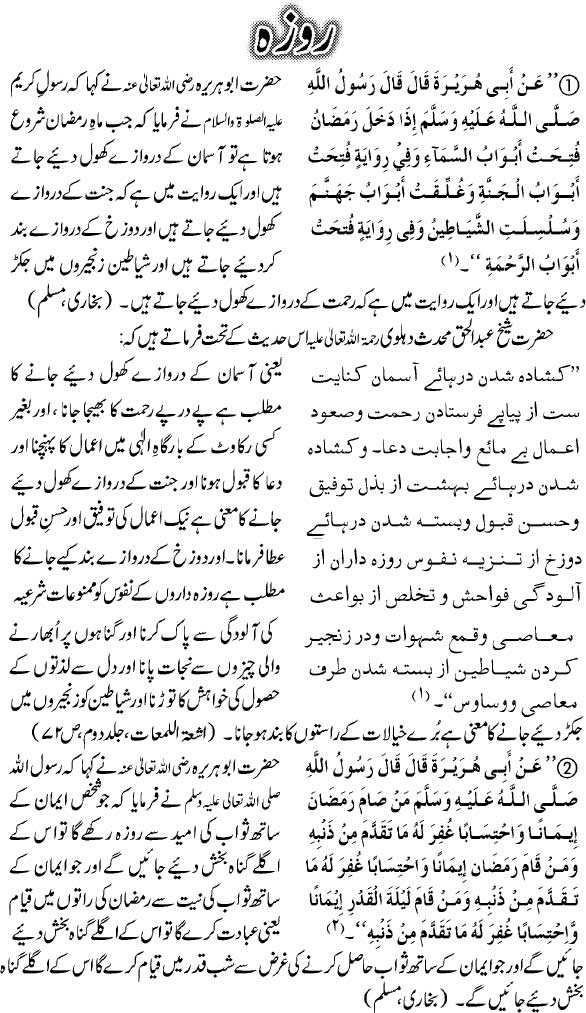
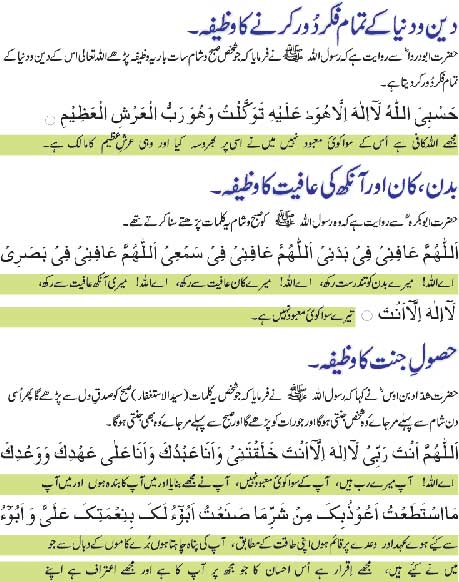
Hasool-e-Jannat Ka Wazifa
The Etiquette Of Clothing
Allah SWT says: ‘O Children of Adam! We have bestowed raiment upon you to cover yourselves (screen your private parts) and as an adornment, that is better. Such are among the Ayat of Allah, that they may remember.’ (Al A’raf, 26)
A Muslim should endeavor to wear those clothes which express modesty, cover the body adequately, and at the same time, they should be suitable in respect of temperature and climate. The clothing should be simple to the extent that one should not be a walking billboard. Today we have in line with ‘fashion’, clothing saying ‘touch me…etc’. This is not appropriate. When one wears a garment, the very act of clothing oneself is a blessing of Allah (SWT) which He bestowed on mankind alone, all other creation is deprived of this blessing For men white clothing is preferred: RasulAllah (saw) said: ‘Wear white clothing, this is the best cloth, verily white clothes are worn in the world and in the white cloth are the dead buried’. (Tirmidhi)
• It is narrated in Bukhari: ‘RasulAllah (saw) would wear white clothing. Meaning RasulAllah (saw) himself wore white clothing and advised the men of the Ummah to do the same.
• Umme Salma (RA) narrates: ‘RasulAllah (saw) preferred a long shirt to all other garments.’ (Shama’il Tirmidhi)
This is because in this garment the body is well covered and concealed, modesty and humbleness are established and It is also attractive. Ibn Abbas (RA) states: ‘The shirt of RasulAllah (saw) was above the ankle’.
• For men to keep the trouser above the ankle: RasulAllah (saw) said: ‘3 types of people are such that on the Day of Qiyamah, Allah will not look at them nor have mercy on them.’ Abu Dhar Gafari (RA) asked: ‘Who will these unfortunate people be?!’ RasulAllah (saw) said:
1. He who allows his trousers to hang below the ankle.
2. He, who boasts of his favors to others.
3. He who takes a false oath.
RasulAllah (saw) said: ‘The portion of the ankle which is covered below the ankle will be in Jahannam’. (Bukhari/Muslim)
Note: As a matter of routine, it is important that men do not wear clothing that Shariah has advised against. Men should at least try to adopt Islamic clothing when coming to the masjid.
• The clothing of men and women should not resemble one another: RasulAllah (saw) said: ‘Allah (SWT) has cursed the men who resemble women and those women who resemble men’. (Bukhari)
• Women should not wear thin garments: RasulAllah (saw) said: ‘Those women are inhabitants of the Hellfire, who even after wearing clothes are naked’.(Riyadus-Saliheen) It states in another place: ‘Those women who wear thin clothing and clothing which causes the desire to arise in the hearts of men… (refers to those women who beautify themselves and walk about without hijab/purdah)…They will not enter Jannah nor will they smell its fragrance’. (Muslim)
How to Adopt the Headscarf? Allah (SWT) says: ‘tell the believing women…to draw their veils over their bodies…’(meaning to cover from the head to the breast). (An-Nur, 31)
This is due to the fact that the breast of women is apparent beauty in form. The women of jahiliyyah would position the cloth on the head and hang the sides to the back exposing the breast area, beautifying themselves in front of strange males. The Qur’an orders the Muslim women to be strict in this observance of modesty and piety and adopt clothing that covers the hair of the head, the ears, the neck and at the same time covers the breast adequately in front of ghayr-mahram males. (Tafsir Usmani) We pray that Allah (SWT) guides our men and women to adopt clothing according to the Shariah and Sunnah in our daily lives and grants us honor and status through this action, Aameen.
Mufti Yusuf Danka
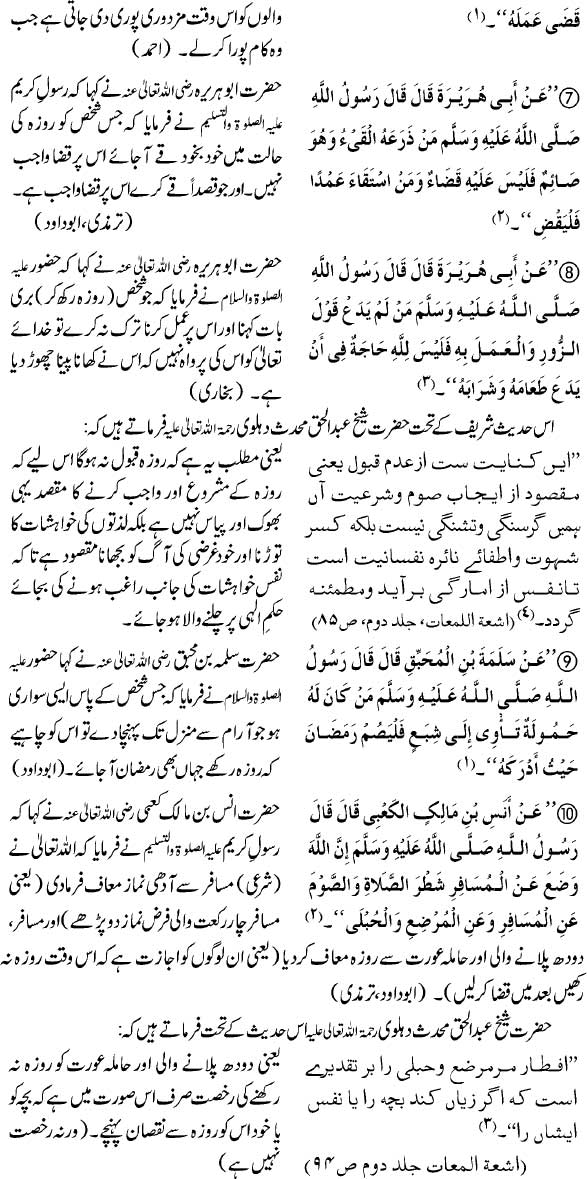
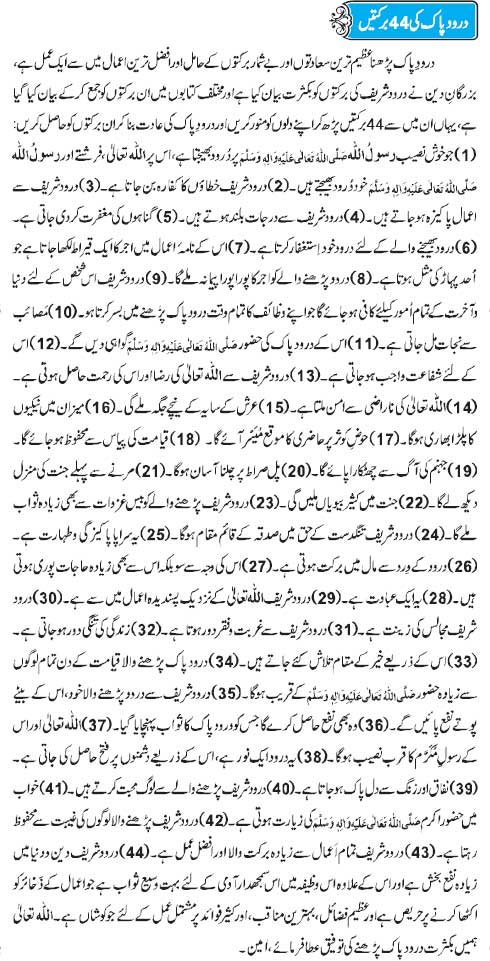
Darood Sharif Ki Barkat
Earning The Blessings Of Paradise Does Not Mean One Has To Forego The Pleasures Of This World
Monks and ascetics, and many of the believers of this ummah think that the blessings of the hereafter cannot be attained without giving up the good things and pleasures of this world. So you see them punishing themselves and making life hard for themselves with non-stop fasting and [qiyaam] praying at night. Some of them even deny themselves good food, drink, and clothing and reject work and marriage. All of this is wrong, for Allah has created the good things of this world for the believers, and He denounces those who forbid the beautiful things that Allah (SWT) has created for His slaves:
“Say (O Muhammad): ´Who has forbidden the adornment which Allah has brought forth for His creatures or the good things from among the means of sustenance?´ Say: ´These are for the enjoyment of the believers in this world, and shall be exclusively theirs on the Day of Resurrection.´ Thus do We clearly expound Our revelations for those who have knowledge ” [7:32]
This world is only condemned when it distracts the believer from the Hereafter, but if he treats it as a means of achieving success in the akhirah then its pleasures need not be spurned, as some people think.
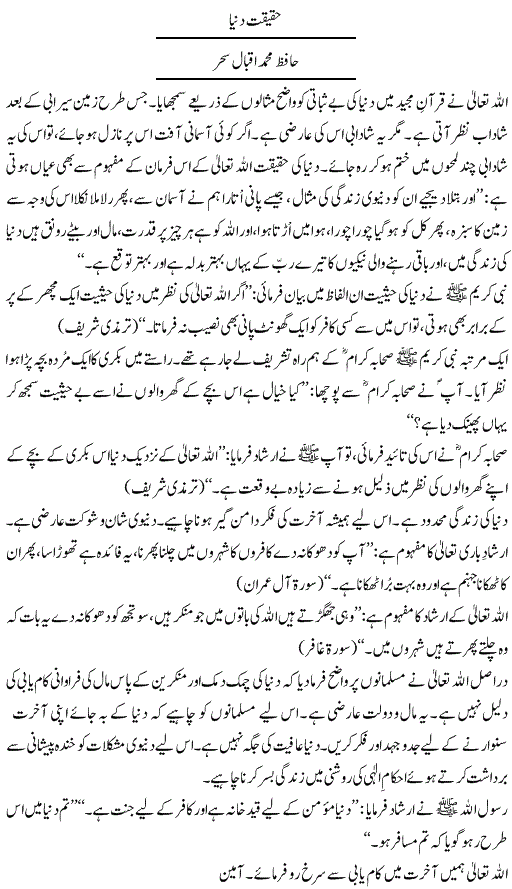
Dunya Ki Haqeeqat