
Backbiting (Gheebat)
Allah (SWT) says: ‘O you who believe! Avoid much suspicion; indeed some suspicions are sins. And spy not, neither backbite one another. Would one of you like to eat the flesh of his brother? You would hate it (so hate backbiting). And fear Allah, Verily Allah is the One who forgives and accepts repentance, Most Merciful (Surah 49,v12)
The above Quran ayat has stated that the despicable act of backbiting fellow Muslims is similar to eating their dead flesh. Would any human being find this act pleasing? Remember that the act of backbiting is even worse than doing this!
In accordance with the Shari’ah, backbiting is to speak of another individual’s bad points (if they are true) when they are not present, be it by speech, pen, or any other means, and, if he was to hear this he would dislike it. However, if such a vice is mentioned which is not present in a particular individual, then this will be a false accusation but is still a form of backbiting.
Our Nabi (Sallallahu Alayhi wassalaam) mentioned once, ‘Backbiting is that one mentions the vices of another brother which are present in him (a reality)…the Sahaba mentioned: ‘Ya Rasulullah (saw) we thought that backbiting was mentioning something which is not present in another brother..’ Nabi (saw) mentioned: You thought wrong, that is falsely accusing a brother.’ (Duri Manthoor)
The Messenger of Allah (saw) stated, ‘The person who controls his tongue as much as possible, he has attained salvation.’ (Darmi)
Ibn Abbas (radiallahu‘anhu) relates, ‘In the same way that Allah (SWT) has made the flesh of carrion (dead animals) haraam, the same way He (SWT) has prohibited the act of backbiting.’ (Ibn Jarri, Duri Manthoor)
In the same way that backbiting of a living individual is haraam, the same is applicable to the dead also.
Rasulullah (saw) mentioned, ‘When anyone of you dies, then let him be… and do not backbite about him.’ (Abu Daawood)
Abu Darda (RA) was asked by Sayyidina Ali (RA): ‘Why do you frequently visit the graves? He answered, ‘The dwellers of the graves remind one of death, this is how we benefit from this, they don’t complain about us and if we get up and leave them, they don’t backbite about us…This is why I spend more time in their company (meaning in the graveyard).’ (Ahyal Uloom)
Rasulullah (saw) stated: ‘Backbiting as a sin is greater than the act of fornication (Zina).’ (Ibn Abi Dunya)
Just as fornication is considered as a great sin, backbiting should be considered in the same manner, or an even greater sin as proven by this Hadith).
The Reason Backbiting is a GREATER Sin than Fornication (Zina)
• In the act of fornication, the sinner (Zani) committing the act of fornication is only punishable for the reason that he/she has disobeyed Allah’s (SWT) order and instead chosen the path of Shaytaan.
• The act of Backbiting involves two sins, (1) disobedience to the law of Allah (SWT), and (2) Disrespecting the honor of a fellow Muslim. The disobedience of Allah (SWT) can be forgiven by the act of repentance (Tawbah). The condition for the second condition will be that they will have to seek forgiveness from the individual they talked about also. With this, it is hoped Insha-Allah, that Allah (SWT) too will forgive him/her.
The narration of Abdullah bin Mubarak (rahmatullahi’alaih), ‘A young person came to Abdullah bin Mubarak (RA) and said: ‘Sir, I have done a very great sin, that I cannot even relate it to you.’ Abdullah bin Mubarak (RA) said, ‘At least tell me what it is.’ The young man replied, ‘I have fornicated.’ Abdullah bin Mubarak (RA) replied,’ O young man, the sin of fornication is indeed very great. Alhumdulillah, at least you did not backbite somebody, for that is an even greater sin.’ (Tazkirat ul Awliya)
What will be done with the Backbiter in the Hereafter?
Hazrat Abu Hurairah (RA) relates, ‘That person who backbites another in this world…in the Hereafter, that person will be offered the flesh of his brother and will be told, ‘The same way in which you ate the flesh of your brother in the Dunya, eat now also.’ When that person will put that flesh in his mouth, he will find it very unpleasant and be disgraced due to this.’ (Targhib)
The Advice of Ibn Abbas (radiallaahu’anhu), ‘When you have decided to backbite someone and narrate their faults and bad points, at that time, remember your own faults, contemplate over your sins so that you may be saved from backbiting and attain Jannah. If you will not realize your own faults and continue to expose the faults of others, then on the Day of Qiyamah, Allah (SWT) too will expose your faults.’ (Ahyal Uloom)
For this very reason, there is a saying of some Tabi’een (rahimahumullah): ‘We have seen this condition in the Sahaba (RA)…they did not consider only Salaah and Fasting as a form of worship. However, they considered the abstaining from backbiting as a great form of worship also.’
After reading these points, we should reflect and judge ourselves in this respect and have concern for the Hereafter. May Allah (SWT) enable us all to use our tongues and do actions in accordance with His will and pleasure. Aameen.
Mufti Yusuf Danka
Hasool-e-Jannat Ka Wazifa
The Etiquette Of Clothing
Allah SWT says: ‘O Children of Adam! We have bestowed raiment upon you to cover yourselves (screen your private parts) and as an adornment, that is better. Such are among the Ayat of Allah, that they may remember.’ (Al A’raf, 26)
A Muslim should endeavor to wear those clothes which express modesty, cover the body adequately, and at the same time, they should be suitable in respect of temperature and climate. The clothing should be simple to the extent that one should not be a walking billboard. Today we have in line with ‘fashion’, clothing saying ‘touch me…etc’. This is not appropriate. When one wears a garment, the very act of clothing oneself is a blessing of Allah (SWT) which He bestowed on mankind alone, all other creation is deprived of this blessing For men white clothing is preferred: RasulAllah (saw) said: ‘Wear white clothing, this is the best cloth, verily white clothes are worn in the world and in the white cloth are the dead buried’. (Tirmidhi)
• It is narrated in Bukhari: ‘RasulAllah (saw) would wear white clothing. Meaning RasulAllah (saw) himself wore white clothing and advised the men of the Ummah to do the same.
• Umme Salma (RA) narrates: ‘RasulAllah (saw) preferred a long shirt to all other garments.’ (Shama’il Tirmidhi)
This is because in this garment the body is well covered and concealed, modesty and humbleness are established and It is also attractive. Ibn Abbas (RA) states: ‘The shirt of RasulAllah (saw) was above the ankle’.
• For men to keep the trouser above the ankle: RasulAllah (saw) said: ‘3 types of people are such that on the Day of Qiyamah, Allah will not look at them nor have mercy on them.’ Abu Dhar Gafari (RA) asked: ‘Who will these unfortunate people be?!’ RasulAllah (saw) said:
1. He who allows his trousers to hang below the ankle.
2. He, who boasts of his favors to others.
3. He who takes a false oath.
RasulAllah (saw) said: ‘The portion of the ankle which is covered below the ankle will be in Jahannam’. (Bukhari/Muslim)
Note: As a matter of routine, it is important that men do not wear clothing that Shariah has advised against. Men should at least try to adopt Islamic clothing when coming to the masjid.
• The clothing of men and women should not resemble one another: RasulAllah (saw) said: ‘Allah (SWT) has cursed the men who resemble women and those women who resemble men’. (Bukhari)
• Women should not wear thin garments: RasulAllah (saw) said: ‘Those women are inhabitants of the Hellfire, who even after wearing clothes are naked’.(Riyadus-Saliheen) It states in another place: ‘Those women who wear thin clothing and clothing which causes the desire to arise in the hearts of men… (refers to those women who beautify themselves and walk about without hijab/purdah)…They will not enter Jannah nor will they smell its fragrance’. (Muslim)
How to Adopt the Headscarf? Allah (SWT) says: ‘tell the believing women…to draw their veils over their bodies…’(meaning to cover from the head to the breast). (An-Nur, 31)
This is due to the fact that the breast of women is apparent beauty in form. The women of jahiliyyah would position the cloth on the head and hang the sides to the back exposing the breast area, beautifying themselves in front of strange males. The Qur’an orders the Muslim women to be strict in this observance of modesty and piety and adopt clothing that covers the hair of the head, the ears, the neck and at the same time covers the breast adequately in front of ghayr-mahram males. (Tafsir Usmani) We pray that Allah (SWT) guides our men and women to adopt clothing according to the Shariah and Sunnah in our daily lives and grants us honor and status through this action, Aameen.
Mufti Yusuf Danka
Darood Sharif Ki Barkat
Earning The Blessings Of Paradise Does Not Mean One Has To Forego The Pleasures Of This World
Monks and ascetics, and many of the believers of this ummah think that the blessings of the hereafter cannot be attained without giving up the good things and pleasures of this world. So you see them punishing themselves and making life hard for themselves with non-stop fasting and [qiyaam] praying at night. Some of them even deny themselves good food, drink, and clothing and reject work and marriage. All of this is wrong, for Allah has created the good things of this world for the believers, and He denounces those who forbid the beautiful things that Allah (SWT) has created for His slaves:
“Say (O Muhammad): ´Who has forbidden the adornment which Allah has brought forth for His creatures or the good things from among the means of sustenance?´ Say: ´These are for the enjoyment of the believers in this world, and shall be exclusively theirs on the Day of Resurrection.´ Thus do We clearly expound Our revelations for those who have knowledge ” [7:32]
This world is only condemned when it distracts the believer from the Hereafter, but if he treats it as a means of achieving success in the akhirah then its pleasures need not be spurned, as some people think.
Dunya Ki Haqeeqat
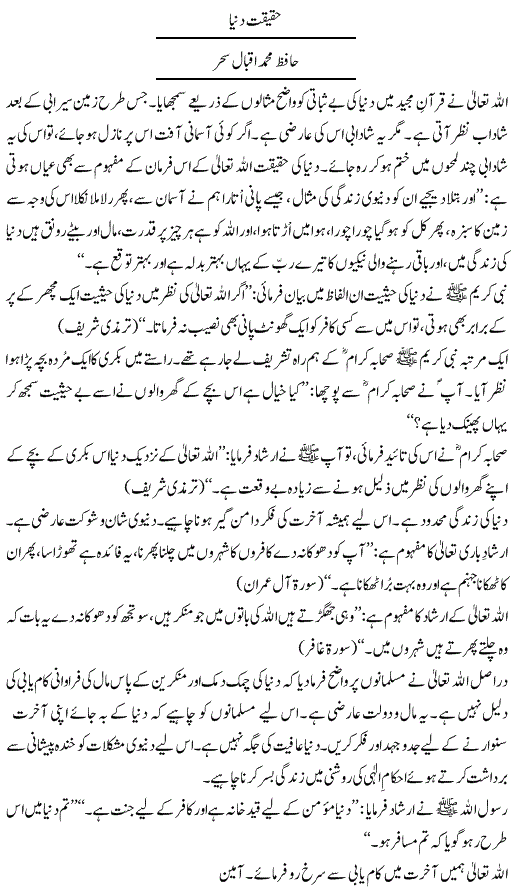
Sayings And Teachings Of Prophet Muhammad (PBUH)
The Reality of Zuhd (Asceticism)
On the authority of Sahl bin Saad Al-Saedi, who said: A man came to the prophet and said: “O Messenger of Allah, direct me to an act which, if I do it, [will cause] Allah to love me and people to love me.” He said: “Renounce the world and Allah will love you, and renounce what people possess and people will love you.”
A fine Hadith related by Ibn Majah and others with good chains of authorities.
No Harming nor Reciprocating Harm
On the authority of Saad bin Malik Al-Khudari, that the messenger of Allah said: “There should be neither harming nor reciprocating harm.”
A fine hadith related by Ibn Majah, Al-Daraqutni, and others
The Onus of Proof is on the Claimant and The Taking of an Oath is on the Denier
On the authority of Ibn Abbas that the Messenger of Allah said: “Were people to be given in accordance with their claim, men would claim the fortunes and lives of [other] people, but the onus of proof is on the claimant, and the taking of an oath is incumbent upon him who denies.”
A fine hadith related by Al-Baihaqi and others
Forbidding Evil with the Hands, Speech, and Heart
On the authority of Abu Saeed Al-Khurdari, who said: I heard the messenger of Allah say: “Whosoever of you sees an evil action, let him change it with his hand; and if he is not able to do so, then with his tongue; and if he is not able to do so, then with his heart; and that is the weakest of faith.”
Related by Muslim.
Brotherhood in Islam
On the authority of Abu Hurairah, who said: the messenger of Allah said: “Do not envy one another; do not inflate prices one to another; do not hate one another; do not turn away from one another, and do not undercut one another, but be you, O servants of Allah, brothers. A Muslim is the brother of a Muslim: he neither oppresses him nor does he fail him, he neither lies to him nor does he hold him in contempt. Piety is right here-and he pointed to his breast three times. It is evil enough for a man to hold his brother Muslim in contempt. The whole of a Muslim for another Muslim is inviolable: his blood, his property, and his honor.”
Related by Muslim.
The Virtue of Gathering for the Remembrance of Allah
On the authority of Abu Hurairah that the Prophet said: “Whosoever removes a worldly grief from a believer, Allah will remove from him one of the griefs of the Day of Judgment. Whosoever alleviates [the lot of] a needy person, Allah will alleviate [his lot] in this world and the next. Whosoever shields a Muslim, Allah will shield him in this world and the next. Allah will aid a servant [of His] so long as the servant aids his brother. Whosoever follows a path to seek knowledge therein, Allah will make easy for him a path to Paradise. No people gather together in one of the houses of Allah, reciting the Book of Allah and studying it among themselves, without tranquility descending upon them, mercy enveloping them, the angels surrounding them, and Allah making mention of them amongst those who are with Him. Whosoever is slowed down by his actions will not be hastened forward by his lineage.”
Related by Muslim in these words.
The Grace of Allah and His Mercy
On the authority of Ibn Abbas that the messenger of Allah, among the sayings he relates from his Lord, is: “Allah has written down the good deeds and the bad ones.” Then he explained it [by saying that]:” He who has intended a good deed and has not done it, Allah writes it down with Himself as a full good deed, but if he has intended it and has done it, Allah writes it down with Himself as from ten good deeds to seven hundred times, or many times over. But if he has intended a bad deed and has not done it, Allah writes it down with Himself as a full good deed, but if he has intended it and has done it, Allah writes it down as one bad deed.”
Related by Bukhari and Muslim in their two salihs
Attaining Nearness to Allah and His Love
On the authority of Abu Hurairah, who said: the messenger of Allah said: Allah the Almighty has said: “Whosoever shows enmity to a friend of Mine, I shall be at war with him. My servant does not draw near to Me with anything more loved by Me than the religious duties I have imposed upon him, and My servant continues to draw near to Me with supererogatory works so that I shall love him. When I love him I am his hearing with which he hears, his seeing with which he sees, his hand with which he strikes, and his foot with which he walks. Were he to ask [something] of Me, I would surely give it to him, and were he to ask Me for refuge, I would surely grant him it.”
Related by Bukhari.
Leniency for the One who Errs, the One who Forgets, and the One who is Forced
On the authority of Ibn Abbas that the messenger of Allah said: “Allah has pardoned for me my people for [their] mistakes and [their] forgetfulness and for what they have done under duress.”
A fine hadith related by Ibn Majah, Al-Baihqi, and others.
Be in This World As a Traveler
On the authority of Abdullah bin Omar, who said: The Messenger of Allah took me by the shoulder and said: “Be in the world as though you were a stranger or a wayfarer.”
The son of Omar used to say:
“At evening do not expect [to live till] morning, and at morning do not expect [to live till] evening. Take from your health for your illness and from your life for your death.”
Related by Bukhari
The World is the Means for Attaining the Hereafter
On the authority of Abu Muhammad Abdullah bin Amr bin Al-Aas, who said: The Messenger of Allah, said: “None of you [truely] believes until his inclination is in accordance with what I have brought.”
A fine and true hadith which we have transmitted from the book of Hujjah with a sound chain of authorities.
The Expanse of the Forgiveness of Allah
On the authority of Anas, who said: I heard the messenger of Allah say: Allah the Almighty has said: “O son of Adam, so long as you call upon Me and ask of Me, I shall forgive you for what you have done, and I shall not mind. O son of Adam were your sins to reach the clouds of the sky and were you then to ask forgiveness of Me, I would forgive you. O son of Adam were you to come to Me with sins nearly as great as the earth and were you then to face Me, ascribing no partner to Me, I would bring you forgiveness nearly as great as its.”
Related by Al-Tirmidhi, who said that it was a good and sound Hadith
Zina Aur Lawatat
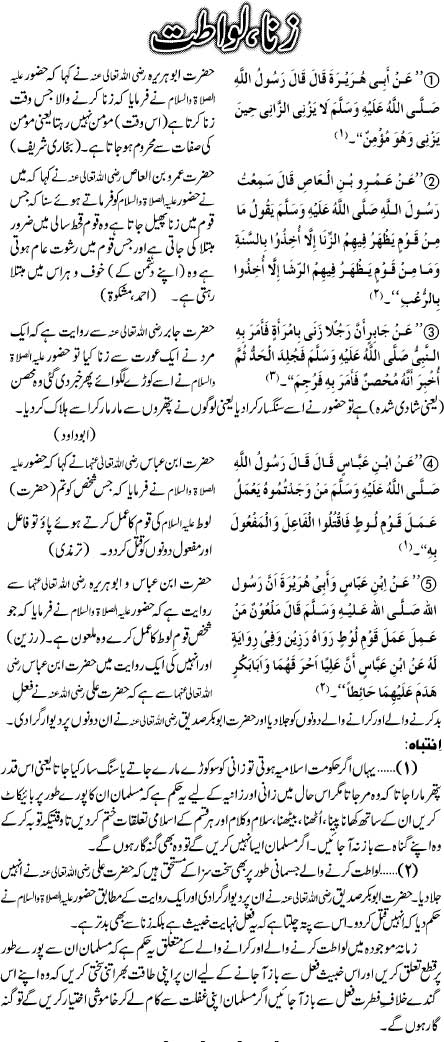
Some Important Ahadith
Say ‘I believe in Allah’ and then be Steadfast
On the authority of Sufyan bin Abdullah (may Allah be pleased with him) who said: “I said, ‘O Messenger of Allah, tell me something about Islam which I can ask of no one but you.’ He (peace be upon him) said, ‘Say “I believe in Allah” — and then be steadfast.'”
Related by Muslim.
Entering Paradise
On the authority of Abu Abdullah Jabir bin Abdullah al-Ansari (may Allah be pleased with him): A man questioned the Messenger of Allah (peace be upon him) and said: “Do you think that if I perform the obligatory prayers, fast in Ramadan, treat as lawful that which is halal, and treat as forbidden that which is haram, and do not increase upon that [in voluntary good deeds], then I shall enter Paradise?” He (peace be upon him) replied, “Yes.”
Related by Muslim.
Hastening to Do Good
On the authority of Abu Malik al-Harith bin Asim al-Ashari (may Allah be pleased with him) who said: The Messenger of Allah (peace be upon him) said: “Purity is half of Iman. Alhamdulillah (praise be to Allah) fills the scales, and Subhan-Allah (how far from imperfection is Allah) and Alhamdulillah (praise be to Allah) fill that which is between heaven and earth. And the Salah (prayer) is a light, and charity is a proof, and patience is illumination, and the Qur’an is a proof either for you or against you. Every person starts his day as a vendor of his soul, either freeing it or bringing about its ruin.”
Related by Muslim.
The Forbiddance of Oppression
On the authority of Abu Dharr Al-Ghafari, of the Prophet (peace be upon him) is that among the sayings he relates from his Lord is that He said: “O My servants! I have forbidden oppression for Myself, and I have made it forbidden amongst you, so do not oppress one another. O My servants, all of you are astray except those whom I have guided, so seek guidance from Me and I shall guide you. O My servants, all of you are hungry except those whom I have fed, so seek food from Me and I shall feed you. O My servants, all of you are naked except those whom I have clothed, so seek clothing from Me and I shall clothe you. O, My servants, you commit sins by day and by night, and I forgive all sins, so seek forgiveness from Me and I shall forgive you. O My servants, you will not attain harming Me so as to harm Me, and you will not attain benefitting Me so as to benefit Me. O My servants, if the first of you and the last of you, and the humans of you and the jinn of you, were all as pious as the most pious heart of any individual amongst you, then this would not increase My Kingdom an iota. O My servants, if the first of you and the last of you, and the humans of you and the jinn of you, were all as wicked as the most wicked heart of any individual amongst you, then this would not decrease My Kingdom an iota. O My servants, if the first of you and the last of you, and the humans of you and the jinn of you, were all to stand together in one place and ask of Me, and I were to give everyone what he requested, then that would not decrease what I Possess, except what is decreased of the ocean when a needle is dipped into it. O, My servants, it is but your deeds that I account for you, and then recompense you for. So he who finds good, let him praise Allah, and he who finds other than that, let him blame no one but himself.”
Related by Muslim.
The Value of Charity
On the authority of Abu Dharr: Some of the companions of the messenger of Allah said:” O Messenger of Allah, the affluent have made off with the rewards, they pray as we pray they fast as we fast, and they give away in charity the superfluity of their wealth.” He said:” Has, not Allah made things for you to give away in charity? every tasbihah is a charity, every takbirah is a charity, every tahmidah is a charity, and every tahlilah is a charity, to enjoin a good action is a charity, to forbid an evil action is a charity, and in the sexual act of each of you there is a charity.” They said: “O Messenger of Allah when one of us fulfills his sexual desire will he have some reward for that?” He said: “Do you not think that were he to act upon it unlawfully he would be sinning? Likewise, if he has acted upon it lawfully he will have a reward.”
Related by Muslim.
What is Sadaqa?
On the authority of Abu Hurairah, who said: The Messenger of Allah said: “Each person’s every joint must perform a charity every day the sun comes up: to act justly between two people is a charity; to help a man with his mount, lifting him onto it or hoisting up his belongings onto it is a charity: a good word is a charity, every step you take to prayers is a charity and removing a harmful thing from the road is a charity.”
Related by Bukhari and Muslim.
Righteousness is in Good Character
On the authority of Al-Nawwas bin Samaan, that the prophet said: “Righteousness is good morality, and wrongdoing is that which wavers in your soul and which you dislike people finding out about.”
Related by Muslim.
And on the authority of Wabisa bin Mabad, may Allah be pleased with him, who said: I came to the messenger of Allah and he said: “You have come to ask about righteousness ?”. I said:” Yes.” He said: “Consult your heart. Righteousness is that about which the soul feels tranquil and the heart feels tranquil, and wrongdoing is that which wavers in the soul and moves to and from in the breast even though people, again and again, have given you their legal opinion [in its favor].”
a good hadith transmitted from the Musnads of the two Imams, Ahmed bin Hanbal, and Al-Darimi, with a good chain of authorities.
The Obligation of Following the Sunnah
On the authority of Abu Najih Al-Erbadh bin Sariah, who said: The Messenger of Allah gave us a sermon by which our hearts were filled with fear and tears came to our eyes. We said: “O Messenger of Allah, it is as though this is a farewell sermon, so counsel us.” He said: “I counsel you to fear Allah and to give absolute obedience even if a slave becomes your leader. Verily he among you who lives [long] will see great controversy, so you must keep to my sunnah and to the sunnah of the rightly-guided Khalifahs – cling to them stubbornly. Beware of newly invented matters, for every invented matter is an innovation and every innovation is a going astray, and every going astray is in Hell-fire.”
Related by Abu Dawud and Al-Tirmithi, who said that it was a fine and true Hadith.
Means of Goodness
On the authority of Muadh bin Jabal, who said: I said: “O Messenger of Allah, tell me of an act which will take me into Paradise and will keep me away from Hellfire.” He said: “You have asked me about a major matter, yet it is easy for him for whom Allah Almighty makes it easy. You should worship Allah, associating nothing with Him, you should perform the prayers, you should pay the zakat, you should fast in Ramadan, and you should make the pilgrimage to the House.”
Then he said:” Shall I not show you the gates of goodness? Fasting [which] is a shield, charity [which] extinguishes sin as water extinguishes fire; and the praying of a man in the depth of night.” Then he recited :
“Who forsake their beds to cry unto their Lord in fear and hope, and spend of that We have bestowed on them. No soul knoweth what is kept hid for them of joy, as a reward for what they used to do”. (Quran, verse)
Then he said: ” Shall I not tell you of the peak of the matter, its pillar, and its topmost part?” I said: “Yes, O Messenger of Allah.” He said: “The peak of the matter is Islam; the pillar is prayer, and its topmost part is jihad.” Then he said: “Shall I not tell you of the controlling of all that ?” I said: “Yes, O Messenger of Allah”, and he took hold of his tongue and said: “Restrain this.” I said: “O Prophet of Allah, will what we say be held against us?” He said: “May your mother be bereaved of you, Muadh! Is there anything that topples people on their faces – or he said on their noses into Hell-fire other than the jests of their tongues?”
Related by Al-Tirmithi, who said it was a fine and true hadith.
Do Not Neglect the Religious Obligations
On the authority of Jurthum bin Nashir that the messenger of Allah said: “Allah the Almighty has laid down religious duties, so do not neglect them. He has set boundaries, so do not overstep them. He has prohibited some things, so do not violate them; about some things He was silent out of compassion for you, not forgetfulness, so seek not after them.”
A fine hadith related by Al-Daraqutni and others.