
Obedience And Manners In Dealing With Parents
Allah (SWT) says: ‘Your Lord has decreed that you worship none but Him and that you be kind to your parents. Whether one or both of them attain old age, say not to them a word of contempt or repel them, but address them in terms of honour. And out of kindness, lower to them the wing of humility and say: ‘My Lord, have mercy on them for they cherished me in childhood.’ (Bani-Israel, v23-24)
In the above ayat, Allah (SWT) gives the order of dealing with parents in an honourable and respectful manner, treating them with love and obeying them. Imam Qurtubi (rah) relates, ‘In this ayat Allah (SWT) mentions the importance of treating the parents in a respectful and honourable manner in conjunction with the worship of Allah (SWT) Himself. Just as in Surah Luqman, Allah (SWT) mentions thanks due to Him with that also of the parents, gratitude should be shown to both. It is proven from this that after the worship and obedience of Allah (SWT), obedience to one’s parents is most lofty in rank, as is the same with gratitude and showing thanks. The following hadith of Sahih Bukhari bears witness to this:
• One Sahaba(RA) asked, ‘Which is the most loved action by Allah (SWT)? Rasulullah (saw) said, ‘To pray Salaat in the specified time.’ It was then asked, ‘Which is most loved after that?’ Rasulullah (saw) said: ‘To have good dealings with your parents.’ (Tafsiri Qurtubi)
The Status of Obeying & Assisting The Parents
• Hazrat Abu Darda (RA) said, ‘Rasulullah (saw) related that, ‘The Father is the middle door of Jannah, now you know if you wish, take care of it or destroy it.’ (Musnad Ahmad, Tirmidhi)
• Hazrat Abu Umamah (RA) relates that a man asked Rasulullah (saw), ‘What are the rights of the parents over their children?’ Rasulullah (saw) said, ‘They both are either your Jannah or Jahanam!’ (Ibn Majah)
Meaning, the obedience and serving the parents is such a deed that it will enter one into Jannah and their disobedience and displeasure will take a person to Jahanam.
• It is related from Ibn Abbas (RA), ‘Rasulullah (saw) related, ‘The children who look at their parents with mercy and love, then on every look, they are rewarded the same reward as a Hajj Mabrur (accepted Hajj).’ The people asked, ‘If they look 100 times in this manner during the day?’ Rasulullah (saw) said, ‘Yes!, with every look the reward will continue to be the same, Allah is the greatest!’ (there is no reduction in his treasures even after all this). (Baihaqi)
The Punishment of Treating Parents Badly Is Also Received In The Dunya
• Hazrat Abi Bakr (RA) relates, ‘Rasulullah (saw) said: ‘The punishment of all sins can be excused by Allah (SWT) until the Day of Qiyamah, apart from the disobedience shown to parents. The Punishment of this is received in the Dunya even before the punishment of the Akhirah!’ (Baihaqi, Tafsiri Muzhari)
The honourable treating of parents who have attained old age is encouraged more so through the above ayat of the Quran. There is no defined emphasis on the different treatment of parents according to age and time, however, in old age more care has to be taken where the parents are more in need of assistance, for example:
1. In old age, the smallest amount of disagreement with parents will affect them greatly and hurt them emotionally.
2. In old age, due to deteriorated health, they are more fragile.
3. In old age, understanding and logic are affected, so what they desire may not always be possible for children to carry out. For this reason, Allah(SWT) reminds us, ‘When you were young, how they treated you, cared for you, did everything you desired, accepting your condition and understanding it. Thus you also treat them in that way. Now your parents have become your responsibility, what they did for you, you repay in your treatment of them.’ Again we recount the Ayat … ‘And out of kindness, lower to them the wing of humility and say:
‘My Lord, have mercy on them for they cherished me in childhood.’
Masaa’il
If the parents are Muslims, then the du’aa for mercy for them is applicable. However, if they are not Muslims, the above-mentioned du’aa should be made with the intention that Allah (SWT) save them from the difficulties of this Dunya and guide them to Islam. After their death, a prayer of mercy is not permissible. (Tafsiri Qurtubi)
In Which Conditions is The Obedience of Parents Wajib (compulsory)?
In this matter, all the Ulama and Fuqaha are unanimous that the obedience of parents is only permissible in halal matters. The obedience of parents in non-permissible and haram acts is not wajib, it is not even permissible, it should not be done on their instruction. Rasulullah (saw) said, ‘In the disobedience of Allah (SWT) the obedience of any creation is not permissible.’ (Bukhari) In permissible things, the parents, even if they are non-muslims, will have to be obeyed.
May Allah(SWT) give all the Muslims the guidance to assist our parents in the correct way to earn his pleasure. Aameen.
Mufti Yusuf Danka
We Should Avoid Harams
Hadrat [1] Imam-i Rabbani says in the 67th letter of the second volume of his Maktubat:
We should avoid the harams [2] as much as possible. We should deem the things which Allahu taala dislikes as fatal poisons. Thinking about our faults, we should feel ashamed, embarrassed for having done them. We should repent and be sorry. This is only becoming of His slaves. He who talks and acts in a manner which Allahu taala dislikes without being ashamed, embarrassed, has been persistently opposing Allahu taala. Their obstinacies will almost drive them out of Islam and will include them among His enemies. O our Allah! Have mercy on us. Through Thine Favour and Mercy, do not let us leave the right way.
It is written in the third paragraph of the second chapter of the fourth section of the book Riyad-un-nasikhin, Though the harams have been divided into two classes, grave sins, and small sins, we should avoid the small sins as well as we avoid the grave ones, nor should we slight any sin. For Allahu taala is muntaqim [3] and ghani (independent) . He does not fear anybody in doing what He wishes. He has concealed His wrath, His enmity in sins. Any sin which is supposed to be small may cause His vengeance, His wrath.
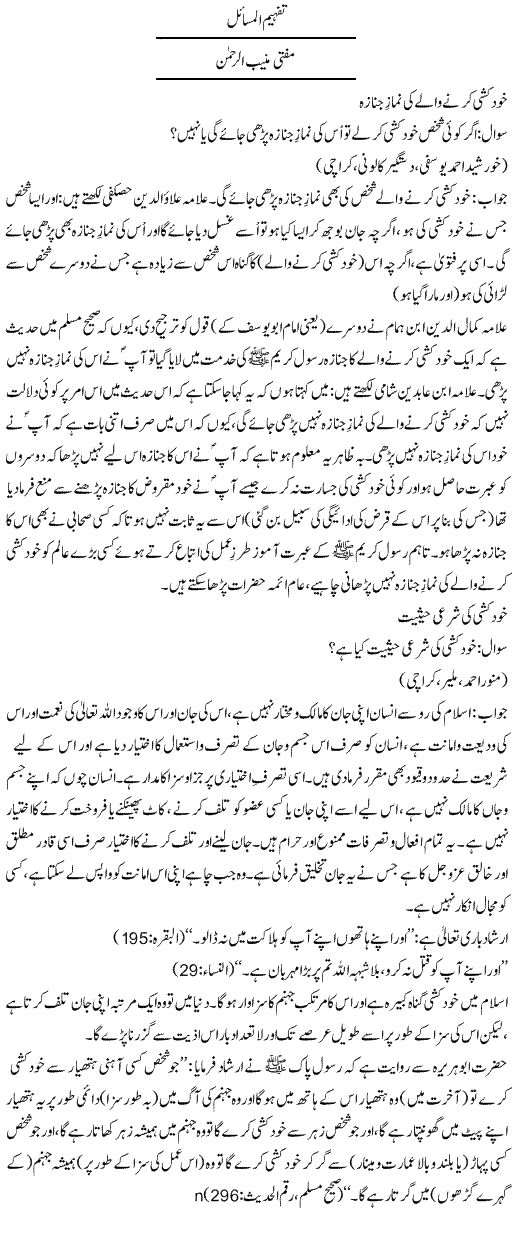
Tafheem-ul-Masail: Khudkushi
What the Qur’an Says: Source of Divine Revelations
In the name of God, the Lord of Grace, the Ever Merciful
Ha. Mim. A revelation from the Lord of Grace, the Ever Merciful: a book, the verses of which have been clearly spelled out as a discourse in Arabic for people of knowledge. It gives good news as well as a warning. Yet, most of them turn away, so that they do not hear. They say: “Our hearts are veiled from whatever you call us to, and in our ears is deafness, and there is a barrier between us and you. So do you what you will, and so shall we.” Say: “I am but a human being like yourselves. It has been revealed to me that your God is the One and only God. Therefore, take the straight path to Him and seek His forgiveness. Woe to those who associate partners with Him.” (Clearly Expounded; Fussilat: 41: 1-6)
The surah opens with the two separate letters, Ha, Mim. We have explained on several occasions the reason why many surahs start with separate letters of the Arabic alphabet. That this is often stated fits in with the Qur’anic method of repeating references to the facts it wants our hearts to internalize. By nature, the human heart needs such repetition because it tends to forget with the passage of time. In order to instill a fact in one’s conscience, one needs to have it repeated in a variety of ways. The Qur’an addresses the human heart with all the qualities instilled in its nature in accordance with its Creator’s knowledge.
It is as if the two letters with which the surah starts, Ha, Mim, are a name given to the surah or to the Qur’an. The two letters constitute the subject of the first sentence while the predicate forms the next verse: “Ha. Mim. A revelation from the Lord of Grace, the Ever Merciful.” Choosing to identify the divine attributes of grace and mercy in connection with the revelation of the Qur’an highlights the quality that is most characteristic of this revelation, namely divine mercy. There is no doubt that the revelation of the Qur’an is an act of mercy for all mankind. It is a mercy for those who believe in it and implement it as also for other creatures, not merely humans. The Qur’an defines a code of living that brings good results for all. It has had a profound impact on the life of humanity, its concepts, values and course of action. Its impact is universal and consistent, ever since it was revealed. Those who study human history with true objectivity, following its course in its wider perspective, which includes all facets of human activity, are able to recognize this truth. Many of them have also recorded this in clear terms.
“A book, the verses of which have been clearly spelled out as a discourse in Arabic for people of knowledge.” Spelling out the verses, clearly and distinctly, according to purpose, people’s nature and mentality, generations, communities, psychologies and needs is a major characteristic of the Qur’an. Its verses are indeed clearly expounded for people who are ready to learn and receive knowledge. In this way the Qur’an gives good news to believers who put their faith in practice, and delivers warnings to those who reject its message and entertain evil. It also explains why such good news and warnings have been given in a fine Arabic style to Arabic speaking people. Most of them, however, refused its message, receiving it cooly: “Yet, most of them turn away, so that they do not hear.”
This is indeed what they did, turning away so as not to hear or be exposed to the powerful logic of the Qur’an. As the surah later informs us, they tried hard to persuade others not to listen to the Qur’an. Of those that did listen their attitude was the same as those who did not: they all resisted the influence of the Qur’an on their hearts. Thus they were like the deaf, deprived of their hearing faculty.
“They say: Our hearts are veiled from whatever you call us to, and in our ears is deafness, and there is a barrier between us and you. So do you what you will, and so shall we.” Such was their stubbornness. They hoped that the Prophet would despair of them ever responding to him and that he would, therefore, stop calling on them to believe. They did so because of the powerful effect of what he said when they deliberately wanted not to believe. Thus, they said to the Prophet: our hearts are covered over so as not to allow your words any penetration, and the deafness in our ears prevents us from hearing you, and the barrier between you and us allows you no interaction with us. Therefore, leave us alone and do what you will. We will go our own separate way. Equally, they might carelessly have said: we will neither listen to what you say nor heed your warnings. You may do what you please. We will continue to follow our own ways, caring nothing for what you do or say.
This is just one example of what the first advocate of the message of Islam had to face. Yet, still he continued to call on people to accept his message, allowing no element of despair to creep into or disrupt his work. He never hastened the fulfillment of God’s promise to him or the infliction of punishment on those who denied him. He acted instead upon instruction, declaring to people that putting the warnings into action was not up to him. He was no more than a human being receiving revelations and delivering a message. His task was to call on people to believe in God’s oneness and to adhere to His message. He was also mandated to warn the idolaters. Once he had done this, matters were left to God while he himself had no say in what was bound to happen: “Say: I am but a human being like yourselves. It has been revealed to me that your God is the One and only God. Therefore, take the straight path to Him and seek His forgiveness. Woe to those who associate partners with Him.”
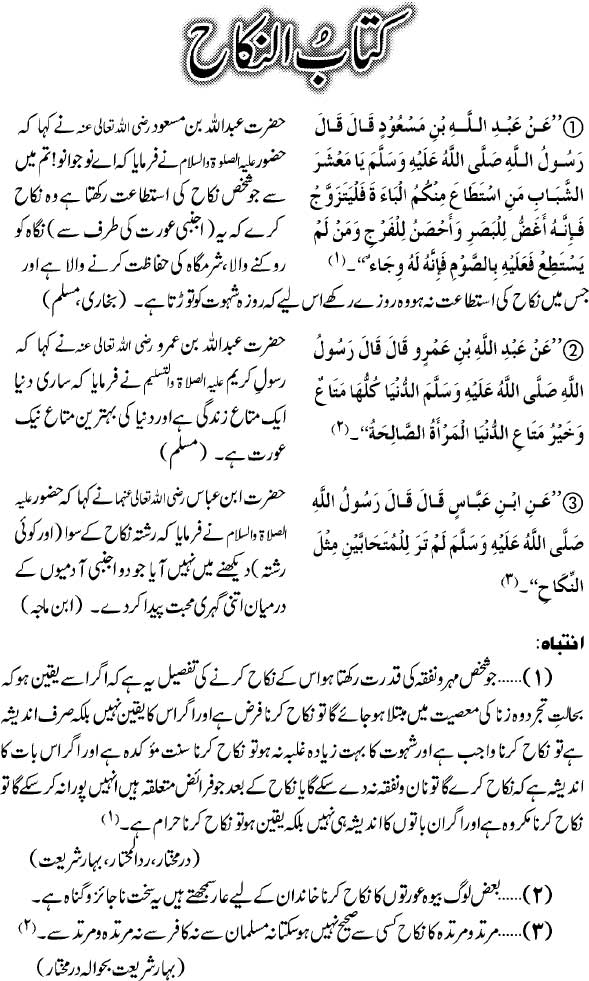
Nikah Kay Mutaliq Ahadith
It Is Disliked To Perform Istijmaar With Bones Or Manure
Although Allah (SWT) upon the tongue of His Prophet (saas) permitted the use of stones and other pure objects as an alternative to water for purification, He (SWT) forbade the use of manure and bones. Perhaps these two objects are not suited for the purpose of purification, and that is the reason behind the prohibition; or perhaps there is another reason for the prohibition that we do not know about, in which case simple, unquestioning obedience is required from us. Once, when the Prophet (saas) was relieving himself, Abdullah Ibn Masood (RA) was nearby, Abdullah (RA) later related, The Prophet (saas) went to Al-Ghaait ( a place prepared as a toilet) and he ordered me to bring him three stones, but I only found two stones, and though I searched for a third, I couldn’t find one. So I took (a piece) of manure, and I went with what I had to the Prophet (saas) He (Saas) took the two stones and cast away the manure. And he (saas) said
This is Impure. 2 .. Related by Bukhaaree (156), Ahmad (3677)
In the hitherto related Hadeeth of Abu Hurairah (RA), the Prophet (saas) said to him,
Search out for stones. I will purify myself with them and do not come to me with bones or manure.
Abu Hurairah (RA) later related, Then I said, What is the problem with bones and manure? He (saas) said,
They are the food of Jinns. (Related by Bukhaaree In Al-Manaaqib (3860)
A delegation of Jinns from Naseebeen – and good indeed are those Jinns – came to me and asked me for provision, and so I invoked Allah (SWT) for them – that they should never pass by any bones or manure except that they should find food upon them. This narration makes clear the reason why it is forbidden to purify oneself with either bones or manure.
Related Issue: Bases on the above-mentioned ruling for the food of Jinn, it is also forbidden to perform Al-Istinjaa or AL-Istijmaar with the food of human beings. Similarly, it is forbidden to perform Al-Istinjaa or Al-Istijmaar with honored paper, such as the paper on which religious knowledge is written, for that paper is likely to have written on it verses of the Quran or Allah’s beautiful Names and Attributes. And an even worst offense is to use the Quran itself.
Shukar-e-Ilahi
Reward For Helping Others
Ibn Abbas narrated, Once I was in a state of i’tikaf in the Prophet’s Mosque (Medina). A certain person came to me and sat down. I said to him, ‘O so and so, you look sad’. He said, ‘Yes of course, o fraternal brother of the Prophet. So-and-so has his due on me, and by the one who lies in eternal peace in the grave (i.e. Prophet Muhammad), I am not able to pay the debt’ I said, ‘Should I not talk to him about your debt?’ He said, ‘You can do so if you like’ Thereupon I put my shoes on and went out of the mosque. The person asked him, ‘Have you forgotten the state you were in (i.e. i’tikaf)?’ I replied, ‘Not at all, but I have heard from the one who lies in eternal peace in the grave [saying this his eyes became filled with tears], said:
“One who moves to fulfill any need of his brother, and makes effort for it, will find it better than itikaaf of ten years; and one who performs i’tikaf for one day for the pleasure of Allah, he will create a distance of three ditches between him and the hell – and each ditch has a width which lies between East and West, or between the heaven and earth.”
Source: Al Targhib Vol II p 272.
By the blessings of Allah, we are approaching another Ramadan. For most of us, we feel a little taste of hunger during this month only. But there are billions for whom it is a matter of daily life. Let us get immense rewards by helping our needy brothers and sisters around the world during this month of generosity.
Zameen Par Najaiz Qabza
