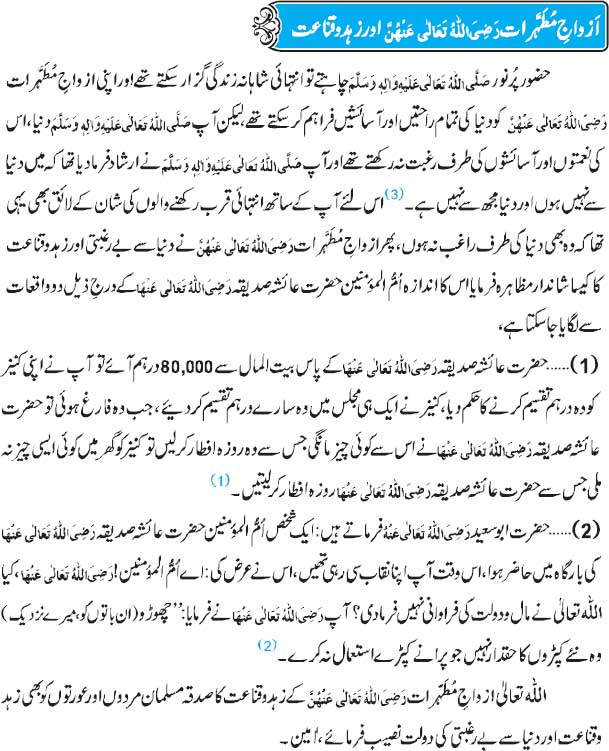
Azwaj-e-Mutaharat Ka Zohd o Qana’at

The Muslim believes that exercising his mind and seeking knowledge and discovering the signs of Allah in the universe is an obligation, because of the saying of the Prophet (peace be upon him):
“Seeking knowledge is a duty on every Muslim.” (Bukhari)
Therefore the Muslim must continue to pursue knowledge, as long as the breath of life remains in his body. The fact that Allah has raised the status of those who have knowledge, and described them alone as truly fearing Him, should be enough to encourage the Muslim to apply himself to seeking knowledge. For Allah said:
“…Those truly fear Allah, among His Servants, who have knowledge…” (Qur’an 35: 28)
No one truly fears Allah except those whose minds are enlightened enough to see the greatness and power of Allah manifested in the creation of the universe and all living things, and these are the people of knowledge. So Allah has preferred them over those who have no knowledge:
“…Say Are those equal, those who know and those who do not know?’ It is those who are endued with understanding that receives admonition.” (Qur’an 39: 9)
Safwaan Ibn ‘Assal Al-Muradi came to the Prophet (peace be upon him) in the mosque and said, “O’ Messenger of Allah, I have come seeking knowledge.” The Prophet (peace be upon him) told him:
“Welcome, O seeker of knowledge! Truly the angels surround the seeker of knowledge with their wings, gathering around him in ranks one above the other, until they reach the first heaven, out of love for that which he seeks.”
The texts from the Qur’an and Hadith that extol the virtue of knowledge and exhort its pursuit are many, therefore the true Muslim is either a scholar or a seeker of knowledge, and cannot be anything else.
Continually seeking knowledge until death. True knowledge does not mean obtaining a degree or diploma that will let one earn an income and guarantee a good standard of living, after which one turns away from learning and does not explore the treasure of knowledge any further; true learning means that one continues to read and study, increasing one’s learning day by day, in accordance with the words of the Qur’an:
“…But say, ‘O my Lord! Advance me in knowledge.'” (Qur’an 20: 114)
Our righteous predecessors never stopped seeking to increase their knowledge, no matter how high a level of learning they had achieved, and they would continue their pursuit until the end of their lives. They believed that knowledge was a living thing that would thrive if it were actively pursued, but would wither and perish if it were ignored and abandoned. Many sayings are attributed to them that eloquently express their respect for learning and their keenness to acquire knowledge. Examples of their sayings are given below.
Imam Ibn Abdul-Barr reported that Ibn Abi Ghassan said: “So long as you are seeking the knowledge you are knowledgeable, but as soon as you abandon this pursuit you become ignorant.”
Imam Malik said: “No one who has knowledge should stop seeking knowledge.”
Imam Abdullah Bin Al-Mubarak was asked: “How long will you seek knowledge?” He said, “Until I die, for probably I have not yet learned the things that will benefit me most.”
Imam Abu ‘Amr Bin Al-‘Ala’ was asked: “For how long does it befit a man to seek knowledge?” He said, “For as long as he has life in him.”
Imam Sufyan Bin ‘Uyaynah gave an excellent answer when he was asked, “Who is most in need of seeking knowledge?” He said: “Those who have the most knowledge.” He was asked, “Why?” and he replied, “Because if they make a mistake, it is worse.”
Such was Imam Fakhr ad-Deen ar-Razi (d. 606 AH), the great mufassir (Qur’anic exegete), and prominent scholar in philosophy (‘llm al-kalam) and other disciplines, who authored many books. Allah gave him such fame in the knowledge that people would come from all over to see him whenever he visited a city.
When he came to the city of Merv (in Turkmenistan), flocks of scholars and students came to have the privilege of listening to and learning from him. Among the seekers of knowledge who attended his circle was a young man, less than 20-years-old, who was very well-versed in literature and genealogy. When Imam Razi realized that this student was an expert in genealogy, a field in which he knew very little, he asked this student to teach him.
He did not find it unacceptable to become the student of his student, and he even made him sit in the teacher’s place while he himself sat at his feet. Such an act was characteristic of Imam Fakhr ad-Deen ar-Razi, and it did not detract from his high status, as he was the Imam of his age.
This remarkable story was told by the literary historian Yaaqoot al-Hamwi in his book Mu’jam al-Udabaa’ (Dictionary of literary authors), where he gives a biography of ‘Aziz ad-Deen Isma’eel Bin Al-Hasan Al-Marwazi An-Nassabah Al-Husayni, whom Yaaqoot met and spent much time with, so was able to write a comprehensive biography of him. In this biography he says:
“Aziz ad-Deen told me: ‘Imam Fakhr Ad-Deen Ar-Razi went to Merv. He had such a great reputation and was held in such awe that nobody dared to argue with him; they would barely breathe in his presence. I went to meet him, and I often went to study with him.
One day he said to me: ‘I would like you to write me a book giving the genealogy of At-Talibiyeen (the descendants of Abu Taalib) so that I may study it, for I do not want to remain ignorant of it.’ I asked him: ‘Do you want it presented as a family tree, or written down as a narrative?’ He said, ‘A family tree cannot be learned by heart. I want something that I can memorize.’ So I went away and wrote the book, which I called Al-Fakhri. When I brought it to him, he took it, then got up from his mattress, sat on the mat, and told me to sit in the place he had just vacated.
I thought this was too much, and told him: ‘I am your servant.’ He reprimanded me severely, saying, ‘Sit where I tell you!’ Allah knows, I felt that I had no choice but to sit where he told me. Then he began to read the book to me, while he was sitting at my feet, asking me about anything he did not understand, until he finished the book. When he had finished, he said, ‘Now sit wherever you wish, for in this field of knowledge you are my teacher and I am your student, and it is not right for the student to sit anywhere but at the feet of his teacher.’ So I got up, and he sat in his rightful place, and I began to read to him, sitting where he had sat previously.”
After quoting this incident, Yaaqoot said, “Indeed this is good manners, especially for a man who enjoys such a high status.”
How great was the love and respect these scholars gave to knowledge! How highly they regarded it, and how great is the need for the later generation to learn from the attitude of their forbears!
What Muslims need to know
The first thing that the Muslim needs to know is how to read the Qur’an properly (with tajweed) and to understand its meaning. Then he should learn something of the sciences of Hadith, the Seerah of the Prophet (peace be upon him), and the history of the Sahabah and Tabi ‘een, who are prominent figures in Islam.
He should acquire as much knowledge of Fiqh as he needs to ensure that his worship and daily dealings are correct, and he should ensure that he has a sound grasp of the basic principles of his religion. This is the duty of the Muslim who is not a specialist in the sciences of Shariah. If he is a specialist in a branch of Shariah, then he does what every true Muslim should do, which is to do his best to learn his specialty thoroughly and be successful in it. It goes without saying that every Muslim also needs to learn Arabic properly.
He should be proficient in his specialty
Besides this, the Muslim turns to his own specialty and gives it all of his energy, and pays a great deal of attention to it. He approaches it like a Muslim who believes that it is a religious obligation to work in his field of specialization, whether it is in Shariah or in another area of religious knowledge, or in another field such as mathematics, physics, chemistry, engineering, astronomy, medicine, industry, commerce, etc.
Therefore he should become proficient in whatever field he has specialized in and should spare no effort to read whatever has been written about it, both in his own language and in others if he is able to. He should keep abreast of developments in his field through continual reading and study of all its aspects.
This is because, in these times, the smart Muslim is the one who achieves great academic success, which will raise his status in the eyes of other people. This in turn will enhance his Da’wah, so long as he presents it sincerely and earnestly, and in accordance with the spirit of Islam and its teachings about knowledge.
Islam has made knowledge a duty, whereby the one who seeks it draws closer to Allah and adopts it as a means of earning His pleasure. So we see that the scholars of the early generation used to emphasize these sublime principles in their introductions to their books, because through the knowledge that they spent their lives spreading, they were seeking to earn the pleasure of Allah, and they presented the results of their study purely for His sake.
Information about other fields
The smart Muslim does not restrict himself to his own field but is open to learning about other areas too. So he reads books and academic, literary, and cultural journals about various useful branches of knowledge, especially those that are related to his own field. In this way, he gains knowledge about many things, which enriches his mind and broadens his horizons.
He is proficient in a foreign language
He does not forget to pay attention to foreign languages, because these days, learning a foreign language is one of the most important tasks required of the active Muslim who understands the demands of contemporary Islamic life.
His religion gives the attentive Muslim a great incentive to learn foreign languages. Fifteen centuries ago, the Prophet (peace be upon him) encouraged the study of foreign languages so that the Muslims would always be able to communicate with various nations and races and convey to them the message of truth that Allah has entrusted to them to proclaim throughout the world. We see evidence of this in the Hadith narrated by Zayd Bin Thabit (may All be pleased with him), in which he says that the Prophet (peace be upon him) told him:
“O’ Zayd, learn the writing of the Jews, for by Allah I do not trust the Jews to write anything down for me.”
(Zayd) said: “So I learned it, and it only took me a month to become proficient in it. Then I used to take down whatever letters the Prophet (peace be upon him) wanted to send to them, and I would read for him the letters that they sent him.”
In another report, he said: “The Messenger of Allah (peace be upon him) asked me, ‘Do you know Syriac? I have received a letter in this language.’ I said, ‘No.’ He said:
‘Then learn it.’ So I learned it.”
Similarly, Ibn az-Zubayr (may Allah be pleased with him) was proficient in a number of languages, but learning them did not distract him from his religion or preparing for the Hereafter. He had a hundred (male) slaves, each of whom spoke a different language, and he used to speak to each slave in his own language. If you were to see this man when he was dealing with worldly affairs, you would think that he was a man who did not give a moment’s thought to the Hereafter, and if you saw him dealing with religious matters, you would think that he was a man who did not give a second’s thought to this world.
Nowadays, more than ever before, the Muslim needs to be proficient in foreign languages so that he may know what is going on around him, both positive and negative, and so that he may understand what has been written about his Ummah and its heritage in languages other than his own, and thus be able to defend his Ummah from evil and speak up for its well-being.
– Taken from the book ‘The Ideal Muslim’ by Mohammad Ali Al-Hashmi, published by International Islamic Publishing House, Riyadh.
All Praise is due to Allah SubHanuhu wa Ta’ala and Choicest Salutations upon His August Habib Peace and Blessings of Allah be Upon Him.
I am sharing this brief note extracted from “Fadl al-Ilm wa al-Ulama”, the Blessed book by Aarife-Billah, ash-Shaykh al-Imam Naqi Ali al-Qadiri Radi Allahu Ta’ala Anho on the Excellence of Knowledge and the Ulama. Here we will discuss some obstacles to the path of seeking knowledge. I humbly pray that this note will enlighten the hearts and encourage my Muslim brothers and sisters to acquire the knowledge of Deen.
Firstly, The strong resistance from the cursed Shaytan.
Be aware that the most hated and dangerous thing to the Cursed Shaytan is the seeking of knowledge. Therefore, he uses all his powers and resources to stop a student from learning. The Shaytan puts the most Waswasa (interference) on a student of Din. No other deed or worship besides the seeking of knowledge experiences such as intensified opposition. The methods of combating these interferences are very simple. All the student has to do is remember all the Ayahs and Ahadith pertaining to the excellence of Ilm-e-Din and never pay attention to the obstruction of the evil Shaytan. Surely, an intelligent man will not give preference to the cursed Shaytan over the Bounties of the Merciful Lord SubHanuhu wa Ta’ala.
Secondly, Carnal desires (Nafs) are very demanding.
It hates hardship and loves relaxing. But when one realises that this world (Duniya) is temporary and that the Hereafter (Akhirah) is the everlasting and original abode, then indeed, the hardship of seeking knowledge becomes a pleasure. One must realise that the hardship of seeking knowledge lasts for a very short period and its benefits and pleasures are limitless. As time passes and the student gets the taste of knowledge, he will develop such pleasure that he will never be at peace without reading a book. No matter where he goes or what he does, he will never be relaxed if he does not read a book on Din.
Thirdly, Association with the public.
In the inception, set out some time to study in privacy and as one progress in this field, one will develop the love of knowledge so much so that everything else will have no value.
Fourthly, Worldly fame and honour.
It is obvious that the seeker of worldly fame is never successful and fades away in time to come. Worldly fame and honour are of no comparison to the honour of the Hereafter. How unfortunate are those who seek knowledge for this world and discard the wealth and dignity of the Hereafter? Such people destroy themselves by thinking that they are successful.
On the contrary, those who give preference to Ilm-e-Din over worldly fame, the Merciful Lord SubHanuhu wa Ta’ala certainly blesses them with honour and integrity in both the worlds. Shaykh Abu-Aswad Radi Allahu Ta’ala Anho states that there is no merit greater than knowledge. A King rules over the people and the Ulama rules over them. Have you not seen that rulers have no choice but to implement the verdicts of the Ulama when matters are brought to their courts?
Anyone who loves and appreciates knowledge will surely not give preference to the kingdom of the world over it. It is reported that a destitute went to a King for a job. The King said that he was ignorant and not fit to serve him. He left and humbled himself at the feet of Imam Ghazali Radi Allahu Ta’ala Anho to study Ilm-e-Din. There, he learnt about the dangers of this world and harms of associating with Kings and the wealthy people. However, Imam Ghazali’s company and tutorship made him an intellectual celebrity. One day, the King called him and assessed his profound knowledge. He was overwhelmed and said: “Now you are worthy of my service. What post would you like to take up?” The ‘Aalim replied, “In the past, I was of no use to you and now you are of no use to me. Previously, you did not like me and now I do not like you.”
Fifthly, The greed of wealth.
It is obvious that the perishable wealth of this mundane world cannot be compared to the wealth of knowledge. When a man dies, his wealth does not accompany him to the grave, but the knowledge accompanies him to the grave and always assists him until he enters Jannah. Worldly wealth decreases when it is spent but knowledge increases when it is imparted. The wealthy have to protect his wealth while knowledge protects the Alim. Furthermore, Allah SubHanuhu wa Ta’ala does not leave one a destitute if one gives preference to the seeking of knowledge over business and trade. Imam Ghazali Radi Allahu Ta’ala Anho records in his Ihya al-Uloom,
One who develops understanding in Din, Almighty Allah SubHanuhu wa Ta’ala protects him from depression and provides sustenance for him from places he cannot imagine of.
Sixthly, The destruction of wealth.
Man gets very worried and depressed when he thinks of his undetermined life span and shortage of time. Hence, he wrongfully deduces that knowledge is an ocean and one’s entire life span is too little to achieve it. This is absolute ignorance. No soul can reach the ultimate peak of perfection in knowledge in one’s lifetime, so much so that Allah SubHanuhu wa Ta’ala Commands His Beloved Rasool Peace and Blessings of Allah be Upon Him
Taking all this into account, there is still no seeker of knowledge that is deprived of honour and excellence. A sincere student of Ilm-e-Din will not experience embarrassment and failure. All the branches of Ilm-e-Din are certainly profitable no matter how little is acquired. The Hadith Sharif states that if a person dies whilst studying Ilm-e-Din and did not complete his course, he will be raised amongst the Ulama on the Day of Qiyamah. Another narration says that if a student of Din dies while studying, the Angels will complete his studies for him in his grave. Is this a small benefit that Almighty Allah SubHanuhu wa Ta’ala Divinely provides for the people of learning (Ulama)?
Seventh, Not to get a compassionate teacher (Ustaz).
This is of paramount importance to a successful student. Surely, one will not be able to achieve anything if the Ustaaz does not teach correctly. Nowadays, there are very few sincere teachers of Din that are dedicated to their students and this has greatly contributed to the dwindling number of good students.
Eighth, The concern for livelihood.
Eight obstructions are the most difficult one and this refers to obtain just enough to carry on with one’s daily needs. Always remember that extra is always extra. The greed for extra is generally found in every human. This greed for extra has destroyed many people. The last two obstructions are serious problems because if one does not get a compassionate teacher what can one benefit from him and if one does not get enough food to eat then how is one to concentrate on studies? Weakness and hunger are serious problems that cannot be controlled by a student. Therefore, it is very important for the wealthy to cater for the student.
Likewise, the financial contributions of generous Muslims to Islamic Institutes will certainly remove these problems. There are enormous virtues for the teachers and students of Din and even more so for those who financially keep these Institutes operational. The same will apply to those who encourage people to support such an institution. The Hadith Sharif states:
Besides the above Hadith Sharif, there are numerous other Ahadith Sharif in the Siha-Sitta that speaks of the virtues on this subject. However, be mindful that the Thawab of actions varies according to situations and moments. Therefore, the status of the noble Sahaba Radi Allahu Ta’ala Anho is so lofty because they promoted the Din and sacrificed their lives in the most difficult and volatile moments and situations in the history of Islam. Hence, if one promotes Ilm-e-Din in these distraught moments of poverty, one will certainly achieve more Thawab than the wealthy individuals and rich Kings of the past who promoted knowledge. This is so because firstly, the Kings had a great resource available and secondly, they lived in the era when Ilm-e-Din was well and alive, progressing day-by-day. The people too were very honourable and loved to study the Din.
A Sincere Request
Beloved Muslim brethren! Awaken from your dreams of fantasies and seek the knowledge of Din. This is your guide to success in the Hereafter. Why do you waste so much of time in fruitless activities in this temporary abode and pay no heed to the real success and salvation? Spend some time to acquire Ilm-e-Din so that you may distinguish between good and bad. Ignorance is no excuse in the Divine Court of Almighty Allah SubHanuhu wa Ta’ala. In fact, it is a sin on its own. This knowledge is helpful in all aspects of this world and the Hereafter. It will save you from embarrassment and humiliation. Spend some money and time to earn this great wealth. Do not wait for the last moment before you think of studying. It will be useless!!
Extracted From
The excellence of Knowledge and the Ulama by Mufti Naqi Ali al-Qadiri
English Translation by Shaykh ‘Abd al-Hadi al-Qadiri
We are told in the last sermon of our prophet(saw) to: “Beware of Satan, for the safety of your religion. He has lost all hope that he will ever be able to lead you astray in big things, so beware of following him in small things”.
Mankind’s softest spot where Satan can easily attack is our Ego (kibr). What the Quran and hadith say about it.
“One does not enter Jannah (paradise) who has in his heart a mustard seed’s weight of Kibr”.(ahadith)
Kibr (ego, pride) is rejecting the truth and belittling people.”
.Surely Allah does not like whoever is arrogant, boastful [Quran 4:36]
“And do not turn your nose up to people, nor walk pridefully upon the earth. Surely Allah does not like whoever is arrogant, boastful. [31:18]
Without a doubt, Allah knows what they conceal and what they reveal. He certainly does not like those who are too proud. [16:23]
…So Today you will be rewarded with the torment of disgrace for your arrogance throughout the land with no right, and for your rebelliousness “[46:20]
I will turn away from My signs those who act unjustly with arrogance in the land. And even if they were to see every sign, they still would not believe in them. If they see the Right Path, they will not take it. But if they see a crooked path, they will follow it. This is because they denied Our signs and were heedless of them. [Quran 7:146]
Racism
The following scene took place on a BA flight betweenJohannesburg and London. A white woman, about 50 years old, was seated next to a black man.
Obviously disturbed by this, she called the air Hostess. Madam, what is the matter, the hostess Asked
You obviously do not see it then? she responded. You placed me next to a black man. I do not agree to sit next to someone from such a repugnant group. Give me an alternative seat.
Be calm please, the hostess replied. Almost all the places on this flight are taken. I will go to see if another place is available. The Hostess went away and then came back a few minutes later.
Madam, just as I thought, there are no other available seats in the economy class. I spoke to the captain and he informed me that there is also no seat in the business class. All the same, we still have one place in the first class.
Before the woman could say anything, the hostess continued. It is not usual for our company to permit someone from the economy class to sit in the first-class, However, given the circumstances, the captain feels that it would be scandalous to make someone sit next to someone so disgusting.
She turned to the black guy and said. Therefore, Sir, if you would like to, please take your hand luggage because a seat awaits you in the first class. At the moment, the other passengers who were shocked by what they had just witnessed stood up and applauded.
All mankind is from Adam and Eve, an Arab has no superiority over a non-Arab, nor a non-Arab has any superiority over an Arab; also a white has no superiority over a black, nor a black has any superiority over a white except by piety and good action. Learn that every Muslim is the brother of another Muslim and that Muslims constitute one brotherhood.
Ahadeeth on ASSABIYYAH (nationalism, tribalism, racism etc.)
“He is not of us if he calls to assabiyyah, and he is not one of us if he fights for the sake of assabiyyah, and not one of us if he dies on assabiyyah.”
Everyone shall taste death…this life is a period of trials and tests then we shall return to (Allah) to get what we deserve: Paradise or Hell.
He (Allah) has created death and life, that He may test which of you is the best in deeds. He is the All-Mighty, the Oft-Forgiving. [Quraan 67:2]
“Nineteen-year-old college student commits suicide because he received a C in Biology.”
Although this was not an actual headline, it could have been. Over the years, we have seen suicides by students for similar reasons. Japan has the highest suicide rate among students and it’s all related to not getting high enough scores on this or that. Harvard University also has a good reputation for suicide students due to high expectations and pressure on the students.
Parent’ Expectations
Parents often have very high academic and career expectations for their children, which some children cannot live up to. Unfortunately, in some societies concern about disappointing one’s parents is a tragedy the student cannot deal with, so he kills himself.
I remember an engineering student who lived next door to me when I was in college. He used to study all of the time, and it was rare to see him. Once I told him that he must love engineering to work so hard for it. He said that he didn’t really want to be an engineer, but that’s what his parents wanted him to be. He really wanted to be a photographer.
Children’s Interests
This is not an uncommon situation. A child has a field of study that he is interested in, but the parent has a totally different goal for him. The child wants to be an artist; his parents want him to go to med school and become a doctor. The child wants to be a political scientist; his parents want him to be an engineer. This clash seems to be especially prevalent in immigrant Muslim families.
In some cases, the parents mean well. They want their children to work in a profession in which they have a good chance of succeeding economically. They feel that the social sciences and arts, in general, do not offer as much potential for financial success as do engineering, medicine, business, and law. And they are right. However, many young people do not place the same priority on getting a high salary as their parents do. They might be more interested in a lower-paying career that matches their interests or that provides spiritual, emotional, psychological, or social rewards, rather than monetary ones.
All Halal Occupations are Honorable in Islam
Unfortunately, many parents may want their children to work in a highly paid and prestigious field because of social snobbery or as a form of competition with their friends and relatives whose children may be studying or working in a prestigious field. In Living With Teenagers: A Guide for Muslim Parents, Ruqaiyyah Waris Maqsood writes:
“Sometimes parents are rather snobbish—they only tend to think in terms of the highly paid, skilled salaried jobs for their offspring. Whereas it is true that Islam encourages every person to seek the most knowledge that they can and to aim as high as they can, any social snobbery is totally against the spirit of Islam, which gives dignity to every honorable employment, no matter how lowly.
Parents have therefore to watch out that they do not push him or her above their capabilities. The Prophet, may Allah bless him and grant him peace, taught that there is no room in Islam for snobbery. The man who works as a simple porter or road-sweeper has as much right to his dignity as the manager of a great business concern (particularly in this age when the manager is deeply immersed in banking and interest transactions which are forbidden). What counts is honesty, and the attitude to the work one is doing.
Since society needs rubbish collectors just as much as brain surgeons, nobody needs regard any useful employment as being beneath them—the prophet Dawud was a shepherd and a metalworker, Nuh and Isa were carpenters, and Musa was a shepherd, peace be upon them, and Muhammad, may Allah bless him and grant him peace, was a trader. Islam actually gave dignity to many professions which people had previously considered lowly and degrading, including, incidentally, being a housewife.”
Luxury without Charity is discouraged in Islam
Although many parents push their children to study medicine, law, or engineering so that they will get a financially rewarding job when they graduate, many other jobs can adequately support a family. The family might not be rich, but it can have its needs met. Moreover, in Islam, even Muslims who have excess money are not encouraged to live lives of luxury. Rather, they are encouraged to help those in need with their excess money, and Muslims who are rich have an even greater responsibility to help others.
These jobs, as long as they are halal and do not involve the person in haram activities, have as much dignity as the higher paid, more prestigious jobs. So unless parents have better reasons than higher pay and more prestige, why should they pressure their children into pursuing careers that they are not interested in?
Important for Parents to Consider Children’s Interests
As previously mentioned, there is also some danger in pushing one’s child into a field of study he has no interest in or which may be beyond his capabilities. Not everyone is meant to be a doctor, a lawyer, or an engineer. To pressure the child into studying something that is not really for him could merely ensure his failure at it, which might also be followed by shame, depression, low self-esteem, rebellion, frustration, and even suicide.
Muslim Ummah Needs People of Diverse Occupations
In addition, the Muslim Ummah needs people to work in a variety of other professions, such as social work, nursing, psychology, auto repair, farming, and education. Muslim leaders have long complained about the lack of Muslims pursuing careers in the media. Although in recent years, there seems to have been an increase in Muslims going into these fields, Muslims are still in no position to compete with non-Muslim media. America should be flooded with high-quality Islamic publications and radio and television broadcasts. But still, only a small number of Muslims are going into media occupations.
A Career: More than Financial Security
In the past, just having a job and being able to support oneself and one’s family was essential. People often went into the same profession as their father. A farmer’s son became a farmer. A carpenter’s son became a carpenter. Opportunities to advance or to go into a field of one’s choice were quite rare. Today, we have a totally different situation. People have a much greater choice in the career they pursue. A career is no longer just a means of financially supporting one’s family; it is a major part of one’s life. To be trapped in a career one hates can be very difficult. To have a job one loves and enjoys can be one of life’s great joys.
Career choice has become a controversial issue in many families.
Although many children may one day appreciate their parents’ insistence that they study engineering or medicine, others may always wish that they had gone into the field “they” wanted rather than the field “their parents” wanted them to. But the real question is not whether the children will one day appreciate their parents’ pressures to go into a certain career or whether they will resent them, the real question is whether or not the parents were right or wrong to pressure them into it in the first place.
All praises and thanks be to Allah, Lord of everything that exists. The Most Gracious, the Most Merciful.Master of the Day of Judgment You (alone) we worship, and You (alone) we ask for help. Guide us to the Straight Way The Way of those on whom You have bestowed Your Grace, not (the way) of those who earned Your Anger, nor those who went astray. Ameen
To deal with this topic it is necessary to know the position of the Prophet in Islam (peace be upon him), because the indispensability of Ahadith depends upon the position of the Prophet (peace be upon him).
Analyzing the problem we can visualize three possibilities:
1. The duty of the Prophet (peace be upon him) was only to convey the message, and nothing more was required from him.
2. He had not only to convey the message but also to act upon it and to explain it. But all that was for the specified period, and after his death, the Qur’an is sufficient to guide humanity.
3. No doubt he had to convey the divine message, but it was also his duty to act upon it and to explain it to the people. His actions and explanations are a source of guidance forever. His sayings, actions, practices, and explanations are a source of light for every Muslim of every age.
Muslim scholars are of the unanimous view that only the third point is the correct assessment of the Prophet’s (peace be upon him) position in Islam. The Qur’an contains dozens of reminders of the important position of the Prophet (peace be upon him). For instance, the Qur’an says:
“Indeed in the Messenger of Allah (Muhammad, peace be upon him) you have a good example for him who hopes for (the Meeting with) Allah and the Last Day and remembers Allah much. (Al-Ahzab 33:21)
According to this verse, every Muslim is bound to have a good example of the Prophet (peace be upon him) as an ideal in life. In another verse, he has been made a hakam (judge) for the Muslims by Allah Almighty. No one remains Muslim if he does not accept the Prophet’s (peace be upon him) decisions and judgments as explained in Surah Al-Nisaa‚ (4:65).
The Qur’an is very clear in expressing its view on the position of the Prophet (peace be upon him). According to the Qur’an, the Prophet (peace be upon him) has four capacities, and he must be obeyed in every capacity. He is mu’allim wa murabbi (teacher and educator); he explains the Book; he is a judge; and he is a ruler. In all these capacities, he is an ideal example for the Muslims. I am quoting a few verses of the Qur’an just to give a hint of this topic:
Indeed, Allah conferred a great favor on the believers when He sent among them a Messenger (Muhammad, peace be upon him) from among themselves, reciting unto them His Verses (the Qur’an), and purifying them (from sins by following him), and instructing them (in) the Book (the Qur’an) and Al-Hikma [the wisdom and sunnah of the Prophet, peace be upon him], while, before that, they had been in manifest error. (Aal Imran 3:164)
O you who believe! Obey Allah and obey the Messenger (Muhammad, peace be upon him), and those of you (Muslims) who are authority among you. (And) if you differ in anything amongst yourselves, refer it to Allah and His Messenger (peace be upon him), if you believe in Allah and the Last Day. (An-Nisaa‚ 4:59)
In all these verses, the Qur’an has explained various aspects of the Prophet’s (peace be upon him) personality. One can judge the importance of the Prophet (peace be upon him) from these verses. I am reminded of another important verse of the Qur’an, which is actually a verdict against those who do not believe in Ahadith as an authentic source of law:
And whoever contradicts and opposes the Messenger (Muhammad, peace be upon him), after the right path has been shown clearly to him, and follows other than the believers’ way, We shall keep him in the path he has chosen, and burn him Hell – what an evil destination! (An-Nisaa‚ 4:115)
The Qur’an, while pressing the Muslims to obey the Prophet (peace be upon him), goes a step further when it announces that the Prophethood of Muhammad (peace be upon him) is above all the limitations of time and space. He is the Last Prophet (peace be upon him) and is a Messenger of Allah (peace be upon him) for the whole of humanity for all time to come. Ahadith is nothing but a reflection of the personality of the Prophet (peace be upon him), who is to be obeyed at every cost.
Dr. Hamidullah in his book, Introduction to Islam, explains: “The importance of Ahadith is increased for the Muslim by the fact that the Prophet Muhammad (peace be upon him) not only taught but took the opportunity of putting his teachings into practice in all the important affairs of life. He lived for 23 years after his appointment as the Messenger of Allah (peace be upon him). He endowed his community with a religion, which he scrupulously practiced himself. He founded a state, which he administered as the supreme head, maintaining internal peace and order, heading armies for external defense, judging and deciding the litigations of his subjects, punishing the criminals, and legislating in all walks of life. He married and left a model of family life. Another important fact is that he did not declare himself to be above the ordinary law which he imposed on others. His practice was not mere private conduct, but a detailed interpretation and application of his teachings.