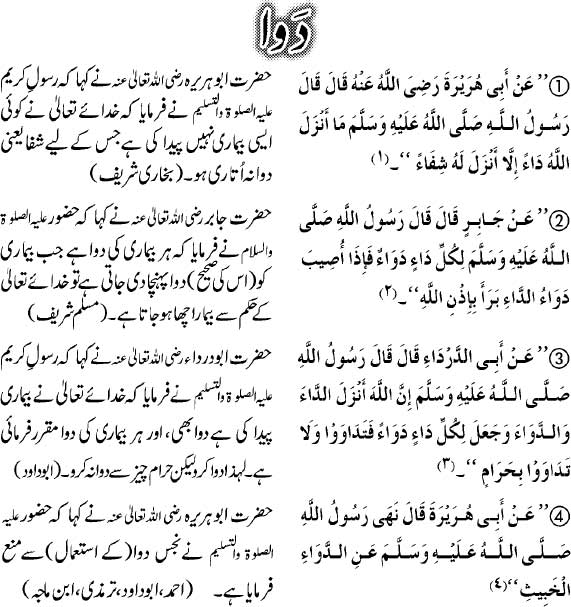
Dawa


I was speaking to a young man recently and during the conversation, I heard him say, “I don’t make dua’ anymore.” I asked him, “Why not?” and he replied, “I made dua’ for some things and I never got them so I just gave up!” I asked him if he was happy in his life, he said, “Not really.” Then I asked him if he felt he needed the mercy of Allah in his life, and at that, he replied very enthusiastically, “Of course I do!”
Now this made me think very deeply about some things in life. Is it right that we (mankind in general) go on expecting things from our Creator while we sit down passively, mostly just observing life and hardly doing anything for anyone else unless it somehow fits in with our scheme of things?
Is it right if you, as an individual, want something from your parents but you’re doing and saying things they do not like, going out without their permission, dressing in an unacceptable way, not pulling your weight around the house, and so on, then you just come right out and ask for money, or new clothes, or whatever, and then grumble when they refuse, and perhaps adding how unfair life is and how very unreasonable they are?
Let’s look at it another way. Imagine you had someone you called your friend but this person spoke badly about you behind your back, took your stuff without permission, and only came hanging around when he wanted something — then one day he comes to you and asks a big favor. Most likely you would tell him to forget it and simply ignore him if he started complaining.
So we all acknowledge that on the human level life is a matter of give-and-take; it’s a matter of rights and responsibilities.
What about your relationship with your Creator? Is it right that we enjoy the bounty of this marvelous creation and, even though everything was created for the benefit of man, we go ahead and make use of things for our own benefit and comfort without thinking of others? Is it right to fail to give others their rights and expect our rights, and often fail to take care of the creation that Allah provided for us?
How often do you use things that you know will pollute the environment — the same environment that Allah created for you? Dropping litter, using chemicals, and generally tapping into the wasteful and excessive way of life in the modern world, without really thinking seriously about your responsibility to yourself, those around you, the world, and your Creator. Then when you get sick because of the polluted and chemical-filled environment, you turn in desperation to the Lord of all asking for help and healing. Then as soon as you are well again, you go back to the old habits of misusing, if not destroying, the environment. How Merciful Allah is! Even though you keep making the same mistakes, even though you misuse yourself, others, and the world around you, He still comes to your aid! He, the Almighty, gives you enough opportunity to change, to see the errors of your ways, and to make a fresh start.
Have you ever noticed how your body heals as does the environment? So where is your place in all this? A person can drink alcohol and abuse his body until he gets liver disease — and then blame fate! Likewise, a person could neglect the rights of his family and even abuse them when he is in the prime of his life and filled with strength, but when he gets old and is left alone and feeling lonely, he curses life and complains how difficult life is! Do you find that you sometimes do things like this?
Have you ever passed by a river that is polluted and said how awful it is that “mankind” destroys nature? But then haven’t you ever tipped chemicals down the sink that end up in the river system, and somewhere along the line, contributed to this awful state of pollution? What I want to say is that you have to be willing to take your responsibilities seriously. The first step is to realize that Allah has called upon mankind to be the caretakers of this world.
Allah the Almighty said: “You are the best of peoples ever raised up for mankind; you enjoin Al-Maruf ( i.e. Islamic Monotheism and all that Islam has ordained) and forbid Al-Munkar (polytheism, disbelief and all that Islam has forbidden) and you believe in Allah…” (Qur’an 3:110)
You have to understand that the nature of this life is not just to make money and live a comfortable life of ease. You have to be willing to give: to give to those around you, your family and friends, and your communities; to participate in the voice of society that calls for justice; to speak out against violations against mankind and the earth. When toxic waste is dumped, what do you do? When logging companies are allowed to destroy one of the last remaining rainforests on earth, what do you do? When people are abused and oppressed, what do you do? If your answer is “nothing.” Then you should think again.
The Prophet (peace be upon him) said: Whoever, among you, sees something abominable should rectify it with his hand; and if he has not strength enough to do it, then he should do it with his tongue; and if he has not strength enough to do it, (even) then he should (abhor it) from his heart, and that is the least of Faith. (Muslim)
Allah created us to worship Him, and a part of that worship is to keep within His boundaries — the rules He has provided us with, knowing full well that whatever He has ordered us to keep away from is in fact bad for us.
So imagine a person who is selfish, stubborn, and harsh. He couldn’t care less about the effects of dumping his factory’s toxic waste into any place convenient (for them). He lives his life trying to make more and more money and gathering up material wealth; he doesn’t really care whose head he steps on to get up the social ladder, and basically he doesn’t really care about anyone except himself. If such a person prays to the Creator of all-should he expects his dua’ to be answered? Listen to what the Prophet (peace be upon him) said about this:
“Allah the Almighty is good and accepts only that which is good. Allah has commanded the Faithful to do that which He commanded the Messengers, and the Almighty has said: “O ye Messengers! Eat of the good things, and do right.” And Allah the Almighty has said, “O ye who believe! Eat of the good things wherewith We have provided you.” Then he mentioned the case of a man who, having journeyed far, is disheveled and dusty and who spreads out his hands to the sky saying: O Lord! O, Lord! While his food is unlawful, his drink unlawful, his clothing unlawful, and he is nourished unlawfully, so how can he be answered?” (Muslim)
What does Allah want from you? Remember He gave you your life, your family and friends, a series of situations, and all the creation around you. Do you think He gave you all this just for fun and games? Or to realize the reality, understand yourself and your role in life, and appreciate your Creator and spread the message of truth wherever you are?
The mercy of Allah is ever-present. It is you who must learn how to tap into that mercy and learn to live your life in a way that will make you deserving of that mercy. The same power that controls the universe promises to turn to you if you turn to Him! It’s like this because your Creator gave you freedom of choice, so you can try to face life either with His help or without it.
The highest position in Paradise which will be attained by only one person is called al-Waseelah. It will be attained, insha’Allah, by the Chosen Prophet, the best of Allah’s creation, our Prophet Muhammad (saw).
This is narrated in a hadith narrated by al-Bukhaari from Jaabir ibn ‘Abdullaah according to which the Prophet (saw) said, “Whoever says, when he hears the call to prayer, “Allahumma Rabba hadhihi-da’wati-tammah, was-salaatil-qaa’imah, aati muhammadan al-waseelata wal-fadeelata, wab’aththu maqaaman mahmoodan alladhi wa’adtahu [O Allah, Lord of this Perfect Call and the Prayer to be Offered, grant Muhammad al-Waseelah – the highest position in Paradise – and also the eminence and resurrect him to the praised position You have promised], intercession for him will be granted on the Day of Resurrection.”
Muslim reported that ‘Abdullaah ibn ‘Amr al-‘Aas said, “I heard the Messenger of Allah (saw) say, “When you hear the muaddhin call, say what he says, then send blessings on me, for whoever sends blessings on me, Allah (swt) will return it to him tenfold. Then ask Allah to grant me al-Waseelah, for whoever asks Allah (swt) to grant me al-Waseelah intercession will be granted for him.””
The Sahaabah asked the Prophet (saw) “What is al-Waseelah?” He said, “It is the highest level of Paradise, which only one man will reach, and I hope that I will be the one”. [Ahmad from Abu Hurayrah]
The Messenger of Allah (saw) said, “al-Waseelah is a rank above which there is no other in the sight of Allah (swt). Ask Allah (swt) to grant me al-Waseelah” [Ahmad from Abu Sa’eed, See Ibn Katheer, an-Nihaayah, 2/2332]

[2:135] They say: “Become Jews or Christians if ye would be guided (To salvation).” Say thou: “Nay! (I would rather) the Religion of Abraham the True, and he joined not gods with Allah.”
[2:136] Say ye: “We believe in Allah, and the revelation given to us, and to Abraham, Isma’il, Isaac, Jacob, and the Tribes, and that given to Moses and Jesus, and that given to (all) prophets from their Lord: We make no difference between one and another of them: And we bow to Allah (in Islam).”
[2:137] So if they believe as ye believe, they are indeed on the right path; but if they turn back, it is they who are in schism; but Allah will suffice thee as against them, and He is the All-Hearing, the All-Knowing.
[2:138] (Our religion is) the Baptism of Allah: And who can baptize better than Allah? And it is He Whom we worship.
[2:139] Say: Will ye dispute with us about Allah, seeing that He is our Lord and your Lord; that we are responsible for our doings and ye for yours; and that We are sincere (in our faith) in Him?
[2:140] Or do ye say that Abraham, Isma’il Isaac, Jacob, and the Tribes were Jews or Christians? Say: Do ye know better than Allah? Ah! who is more unjust than those who conceal the testimony they have from Allah? but Allah is not unmindful of what ye do!
(Al-Quran)

1.There will b a time, when no one will care about his way of earning, whether its right or wrong. (Bukhari Shareef)
2. It’s your duty to earn in a pious way. (Hadees Mubarak Sallalahu Ale Hi Waale Hi Wasalam)
3. A flesh that is nourished by false earning, will not be entered in Jannah. (Hadees Mubarak Sallalahu Ale Hi Waale Hi Wasalam)
4.A person who earns false then gives from that money In the way of ALLAH, it will never b accepted and if he will spend it for himself and his family, it would b without blessing and if he would die, leaving this money, his journey would b towards hell. (Hadees Mubarak Sallalahu Ale Hi Waale Hi Wasalam )
5.To earn with doubt in better than begging.
(Hadees Mubarak Sallalahu Ale Hi Waale Hi Wasalam)
6.If Halal and Haram are mixed, Haram gets domination though its in little quantity. ( Hazrat Umar Farooq RA )
7.We leave 90 % Halal for the fear of 10 % Haram. ( Hazrat Umar Farooq RA )
8.A wise person never enjoys life, as if his earnings are fair, he fears the answers on the day of judgment and if unfair, he is terrified by the fear of hell. (Hazor Ghus Al Azam RA)
9.A person who searches for the way of ALLAH should testify that his food should b pure, and if it’s not, he should not pretend to prove it right.
10.Coins are like Snakes and Scorpios, one who will not learn properly to handle them, their poison will kill him, and to handle them properly is to earn in the right way.
11.To earn fairly is more difficult than to replace a mountain from its place.
12.We can never get more, we are to be destined, so try to have money fairly.
13.The best thing you earn is earned by your own struggle.
14.To earn fair, for family, is the way of very pious people.
15.A person who can’t earn fair, shouldn’t marry anyone, coz earn false is as the worst thing that no good deed can cure for it.
16.To spend in the way of ALLAH by unfair earning is just like to wash a dirty cloth with urine.
17.If a person offers prayers and keeps fasts abundantly but his means of earning are HARAM, it’s all of no use for him.
18.If you want answered prayers, you should earn HALAL.
19.A person who is unfair in earning, his all body parts become sinful.
20.A body which is activated by HARAM, its eternal place is hell.
21.To avoid unfair dealings & earning is a way of rescue.
22.In real sense if someone wants to be indifferent to this world should earn fair.
23.Fair Earning helps to avoid poverty.
24.O Man! rescue yourself from being dependant on others by fair earning as who is dependant,3 miseries fall upon him, 1. weakness in Islam 2. deficiency in wisdom, 3. lack of good manners.

All praise is due to Allah, the One Who says:
[And do not come near to the unlawful sexual intercourse.]
(Al-Israa 17:32)
And peace and blessings be upon His slave and Messenger Muhammad, who said, “When a man commits fornication, faith departs from him and there is something like a canvas roof over his head; and when he quits that action, faith returns to him”
(Abu Dawud 40:4673).
Undoubtedly, all Muslims are aware of the prohibition of adultery and fornication. However, many of us live in a Western society where this crime has become widespread and commonly accepted. This crime has even crept into some Muslim homes to the extent that we find some who are proud to see their son entering the house with a girl accompanying him.
This article will define adultery and fornication in Islam; it will discuss the punishment for them and the status of one’s marriage to one who commits either of them, and it will advise how to repent and how to protect yourself from them.
In today’s English, unlawful sexual intercourse by a married person is called adultery; sexual intercourse by an unmarried person is called fornication. Unlike English, Arabic has only one word for both cases — zina.
Throughout the history of religions, zina always has been prohibited; however, its prohibition is more emphatic and forceful in Islam.
Zina is regarded as one of the gravest of all the major sins.
Over fourteen hundred years ago, Prophet Muhammad (peace and blessings be upon him) prophesied that among the signs of the Day of Judgment is the prevalence of illegal sexual intercourse.
Anas ibn Malik reported Allah’s Messenger (may peace be upon him) as saying, “It is from the conditions of the Last Hour that knowledge would be taken away and ignorance would prevail (upon the world), liquor would be drunk, and adultery would become rampant” (Muslim 34:6451).
Prophet Muhammad viewed zina as a serious crime. It is reported that Allah’s Messenger ordered that an unmarried man who committed illegal sexual intercourse to be scourged one hundred lashes and sent into exile for one year (Al-Bukhari 3:48 817).
A person has committed zina if he or she voluntarily and deliberately performs sexual intercourse with other than his or her spouse. The act of zina has taken place when the man’s sexual organ has been inserted inside the women, regardless of the number of times or whether contraception was used, such as a condom or separator between the consenting adults organs.
Proving Zina
A person is convicted of zina by one or more of the following ways:
If the zaani (fornicator or adulterer) makes a confession without going back on his or her word until he or she is subjected to any prescribed punishment. If at some stage the person retracts the confession, he or she must not be subjected to any prescribed punishment.
The testimony to the act of four reliable and pious men, each of whom must testify that he actually saw the man’s sexual organ inserted inside the womans.
This stringent condition is to protect innocent Muslims and to block the road for those who want to spread evil among Muslim society.
If a woman who is not married is found pregnant.
Punishment for Zina in This Life
There are definite prescribed punishments known as hadd (plural: hudud), which have been mentioned in the Quran and the Sunnah concerning those who engage in the criminal act.
The following conditions must be fulfilled before the hadd is applied:
1. The offenders must be sane.
2. They must be Muslim.
3. They have reached the age of puberty.
4. They must be free and not slaves.
The Quranic injunctions with regards to those who commit zina were revealed in stages.
The wisdom behind this was to make these injunctions acceptable to the new converts to Islam who often engaged in zina during the days of Jahiliyah (ignorance).
The first revelation concerning the punishment of zina was that a woman guilty of zina was to be confined to her home until she died (An-Nisaa 4:15).
The second revelation covered both men and women and was not very specific regarding punishment:
[And as for the two who are guilty of indecency from among you, give them both a punishment; then if they repent and amend, turn aside from them; surely Allah is Oft-returning (to mercy), the Merciful.] (An-Nisaa 4:16)
Allah Almighty then revealed:
[(As for) the fornicatress and the fornicator, flog each of them, (giving) a hundred stripes, and let not pity for them detain you in the matter of obedience to Allah and the last day.] (An-Nur 24:2)
Know that punishment for this crime of zina acts as atonement for this sin. The idea behind the harsh and severe punishment does not contradict the spirit of Islam; it actually serves as a deterrent in society. It protects a person’s family lineage and the spread of moral decadence and disease in society.
When people realize the graveness of their sin, and that its punishment is most humiliating and painful, very few would dare to commit it.
Marriage to a Person Guilty of Zina
Marriage between two who are guilty of zina is permissible as per what Allah Almighty says:
[The fornicator shall not marry any but a fornicatress or idolatress, and (as for) the fornicatress, none shall marry her but a fornicator or an idolater; and it is forbidden to the believers.”] (An-Nur 24:3)
There is a difference of opinion among the scholars with regards to a chaste man marrying an adulteress who has not repented or vice versa. Some of them said that it is not lawful.
This is the opinion of Ali, Al-Baraa, Aishah, and Masud (may Allah be pleased with them all).
The majority of scholars, including Abu Bakr, Umar or Uthman, and Ibn Abbas (may Allah be pleased with them all), on the other hand, permitted marriage with an adulterer, adding, however, that marriage to a chaste and pure person was more virtuous.
Repentance
One might think that the only way a person guilty of zina can be forgiven is by undergoing the prescribed punishment (hadd), but scholars have said that a person who commits a sin should repent to Allah Almighty.
The repentance should be sincere, and the guilty person should perform lots of righteous acts and acts of worship. Furthermore, the person should feel remorse and have no intention of ever committing the sin again.
The repentance will not be accepted if it is done during the throes of death, as Allah Most High says
[And repentance is not for those who go on doing evil deeds, until when death comes to one of them, he says: Surely now I repent; nor (for) those who die while they are unbelievers.] (An-Nisaa’ 4:18)
Protection From Committing Zina
There are many ways that Muslims can protect themselves from zina. Salah (prayer), both obligatory and supererogatory, is one of the strongest defenses against zina. Allah Almighty says
[Recite that which has been revealed to you of the Book and keep up prayer; surely prayer keeps (one) away from indecency and evil, and certainly the remembrance of Allah is the greatest.]
(Al-Ankabut 29:45)
Regular fasting is another way of suppressing sexual desires, as Allah’s Messenger prescribed it for young people who could not afford to get married.
Another way to keep away from zina is by reminding yourself how you would abhor and dislike it for your mother, daughter, sister, brother, and aunt.
This was how Prophet Muhammad explained it to a man who came seeking permission to commit zina. The Prophet told him to remember that Satan watches and waits for you to be distant from your Muslim brethren, then he makes his attack. And so among the things that will deter you from zina is to always be in the company of righteous people who will remind you of Allah Almighty.
The Messenger of Allah (peace and blessings be upon him) said in the hadith collection of Abu Dawud, “Indeed the wolf devours the lone sheep.” Remember that saying “no” to someone who invites you to commit zina will secure you a place of shelter under the shade of Allah’s Throne on the day when there will be no shelter except His.
We ask Allah Most High to protect us from the evil of zina, to accept out righteous actions, and to shower us with His bounties in this life and in the hereafter.
Aameen!!!