

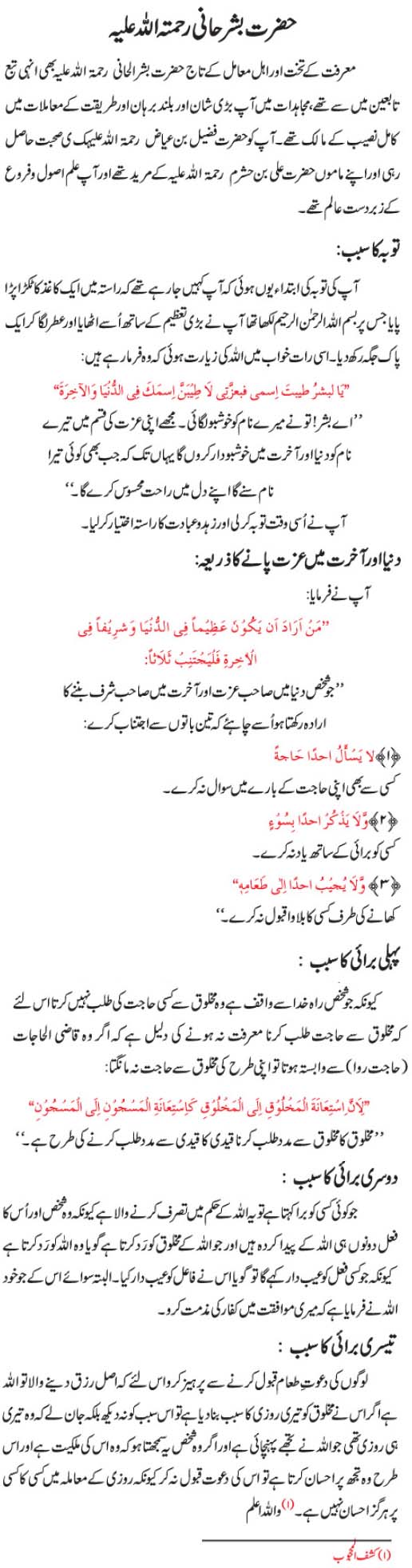
Hazrat Bashar Hani Rehmat Ullah Aleh
A Muslim Believer’s Attitude During Times Of Difficulties And Calamities
“… So, one may wonder how to distinguish whether a person is being simply tested by Allah Ta’ala or being punished for one’s sins…”
As part of our Islamic faith, we believe that all matters are in the hands of Allah Ta’ala. However, for some of us our faith can get shaken during times of trials and hardships. It is during those times, though, that we should remind ourselves that a believer’s position and rank is raised in front of Allah Ta’ala and that such a hardship may very well be a sign of Allah’s love for the believer. This can help us maintain and even strengthen our faith.
Great Rewards Associated with Great Calamities
It was narrated from Anas ibn Malik that the Prophet (Sallallaahu Alaihi Wasallam) said: “Great reward comes with great trials. When Allah loves a people, He tests them, and whoever accepts it attains His pleasure, whereas whoever shows discontent with it incurs His wrath.” Narrated and classed as hasan by at-Tirmidhi (2396)
In this hadith, we find that the Prophet (Sallallaahu Alaihi Wasallam) has provided a message of relief for those who endure difficulties with patience. He also associated the greatness of difficulties and calamities with higher rewards. So, enduring through lighter problems and challenges has a smaller reward than enduring greater difficulties and challenges. Given that this life has its share of challenges and difficulties for all, Allah Ta’ala has provided an opportunity for high rewards for those who endure these challenges with patience rather than with complaints and ingratitude. And for those who show displeasure and discontent with Allah’s decree end up in a lose-lose situation because not only do they have to live through their current suffering, but also incur Allah’s wrath for their displeasure and discontent with His decree.
We should also realize that our patience when facing difficulties raises our status in front of Allah and may lead to the forgiveness of our sins. He says in the Quran:
“… Only those who are patient shall receive their reward in full, without reckoning” Quran (Surah Az-Zumar:10)”
The Prophet (Sallallaahu Alaihi Wasallam) said: “Nothing befalls a believer, a (prick of a) thorn or more than that, but Allah will raise him one degree in status thereby, or erase a bad deed.” Narrated by al-Bukhaari (5641) and Muslim (2573).
The Messenger (Sallallaahu Alaihi Wasallam) said in a well-known hadith the following: “How wonderful is the affair of the believer, for his affairs are all good, and this applies to no one but the believer. If something good happens to him, he is thankful for it, and that is good for him. If something bad happens to him, he bears it with patience, and that is good for him.” (Narrated by Muslim, 2999).
We should also realize that when Allah puts His steadfast believers through trials and tribulations, that is a sign of His love for them. It was narrated that Anas (may Allah be pleased with him) said: “If Allah wills good for His slave, He hastens his punishment in this world, and if He wills bad for His slave, He withholds from him (the punishment for) his sin, until He requites him for it on the Day of Resurrection.” Narrated and classed as hasan by at-Tirmidhi (2396)
Al-Hasan al-Basri (may Allah have mercy on him) said: “Do not resent the calamities that come and the disasters that occur, for perhaps in something that you dislike will be your salvation, and perhaps in something that you prefer will be your doom.”
Al-Fadl ibn Sahl said: “There is a blessing in calamity that the wise man should not ignore, for it erases sins, gives one the opportunity to attain the reward for patience, dispels negligence, reminds one of blessings at the time of health, calls one to repent and encourages one to give charity.”
Calamities and Problems – Trials or Punishment?
We also know that some who face difficulties are punished for their sins. So, one may wonder how to distinguish whether a person is being simply tested by Allah Ta’ala or being punished for one’s sins. In this context, scholars have said that “(as Allah knows a person beforehand), the sign of calamity by way of punishment shows as signs of impatience and ingratitude in a person when a calamity befalls, and the sign of calamity by way of expiation and erasing of sins shows as contentment, acceptance, and patience in accepting the will of Allah Ta’ala until relief comes.”
Furthermore, if the one who is affected shows displeasure and panic, then it cannot be thought that his calamity is an honor from Allah Ta’ala to raise him in status, because Allah Ta’ala, may He be glorified, knew that he would not be patient and accept it with contentment. So in this case, it is most likely that it is a requital and punishment.
Also, if the Muslim is a devoted worshiper, obedient and righteous, and there is nothing between him and Allah but true ‘uboodiyyah (servitude), gratitude, praise, repentance and submission to Him, may He be glorified, then it is most likely that this calamity is a kind of honor and raising in status, and people are the witnesses of Allah Ta’ala on earth. If they know him to be righteous, then they may give him the glad tidings of raised status before Allah Ta’ala if he is patient in bearing the calamity. (source: islamqa.info)
Regarding difficulties, in the following verse, Allah compares the situation of the one who is steadfast in his faith and facing difficulties with those who are evildoers and are in a similar situation:
“… if you are suffering (hardships) then surely, they (too) are suffering (hardships) as you are suffering, but you have a hope from Allah (for the reward) that for which they hope not; and Allah is Ever All-Knowing, All-Wise” Quran (Surah An-Nisa:104).
So, a true believer can face his difficulties with a positive state of mind, hoping for rewards from Allah Ta’ala and such an attitude can provide true relief and happiness. Besides, if Allah lifts this calamity from the believer and saves him from the torment, then that can double the reward and happiness. Allah Ta’ala says in the Quran: “… and give glad tidings to As-Sabirun (the patient).”
Who, when afflicted with calamity, say: “Truly! To Allah, we belong and, truly, to Him, we shall return.”
They are those on whom are the Salawat (i.e. who are blessed and will be forgiven) from their Lord, and (they are those who) receive His Mercy, and it is they who are the guided ones. Quran (Surah Al-Baqara:155-157)
Saat Qisam Kay Khush Naseeb Log
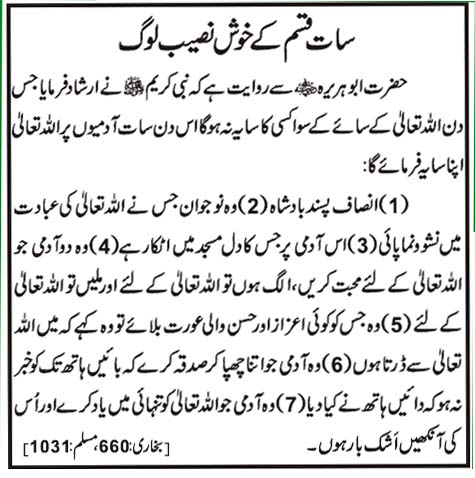
Saat Qisam Kay Khush Naseeb Log
Torment For Hypocrites And Beguilers, Already Determined
[Allah’s Quran 16:88] “Those who disbelieved and hindered others from the way of Allah – We shall increase for them torment upon torment, for they have been spreading corruption.”
The prophet (Peace Be Upon Him) has said :
[Bukhari, Book #92, Hadith #384] “Narrated Abu Huraira: Allah’s Apostle said, “All my followers will enter paradise except those who refuse.” They said, “O Allah’s Apostle! Who will refuse?” He said, “Whoever obeys me will enter paradise, and whoever disobeys me is the one who refuses (to enter it).”
Anjeer Aur Zaitoon Kay Barey Mein Hadith
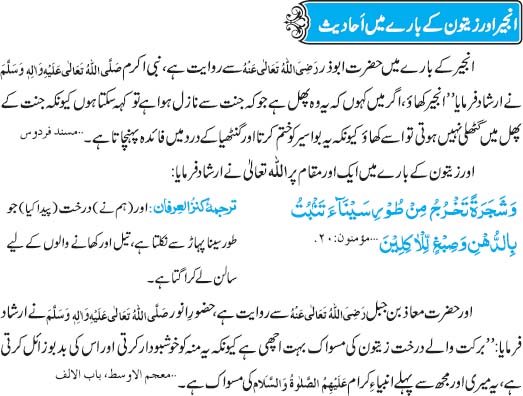
Anjeer Aur Zaitoon Kay Barey Mein Hadith
16 Duas To Safe Guard From Kuffar
1) Upon Allah do we rely. Our Lord, make us not [ objects of ] trial for the wrongdoing people. And save us by Your Mercy from the disbelieving people.” [Quran-Surah-Yunus 10/85-86]
2) Our Lord, make us not [ objects of ] torment (severe physical and mental sufferings) for the disbelievers and forgive us, our Lord. Indeed, it is You who is the Exalted in Might, the Wise. [Al-Mumtahinah 60/5]
3) Our Lord, forgive us our sins and the excess [committed] in our affairs and set firmly our feet and give us victory over the disbelieving people. [Al-Imran 3/147]
4) Our Lord, do not place us with the wrongdoing people. [Al-A’raf 7/47]
5) Our Lord! Do not punish us if we forget or make a mistake. Our Lord! Do not place a burden on us like the one you placed on those before us. Our Lord! Do not burden us with what we cannot bear. Pardon us, forgive us, and have mercy on us. You are our ˹only˺ Guardian. So grant us victory over the disbelieving people
[Al-Baqarah 2/286]
6) Our Lord, pour upon us patience and plant firmly our feet and give us victory over the disbelieving people.
[Al-Baqarah 2/250]
7) My Lord, support me against the corrupting people. [Al-Ankabut 29/30]
8) My Lord, save me from the wrongdoing people. [Al- Qasas 28/21]
9) My Lord, then do not place me among the wrongdoing people. [Al-Muminun 23/94]
10) Indeed, I am overpowered, so help (me). [Al-Qamar 54/10]
11) Sufficient for me is Allah; there is no deity except Him. On Him, I have relied, and He is the Lord of the Great Throne [At-Tawbah 9/129]
From Hadith and Sunnah
12) O Allah, we place You before them and we take refuge in You from their evil. [Abu Dawood 2/89-AlHaakim declared it authentic]
13) O Allah! I seek refuge with you from (worries) care, and grief, from incapacity and laziness, from miserliness and cowardice, from being heavily in debt and from being overpowered by other men. [Bukhari 8/374]
14) Allah’s Apostle used to seek refuge with Allah from the difficult moment of a calamity and from being overtaken by destruction and from being destined to an evil end, and from the malicious joy of enemies. [Bukhari 8/358]
15) O Allah, protect me from them with what You choose. [Muslim 4/2300]
16) Indeed, we belong to Allah, and indeed to Him we will return. O Allah! Reward me for my calamity, and replace it for me with that which is better. [Muslim]
Salat-Ul-Tasbih Kay Fazail
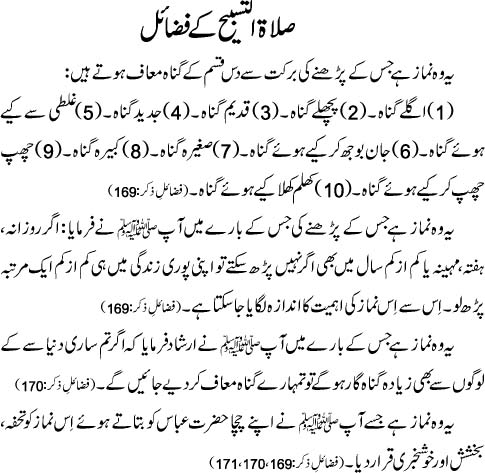
Salat-Ul-Tasbih Kay Fazail
Thee Alone We Worship
[Quran – 1:5] “Thee alone we worship and to Thee alone we pray for help.”
The Prophet (Peace Be Upon Him) has said:
[Bukhari, Book #2, Hadith #50] “Do you know what is meant by believing in Allah alone?” They replied, “Allah and His Apostle know better.” Thereupon, the Prophet said, “It means:
1. To testify that none has the right to be worshiped but Allah, and that Muhammad is Allah’s Apostle.
2. To offer prayers perfectly
3. To pay the Zakat (obligatory charity)
4. To observe fast during the month of Ramadan.
5. And to pay Al-Khumus (one-fifth of the booty to be given in Allah’s Cause).
Then he forbade them four things, namely, Hantam, Dubba,’ Naqir Ann Muzaffat or Muqaiyar; (These were the names of pots in which Alcoholic drinks were prepared) (The Prophet mentioned the container of wine, and he meant the wine itself). The Prophet further said (to them): “Memorize them (these instructions) and convey them to the people whom you have left behind.”
[Muslim, Book #001, Hadith #0023] “I direct you to affirm belief in Allah alone, and then asked them: Do you know what belief in Allah really implies? They said: Allah and His Messenger know best. The Prophet said: It implies testimony to the fact that there is no god but Allah, and that Muhammad is the messenger of Allah, establishment of prayer, payment of Zakat, fast of Ramadan, that you pay one-fifth of the booty (fallen to your lot) and I forbid you to use gourd, wine jar, or a receptacle for wine. Shu’ba sometimes narrated the word naqir (wooden pot) and sometimes narrated it as muqayyar. The Holy Prophet also said: Keep it in your mind and inform those who have been left behind.”
Namaz-e-Kasoof Aur Khasoof
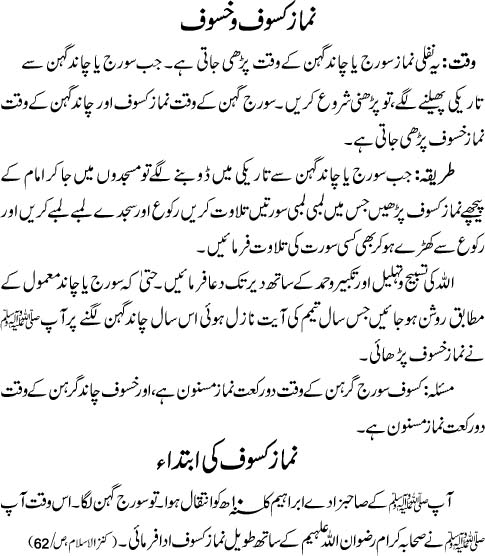
Namaz-e-Kasoof Aur Khasoof
Allah’s Rewards, The Righteous, The Faithful
“Lo! men who surrender unto Allah, and women who surrender, and men who believe and women who believe, and men who obey and women who obey, and men who speak the truth and women who speak the truth, and men who persevere (in righteousness) and women who persevere, and men who are humble and women who are humble, and men who give alms and women who give alms, and men who fast and women who fast, and men who guard their modesty and women who guard (their modesty), and men who remember Allah much and women who remember – Allah hath prepared for them forgiveness and a vast reward.” [33:35]
The Prophet (Peace Be Upon Him) has said:
[Bukhari, Book #1, Hadith #1] “Narrated ‘Umar bin Al-Khattab: I heard ALLAH’s Apostle saying, “The Reward of deeds depends upon the intentions and every person will get the Reward according to what he has intended. So whoever emigrated for worldly benefits or for a woman to marry, his emigration was for what he emigrated for.”
[Bukhari, Book #2, Hadith #36] “Narrated Abu Huraira: ALLAH’s Apostle said: “Whoever establishes prayers during the nights of Ramadan faithfully out of sincere faith and hoping to attain ALLAH’s Rewards (not for showing off), all his past sins will be forgiven.”
[Bukhari, Book #2, Hadith #37] “Narrated Abu Huraira: ALLAH’s Apostle said, “Whoever observes fasts during the month of Ramadan out of sincere faith, and hoping to attain ALLAH’s Rewards, then all his past sins will be forgiven.”