
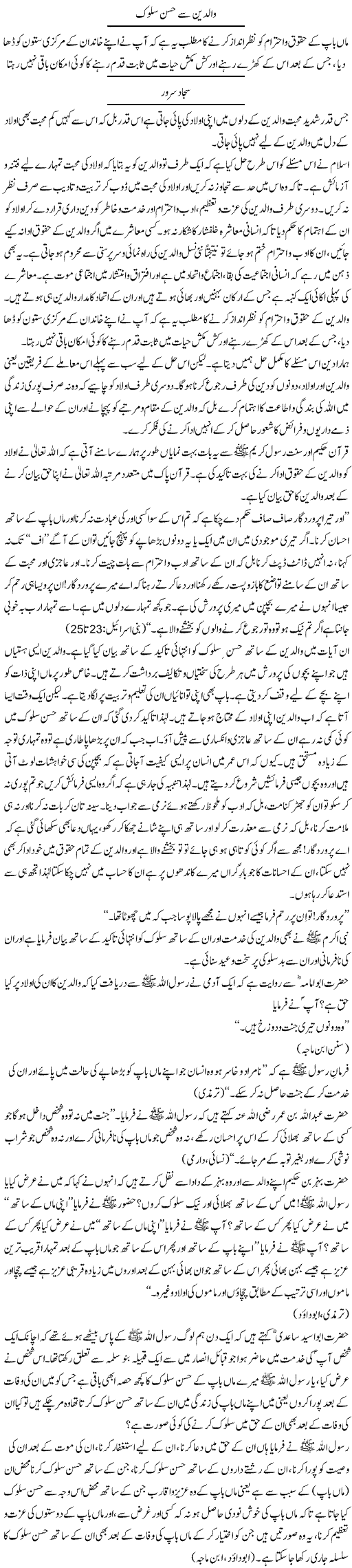
Waldain Sey Husn e Salook
Human Rights In Islam
ISLAM guarantees the basic rights of every living creature. The sanctity of human life is extremely sacred.
Prophet Muhammad (peace be upon him) said: “Truly your blood, your property, and your honor are inviolable.” (Al-Bukhari)
Allah said in the Qur’an:
“O mankind! We have created you from a male and a female and made you into nations and tribes that you may know one another. Verily, the most honorable of you with Allah is that (believer) who is pious. Verily, Allah is All-Knowing, Well-Acquainted (with all things).” (Qur’an, 49:13)
The human race is only for the purpose of identification in Islam, and it doesn’t give one superiority over another.
Prophet Muhammad (peace be upon him) said: “O people! Your God is one and your forefather (Adam) is one. An Arab is not better than a non-Arab and a non-Arab is not better than an Arab, and a red (i.e. white tinged with red) person is not better than a black person and a black person is not better than a red person, except through piety.” (Musnad Ahmad)
Allah has commanded to uphold justice and discharge the trust of people:
“Verily, Allah commands that you should render back the trusts to those, to whom they are due; and that when you judge between men, you judge with justice. Verily, how excellent is the teaching which He (Allah) gives you! Truly, Allah is Ever All-Hearer, All-Seer.” (Qur’an, 4:58)
“…And act justly. Truly, Allah loves those who are just.” (Qur’an 49:9)
“…and let not the enmity and hatred of others make you avoid justice. Be just: that is nearer to piety;…” (Qur’an 5:8)
The Prophet Muhammad (peace be upon him) said: “O People, beware of injustice, for injustice shall be darkness on the Day of Judgement.” (Saheeh Al-Bukhari).
Differences Among People: A Fact Of Life
It is a law of nature that differences will always exist among people. Everywhere and at all times there have been diverse colors, tongues, customs, concepts, intellects, and degrees of knowledge. All that is a sign of Allah’s Omnipotence, as the following verse from the Holy Qur’an states:
“And among His signs is the creation of the heavens and the earth, and the variations in your languages and your colors: verily in that are signs for those who know.” (Qur’an, 30:22)
These external variations reflect internal variations, variations of opinions, attitudes, and objectives. This also is registered in various places of the Holy Qur’an. Here is an example:
“If your Lord had so willed, He could have made mankind one people: but they will not cease to dispute, except those on whom your Lord has bestowed His mercy: and for this did He create them.” (Qur’an, 11:118-19)
Imam Al-Razi comments: “This verse is indicating the diversity in people’s creeds, moral codes, and behaviors.”
I would like to elaborate on the above verse by saying that had Allah so willed, all humans would have embraced one religion by instinct and original creation (Arabic: Al-Fitrah).
But in this case, they would cease to be human in the sense we know them — their social life would be something similar to bees or ants, and in spirit, they would be like angels who are disposed by creation to embrace truth and obey all that they are commanded to by Allah.
There is no room for conflict or disagreement among them. But Allah in His wisdom has chosen to create humans otherwise. They have to acquire knowledge rather than have it as an inherent endowment; they have the volition to choose how to act and to weigh out positives and negatives; they are not predestined to behave in a fixed way. They differ widely as to abilities, capacity for acquiring knowledge, and preferences.
As for the clause: “and for this did He create them” in the above-quoted verse, it may not be presumed to mean that Allah created humans so that they may disagree. It is known from other texts that what Allah created humans for is to worship Him.
The purport of the above clause is rather that Allah created humans so that there will be among them the group of the well-guided and the group of the misguided, the former destined to enter Paradise and the latter to be punished in Hell-Fire.
In addition, the following may be deduced from the same clause: Allah created humans so that they would, because of diversity in abilities and dispositions, choose different professions, and this would make for stability in the world.
It is through humans that Allah carries out His ordinances. Men will employ other men to do work for them (See Tafseer Ruh Al-Ma’ani, Vol IV, Chapter 12, p 164, and Tafseer Al-Qasimi, Vol ix, p 182)
There is in the creation of humans the propensity for variation in learning, inclinations, and feelings; this, in turn, will lead to variation in wills and preferences; and faith, obedience, and disobedience are part of that. (Tafseer Al-Manar, Vol xii, p 194)
Selfishness That Incurs God’s Punishment
Sometimes the Prophet (peace be upon him) used a form of stern warning in order to impress on people the horrid nature of the action he is warning against.
One of the stronger forms of warning is that which the Prophet uses in the following Hadith related by Al-Bukhari on the authority of Abu Hurayrah who quotes the Prophet as saying: “God shall neither look at three types of people on the Day of Judgment nor cleanse them of sin. They shall also endure grievous suffering. The first is one who has along the road water in excess of his needs but refuses to give some of it to passersby. The second is one who pledges loyalty to a governor only in the hope of receiving certain gains: if he gets that, he is happy and if he is denied it, he is unhappy. The third is one who sets up his goods in the afternoon and swears by God that he has paid (or offered) for it so much, leading others to believe him. The Prophet then read the Qur’anic verse that says: “Those who barter away their covenant with God and their oaths for a trifling gain will have no share in the life to come. God will neither speak to them, nor cast a look on them on the Day of Resurrection, nor will He cleanse them of their sins. Theirs will be a grievous suffering.” (3: 77)
The common denominator that applies to all three types is selfishness and greed. They are all after their own interests, caring little for other people. The first, the one who denies some water to a passerby, is so full of greed that he will not give water, which he has no need for, to one who needs it. He forgets that water is granted to mankind by God. They need it for living and God has set in operation certain laws of nature that ensure that people get water all the time for themselves, their cattle, and farmland.
The second type is more common. People often pledge their loyalty to rulers and governors only for their own benefit. They are after certain gains. Unless they get such gains, they are dissatisfied. Their dissatisfaction may go further than thoughts and feelings. It may develop into encouraging rebellion or strife in society. The main factor in all this is the gain one hopes to achieve. It has nothing to do with the ruler being good, just, or diligent in serving the community.
An important aspect in the Prophet’s warning is concerned with the need of being true to one’s pledges. If one pledges loyalty to a governor, the pledge should be sincere, free of personal ambitions, and made only to serve the interests of the community. To relate one’s loyalty to what one hopes to receive for personal gains is to make a mockery of one’s pledge. Needless to say, a pledge of loyalty is a very serious matter. Hence, it must never be related to what one hopes to receive from the ruler to whom one has pledged full loyalty.
The third type is again very common. People are eager to sell their goods at a profit. The greater the margin of profit, the happier they are. If the customer tries to get a discount, the seller tries to assure him that the goods are worth more. One way of convincing people that they are not paying too much for their merchandise is to swear by God that the price is right. A trader may swear that he paid for the goods so much and that his profit is so little or very reasonable. Alternatively, he may swear that he was offered more for it. The customer is more likely to believe him when he swears by God. If, however, the truth does not match the oath, and the oath is false, the offense is very serious indeed as it seeks to cite God in support of one’s false claim.
In all these situations, selfish and greedy people earn themselves God’s displeasure which results in God ignoring them on the Day of Judgment when they are destined for grievous suffering.
-by Adil Salahi
Sabar
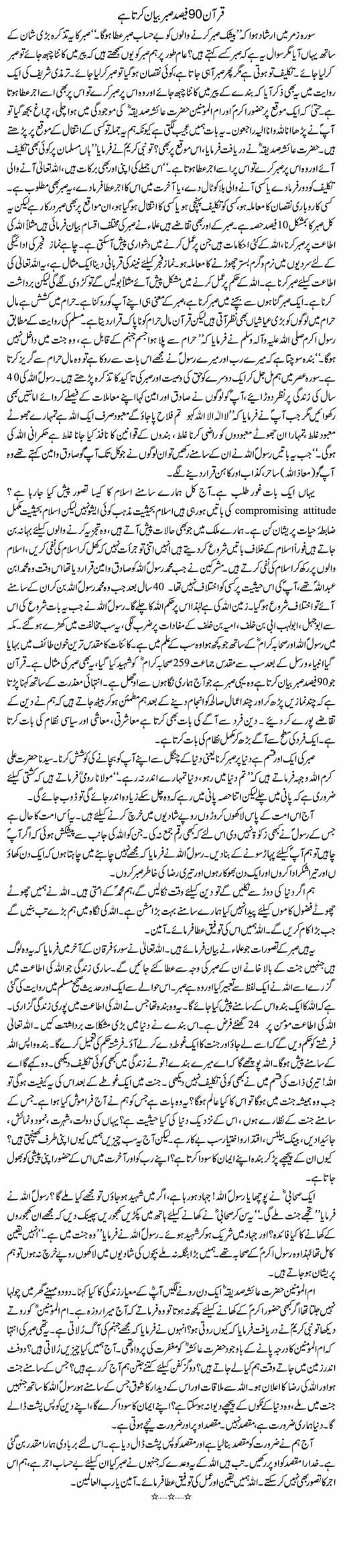
Sabar Ki Fazeelat Aur Ahmiyat
Encouraging Children To Pray
In a Hadith narrated by Abdullah Ibn Qart the Messenger of Allah (peace be upon him) said, “The first act that the servant of Allah will be accountable for on the Day of Judgment will be prayer. If it is good, then the rest of his acts will be good. And if it is evil, then the rest of his acts will be evil.” (Tabarani) Furthermore, prayer was the first act of worship that was made obligatory by Allah. Therefore, due to its extreme importance to the Believer, prayer should be one of the first acts of worship that parents should teach their children.
When discussing teaching children how to make prayer parents typically ask when it is necessary to begin teaching their children. Let us be realistic; learning how to perform prayer is not easy for children or in some cases adults. It can take a lot of work to master even the simplest elements of prayer. The learner must memorize the various du’a and Surahs of the Qur’an – not to mention the other required portions of the prayer. Furthermore, there must be work on proper pronunciation and rules on how, when, and what makes prayer valid. This is not an overnight process but rather one that takes time. Therefore, this leaves us with the question – when should children learn how to perform prayer?
Abdullah ibn Amr ibn al-As, narrated that the Apostle of Allah,(PBUH), said, “Command your children to start prayer when they become seven years old, and spank them for it (prayer) when they become ten years old, and arrange their beds (to sleep) separately.” (Abu Dawud).
This does not mean that parents can only start teaching their children how to perform it when they reach the age of seven. Rather, informal instruction should start when a child starts to show an interest in prayer, which usually occurs around the age of two. It is only human nature that children love to imitate their parents. In fact, this is one method that Allah has provided us for teaching our youth.
Therefore, it is important for parents of small children to let them “pretend” to perform the prayer alongside of the parents. The benefits of this are twofold. First, it teaches children that it is necessary to perform prayer every day five times a day. And second, it helps children learn the physical movements of the prayer. It really is amazing how fast a two-year-old will learn the phrase Allahu-Akbar (Allah is Greatest) when he performs prayer alongside his parents!
The next step is to teach your child Al-Fatihah (The Opening Chapter of the Qur’an). This should begin around the age of three or four. When teaching children Surahs or any other portions of the prayer that must be memorized it is important to remember to break down the instructions by using a reasonable number of verses or small segments.
In other words, teaching a child how to perform the prayer should be done progressively in small steps. It is important to practice reciting the previously learned material consistently every day along with any new material. These practice sessions should only last between 5 to 15 minutes. At this age, length of practice is not as important as consistency.
Lastly, one of the most important aspects of successful teaching is praise and encouragement. Remember that children like to please their parents. Also, it is really important that parents praise and celebrate their children’s accomplishments. This is especially true for learning how to perform prayer. After the mastery of a section, children typically feel a strong sense of achievement. Praise motivates the child to continue to learn and accomplish new goals.
Being Undutiful To Parents
As Muslims it is our duty to keep ourselves away from all sins; minor and major. This is based on the fact that the first priority for Muslims is to gain the pleasure of Allah the Almighty by doing what He likes and avoiding what He dislikes, irrespective of the gravity or the simplicity of the sin.
The first commandment in Islam as revealed to all the prophets is to worship Allah the Almighty and immediately after this comes the duty of being dutiful to parents
{Thy Lord has decreed, that you worship none save Him, and (that you show) kindness to parents.} (Al-Israa 17: 23).
Thus, Islam urges every Muslim to be dutiful to his parents, extending to them the kindest treatment possible.
Failing to treat parents kindly makes the person guilty of disobedience to parents as well as to Allah the Almighty.
Doing so may deprive him of the chance of being admitted to Paradise. Therefore, it goes without saying that disobedience to parents or mistreating them is the second major sin after Shirk (associating other beings with Allah).
The Prophet (peace and blessings be on him) was asked about the greatest sins. He said, “To join partners in worship with Allah; to kill a soul which Allah has forbidden to kill; and to be undutiful or unkind to one’s parents…“(Bukhari)
In another tradition, the Prophet (peace and blessings be on him) said, “The person who severs the bond of kinship will not enter Paradise.” (Al-Bukhari)
He also said, “The pleasure of Allah is in the pleasure of one’s parents and the wrath of Allah is in the wrath of one’s parents.” (Ibn Hibban)
Talaq: Haqooq-O-Faraiz Mein Adam Tawazun Ka Natija
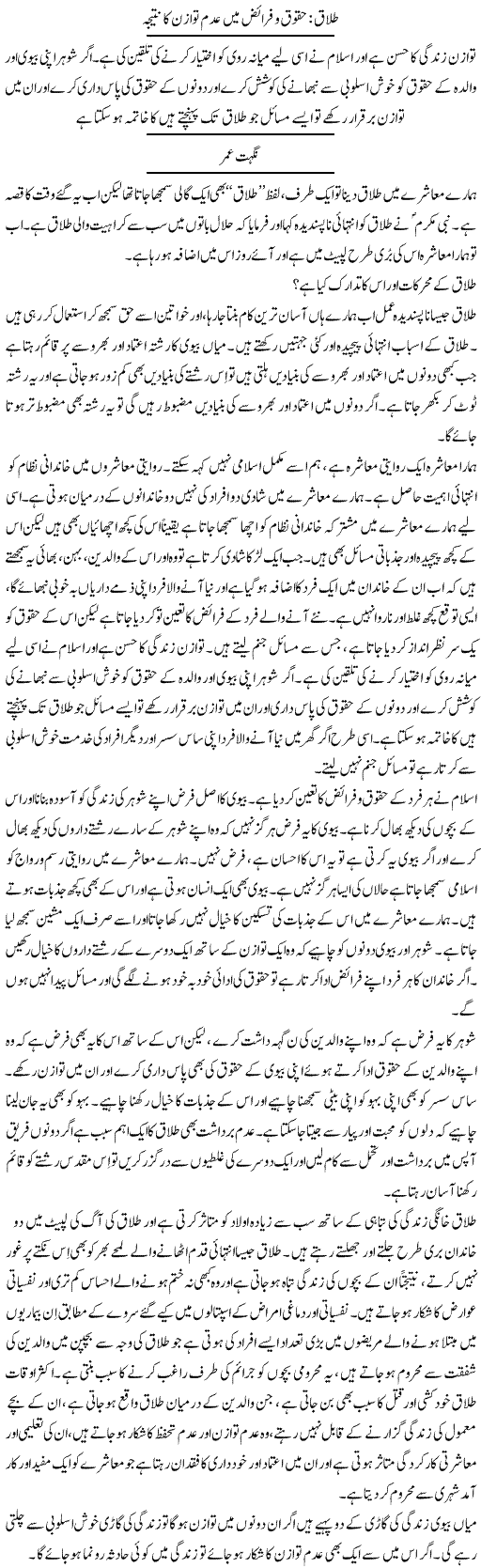
Talaq: Haqooq-O-Faraiz Mein Adam Tawazun Ka Natija
Right Consequence Of Faith
A student studies hard for his final examinations, researching in libraries, re-doing past papers, and revising his notes because he wants a university degree that will help advance his career.
A businessman invests much of his time, energy, and money into a commercial venture in the hope of large profits in the future.
A farmer plows his land, sows it, waters it, and tends it regularly in the hope of a good harvest.
They all know that success does not come down on a plate but has to be achieved through hard work. Man does certain things in life for certain results, and he avoids other acts because of their consequences.
An adult will not put his hand into a naked flame because he knows that fire burns, but a child will do so as he is unaware of the consequences.
The most important belief and knowledge that should dictate our actions is that Allah Almighty exists, that He is the Creator and Provider, and that none can benefit nor harm us except with His permission. If a person’s Iman (faith) in Allah is firm and unyielding, he will be able to direct all his worship and obedience to Allah and will feel no fear of false deities or worldly powers.
Consider the encounter of Pharaoh’s court magicians with Prophet Musa (peace be upon him) as described in the Qur’an. Before meeting the Prophet, they pleaded with Pharaoh for a substantial reward were they to defeat Musa in a duel using magic.
“So the sorcerers came to Pharaoh and said, ‘Of course, we shall have a suitable reward if we win.’ (Qur’an, 7:113)
Finding Time For The Family
Today an average person spends more dedicated time with technological devices than with people. We do not even realize nowadays how for hours we are occupied with televisions, laptops, smartphones, and game consoles that we hardly spend time with our families. It’s time we woke up to reality: family members need to communicate more with each other.
Weekdays are a whirl of chores, activities, classes, errands, and deadlines; the morning’s whiz-by and the evenings provide a fleeting respite from the day’s drudgery. The family hopes for a “slower” weekend, one that’ll allow them to spend more time together. But with the presence of 24-hour Internet, weekend TV programs, and the washer waiting to be loaded with a pile of laundry, the weekend is gone before anyone can even say ‘Subhan Allah.’
However, there are creative ways of cashing in on must-do activities that can make family members enjoy each other’s company more.
Everyday Islamic gathering
“And warn your nearest family members.” (Qur’an, 26:214)
There’s nothing like Allah’s speech, the Qur’an, to bond its adherents together by true love, one that is for the sake of Allah. An hour before dinner or after Fajr, the family can sit around the dining table to read the Qur’an aloud to each other. This could be followed by a reading from Hadith books like Riyad-us-Saaliheen or stories from the Seerah.
Going to mosque
The mosque should be like a second home to a Muslim family. Everyone should try to attend the weekly Jumuah congregation together. If that’s not possible, try to go to mosques for lectures, as they are usually available to both men and women. Going with the family will give a sense of togetherness, Insha, Allah boosts everyone’s faith at the same time and keep up with the obligation to learn Islam.