

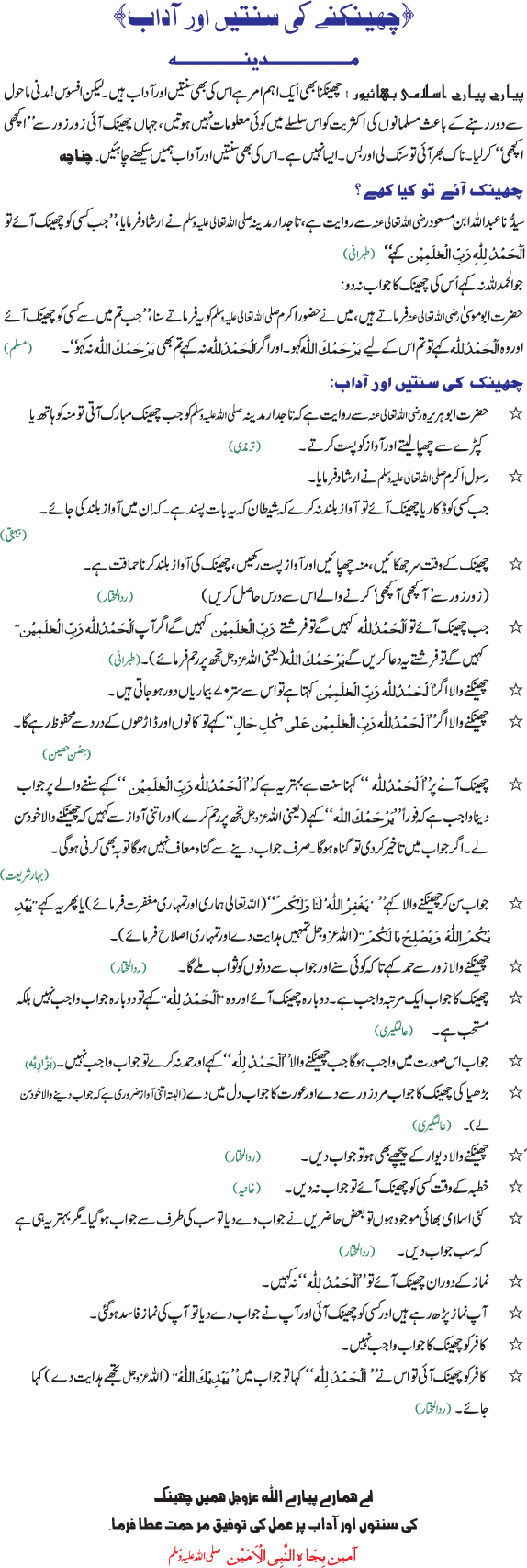
Cheenkney Ki Sunnatain
Qur’an Recitation
Qur’an recitation is of two types:
1. Practical recitation
Reading sincerely with belief in it and acting upon the orders of Allah and refraining from what He prohibited.
2. Word recitation
Many narrations emphasize the great reward for those who recite the Qur’an.
The Prophet (peace be upon him) said, “The best of you is he who learns the Qur’an and teaches it.” (Bukhari)
He (peace be upon him) also said, “The one who excels in reciting the Qur’an will be in the company of the honored angels.” (Sahih Muslim)
And, “The example of the believer who reads the Qur’an is like that of the Utrujah (a citrus fruit) which has a beautiful fragrance and a beautiful taste.
While the example of the believer who does not read the Qur’an is like that of the date fruit: It has sweet taste, but has no fragrance.” (Bukhari and Muslim)
The Prophet (peace be upon him) also said, “He who recites one letter of the Book of Allah, will be rewarded for it, and the reward will be multiplied in folds.” (Tirmidhi – classed Saheeh by Al-Albani)
There are certain Surahs of the Qur’an that have more rewards for their recitation. The Prophet (peace be upon him) said that Satan does not enter the house wherein Surah Al-Baqarah is recited. (Sahih Muslim)
When one recites Ayaatul-Kursi at night, as the prophet (peace be upon him) informed us, he will be protected by Allah, and Satan will not come near him till he wakes up in the morning. (Bukhari)
Similar protection is also for reciting the last two verses of Surah Al-Baqarah or the last three Surahs of the Qur’an. (Bukhari)
– By Shiekh Muhammad Bin Saalih Al-Uthaymeen
Beating The Heat With Positive Thinking
Every other person nowadays repeatedly exclaims, with loud sighs and exasperated wipes of wet brows, how extremely hot the weather is. Despite going through this bout of intense heat every year as summer makes its debut, we seem to find it shocking how high the temperatures can shoot up, come July. Consequently, we loathe how the heat adversely affects our day-to-day living, especially in those developing countries where air conditioners, generators, refrigerators, and deep freezers are still elusive luxuries that not everyone can afford.
There are ways of countering our by-default habit of complaining, cribbing and negative thinking about the hot summer. We should remind ourselves that we are indeed tremendously blessed by Allah through His wonderful creation of the heavens and the earth, which sees four seasons come and go throughout the year, with each bringing forth special bounties and joys that benefit us.
Heat brings vegetation
The heat, accompanied by rainfall, brings forth our provision – all that we eat and drink with much relish. The blazing sun melts the snow from the mountains causing rivers, geysers, and fresh-water streams to gush forth for us.
“And He it is who has caused waters to come down from the sky; and by this means have We brought forth all living growth, and out of this have We brought forth greenness. Out of this do We bring forth close-growing grain; and out of the palm tree, dates in thick clusters; and gardens of vines, and the olive tree, and the pomegranate: (all) so alike, and yet so different! Behold their fruit when it comes to fruition and ripens! Verily, in all this, there are messages indeed for people who will believe!” (Qur’an, 6:99)
The process of photosynthesis that the sunlight causes makes the dead trees come alive and bear fruit; the seeds sown into the ground produce grains, pulses, vegetables, and rice that we whip up into exotic delicacies. Furthermore, animals mate during this season and increase in numbers.
Fruit and flowers
When Allah brings upon us the summer season, He also provides us with means to get relief from the hot weather in the form of succulent seasonal fruit full of nutrients that replenish our bodies, saving them from the adverse effects of dehydration and perspiration. Similarly, the summer sees flowers bloom and arid landscape come alive with greenery and color. The Muslim gets a chance to see the breathtaking beauty of Allah’s creation that immediately sets his tongue in motion with praise and dhikr!
Blessing of clothing
If Allah shines the sun’s heat down upon us for some weeks without relent, He also provides us with the material with which we can protect ourselves from it. Allah says in the Qur’an:
“And Allah has given you, of that which He has created, shelter from the sun; and has given you places of refuge in the mountains, and has given you coats to ward off the heat from you, and coats (of armor) to save you from your own foolhardiness. Thus does He perfect His favor unto you, in order that you may surrender (unto Him).” (Qur’an, 16:81)
Fasting Of Spiders
There are many types of spiders in the world. Spiders have eight legs, mandibles converted into poison fangs, two feelers, and a large unsegmented abdomen bearing several spinnerets that produce the silk used to make nests, cocoons, or webs for trapping insects. Spiders have six or eight eyes on the back of the cephalothorax, the upper part of their body.
There is a Surah in the Noble Qur’an called “Al-Ankabout”, meaning “The Spider”. There Allah says: “The likeness of those who choose other patrons than Allah is as the likeness of the spider when she taketh unto herself a house, and lo! The frailest of all houses is the spider’s house if they but knew.” [Al-Ankabout 41]
Spiders played a great role in hiding the Prophet (peace and blessings be upon him) and his Companion Abu Bakr (may Allah be pleased with him) when they were in the Cave of Thawr on the way to Al-Madinah during the course of the Hijrah (the Prophet’s emigration from Makkah to Madinah). Spiders spun a great web across the entrance of the cave, and this misled the polytheists who were seeking Prophet Muhammad (peace and blessings be upon him) and his Companion. They thought that the spiders had spun their web years before Prophet Muhammad (peace and blessings be upon him) was born.
Spiders fast during the period of laying eggs and incubating them. At that time they do not have any sort of food. Female spiders spin nests and cocoons and lay their eggs. Then they remain there all the time to protect the eggs till the young emerge. The length of incubation varies from one species of spider to another. But in all cases, this term is spent without any food, which makes the spiders very weak.
From specific glands, the spiders release some liquids that are necessary for feeding the young, who are not able to seek their food by themselves until they grow up. So they take these juices until they are able to hunt their food from the surrounding environment.
At that time mother spiders break their fast and return back to their normal life. This is another demonstration of Allah’s Power manifest in His creatures. Chance has nothing to do with such demonstrations of Allah’s Might. Rather it is the ultimate truth of creation.
Khana Khanay Ki Sunnatain

Khana Khanay Ki Sunnatain
Prophet Sulaiman (Alaih Assalaam)
Sulaiman (Alaih Assalaam)was the son of Dawud(Alaih Assalaam). As you already know, Sulaiman(Alaih Assalaam) was very just even as a young boy, and he became well-known and respected for his wisdom. when he became a man, Allah made him His prophet. Allah also taught him to understand the languages of birds and animals. yet in spite of his wisdom and many wealthy possessions, Sulaiman (Alaih Assalaam) never forgot Allah. He knew that all goodness comes from Allah. Thus, he always told his people: Thank Allah for the good He has given you and for His generosity. Worship Allah and do good deeds.
Once, Sulaiman (Alaih Assalaam) and his soldiers were passing through a valley inhabited by ants. Sulaiman(Alaih Assalaam) heard one ant say to another: Quick, get out of the way and hide! Sulaiman (Alaih Assalaam) and his soldiers are coming, and they will trample on us and not even know they have done so!
Sulaiman(Alaih Assalaam), of course, was able to understand the ants’ language. He laughed and ordered his soldiers to stay still and wait until all the ants had crawled away to safety. Then he prayed to Allah: O Allah, help me in doing the right things so that You will be contented with me.
One day, Sulaiman (Alaih Assalaam) called all the birds to gather around him, but as he glanced through the flock, he noticed that the Hoopoe bird was not there. Sulaiman (Alaih Assalaam) waited for some time, and just as he was deciding not to wait any longer, the Hoopoe suddenly came flying in and sat himself down next to Sulaiman(Alaih Assalaam). I have come from a far-away city called Saba, the Hoopoe said. The people there are very rich and they have a Queen who sits on a magnificent throne. These people worship the sun and believe that they are right to treat the sun as God. But they are wrong, are they not? They will never find the right way to Allah if they go on like that. Allah is the only One Whom all creatures should worship.
Sulaiman(Alaih Assalaam) then wrote a letter to the Queen of Saba and sent the Hoopoe to take it to her.
When the Queen of Saba received the letter, she called all the wise men of the city to her. I have received a letter from Sulaiman(Alaih Assalaam), said the Queen. In it, Sulaiman(Alaih Assalaam) writes that we should believe in Allah and worship only Him. What would you advise me to do?
We are very powerful and can make war against Sulaiman(Alaih Assalaam), but you have to decide for yourself what is to be done, the wise men answered.
But war could cause destruction to our city, and our best warriors will turn into cruel fighters, the Queen protested. Therefore, I would prefer not to make war. Instead, I will send Sulaiman (Alaih Assalaam) a present.
When the messengers of the Queen of Saba arrived with the present, they were very surprised because Sulaiman(Alaih Assalaam) became very angry. Why do you bring me these riches instead of listening to my advice? Sulaiman (Alaih Assalaam) scolded. What Allah has given me is much better than all these riches. Go to your Queen and take her presents with you!
When she heard the Sulaiman (Alaih Assalaam) had refused her valuable gifts, the Queen of Saba, in her turn, was surprised. So, she decided to go to see Sulaiman (Alaih Assalaam) for herself. She called her people and made preparations for the journey to Sulaiman’s city.
When the Queen arrived, Sulaiman (Alaih Assalaam) explained to her about Allah and she realized how wrong she had been to worship the sum. You are right, she told Sulaiman(Alaih Assalaam), from now on, I shall worship only Allah. He is our only Lord and we should obey only Him.
Duty Towards Kin And Neighbors
After the limited circle of the family, the next social sphere is that of kinship and blood relationships. Islam wants all those who are related through common parents, common brothers, and sisters, or marriage to be affectionate, cooperative, and helpful to each other. In many places in the Quran good treatment of the near relations (Dhawi-al-qurba) is enjoined. In the Hadith of the Prophet (peace be upon him) proper treatment of one’s blood relations has been strongly emphasized and counted among the highest virtues. Islam looks with great disfavor to a person who cold-shoulders his relations or treats them indifferently.
But this does not mean that it is an Islamic virtue to favor one’s relations. If such support or bias towards one’s relations results in injustice, it is repugnant to Islam and is condemned as an act of Jahiliyyah (pre-Islamic times). Similarly, it is utterly against the principles of Islam for a government official or public servant to support his relations at public expense or to favor his kith and his kin in his official decisions: this would actually be a sinful act. Fair treatment of one’s relations, as enjoined by Islam, should be at one’s own expense and within the limits of justice and fair play.
After relations come one’s neighbors. The Qur’an has divided them into three categories:
1. a neighbor who is also a relation
2. a neighbor who is a stranger
3. a casual or temporary neighbor with whom one happens to live or travel for a certain time.
All of them are deserving of sympathy, affection, kindness, and fair treatment. The Prophet (peace be upon him) once said that the rights of the neighbor were so strongly emphasized by Angel Gabriel that he thought neighbors might even share one ‘s inheritance. (Bukhari and Muslim)
The Prophet (peace be on him) said: Anyone whose neighbor is not safe from his misdeeds is not a true Believer. (Bukhari and Muslim)
Again, he said: A person who enjoys a meal while his neighbor is starving is not a true Believer. (Ahmad, Baihaqi)
The Prophet (peace be upon him) was once asked about the fate of a woman who performed regular prayers and fasted extensively and who was a frequent almsgiver, but whose neighbors complained of her abusive tongue. He said: Such a woman shall be in the Hellfire. He was, then, asked about another woman who did not possess these virtues but did not trouble her neighbors either, whereupon he said: She would be in Paradise. (Ahmad, Baihaqi)
The Prophet (peace be upon him) has laid so much emphasis on being considerate to neighbors that he has advised that whenever a Muslim brings home fruit for his children he should either send some to his neighbors as a gift or at least take care not to offend them by throwing the peelings away outside their door. On another occasion, he said: A man is really good if his neighbors regard him as such, and bad if they consider him so. (Ibn Majah)
Islam, therefore, requires all neighbors to be loving and helpful and to share each other’s sorrows and happiness. It enjoins them to establish social relations in which one can depend upon the other and regard his life, honor, and property as safe among his neighbors. A society in which two people, separated only by a wall, remain unacquainted with one another for years, and in which those living in the same area of a town have no interest or trust in one another, can never be called Islamic.
Next to these come the wider relationships covering the whole of society. The broad principles on which Islam wants people to structure their social lives are:
Help you one another in Al-Birr and Al-Taqwa (virtue, righteousness, and piety); but do not help one another in sin and transgression. (Qur’an 5: 2)
You are the best of peoples ever raised up for mankind; you enjoin Al-Maruf (i.e. Islamic Monotheism and all that Islam has ordained and forbid Al-Munkar (polytheism, disbelief, and all that Islam has forbidden. (Qur’an 3:110)
Do not think evil of each other, nor probe into each other’s affairs, nor incite one against the other. Avoid hatred and jealousy. Do not unnecessarily oppose each other. Always remain the slaves of Allah, and live as brothers to each other. (Muslim)
Do not help a tyrant, knowing him to be such. (Abu Daud)
To support the community when it is in the wrong is like falling into a well while catching the tail of your camel which was about to fall into it. (Abu Daud; Mishkat)
No one among you shall be a true believer unless he likes for others what he likes for himself. (Bukhari and Muslim)
Happiness And Inner Peace
Real happiness and peace can be found in submitting to the commands of the Creator and the Sustainer of this world.
Allah has said in the Qur’an: “Truly, in remembering Allah do hearts find rest.” (Qur’an 13:28)
On the other hand, the one who turns away from the Qur ‘an will have a life of hardship in this world. Allah has said: “But whoever turns away from the Qur’an he will have a hard life, and We will raise him up blind on the Day of Judgment.” (Qur’an 20:124)
This may explain why some people commit suicide while they enjoy the material comfort money can buy.
You will also find true happiness in helping others, keeping good relationships with blood relatives, sheltering an orphan, helping someone to pay his debts, supporting the weak, feeding the needy, spending money on charity… etc.
This simply means that happiness is not found in collecting money as a lot of people think.
Real happiness is found in enjoining what is good and forbidding what is evil.
You have to be always busy thinking about how to make the best use of your time in satisfying Allah and this in fact is the real pleasure of life. You have to realize that your life is short and it is a journey from birth to death during which you have to follow what your conscience tells you.
Joote Pehnaney Ki Sunnatien

Joote Pehnaney Ki Sunnatien
Small Acts Of Kindness Earning A Great Reward
The Prophet (peace be upon him) often used graphic descriptions and vivid images to emphasize the point he is imparting to his audience. Needless to say, when the point is linked to an image the recipient is impressed with, the point is never forgotten.
One good example is given in a Hadith related by Al-Bukhari on the authority of Abu Hurayrah who quotes the Prophet as saying: “A man was walking and he was very thirsty. He went down a well to drink. When he came up, he found a panting dog who was licking the earth because of his thirst. The man thought: This dog is as thirsty as I was a short while ago. He went down the well again, filled his shoe with water, and came up holding the shoe by his mouth. He gave it to the dog to drink. God thanked him by forgiving him for his sins. People asked the Prophet: Are we given a reward for kindness to animals? He said: You shall be rewarded for kindness to any living thing.”
As human beings, we are always liable to slip, make mistakes, incur sins, and yield to temptation. Therefore, we are always in need of God’s forgiveness. Hence, any action that brings us forgiveness is viewed with great interest. What the Prophet describes in this Hadith as bringing such reward from God is very simple and costs only small labor. The Prophet describes a man traveling on foot, probably in hot weather or in the desert. His water is exhausted and he is very thirsty. Then he finds a well, but he has to go down the well to drink. He does so and comes up having refreshed himself, only to find a dog who looks very thirsty. The man compares the dog’s condition to his own before he had his drink. He could easily turn away and continue on his way. However, he feels unable to do so unless he helps the dog. He has no container to bring water in. Therefore, he uses his own shoe. Consider the image the Prophet draws of the man as he is coming up, holding his shoe, which is filled with water, in his mouth only to give to a stray dog. What kindness motivates that man!
Up till this point, the image is fine and the man’s kindness is shown in full color. We admire him for what he has done. The Prophet, however, adds here a couple of greatly important touches, telling us how God views man’s actions. The first touch is that God is grateful to man. The second translates this gratitude into forgiveness of sins. To a Muslim, God’s forgiveness is a great reward, because it enhances one’s chances of admission into heaven. Great indeed is the prize.
The Prophet’s companions were amazed at the thought that such forgiveness is ensured through an act of kindness to a dog. Hence their question: “Are we given a reward for kindness to animals?” They wanted to be sure that this is true so that they would bring their treatment of animals in line with this principle. The Prophet’s answer was very clear: “You shall be rewarded for kindness to any living thing.” Even a small kindness is rewarded. If you put out some water in the garden for birds or other animals to drink, or some food that you may not need, you earn a reward for that.
Islam impresses on its followers that no kindness, however small, is overlooked. God rewards people even for the smallest action they do, as long as it is done for no selfish reason. A good action that is done purely for show-off earns no reward from God. What pleases Him and earns His generous reward is an action that is pure of selfish interest.
– by Adil Salahi