
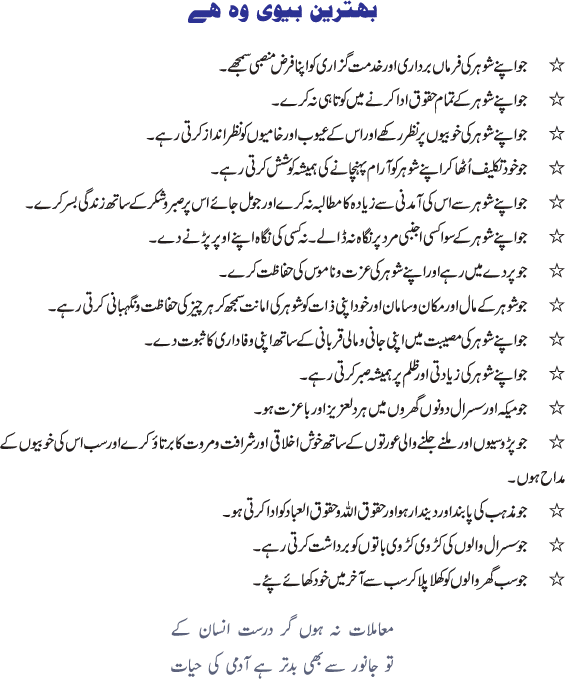
Behtreen Biwi
700 Percent Profit
During the caliphate of Umar (may Allah be pleased with him) there was a severe famine. The people of Madina were suffering due to a shortage of food.
A caravan of a thousand camels loaded with a large stock of food grains belonging to Uthman (may Allah be pleased with him) arrived from Shaam (Syria). Several merchants offered to buy all of it.
He asked them what profit they would pay. “Five percent,” they said. He answered that he could get a higher profit than that. They began to argue with him, saying that they did not know of any merchant who would offer him more than their quote.
He said to them, “I know of one who repays a profit of more than seven hundred to a dirham.” He then recited the verse of the Noble Qur’an in which Allah mentioned this profit. “The likeness of those who spend their wealth in the Way of Allah is as the likeness of a grain (of corn); it grows seven ears, and each ear has a hundred grains. Allah gives manifold increase to whom He pleases. And Allah is All-Sufficient for His creatures’ needs, All-Knower.” (Qur’an, 2:261)
“O traders! Bear witness with me that I donate all this to the poor people of Madinah!” said Uthman (may Allah be pleased with him).
Dear readers, whatever we give for the sake of Allah is really ours and whatever we keep with us will one day be someone else’s. Let us follow the footsteps of our Prophet and the pious Sahabah, with whom Allah was pleased, by helping the needy ones.
Why Our Dua’s Are Not Answered
IBRAHEEM IBN Adham (may Allah have mercy on him), a teacher and a companion of Sufyaan Ath-Thawree (d. 161H), was asked, “We supplicate, and we are not answered.”
So he replied:
- You know Allah, yet you do not obey Him.
- You recite the Qur’an, yet you do not act according to it.
- You know Satan, yet you have agreed with him.
- You proclaim that you love Muhammad (peace be upon him), yet you abandon his Sunnah.
- You proclaim your love for Paradise, yet you do not act to gain it.
- You proclaim your fear of the Fire, yet you do not prevent yourselves from sins.
- You say “Indeed death is true”, yet you have not prepared for it.
- You point out the faults with others, yet you do not look at your faults.
- You eat of what Allah has provided for you, yet you do not thank Him.
- You bury your dead, yet you do not take a lesson from it.
Visiting The Sick
The Messenger of Allah (peace be upon him) said there were five rights of a Muslim towards his brother in faith, out of which one is that, if one were to fall sick, it is incumbent upon the others to inquire about his welfare and to alleviate his sufferings. (Bukhari and Muslim)
This is part of a long Hadith. We find such exemplary teachings in Islam to inquire about the welfare of the sick and to take lead to alleviate their sufferings.
The Hadith teaches us to take care of our near and dear ones and share their sufferings. If someone happens to fall sick or suffer from some ailment, we are enjoined not only to inquire about his suffering but also to alleviate it. This is out of our deep sense of service to humanity at large.
The sick, neurotic and deranged persons deserve our highest sympathies. Naturally, it becomes the foremost duty of a Muslim to look after them and to care for and nurse them with due kindness and compassion.
One’s superior stance and happy position should at no moment make him too good and too wise, out of his sense of false pride, to become indifferent and discourteous to the sick and infirm, nor should he run away with the notion that he will never fall sick, or that he will never be in such a predicament that he would need others’ help at any moment in his life.
To show compassion to the sick and to nurse them is an act of piety that pleases Allah and His Messenger. It also creates a salubrious effect among individuals in society. It develops cordial relations among them and strengthens their bonds of friendship and brotherhood.
And this mutual cooperation and amity act as a cementing force to fortify the arch pillar of the structure of Islamic society, thereby bringing stability to the community and the nation at large.
Surah Fatiha Aur Surah Baqarah Ki Fazeelat
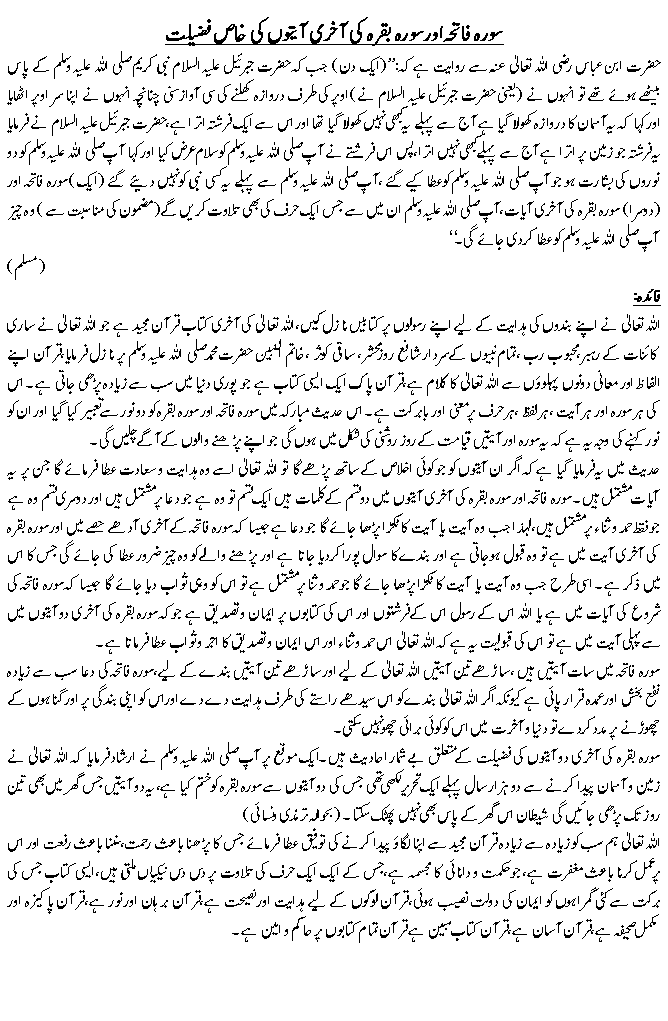
Surah Fatiha Aur Surah Baqarah Ki Fazeelat
The Evils Of Backbiting
Backbiting – mere words – but they are words that bring upon the one who utters them shame and ignominy and that consigns him to the Fire. Such a person has given in to his vain desires and succumbed to his destructive tendencies.
The Prophet (peace be upon him) said: “A man might speak a word without thinking about its implications, but because of it, he will plunge into the Hellfire further than the distance between the east and west.“ [ Sahih al-Bukhari (6477) and Sahih Muslim (2988)]
A Muslim utters a word whereby he describes his brother Muslim in a negative way – either explicitly or implicitly – and it plunges the speaker into a clear and evident loss. And what could be a greater loss than for a person to say something that does nothing for him but rob him of his blessings and of the rewards for his good deeds? Then, if his good deeds run out, the sins of the one he has backbitten are taken from that person and foisted upon the speaker until he is hurled by them into Hell.
A Muslim utters a mere word upon his tongue thoughtlessly, without any consideration, and without thinking that he will be taken to task for it. Indeed, it is something about which many people are heedless.
Once Mu’adh b. Jabal, the illustrious Companion, asked the Prophet (peace be upon him) to inform him of some good work that would admit him into Paradise and distance him from the Hellfire. The Prophet (peace be upon him) mentioned to him the virtues of many good deeds, then said: “Shall I inform you of the foundation of all of that?”
Mu’adh said: “Certainly.”
The Prophet (peace be upon him) took hold of his own tongue and said: “Restrain yourself from this.”
Mu’adh then asked: “O Prophet of Allah! Are we held to task for the things that we say?”
The Prophet (peace be upon him) replied: “May your mother be bereaved of you, O Mu’adh! Does anything topple people headlong into the Hellfire save the harvests of their tongues?” [Sunan al-Tirmidhi (2616) and Sunan Ibn Majah (3973)]
The Prophet (peace be upon him) said: “Whoever can guarantee to me what is between his two lips and what is between his two legs, I can guarantee for him Paradise.“ [Sahîh al-Bukhârî (6474)]
The Prophet (peace be upon him), when he said “what is between his two lips” was alluding to the words that a person speaks. To guarantee it means to only speak what Allah is pleased with. When he said ” and what is between his legs” he was alluding to sexual relations, meaning that the person guarantees that he will not engage in any unlawful sexual activity that is prohibited by Allah.
Backbiting can be defined as the utterance of words whereby one mentions his fellow Muslim in a bad way or mentions him in a manner that he would be displeased with. It is called backbiting because a person generally berates another person in that person’s absence.
The Prophet (peace be upon him) defines backbiting in the following way, and his definition is preferred over any other:
He said: “Do you know what backbiting is?”
They said: “Allah and His Messenger know best.”
He said: “It is to mention about your brother something that he would dislike having mentioned about him.” [Sahih Muslim (2589)]
Prophet Abraham (Aleh Salam) And The First House Of Allah On Earth
Prophet Abraham (Aleh Salam) was born to honorable parents descended from Prophet Noah(Aleh Salam). He was born in the city of Hara, Iraq during the reign of King Nimrod and is often referred to as “The Friend of Allah” and “The Father of the Prophets”. Before Abraham (Aleh Salam) reached maturity his father passed away, and as was the custom in those days, he would, out of respect for his paternal uncle, refer to him as his father. There had been a void in guidance since the death of Prophet Noah and the people of Hara reverted to idolatry.
Hara was renowned for its ornate, pagan temples and its citizens took great pride in the idols housed within them. Offerings were sacrificed to the idols and ritual ceremonies, wishfully invoking their favors performed before them. Lucrative commerce had grown around the activities of the temples. Carved replicas of the idols were a much sought-after possession and it was to this profession that Azar, Abraham (Aleh Salam)’s uncle, whom he now called “father” directed his talents.
WHO IS MY LORD
Abraham (Aleh Salam) was unlike his contemporaries, he grew to be an upright, caring, young man repulsed by idol worship and sought the answer to a question that had consumed him for many years — who was his Lord? In the process of his guidance, Allah in His Mercy caused Abraham (Aleh Salam) to contemplate upon the kingdoms of the heavens and earth. One evening, as he gazed up into the night sky, he saw a planet shining more brightly than the others and exclaimed, “This is surely my Lord!” but, as the morning light came the planet set he rejected his thought saying, “I do not like the setting ones!” On another occasion, as he saw the moon rise he said once again, “This is my Lord!” But like the planet as the light of the morning broke it disappeared whereupon he said, “If my Lord does not guide me, I shall be amongst the astray nation!” Then, when he saw the sun rise upon the horizon he said, “This must be my Lord, it is larger!” But as it set he turned to his people saying, “O nation I am quit of what you associate (with Allah, the Creator) I have turned my face to Him who created the heavens and the earth, uprightly, and I am not among the idolaters!” Qur’an, Chapter 6 verses 76-79 “Abraham (Aleh Salam) IS CHOSEN BY ALLAH AND BECOMES A PROPHET”.
Shortly after this Allah sent the Arch Angel Gabriel to inform Abraham (Aleh Salam) that He had chosen him to be His Messenger. Abraham (Aleh Salam) was deeply humbled by the news and Gabriel brought him, over a period of forty-two visits, ten Holy Scrolls. Prophet Muhammad(saws) informed his companions later on that the contents of the Scrolls were examples. Abraham (Aleh Salam)’s open rejection of idolatry caused a commotion, no one had ever challenged the deity of the idols of Hara; to his fellow citizens, the notion was deemed blasphemous. However, Abraham (Aleh Salam) was resolved, he had no doubt that Allah was the only One to be worshiped because he was convinced that it was He alone who had created everything.
The Gates of Hell
Allah has told us that Hell has seven gates, as He (SWT) said: “And surely, Hell is the promised place for them all. It [Hell] has seven gates, for each of these gates is a [special] class [of sinners] assigned“. (15:43-44)
Ibn Katheer commenting on this ayah, said: “This means that each gate has been allotted its share of the followers of Iblees who will enter it, and they will not be able to avoid it. May Allah (SWT) protect us from it. Each will enter a gate according to his deeds, and will be assigned to a level of Hell according to his deeds.”
It was reported from ‘Ali ibn Abi Taalib (ra) that he said, during a khutbah (sermon): “The gates of Hell are such-and-such”. Abu Harun said, “They are in layers, one above the other”. It is reported that he also said, “The gates of Hell number seven, one above the other. The first will be filled, then the second, then the third, until all of them are filled.” (Tafseer Ibn Katheer, 4/162)
When the disbelievers come to Hell, its gates will be opened, and they will enter it, to remain there forever:
“And those who disbelieved will be driven to Hell in groups, till, when they reach it, the gates thereof will be opened [suddenly like a prison at the arrival of the prisoners]. And its keepers will say, “Did not the Messengers come to you from yourselves – reciting to you the Verses of your Rabb, and warning you of the Meeting of this Day of yours”. They will say, “Yes” but the Word of torment has been justified against the disbelievers“. (39:71)
After they are admitted, they will be told:
“Enter you the gates of Hell, to abide therein. And [indeed] what an evil abode of the arrogant!” (39:72)
These gates will be shut upon the evildoers, and they will have no hope of ever escaping from them after that, as Allah (SWT) says, “But those who reject Our Signs, they are the [unhappy] Companions of the Left Hand. On them will be Fire vaulted over [all round].” (90:19-20)
Ibn ‘Abbaas said, “vaulted” (literally: “shut over them”) means that the gates will be locked”. al-Mujaahid pointed out that the word used (mu’sadah) is the word used in the dialect of Quraysh to mean “locked” or shut” (Tafseer Ibn Katheer 7/298)
In the Qur’an Allah (SWT) says:
“Woe to every [kind of] scandalmonger and backbiter, who piles up wealth and lays it by. Thinking that his wealth would make him last forever! By no means! He will be sure to be thrown into that which Breaks to Pieces. And what will explain to you that which breaks to pieces? The Fire of [the wrath of] Allah, kindled [to a blaze], which mounts [right] to the heart. It shall be made into a vault over them, in columns outstretched.” (104:1-9)
Salath
The one who disdains the prayers will receive fifteen punishments from Allah.
Six punishments in this lifetime Three while dying three in the grave & three on the Day of Judgment.
THE SIX PUNISHMENTS OF LIFE:
- Allah takes away blessings from his age (makes his life misfortunate)
- Allah does not accept his plea (Dua’s)
- Allah erases the features of good people from his face.
- He will be detested by all creatures on earth.
- Allah does not award him for his good deeds. (No thawab)
- He will not be included in the Dua’s of good people.
THE THREE PUNISHMENTS WHILE DYING:
- He dies humiliated.
- He dies hungry.
- He dies thirsty. Even if he drinks the water of all seas he will still be thirsty.
THE THREE PUNISHMENTS IN THE GRAVE:
- Allah tightens his grave until his chest ribs come over each other.
- Allah pours on him fire with embers.
- Allah sets on him a snake called “the brave”, and “the bold” which hits Him from morning until afternoon for leaving the Fajr prayer, from the afternoon until Asr for leaving Dhuhr prayer, and so on. With each strike, he sinks 70 yards under the ground.
THE THREE PUNISHMENTS ON THE DAY OF JUDGMENT:
- Allah sends who would accompany him to hell pulling him in the face.
- Allah gives him an angry look that makes the flesh on his face fall down.
- Allah judges him strictly and orders him to be thrown in hell.
Miswak Ki Sunnatain

Miswak Ki Sunnatain