
Allah Made Religion Easy
[Quran – 22:78] “And strive hard in the way of Allah (for the establishment of peace and human dignity,) such a striving as is due to Him. He has chosen you and has not laid upon you any hardship or constriction (in the matter of) Din (Religion). This is the Din (Religion) of your father Ibrahim (Abraham). He (Allah) has named you Muslims in the previous (Books) as well as in this (Holy Qur’an) so that this (final) Messenger may be a witness over you and you be witnesses over mankind. So, (to sustain this status) establish the Prayer, pay Zakat (the Alms-due) and hold fast to (the embrace of) Allah. He (alone) is your Helper (i.e., Patron). So what an excellent Patron and what an excellent Helper is He!”
The Prophet (Peace Be Upon Him) has said :
[Bukhari, Book 78, Hadith 152] Narrated Anas bin Malik: “The Prophet (PBUH) said, “Make things easy for the people, and do not make it difficult for them, and make them calm (with glad tidings) and do not repulse (them ).”
[Sunan Abi Dawud, Book 42, Hadith 4817] “ABU MUSA reported the apostle of Allah(MAY PEACE BE UPON HIM) as saying :
“Gladden people and don’t scare them; make things easy and don’t make them difficult”
Fasting In Shawwal & Muharram

[9. Surah Tauba : Ayah 129]

Allah is sufficient for me, there is no god but He; on Him do I rely, and He is the Lord of mighty power.

Fasting in Shawwal & Muharram
[Sahih Muslim : Book 6 Kitab Al-Sawm, Number 2614]
Abu Ayyub al-Ansari (Radi Allah Anhu) reported Allah’s Messenger (sal-allahu-alleihi-wasallam) as saying: He who observed the fast of Ramadan and then followed it with six (fasts) of Shawwal. it would be as if he fasted perpetually.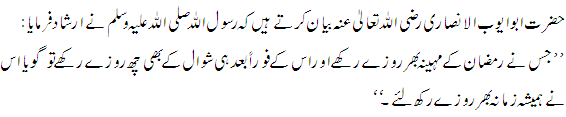
[Sahih Muslim : Book 6 Kitab Al-Sawm, Number 2612]
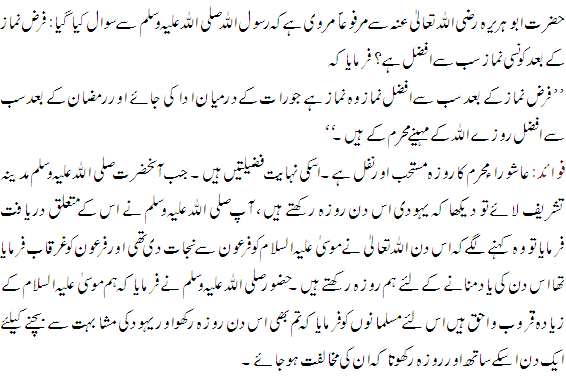
Abu Huraira (Radi Allah Anhu) reported that He (sal-allahu-alleihi-wasallam) was asked as to which prayer was most excellent after the prescribed prayer, and which fast was most excellent after the month of Ramadan. He said: Prayer is offered in the middle of the night and the most excellent fast after (fasting) in the month of Ramadan is the fast in God’s month al-Muharram.


Our Lord! surely we have heard a preacher calling to the faith, saying: Believe in your Lord, so we did believe; Our Lord! forgive us, therefore, our faults, cover our evil deeds, and make us die with the righteous.

Allah’s Command, Pay Zakah
“And strive for Allah with the striving due to Him. He has chosen you and has not placed upon you in the religion any difficulty. [It is] the religion of your father, Abraham. Allah named you “Muslims” before [in former scriptures] and in this [revelation] that the Messenger may be a witness over you and you may be witnesses over the people. So establish prayer and give zakah and hold fast to Allah. He is your protector, and excellent is the protector, and excellent is the helper.”
[22:78 ]
The Prophet (Peace Be Upon Him) has said:
[Sahih Al-Bukhari HadithHadith 2.478]
“Narrated by Ibn AbbasThy Prophet sent Muadh to Yemen and said, “Invite the people to testify that none has the right to be worshipped but Allah and I am Allah’s Apostle, and if they obey you to do so, then teach them that Allah has enjoined on them five prayers in every day and night (in twenty-four hours), and if they obey you to do so, then teach them that Allah has made it obligatory for them to pay the Zakat from their property and it is to be taken from the wealthy among them and given to the poor.”
[Sahih Al-Bukhari HadithHadith 2.479]
“Narrated by Abu AiyubA man said to the Prophet “Tell me of such a deed as will make me enter Paradise.” The people said, “What is the matter with him? What is the matter with him?” The Prophet said, “He has something to ask. (What he needs greatly.)” The Prophet said: “(In order to enter Paradise) you should worship Allah and do not ascribe any partners to Him, offer prayer perfectly, pay the Zakat and keep good relations with your kith and kin.”
(See Hadith No. 12, Vol 8). [Sahih Al-Bukhari Hadith 2.480]
“Narrated by Abu Huraira Bedouin came to the Prophet and said, “Tell me of such a deed as will make me enter Paradise if I do it.” The Prophet (p.b.u.h) said, “Worship Allah, and worship none along with Him, offer the (five) prescribed compulsory prayers perfectly, pay the compulsory Zakat, and fast the month of Ramadan.” The Bedouin said, “By Him, in Whose Hands my life is, I will not do more than this.” When he (the Bedouin) left, the Prophet said, “Whoever likes to see a man of Paradise, then he may look at this man.”
Waldain Ka Ehtram
Merit Of Suhur (Predawn Meal In Ramadan)
The merit of Suhur (Predawn meal in Ramadan) and the Excellence of Delaying having it till before Dawn
1229. Anas (May Allah be pleased with him) reported: The Messenger of Allah (PBUH) said, “Eat Suhur (predawn meal). Surely, there is a blessing in Suhur.”
[Al-Bukhari and Muslim].
Commentary: This Hadith tells us that Suhur is Masnun (Sunnah of the Prophet (PBUH)), even if one takes a small quantity of food. This meal is blessed and maintains one’s energy and vitality during Saum. Against this, if a person goes to sleep after taking his dinner to save himself from the inconvenience of getting up before dawn or takes Suhur early will be, on one side, disobeying the Messenger of Allah (PBUH), while on the other side, he will be feeling hunger and thirst very early and very much as he himself has increased the period of fasting by not taking the Suhur. Subhan Allah! How the weaknesses of man have been taken into account in the teachings of Islam while suitable provision has been provided to overcome them!
1230. Zaid bin Thabit (May Allah be pleased with him) reported: We took Suhur (predawn meal) with the Messenger of Allah (PBUH) and then we stood up for (Fajr) Salat (prayer). It was asked: “How long was the gap between the two?” He replied: “The time required for the recitation of fifty Ayat.”
[Al-Bukhari and Muslim].
Commentary: We learn from this Hadith that Suhur should be taken towards the end of its timing. This is the Sunnah of the Prophet (PBUH). One should, however, take care that it is done before dawn.
1231. Ibn `Umar (May Allah be pleased with them) reported: The Messenger of Allah (PBUH) had two Mu’adhdhin: Bilal and Ibn Umm Maktum (May Allah be pleased with them). The Messenger of Allah (PBUH) said, “Bilal proclaims Adhan [call to Salat (prayer)] at fag end of the night, so eat and drink till Ibn Umm Maktum pronounces Adhan.’‘ Ibn `Umar (May Allah be pleased with them) added: And the gap between their Adhan was not more than the time spent in one’s getting down and the other’s climbing (the minaret).
[Al-Bukhari and Muslim].
Commentary: We learn from this Hadith that in the days of the Prophet (PBUH) there used to be two Mu’adhdhin and two Adhan in the morning. The first Adhan was meant to warn the people who were taking the Suhur meals that the time for the Suhur was about to finish and they should make preparation for Fajr prayer. Soon after that there was a second Adhan by another Mu’adhdhin which signified that the time for food was finished and people should attend to Salat. This practice was, however, terminated later so much so that we do not find it even in the times of the Companions of the Prophet (PBUH) and that of At-Tabi`un (the successors of the Prophet’s Companions) and Tabi`ut-Tabi`in (the followers of the Successors). In any case, this practice can be revived.
So far, the question of time between the two Adhan is concerned, `Ulama’ have stated that after announcing the Adhan, Bilal used to be engaged in prayer, etc., and waited for daybreak. When the time for the daybreak drew near, he would then come down and inform Ibn Umm Maktum who would then make Wudu’, and then proceed to call the Adhan at the beginning of the daybreak. (Ibn Allan).
1232. `Amr bin Al-`As (May Allah be pleased with him) reported: The Messenger of Allah (PBUH) said, “The difference between our observance of Saum (fasting) and that of the people of the Scriptures is Suhur (predawn meal in Ramadan).’‘
[Muslim].
Commentary: We learn from this Hadith that Suhur is a distinctive mark with which Allah has blessed the Muslim Ummah.

Hazrat Ayesha Siddiqa
Change Your Habits In Ramadan
Try These Proven Techniques For A Successful positive change in your habits during Ramadhaan and beyond!
1. Acknowledge and Identify your bad habits: The first step is to admit you need to change. If you are in a state of denial, you won’t recognize that you have a bad habit to change.
2. Pick a habit for this month: Prioritize your bad habits and focus on one for this month. If you are committed to changing at least one habit, you will see remarkable results, Allah-willing.
3. Realize that it’s in us to change: Don’t believe the old saying, “You can’t teach an old dog new tricks.” You can break a bad habit if you really want to. No one else can change your habits if you don’t want to.
4. Remember, Allah loves those who commit mistakes and repent: The Noble Messenger of Allah (peace be upon him) said:
“By Him in Whose Hand is my life, if you were not to commit sin, Allah would sweep you out of existence and He would replace (you by) those people who would commit sin and seek forgiveness from Allah, and He would have pardoned them.”
(Hadith -Sahih Muslim)
5. Intention & Plan to change: “If you fail to plan, you plan to fail.” A healthy process of change in character requires a gradual pace, which entails planning. Develop concrete milestones to measure your progress.
6. Replace a bad habit with a good one: Completely eliminating a habit is more challenging than replacing it with a more productive habit. Moreover, it’s crucial to replace the lost natural needs, such as the need to socialize and to be entertained with something healthy.
For instance, it’s easier to replace your addiction to TV with a physical workout or reading the Qur’an or a good Islamic book, etc. Interestingly, Prophet Muhammad (peace be upon him), the greatest ‘psychologist’ of humanity, illustrated this principle in these words:
“Fear Allah wherever you may be; follow up an evil deed with a good one which will wipe (the former) out, and behave good-naturedly towards people.”
(Hadith-At-Tirmidhi).
Badar Kay Maidan Mein


The Blessed Month Of Ramadan al-Kareem
1. Hadrat Sayyiduna Abu Hurairah Radi Allahu Ta’ala Anhu reported that the Messenger of Allah (SallAllahu Alaihi wa Sallam) has said, “When Ramadan begins, the doors of heaven are opened.” A version has, “the doors of Paradise are opened and the doors of Hell are closed, and the Satans are tied with chains.” Another version has, “the doors of Mercy are opened.“ [Sahih al-Bukhari, Vol. 1, Page 255 and Sahih al-Muslim, Vol. 1, Page 346]
Hadrat Shaykh ‘Abd al-Haq Muhaddith-e-Dehlwi Alaihir raHmah comments:
The meaning of the “Doors of heaven” being opened is the continuous descending of mercy, and the ascension of good deeds to the Court of the Almighty without any obstacle (preventing it from ascending). It also means the acceptance of (permissible) supplications. The meaning of the “doors of Paradise” being opened is being encouraged and granted the ability to perform good deeds and the acceptance of these good deeds. The meaning of the “doors of Hell” being closed is the protection of the souls of those who fast, from things that have been forbidden by Islamic Law, and rescue from the things which provoke a person on doing bad deeds. It also means to break the desire that the heart has for things of lust. The meaning of Satan being tied with chains is the sealing off of all the ways by which evil whispers enter the mind. [Ashi’ah al-Lam’at]
2. Hadrat Abu Hurairah Radi Allahu Ta’ala Anhu reported that the Messenger of Allah (SallAllahu Alaihi wa Sallam) has said, “Whoever fasts during Ramadan with faith and seeking his reward (from Allah SubHanuhu wa Ta’ala) all his past sins will be forgiven. Whoever prays during the night in Ramadan with faith seeking his reward (from Allah SubHanuhu wa Ta’ala) all his past sins will be forgiven. And whoever passes Lailat-ul-Qadr in prayer with faith and seeking his reward (from Allah SubHanuhu wa Ta’ala) all his past sins will be forgiven.” [Sahih al-Bukhari Vol. 1, Page 255 and Sahih al-Muslim, Vol. 1, Page 259]
3. Hadrat Abu Hurairah Radi Allahu Ta’ala Anhu reported that the Messenger of Allah (SallAllahu Alaihi wa Sallam) has said, “When the first night of Ramadan comes, the satans and the rebellious Jinn are chained, the doors of hell are closed and not one of them is opened (during the entire the month of Ramadan); the doors of Paradise are opened and none of them are closed (for the entire month of Ramadan); and a crier calls, ‘Those who desire what is good, come forward, and those who desire evil refrain from it’, and many people are freed from Hell by Allah SubHanuhu wa Ta’ala, and that happens every night.” [Tirmidhi, Vol. 1, Page 153 and Ibn Maajah, Vol. 1, Page 118]
4. Hadrat Abu Hurairah Radi Allahu Ta’ala Anhu reported that the Messenger of Allah (SallAllahu Alaihi wa Sallam) has said, “Ramadan, a blessed month, has come to you during which Allah SubHanuhu wa Ta’ala has made it obligatory for you to fast. In it the doors of Heaven are opened, the doors of Hell are closed, and the rebellious satans are chained. In it there is a night (worshiping in it) which is better than (worshiping for) a thousand months. Whoever is deprived of its good (and blessing) has indeed been deprived of all good.” [Nasa’i, Vol. 1, Page 299 and Mishkat, Vol. 1, Page 173]