

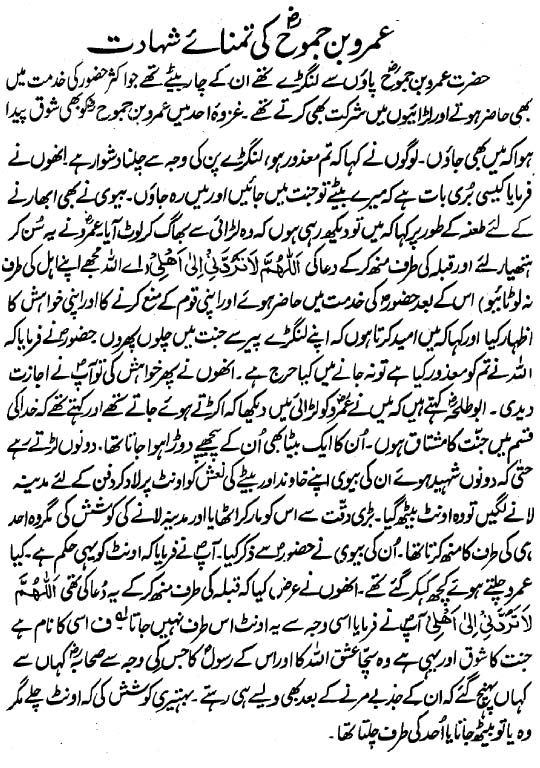
Amr ibn al-Jamuh (RA) Ki Tamanna e Shahadat (Ghazwa E Uhad)
Servants Of Allah: Pass By Evil Play Or Evil Talk With Dignity
‘And those who do not bear witness to falsehood, and if they pass by some evil play or evil talk, they pass it with dignity.’ (25:72)
The special servants of Allah do not participate in the meetings where lies and falsehood is occurring. The biggest falsehood is disbelief and ascribing partners and the next in order comes the common lie and acts of shirk and the next in order comes the common lie and acts of sin.
Imam Abu Hanifah and Mujahid are of the view that these gatherings are music concerts, whilst others are of the view that these gatherings are carnivals and field days. The righteous people should avoid such gatherings as even an intentional look is tantamount to participation. (Mazhari)
It is a well-known fact that both Holy Qur’an and Sunnah declare false evidence as a great sin and an enormous evil. Hazrat Ibn Abbas quoted from the Holy Prophet that ‘false evidence is the gravest of major sins.’ (Bukhaari, Muslim)
Hazrat Abu narrates, that Rasulullah (PBUH) said, “The signs of a hypocrite are three; whenever he speaks, he tells a lie; whenever he promises, he breaks his promise; if you have trust in him, he proves to be dishonest.” The above Hadith is of such importance to us, because it demonstrates to us how evil it is to speak lies, that the Prophet associated the telling of lies with a hypocrite.
Unfortunately, our problem is that we think that by fulfilling the five fundamental principles of Islam we have become perfect Muslims. Islam has many different aspects to it, only fulfilling one aspect of worship, does not make us true Muslims. Turning a blind eye to such aspects of religion, like restraining our tongues when it comes to our utterances, will only be to our detriment.
During the days of ignorance, before the Prophet (PBUH) propagated the message of the truth of the religion of Islam, the Arabs were the worst of people on the surface of the Earth. No government or king was prepared to rule over them because they had the worst of qualities in them. But, with all the evil qualities and bad habits, the Arabs had at that time, the telling of lies was regarded as a detestable act.
Hazrat Abdullah ibn Umar (RA) narrates that Allah’s Messenger (PBUH) said, “When a man lies, the angel moves a mile from him because of the bad odor of what he has produced.”
Abdullah (RA) narrates that the Prophet (PBUH) said, “Truthfulness leads to righteousness, and righteousness leads to paradise. And a man keeps on telling the truth until he becomes a truthful person. Falsehood leads to wickedness and evil-doing, and wickedness leads to the (Hell) fire, and a man may keep on telling lies till he is written before Allah, a liar.”
Abu Bakr (RA) narrates that Allah’s Apostle (PBUH) said thrice, “Shall I not inform you of the biggest of the great sins?” We said, “Yes, O Allah’s Apostle.” He said, “To join partners in worship with Allah; to be undutiful to one’s parents.” The Prophet sat up after He had been reclining and added, “And I warn you against giving a false statement and a false witness; I warn you against giving a forged statement and a false witness.” The Prophet kept on saying that warning till we thought that he would never stop.
In conclusion, Allah Ta’ala mentions in the Quran: “And they even assign to things they do not know a portion out of that which we have bestowed for their sustenance! By Allah ye shall certainly be called to account for your false inventions.” (Sura 16, Verse 56).
Telling lies is a great and grievous sin and it removes all the blessings from our lives. We must therefore, at all costs, abstain from uttering such things that will be to our detriment in this world and hereafter. May Allah grant us the ability to abstain from speaking lies. Ameen.
Hadith Qudsi: Al-Ghaffar, Al-Zunoob
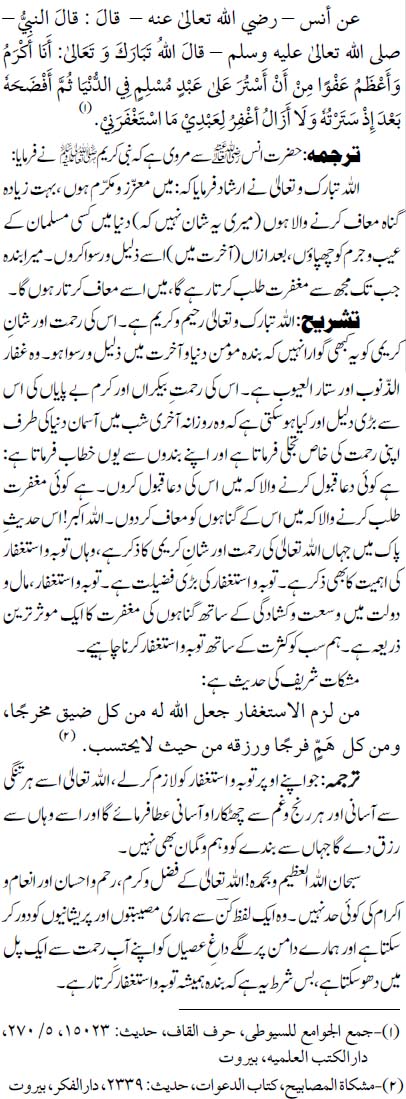
Hadith Qudsi: Al-Ghaffar, Al-Zunoob. Istighfar Ki Fazeelat. Maghfirat Aur Rehmat-E-Ilahi
Servants Of Allah: Spend Moderately
‘And those who when they spend, are neither extravagant nor niggardly, but hold a medium (way) between those (extremes). (25:67)
Allah’s chosen servants are those who neither spend excessively nor become misers but spend moderately.
“Give the kinsman his due, and the needy, and the wayfarer, and squander not (your wealth) in wantonness. Lo! the squanderers were ever brothers of the devils, and the devil was ever an ingrate to his Lord” (Quran 17:26-27).
Amr ibn Shuaib, on his father’s authority, said that his grandfather related, that the Prophet (PBUH) said: When you eat, drink, give charity, and wear clothes, let no extravagance or pride be mixed up with what you do. (Ibn Maja, Nasai)
Abu Huraira (RA) narrated that the Prophet (PBUH) said: Every day two angels come down from Heaven and one of them says, ‘O Allah! Compensate every person who spends in Your Cause,’ and the other (angel) says, ‘O Allah! Destroy every miser’. (Bukhari)
Abu Said Khudri (RA) related that the Prophet (PBUH) said: There are two habits which are never present together in a believer: miserliness and bad manners. (Tirmidhi)
Jabir reported that the Prophet (PBUH) said: Avoid doing injustice to others, for on the Day of Judgment, it will turn into manifold darkness, and safeguard yourself against miserliness, for it ruined those who were before you. It incited them to murder and treat the unlawful as lawful. (Muslim)
Rasulullah (PBUH) is quoted to have said ‘It is the sagacity of man to adopt in the middle path in spending.’
Ways and means of income, earning one’s livelihood, and spending such income should confirm with the Shari’ah. Hadhrat Ibn Mas’ood (RA) narrates that Rasulullah (PBUH) said: “On the Day of Judgement, no one will be able to move Reckoning until a reckoning of five things has not been taken. (Tirmidhi)
Rehmat e Alam Ka Afu e Aam
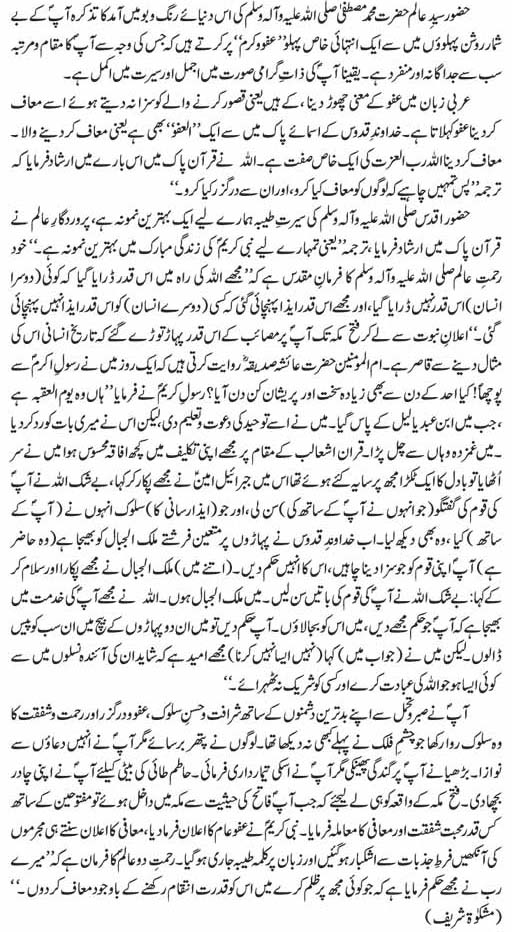
Rehmat e Alam Ka Afu e Aam
Servants Of Allah: Fear Allah And keep Day Of Judgment In Mind
‘And those who say: ‘Our Lord, avert from us the torment of Hell. Verily its torment is ever an inseparable, permanent punishment.’
Despite being constantly engaged in the worship of Allah, these favored servants fear Allah and keep the day of judgment in mind. The fear of Allah severs the roots of all evil, while at the same time, it is the medium of all obedience. The manner in which to acquire the fear of Allah Most High is to consider His wrath and punishment.
Abu Zar al-Ghifari (RA) and Mu`adh bin Jabal (RA) relate that the Prophet (PBUH) said: “Fear Allah wherever you are. Follow up a bad deed with a good deed and it will blot it out. And deal with people in a good manner.” (Tirmizi)
If you have the audacity to indulge in sins, do so to the extent that you can endure Hellfire. (Luqmaan the Wise) Ghazali says: ‘Fear rips away desires and luxuries so that cherished sins become reprehensible, just as a honey lover is repelled by it when he learns that it has poison. This is how fear burns desires; disciplines the organs; subordinates the heart and gives it tranquillity. It also enables the heart to rid itself of pride, hatred, and envy; and it leaves it absorbed in it (fear). Hence, the heart becomes preoccupied with its own worries and looks toward its best interest in the long run. It is then engaged in only matters like meditation, self-analysis, and struggle. It cherishes its time and moments.’ (Ihya: 4/160)
Fear is the painful condition of the heart that arises as a result of thinking of something reprehensible and the fear of it materializing. The nature of fear consists of the possibility of punishment. This possibility extends to every person, for he may be overtaken by punishment. This is the extent of fear that has been commanded and imposed upon the servant. To this extent, fearing the possibility of punishment is a compulsory condition of faith. At the motivation of sin, this faculty has to be put into operation. The warnings and punishments of Allah Most High should be recalled and considered so as to save oneself from sin. This degree of fear is obligatory. Its non-existence induces and involves one in sin. It is the medium of exhorting toward virtue and steering one away from sin.
Allah Most High has combined the noble attributes of guidance, mercy, knowledge, and contentment for those who are imbued with His fear. The servant of Allah who on earth entertains fear of Allah Most High will be fearless in the Hereafter, and he who had no fear of Allah Most High on earth will be overtaken by fear and calamity. Fear is thus obligatory upon every believer.
The fear station is one of the most splendid stations on the road and the most beneficial to the heart. Allah also praised His people in His book, saying, “Verily! Those who live in awe for fear of their Lord . . . It is these who race for the good deeds and they are foremost in them.” (23:57-61)
Abu Hafs said, “Fear is the whip of Allah. He corrects with it those straying from His door.” He also said, “Fear is a light in the heart, with it one can see the good and evil. Everyone you fear you run away from except Allah. When you fear Him, you run away to Him.” The person with fear is a person fleeing from His Lord to His Lord.
Abu Sulaiman said, “When fear of Allah departs from any heart, it falls apart.”
Ibrahim bin Sufyan said, “When the fear of Allah settles in the heart, it burns the places of vain desires within it and it kicks out the love for this world.”
Hazrat Thun-Nun Misri said, “People are on the Straight Path as long as the fear of Allah is instilled in their hearts. When they lose the fear of Allah, they stray from the road.”
Shaikhul-Islam Ibn Taymiyyah says, “The commendable fear of Allah is what restrains you from the prohibitions of Allah.”
Al-Harawi said, “Fear is to slip away from comfort and security by recognizing the warning of Allah .” The beginning of fear of Allah is to fear the punishment. This is the kind of Khawf that produces sound faith. This can be attained by believing in the warnings of Allah and remembering the sin. Fear of Allah is preceded by feeling and knowledge.
The fear of Allah is associated with two things: first, the things feared; and second, anything that may lead to it. The fear of Allah can then be as great as the feeling of the person to the feared thing and what leads to it. When a person doesn’t think that something would lead to the object that should be feared, then would not fear that thing. The same is true if he does not know the measure of the fearful thing then, he would not have the correct fear.
Fear and hope complement one another. The similitude of the heart in its travel to Allah is like a bird. Love is its head, and fear and hope are the wings. When the head and both wings are sound, the bird is capable and skilled in flying. However, when the head is cut off, the bird will die. When the bird loses a wing, it then becomes a target for every hunter and predator. The scholars favored the wing of fear over the wing of hope, especially when the person is young and healthy. They favored the wing of hope over the wing of fear when the person is about to leave this world.
Abu Sulaiman said, “The heart should be dominated with the fear of Allah. When hope dominates, it ruins it.” It was also said, “The best state is to have the same amount of fear and hope but to have more love for Allah. Love of Allah is the boat, hope is the leader, fear is the driver, and Allah is the One Who helps those reach the goal by His Grace and Generosity.”
‘The state of your life is nothing more than a reflection of your state of mind. Inner development is just as important as outer physical development.’
Moat Ki Tamanna Karnay Ka Sharai Hukm
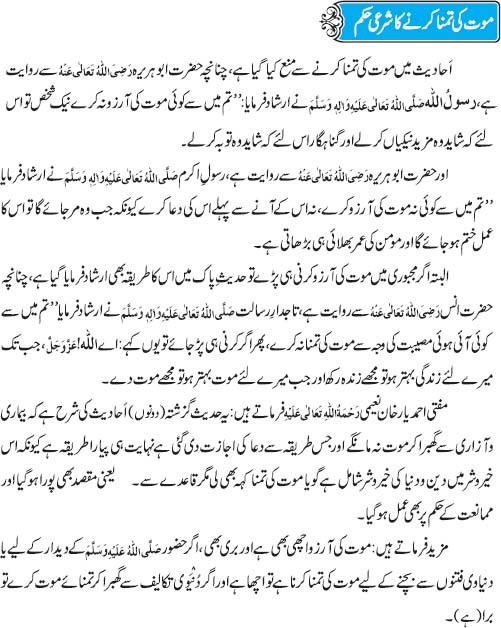
Moat Ki Tamanna Karnay Ka Sharai Hukm
Servants Of Allah: Spend Night In Worship
‘And those who spend the night in the worship of their Lord, prostrating and standing.’ (25:64)
Special mention of the night worship has been made because worshipping at the time of rest, requires a lot more effort than worshipping at other times. One of the advantages of spending the night in worship is that it rules outperforming the act of worship for show.
Abu Umamah narrates that the Holy prophet said, ‘Remain steadfast to your night prayers as this has been the practice of all the righteous people before your time and this will bring you closer to Allah and will expiate the evils and keep you away from sins.’ (Tirmizi)
Hazrat Uthmaan is reported to have observed that the Holy Prophet (PBUH) has said, ‘One who has offered Isha prayer with the congregation would be regarded as having worshipped half the night and one who has offered Fajr prayer with congregation would be regarded as having offered the other half of the night in prayers.’ (Muslim)
In early Islam, prior to the five Salah becoming obligatory, Tahajjud was Fardh on Rasulullah (PBUH) and the Ummah. Rasulullah and the Sahaba were so vigilant in executing this duty that they would remain awake most of the night performing Tahajjud. Rasulullah’s blessed feet would swell because of excessive standing in Tahajjud. “This is a time of peace and tranquillity in which the ears respond quicker and the heart is more alert and receptive to one’s devotions..”
Allah Ta’ala says, “As for the Righteous, they will be in the Gardens and fountains [of Jannah], with joy the rewards which their Lord gives them, before this (in the world) they were virtuous. They slept but little at night, and they prayed for forgiveness in the hours of early dawn.” (51:15,16,17)
Hadhrat Abdullah bin Abbas (RA) has stated that this ayah conveys glad tidings to all those who spend a portion of the night, however short it may be, in the Ibadah of Allah Ta’ala. (Ibn e Kathir)
Hadhrat Abdur Rahmaan bin Zaid relates that once a person from the Banu Tameem clan remarked to his father, “O Abu Usamah, we do not find that quality within us about which Allah Ta’ala praised the righteous. i.e. they remain awake most of the night. Our condition is such that we remain awake for a very short time only to render our Ibadah. His father replied,” Glad tidings are for those who sleep when sleep overtakes them, but they fear Allah on awakening.” (Maariful Quraan vol.5)
Although it is virtuous to perform the Tahajjud Salaah after rising up from one’s sleep, one may perform it before retiring to bed. Hadhrat Hassan said, “Any Nafl Salah performed after Isha is regarded as Tahajjud, although it is normally referred to as a Salah performed after one sleeps a portion of the night. (Maariful Quran vol.5)
Rasulullah (PBUH) said, “When Allah Ta’ala resurrects the entire mankind on the Day of Qiyamah, an announcer will announce, and his voice will be heard by the entire creation, “O you who have been resurrected, on this day you will come to know those who deserve honor and reverence, O you who have been resurrected, Stand up, those among you who possess the quality of “Their sides remained away from their beds”. A small group of people will stand up. Another narration states, “They will enter Jannah without reckoning. Thereafter the rest of mankind will be called for the reckoning. (Ibn e Kathir)
Hadhrat Abu Hurairah (RA) relates that Nabi (PBUH) said, “Allah Ta’ala has mercy on a person who stands up at night to perform Tahajjud and also awaken his wife. If she does not wake up he sprinkles water on her face. And Allah Ta’ala has mercy on a woman who stands up for Tahajjud and also awakens her husband. If he does not wake up, she sprinkles water on his face.” (Abu Dawood – Mishkaat).
In another Hadith, Rasulullah (PBUH) said, “The closest Allah Ta’ala gets to his servant is in the last portion of the night. If you possess the ability to be from among those who remember Allah, then become one of them.” (Tirmizi)
Our righteous predecessors would spend the entire night engrossed in the recitation of the Quran Shareef. At the time of Rasulullah (PBUH), in Madinah, if a person was walking outside at the time of the Tahajjud prayer, he would hear the recitation of the Quran Shareef like the buzzing of bees around their hive. Hazrat Imam Abu Hanifah used to complete one recitation of the Quraan Shareef during the day and one during the night. It is said that in the month of Ramadhaan, he would finish his recitation sixty-three times.
It is said of the daughter of Imam Ahmad bin Hanbal, recited seven chapters of the Quran during her Tahajjud prayer on her wedding night. A person remarked to Abdullah bin Abbas, “I always intend awakening in the last portion of the night to perform Salat but sleep overpowers me.” Ibne Abbas replied, “Before sleeping recite from “QUL LAW KAANAL BAHRU MIDADAL…” to the end of Surah Kahf. Allah Ta’ala will waken you at whatever time you intend rising.” (Tha’labi)
May Allah through His infinite Grace and Mercy, give us the ability to be amongst the servants who abandon their sleep to present ourselves in from of Him.
Hadith Qudsi: Fajar Aur Asar Ki Namaz Kay Baad Zikr
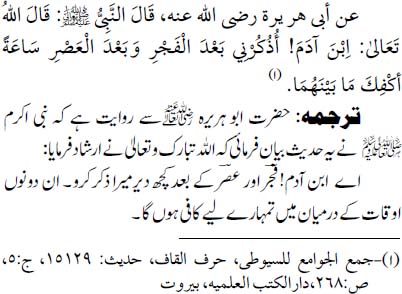
Hadith Qudsi: Fajar Aur Asar Ki Namaz Kay Baad Zikr
Servants Of Allah: Reply Peacefully To Ignorant
‘And when the ignorant address them (with bad words) they reply back peacefully.’ (25:63)
Here by a foolish person, it is meant a person who comes across as foolish even though he may be knowledgeable. The special characteristic of this servant of the All Merciful is that when he comes across an ignorant person he remains composed and answers with calmness so that he doesn’t commit a sin by offending anyone.
This special servant of Allah remains tolerant when dealing with insolent people and overlooks them, he deals with them with patience and overlooks any hostility. Rasulullah (PBUH) himself practically displayed the best character in every aspect of life. Likewise, he exhorted the Ummah to also adopt good character. Hence he would repeatedly say: “The best amongst you is the one who has the best character.” (Sahih Bukhari)
In another Hadith, Rasulullah (PBUH) is reported to have said: “There will be nothing weightier in the scales of a Believer on the day of Judgement than good character, and verily Allah detests a vulgar and foul-mouthed person.” (Tirmizi)
From the above Hadeeth, it is understood that good character has a very strong bond with Iman. It was the “sword” of good character. Rasulullah was blessed with the most excellent character. This powerful magnet drew the people to him and even his enemies fell meekly at his feet.
Good character is a comprehensive code of conduct encompassing all aspects of life for example, how should one conduct the matters that pertain to him and Allah, how should he behave with his family, how should he conduct himself in business or in social life. A good character has to be adopted in all these spheres of life. However, the bottom line of good character is that no person must be unjustly inconvenienced in any way. Rather, as far as possible suppress one’s own rights, overlook the faults of others, and be kind and good to them. Luqmaan gave the following advice to his son: “Never remember two things – Firstly, the favors that you have done for others. Secondly, the harm that others have done to you.”
One of the great predecessors has stated: “Nobody will enter Jannah on the basis of his worship since we cannot perform any action perfectly enough to be regarded as worthy of presenting in the court of Allah Ta’ala. Despite this, the Ibaadat must never be neglected since Allah, of His grace will absolve us of the obligation if we try to perform it as best we can. However, overlooking some person’s fault, and forgiving somebody, are actions upon which we can hope for the mercy of Allah .”
A simple prescription for rectifying one’s character is to adopt the advice of Hakimul Ummah. He states: “Before doing or saying anything … THINK: Will this word or action cause any inconvenience to anybody?” For instance, a perfect thing to ponder about daily in our case would be: “How have I parked my car in the Masjid parking?” Likewise think: “Am I disturbing anybody by talking aloud at this late hour of the night? Am I hurting somebody’s feelings in any way?” By making a habit of thinking first in this manner, we would become conscious of refraining from any such action and deed that may inconvenience others. May Allah adorn us with the character of Rasulullah and make us true ambassadors of Deen. Aameen.